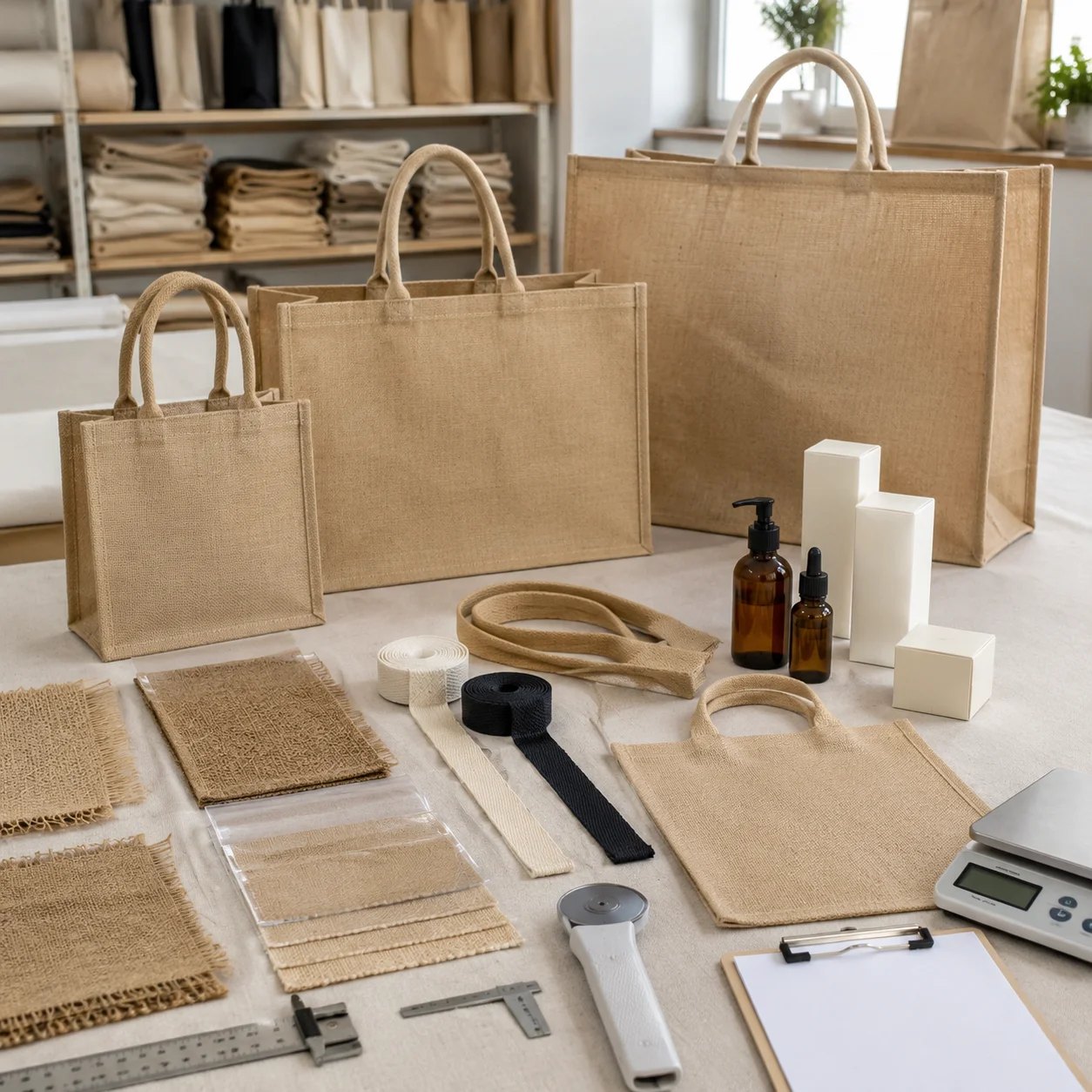
The Buying Problem
Skincare brands often choose jute because it gives spa, apothecary, clean beauty and gift-with-purchase programs a natural retail signal. The same texture can create procurement risk: loose fiber, uneven print edges, odor, weak standing shape and visible creasing.
The buying task is to specify a tote that keeps the set clean, upright, printable and shippable. A bag can look acceptable when empty and still fail with glass jars, matte cartons, tissue wrap and an insert card. Define the load and presentation first, then ask suppliers to quote the same material, finish, handle, print and packing basis.
- Best fit: boxed skincare kits, spa gift sets, natural retail promotions and controlled distributor sample sets.
- Higher-risk fit: unboxed oily products, damp environments, very fine artwork and bright white cartons that show fiber dust.
- Main sourcing goal: turn the desired brand look into a measurable specification before comparing quotes.
Publication And Evidence Note
Vincent Xi is the Editorial Author. His articles use cited public sources and distinguish documented claims from buyer checks that require current verification.
Vincent Xi is the Editorial Author. His articles use cited public sources and distinguish documented claims from buyer checks that require current verification.
- Jute-specific source context: Yanxin's custom jute bag guide at https://yanxinbag.com/how-to-customize-jute-bags-for-your-brand.
- Tote-use source context: BodrumCrafts' tote use case guide at https://bodrumcrafts.com/pages/tote-bag-use-case-guide.
- Claim caution context: environmental language should be controlled by current documents for the exact material, coating, ink and market.
Start With The Set
Material selection should begin with the products that will go inside the tote. A boxed serum bottle, glass jar, sunscreen tube and sample sachet create different pressure points from brochures or apparel. Skincare packaging is handled close to the face, so odor, fiber dust and print neatness matter.
Before sending an RFQ, lay out the largest expected set with tissue, insert card and secondary wrap. Decide whether products should be visible above the rim or hidden inside. A tall tote can make a compact set look sparse, while a shallow gusset can push cartons into the seams.
- Give suppliers the tallest product, widest carton and intended fill direction.
- State whether the tote must stand empty, stand filled or fold flat for later kitting.
- Send product weights as buyer assumptions to verify, especially when glass packaging is included.
Size And Gusset
Yanxin's 2025 custom jute bag guide lists three reference sizes: 26.5 W x 20 H x 9 G cm for a small example, 36.5 W x 30 H x 17 G cm for a medium example and 45 W x 35 H x 14 G cm for a large example. The page was published on 2025-07-03, modified on 2025-10-28 and captured in the source set retrieved on 2026-07-12T21:40:40+00:00.
For skincare, the medium reference can start the discussion because it leaves room for several cartons and gift wrap. It should not become the default. A tall serum box may need height, a jar set may need a wider base and a sample kit may look better in a smaller body. Require finished dimensions after sewing, not only cut panel dimensions.
- Use source-listed sizes to brief the supplier, then require a finished-size drawing before sampling.
- Increase gusset only when products need base stability; extra gusset adds bulk and freight cube.
- Confirm whether quoted dimensions include handle drop, seam allowance or only the finished bag body.
Coated Or Uncoated
The largest material decision is laminated jute versus uncoated jute. The Yanxin source describes coated jute bags as having a PE film inside, giving better water resistance and structural stiffness. The same excerpt describes uncoated jute as softer and more breathable, while also being less water-resistant.
Laminated jute usually gives a cleaner upright shape and can support sharper printing. Uncoated jute often feels more natural, but it needs closer review for shedding, odor and body collapse. Avoid vague wording such as natural jute tote. State whether the body is laminated, uncoated or bonded to another backing.
- Choose laminated jute when the bag must stand well, resist light moisture and protect carton presentation.
- Choose uncoated jute when touch, breathability and a rustic surface matter more than stiffness.
- Ask the supplier to disclose coating material, coating side and any available thickness or construction basis.
Weight And Grade
A useful RFQ states fabric weight in gsm and asks the supplier to explain the material grade. The Yanxin excerpt mentions 45D and 50D jute options, with 45D described as slightly softer and more budget-friendly and 50D described as tighter with a slightly thicker feel. Because grade language can vary, it should not be used alone.
Example RFQ assumptions can help the buyer start: 280 gsm uncoated jute for a softer sample-kit tote, 320 gsm laminated jute for a more upright gift tote or 350 gsm laminated jute for a firmer premium body. These gsm values are buyer assumptions to verify in the supplier quote, not source-derived test data.
- Write gsm, finish and grade language together on the quote sheet.
- Ask whether the quoted fabric is stock material or requires special procurement.
- Keep approved swatches for body jute, handle webbing, label fabric and print ink.
Print And Branding
Jute is not a smooth paperboard surface, so artwork should be simplified early. The Yanxin source says screen printing and UV printing are commonly used for bulk jute bag customization, while heat transfer can be considered for photo-realistic images or gradient colors. The final choice should still come from a strike-off on the selected material.
Minimal skincare branding can look strong on jute when the logo is bold, ink coverage is controlled and the design respects the weave. Fine type, small icons, pale ink on natural fiber and large solid blocks can create approval problems. For delicate typography, consider a woven label, stitched cotton patch or printed canvas panel.
- Send vector artwork and ask the supplier to flag line weights or gaps that may break on jute texture.
- Approve print on final material, final coating and final ink before bulk production.
- Do not print environmental or certification wording unless exact-order documents support it.
Handles And Structure
Handles affect both carrying strength and first touch. Cotton webbing can feel cleaner and softer for skincare buyers, especially when the tote is expected to be reused. Flat jute handles keep the look consistent, but they may feel rougher. Rope handles can look more gift-oriented, yet the attachment method must match the body and expected load.
Structure comes from fabric weight, gusset depth, inner lamination, seam design and bottom support. A base board can improve presentation for glass jars, but it adds another material to inspect. If a quote does not name handle material and bottom construction, the quote is incomplete.
- Specify handle material, color, width, drop length and attachment construction.
- Decide whether a base insert is loose, stitched, laminated or omitted.
- Check handle color transfer against pale cartons, tissue paper and uncoated retail packaging.
Quote, Sampling And Shipment Control
MOQ should be tied to production logic. Stock jute and stock handle colors may allow lower quantities. Custom dyed handles, uncommon gsm, private labels, special lamination or unique packing can raise the threshold. A direct manufacturer may give better material control; a trading company may consolidate trims; a domestic distributor may be faster for stock styles.
The key sample is a pre-production sample made with the same jute, coating, handle, print method, label, stitch construction and packing plan intended for bulk. For skincare buyers, check the sample after sealed-carton storage for odor, fiber dust, deformation and lamination edges. Measure finished dimensions, compare fabric weight, rub the print, load the bag with the intended set and review packed cartons from different carton positions.
- Ask whether timing starts after deposit, artwork approval, material arrival or approved pre-production sample.
- Request unit price by quantity tier, sample fee, print setup, label cost, packing cost, carton dimensions and remake terms.
- Confirm inner wrap, export marks, carton strength, net weight, gross weight and packed-carton photos before shipment release.
Specification comparison for buyers
| Spec decision | Recommended option | When it fits | Buyer risk to check |
|---|---|---|---|
| Body finish | Laminated jute for crisp retail gift totes; uncoated jute for a softer rustic look | Laminated material fits boxed skincare sets, glass jars and counter displays that need the bag to stand cleanly | Uncoated jute can absorb moisture and show more loose fiber; check odor, shedding and cleanliness on the approved sample |
| Fabric weight and stiffness | Example RFQ assumptions to verify in the supplier quote: 280 gsm uncoated jute, 320 gsm laminated jute or 350 gsm laminated jute | Softer assumptions fit sample kits; firmer assumptions fit premium sets with cartons or bottles | Do not accept the word jute alone; require gsm, finish, grade language and tolerance in writing |
| Size and gusset | Use Yanxin's 2025 medium reference size of 36.5 W x 30 H x 17 G cm as a starting point, then resize around the actual set | Useful for several boxed items, tissue wrap and a small insert card when the bag should still look full | A bag that is too tall hides the set; a narrow gusset pushes cartons into seams |
| Handle material | Cotton webbing, flat jute handle or rope handle selected by weight, handfeel and brand style | Cotton webbing often feels cleaner for skincare; jute handles reinforce the natural look | Dyed handles can transfer color; ask for rub checks and confirm handle attachment construction |
| Branding method | Screen print for bold simple marks, woven label or patch for fine detail, heat transfer only when artwork demands gradients | Minimal skincare branding usually works best with limited colors and generous space around the mark | Jute texture breaks fine lines; approve a real strike-off on final material |
| Interior protection | Inside lamination or a base board when the tote must stand upright or carry boxed jars | Useful for retail counters, gift-with-purchase kits and distributor sample sets | PE-type lamination can change recyclability and claim language; verify documents for the exact order |
| Packing method | Flat packed with clean separators or tissue when the outside surface must stay presentation-ready | Fits buyers who receive bags into a warehouse before final skincare kitting | Over-compressed cartons can crease laminated jute; loose cartons can deform corners and handles |
| Supplier route | Direct manufacturer for custom material control, trading company for consolidated accessories, domestic distributor for urgent stock styles | Choose based on artwork complexity, reorder forecast, inspection access and launch timing | Compare the same spec sheet across routes; unit price is not comparable when packing, print setup or QC scope differs |
Buyer checklist before sampling
- Define the skincare set before defining the bag: bottle height, carton width, jar diameter, insert card, tissue wrap and intended display angle.
- Decide whether the tote is a retail product, gift-with-purchase item, distributor sample carrier or event handout.
- State laminated or uncoated jute in the RFQ, plus fabric gsm, handle material, gusset, bottom support and packing method.
- Use source-backed size references only as starting points; Yanxin's 2025 guide lists 36.5 W x 30 H x 17 G cm as a medium example, but the final size must match the actual set.
- Limit direct print complexity on jute; move fine type, gradients or small icons to a woven label or printed patch when needed.
- Require a physical pre-production sample using final material, final print method, final handle and final packing.
- Ask each supplier to quote by the same incoterm, carton assumptions, sample approval milestone and lead-time basis.
- Review odor, loose fiber, color transfer, lamination edge, handle attachment and standing shape before bulk cutting approval.
- Keep sustainability claims conservative unless current documents support the exact material, coating, ink and shipment.
- Approve export carton marks, inner wrap, carton quantity, gross weight and cube before the purchase order is released.
Factory quote questions to send
- What is the exact body fabric gsm, and is the jute laminated, uncoated or bonded to another backing material?
- Which material grade is being quoted, and how does it compare with the source-listed 45D and 50D jute material grade options from the Yanxin 2025 guide?
- What are the finished width, height and gusset after sewing, and what measurement tolerance will be written on the approved sample sheet?
- What handle material, handle length, handle width and attachment construction are included in the quoted price?
- Which print method is quoted for the submitted artwork: screen print, UV print, heat transfer, woven label or stitched patch?
- Are print setup charges, sample charges, artwork charges and remake conditions separated from the unit price?
- What MOQ logic is driving the quote: stock jute roll, custom lamination, handle color, label setup, print screen, packing changeover or export carton requirement?
- What lead time is counted after deposit, after artwork approval, after material arrival or after approved sample?
- How will the bags be packed to reduce creasing, odor transfer, loose fiber and handle deformation during export transit?
- Which current compliance documents can be supplied for the exact fabric, coating, ink, handle dye and packaging materials in this order?
Quality-control points to confirm
- Measure finished width, height, gusset and handle drop against the approved sample and purchase order specification.
- Weigh and visually compare body fabric against the declared gsm and approved swatch before bulk cutting.
- Check jute odor after sealed-carton storage because skincare packaging is often opened close to fragrance or product scent.
- Rub the printed area with a dry white cloth and a lightly damp white cloth using the buyer-approved method, then record visible color transfer.
- Inspect inside lamination for bubbles, peeling, sharp edges, trapped fibers and uneven bonding near seams.
- Load the bag using the buyer-agreed product weight and handling method, then inspect handle stitch points, side seams and bottom corners.
- Stand the empty bag and a filled sample on a flat surface to confirm counter presentation and gusset stability.
- Review loose fibers on inner and outer surfaces, especially when skincare cartons are white, matte or uncoated paper stock.
- Open packed cartons from top, middle and bottom positions to compare creasing, moisture, odor and shape recovery.
- Confirm carton labels, inner packing, export carton strength, net weight, gross weight and carton dimensions before shipment release.