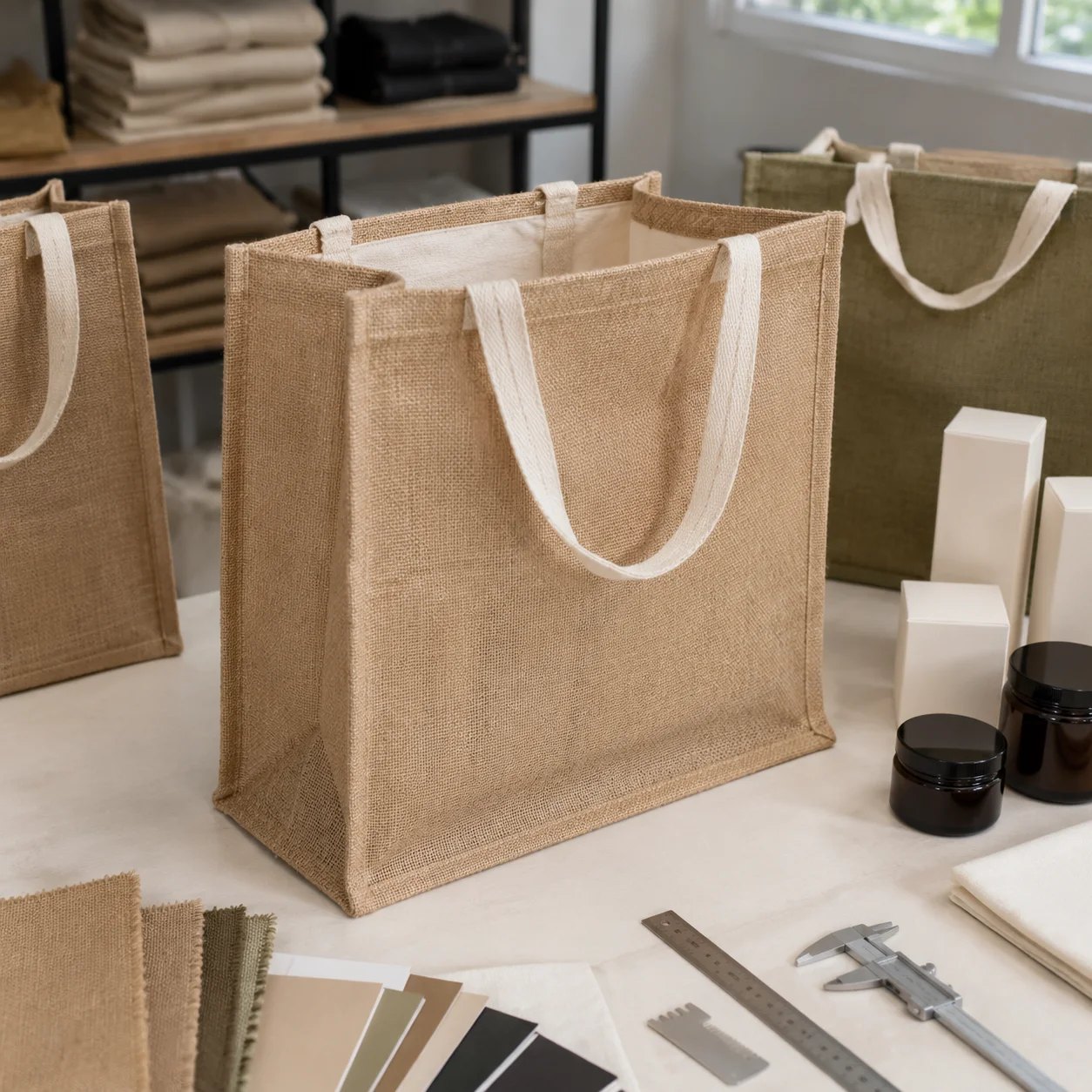
Define the Pricing Problem
For skincare brands, a custom jute tote can be a gift-with-purchase carrier, spa counter kit, distributor launch pack, seasonal bundle, or retail add-on. Those use cases look similar in a quick quote request, but they do not place the same demands on structure, cleanliness, handle comfort, and carton protection.
The common procurement failure is a blended unit price that hides material, lamination, print, handle, packing, MOQ, and freight assumptions. A better pricing plan fixes those variables first, so every supplier quotes the same bag rather than a cheaper lookalike.
- Start the RFQ with the commercial use case and destination market.
- Attach the intended skincare pack-out, including filled product weight and secondary packaging.
- Quote the same construction, Incoterm, currency, packing method, and artwork at every tier.
Build Around the Pack-Out
A skincare tote should be sized from the finished pack-out, not from a catalog thumbnail. Product cartons need loading clearance. Jars and pump bottles need a base that does not twist. Insert cards, tissue, sachets, and retail sleeves add volume even when they add little weight.
Before requesting bulk pricing, pack the real products into a reference bag and record the failures: tight opening, short handle, soft base, blocked logo area, carton corners pushing through the weave, or a fold crossing the artwork. Those observations become supplier instructions.
- Provide finished width, height, gusset, handle drop, and target filled load.
- Keep the logo away from the likely packing fold and high-stress corners.
- Confirm whether the tote must stand upright or only function as a hand-carry bag.
Specify Jute and Lamination
Jute and burlap are often used loosely in buyer conversations. In a purchase order, the factory needs clearer language: natural or dyed body, open or tighter weave, laminated or unlaminated inner face, handle material, and acceptable odor or shedding level.
Use a target GSM as a quote assumption, then require confirmation by swatch and finished sample. Example RFQ assumption to verify in the supplier quote: 280-320 gsm laminated jute body fabric for a skincare gift tote. This is not a CottonToMaker standard or sourced benchmark; it is a buyer-controlled starting point for supplier confirmation.
- State whether GSM applies to raw jute, laminated jute, or total composite material.
- Request a swatch from the planned production material, not only a catalog card.
- Check loose fibers on the inside face because transfer can make cartons look dusty.
Choose the Print Method
Skincare artwork can be harder to print on jute than it appears in a digital proof. Fine serif type, thin botanical lines, small ingredient icons, and pale inks can disappear into the weave. Screen printing is often practical for simple marks; transfer methods may help when sharper edges are needed.
The BodrumCrafts guide at https://bodrumcrafts.com/blogs/logo-printing-guide/custom-printed-tote-bags-wholesale-pricing-guide, retrieved 2026-07-12 with no publication date shown in the research pack, states that the screen printing versus DTG break-even point typically falls between 50-100 units for custom tote orders. Treat that as source-specific context, not a universal jute rule.
- Send vector artwork and flat color targets, not a low-resolution logo image.
- Ask whether setup cost is charged by artwork, color, print position, or run.
- Approve a real print sample on selected jute before bulk production.
Set MOQ and Quote Lines
A useful bulk pricing plan shows how fixed setup costs spread across more bags. Ask suppliers to split blank bag cost, print cost, setup, sample, inner packing, master carton, inspection support, and freight. A single blended line makes supplier comparison weak.
Pamusan's guide at https://pamusan.com/blogs/news/bulk-tote-bags-2026-wholesale-pricing-guide-for-businesses, with figures stated as April 2026 and retrieved 2026-07-12, says printing adds USD 0.30 to USD 2.50 per unit depending on method. Its reference table is for standard 14 x 16 inch blank bags, FOB Turkey, and the excerpt says moving from 100 pieces to 1,000 pieces can drop per-unit cost by 30-40 percent. These are external tote references, not jute-specific CottonToMaker prices.
- Quote launch, reorder, and annual-program tiers using the same specification.
- Keep setup charges separate so finance can see the scale effect.
- Ask whether MOQ is driven by fabric, print setup, labor scheduling, or packing efficiency.
Compare Supplier Routes
Skincare buyers may source from a direct bag factory, a trading company, or a blank-stock decorator. A factory route gives more control over cutting, sewing, handles, printing coordination, and export packing, but it requires a disciplined RFQ and sample approval process.
A trading company can help consolidate categories, but the buyer should know who owns the specification. A stock decorator can move faster when the existing tote already fits the pack-out, yet stock dimensions, GSM, and handle options may limit the final result.
- Use factory sourcing when size, GSM, lamination, handle, or packing must be controlled.
- Use stock decoration only when the existing bag already fits the skincare set.
- Use a trading company when consolidation value is clear and production accountability is documented.
Control Claims and Documents
Jute has a strong natural-material signal, which is why many skincare brands consider it. That signal should not become an unsupported packaging claim. Words such as biodegradable, reusable, eco-friendly, natural fiber, or low impact need documentation and destination-market review.
FY Bag Custom's page at https://www.fybagcustom.com/products/custom-bag-fabrics/jute-burlap-bag, retrieved 2026-07-12 with no publication date shown in the research pack, claims that jute biodegrades naturally in 1-2 years. Treat this as a supplier marketing claim unless supported by documents for the actual construction, finish, and market. For European programs, REACH is a restricted-substance framework; asking for REACH-relevant information is a document request, not a certification claim or a statement of CottonToMaker practice.
- Separate material-composition statements from environmental marketing claims.
- Ask whether dyes, inks, lamination, adhesives, and handles are covered by documents.
- Do not use certification logos or regulated claims without current authorization.
Approve Samples Before Cutting
The sample stage turns a quote into a production decision. A lower price may depend on looser weave, thinner handle tape, smaller gusset, cheaper lamination, simplified print, or less protective packing. If the supplier sends a substitute, mark it as a reference sample only.
For skincare, sample approval should include a pack-out test and a shelf-view test. Load the final products, carry the tote, set it on a counter, and check logo position, base shape, fiber transfer, odor, handle comfort, and seam stress after filling.
- Approve fabric, lamination, print, handle, stitching, finished size, fold, and carton method together.
- Keep the signed physical sample as the bulk inspection reference.
- Record any approved deviation so the invoice and reorder quote use the same assumption.
Plan Packing and Release
Jute can pick up odor and moisture when storage or packing is poor. That matters for skincare because the tote may sit near fragranced products, clean cartons, paper inserts, and retail sleeves. Define individual packing, bundle packing, or loose packing before comparing prices.
Lead time should be broken into sample preparation, revision if needed, material booking, cutting, sewing, printing, finishing, packing, inspection, export handling, and transit. A shorter quote may assume stock fabric, simpler print, or a looser approval path.
- Identify which stages start only after artwork, deposit, sample approval, or material confirmation.
- Confirm cartons are stored away from strong odors, damp floors, and mixed chemicals.
- Define acceptable fold marks and rejectable logo creases before packing begins.
Keep the Record Auditable
The final RFQ should read like a production document: product use, body material, GSM target, lamination, finished dimensions, handle, stitch construction, print method, artwork, print placement, packing, carton requirements, document requests, sample requirements, MOQ tiers, Incoterm, currency, and delivery window.
Vincent Xi is the Editorial Author. His articles use cited public sources and distinguish documented claims from buyer checks that require current verification.
- Keep the approved sample, signed quote, artwork, carton mark file, and document requests in the order record.
- Compare total landed cost, not only ex-factory unit price.
- For reorders, confirm whether fabric shade, GSM, lamination, handle, ink, and packing remain unchanged.
Specification comparison for buyers
| Spec decision | Recommended option | When it fits | Buyer risk to check |
|---|---|---|---|
| Body fabric and GSM | Buyer-stated GSM range confirmed by swatch and finished sample; example RFQ assumption to verify in the supplier quote: 280-320 gsm laminated jute body fabric. | Gift-with-purchase sets, spa kits, discovery kits, and distributor samples that need structure without a handbag feel. | Avoid vague heavy-jute labels. Confirm measured GSM, whether it is before or after lamination, weave consistency, odor, and shedding. |
| Lamination | Matte inner lamination when the bag carries boxed skincare, inserts, tissue, or retail cartons. | Programs needing a cleaner inner face, better shape retention, and less fiber transfer onto cartons. | Lamination can add odor, stiffness, wrinkles, and delamination risk. Ask for fold, rub, and aging checks on the approved sample. |
| Bag size and gusset | Size the tote from the real pack-out; quote finished width, height, base gusset, and handle drop. | Jars, tubes, cartons, tools, sachets, or samples that must load quickly and sit upright. | A low quote may hide a shallow gusset or tight opening. Test the largest carton and final insert before bulk cutting. |
| Handle construction | Cotton webbing, jute-cotton blend, or padded jute handle with reinforced stitching matched to filled weight. | Retail hand-carry, spa counter pickup, event gifting, and reusable distributor kits. | Handle failure often comes from weak seam allowance, poor stitch density, or twisting handle tape. Pull-test the finished sample. |
| Print method | Screen print for simple logos on natural jute; use transfer only when artwork needs sharper edges than the weave can hold. | Minimal skincare branding, ingredient-led ranges, and boutique retail programs. | Fine type can break on coarse weave. Approve production-style print on selected jute, not a smooth-fabric proof. |
| Artwork color count | Specify Pantone target, print size, print location, and whether printing is on front panel, back panel, or both panels. | Brands seeking a refined natural look while controlling setup and registration cost. | Extra colors add screens, setup time, and registration risk. Check color on jute under normal retail lighting. |
| MOQ and tier logic | Quote launch, replenishment, and annual-program tiers under the same Incoterm, currency, packing method, and artwork file. | Brands comparing a pilot order with forecasted reorders, or distributors quoting several skincare accounts. | Suppliers may quote different assumptions by tier. Separate bag cost, printing, setup, sample, packing, carton, and freight. |
| Export packing | Use dry master cartons, stable folding, SKU separation, and buyer-approved inner packing. | Bulk jute totes moving through storage before kitting, retail delivery, or ecommerce fulfillment. | Jute can absorb odor and moisture. Confirm carton strength, humidity protection, pallet plan if used, and logo-crease risk. |
Buyer checklist before sampling
- Define the skincare pack-out before requesting pricing: cartons, jars, inserts, tissue, samples, and retail sleeves.
- State whether the tote is for giveaway, retail resale, gift-with-purchase, distributor sampling, or ecommerce kitting.
- Specify jute or burlap appearance, natural or dyed color, lamination, GSM target, handle material, and finished dimensions.
- Send vector artwork with print size, color target, placement, and front, back, or both-panel requirement.
- Ask suppliers to separate blank bag cost, print cost, setup charge, sample charge, packing charge, inland freight, export cost, and international freight.
- Request the same Incoterm, currency, MOQ basis, packing method, and artwork assumption across all quoted tiers.
- Require a physical pre-production sample using the selected fabric, lamination, print method, handle, stitch construction, and packing fold.
- Test the sample with real skincare products, not only empty boxes or visual mockups.
- Check odor, shedding, lamination feel, print rub, stitch strength, handle comfort, and filled-bag stability.
- Confirm whether compliance documents are available for the destination market before approving packaging claims.
- Lock carton packing, moisture control, label format, SKU separation, and acceptable crease position before bulk production.
- Keep the approved sample, signed spec sheet, artwork file, and carton mark file together as the purchase order reference.
Factory quote questions to send
- What is the MOQ for this exact jute tote construction, and does it change with lamination, dyeing, or custom weaving?
- What GSM will be used for the jute body, and is it before lamination, after lamination, or supplier-specification weight?
- Can the supplier provide a swatch and finished sample from the same material lot planned for bulk production?
- Which print method is quoted, and what artwork assumptions drive the setup charge and per-unit print cost?
- Does the unit price include printing, inner packing, master carton, carton marks, export labels, and inspection support?
- What is the sample timeline, and which production stages are included in the quoted bulk lead time?
- How will the factory control jute odor, loose fibers, lamination bubbles, print rub, and handle stitching consistency?
- What finished-bag tolerance applies for width, height, gusset, handle drop, and print placement?
- Will bags be individually packed, bundle-packed, or packed loose, and how does that affect moisture, creasing, and landed cost?
- What material-composition and restricted-substance documents can be provided, and are they current for the order lot?
- What happens if bulk production differs from the approved sample in shade, weave density, handle color, or print position?
- Which costs are fixed setup costs, which are variable per-unit costs, and which change when order quantity increases?
Quality-control points to confirm
- Compare bulk fabric shade, weave openness, hand feel, odor, and lamination surface against the approved sample before cutting continues.
- Measure finished bag width, height, gusset, handle drop, and print placement against the signed spec sheet.
- Check body GSM using the agreed method and record whether it refers to raw jute or laminated material.
- Inspect handle attachment for stitch consistency, seam allowance, loose threads, and reinforcement pattern.
- Load the tote with the real skincare pack-out and check handle comfort, body distortion, base stability, and seam stress.
- Rub the printed logo with dry and lightly damp white cloth to screen for ink transfer or weak curing.
- Fold the bag using the planned packing method and inspect whether creases cross the logo or damage lamination.
- Open random cartons and check SKU separation, count accuracy, inner packing, odor, moisture marks, and carton deformation.
- Verify carton marks and shipping labels against the purchase order before release.
- Hold a retained production sample from the bulk lot for future reorder comparison.