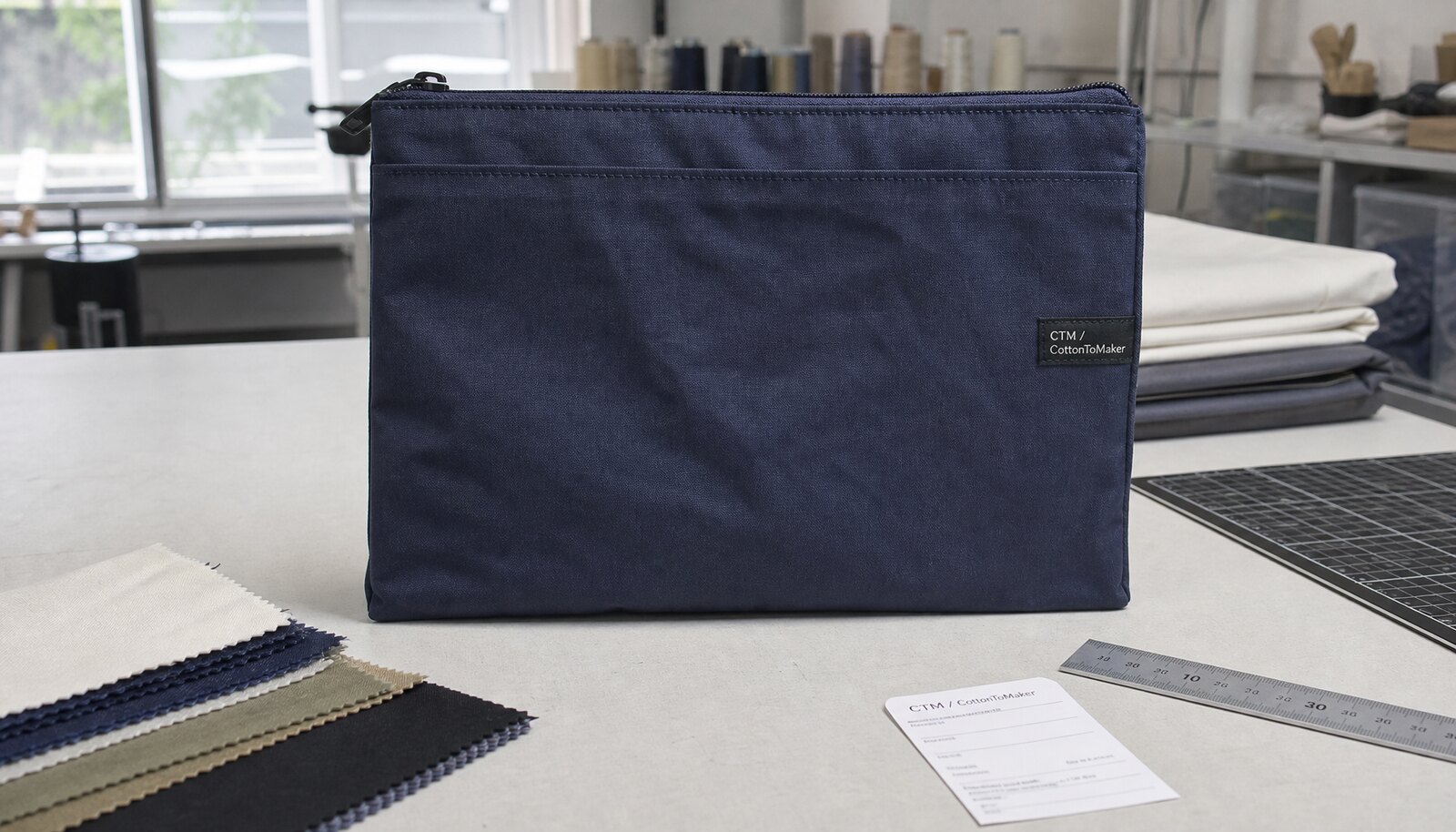
What a Retail Buyer Needs From a Zippered Portfolio Bag
A zippered portfolio bag for retail is not just a document folder with a zipper. For procurement teams and brand owners, the real job is to sell a product that looks credible on shelf, holds up through repeated open-close use, and carries a logo without warping the face of the bag. The bag may hold letter-size paper, an A4 pad, a tablet, a pen, and a few inserts, but the buying decision is usually won or lost on shape, zipper feel, and how clean the front panel looks after printing.
The common mistake is to treat the bag like a generic office accessory and let the factory decide the details. That creates quotes that cannot be compared and samples that look different from the final bulk order. A clean retail program starts with one use case, one finished size, one logo method, and one packing standard. If the bag is meant to sit in a retail channel, the sample has to answer a merchandising question as much as a functional one.
- Define the end use: documents only, sales kit, tablet carry, or premium presentation folder.
- Decide whether the bag must stay flat, stand with structure, or carry a light protective insert.
- Treat the zipper, face panel, and retail packing as part of the product, not as afterthoughts.
Start With the Use Case, Not the Decoration
The first spec decision is what goes inside the bag. A folder for loose papers can be slim, while a retail portfolio for a tablet or sample kit needs more body, a wider gusset, and stronger edge support. If the buyer leaves that open, the factory may build a bag that technically fits the artwork brief but fails in the channel. For example, a 12 mm gusset works for documents, but a kit with a charger, pen, and brochure often needs a deeper side wall and better zipper clearance.
Once the use case is clear, the style decision becomes easier. A slim portfolio is usually lighter, cheaper to ship, and more shelf-friendly, but it has less protection and less room for inserts. A mid-gusset version gives better utility and can accept a lightly structured insert. A premium retail version may use a more rigid shell, better lining, and a smoother zipper path. Buyers should write the function in plain terms so the factory does not have to infer it from a photo.
- State the maximum item thickness the bag must carry.
- Confirm whether the bag needs a pen loop, card pocket, or tablet sleeve.
- Specify if the zipper must run around the top only or around more than one side.
Spec Choices That Move Cost and Shelf Appeal
Fabric weight matters more than many buyers expect. For polyester, 300D is a common light-to-mid option that can print well and keep cost down, while 600D gives more body and a more substantial retail feel. For canvas, 12 oz is roughly in the 340 gsm range and gives a natural texture without becoming too heavy, while 16 oz is around 450 gsm and feels more durable but can make sewing and freight more expensive. If the product is meant to present as premium, the handfeel of the shell often matters as much as the artwork.
Structure is the other big lever. A simple portfolio may use no board at all and rely on fabric plus lining, but retail buyers often benefit from a thin PE board or EVA layer so the bag does not collapse on the shelf. Lining can be a basic 210D polyester or a smoother brushed fabric if the product will be opened often. The more the bag needs to hold shape, the more the quote will move toward material and labor rather than decoration. That is normal and should be planned instead of hidden.
- Use 300D to 600D polyester for cleaner print control and lower risk of distortion.
- Use 12 oz canvas when you want a more natural retail feel without excess weight.
- Use a light board or EVA insert when the bag must stand flatter in store displays.
Reading Quotes Without Being Misled by Unit Price
A low unit price only means something if the quote includes the same construction, same packing, and same delivery term as the others. In this category, buyers need a line-item quote that separates shell fabric, lining, zipper, print, label, reinforcement, polybag, carton, and any setup fee. A quote that looks cheaper may simply be excluding the lining or quoting a lighter fabric weight. That is not a savings if the final goods fail retail expectations.
The fastest way to compare suppliers is to normalize the quote into a landed-cost view. Ask whether the price is EXW or FOB, whether sample fees are credited later, and whether the unit price assumes one print color or multiple passes. A small change in logo method can affect both cost and defect risk. For example, a simple silkscreen logo is cheaper than a woven label in some cases, but a woven label may give more consistency if the retail pack is handled often.
- Compare quotes only after stripping out setup, packing, and freight assumptions.
- Check whether the quote includes a standard zipper pull or a custom puller.
- Ask for the same carton pack and outer carton strength before comparing unit price.
MOQ Logic and Supplier Route Tradeoffs
MOQ for zippered portfolio bags is usually driven by fabric availability, artwork method, zipper sourcing, and whether the factory must open special materials just for your order. If the supplier is using stock fabric, standard zipper tape, and a simple print, the MOQ can stay relatively low. If the order needs custom lining, special pullers, or a new woven label, the minimum often rises because the factory has to reserve separate materials or set up extra runs.
The supplier route matters. A direct factory is usually better when the bag will repeat season after season and the spec needs tight control. A trading company can help if you need to combine multiple SKUs, but it can also hide where the real QC control sits. If a buyer is running a pilot or a mixed program, it is often smarter to split the order into a test run and a follow-on bulk run instead of forcing one large MOQ that creates inventory risk.
- Do not accept a single MOQ number without knowing which component drives it.
- Split the order if the artwork, lining, and zipper package are not yet fully proven.
- Use stock components where possible if your retail calendar is tight.
Sampling That Prevents Production Drift
A pre-production sample for a retail portfolio bag should verify more than appearance. It should lock the finished size, zipper travel, panel alignment, pocket depth, and logo placement. The sample must be made with final or final-equivalent materials, because a soft substitute fabric can hide shape problems that appear in bulk. Buyers should keep one sealed golden sample and one working sample marked with the approved measurements so the production team has a physical reference, not just a PDF.
Useful sample checks are practical and short. Open and close the zipper several times to feel for snagging, check whether the bag lies flat when closed, and test the fit with the actual item that will be placed inside. If the logo is printed, inspect it under daylight to catch edge blur or ink shade shift. If the bag is lined, look inside for loose thread ends, misaligned pockets, or exposed seam allowances. If a sample fails on one of these points, do not treat it as a minor note; that is the production warning sign.
- Approve the bag against a physical size sheet, not only against photos.
- Test zipper cycles and carry insert fit before bulk approval.
- Store a sealed golden sample with the purchase file and revision history.
QC Thresholds That Matter in Factory and at Delivery
For this product, the failure points are usually easy to name: crooked stitching, zipper misalignment, warped panels, poor logo placement, and inconsistent packing. Buyers should separate critical defects from cosmetic ones before production begins. A broken zipper, wrong size, wrong artwork, or open seam is a critical fault because the bag cannot function or cannot be sold as approved. A light wrinkle or small thread tail may be minor if it does not affect retail appearance or performance.
Set practical acceptance criteria. Stitching should be even and secure at stress points, with no skipped stitches along the zipper line. The zipper should glide without forcing or curling the top panel. If there is an inner pocket or divider, it must match the depth shown in the sample, because a shallow pocket can make a retail portfolio feel unfinished. Buyers should also ask for carton counts, carton marks, and barcode stickers to be verified before shipment, not after arrival.
- Define critical, major, and minor defects in the RFQ or purchase order.
- Require inspection of zipper function, logo alignment, and size tolerance.
- Check carton count and barcode placement before goods leave the factory.
Packing and Distribution Readiness
Packing is part of the product economics. A zippered portfolio bag can ship in a polybag with a barcode sticker and then into a master carton, but the exact pack needs to match the channel. Ecommerce buyers often want a cleaner retail-ready inner pack, while wholesale buyers may prioritize dense carton packing and low damage risk. If the bag has a structured panel or foam insert, the factory should pack it in a way that protects the shape without adding unnecessary volume.
Carton design affects freight more than many buyers expect. A carton that is slightly oversized can raise cube cost across a whole container load. Inner pack count, carton strength, and moisture protection all matter if the route includes long ocean transit. If the product will go to distributors or chain stores, ask for case-pack consistency and a labeling system that lets the warehouse receive and count without opening every carton. That saves time and reduces repacking damage.
- Match the inner pack to the sales channel before finalizing the carton pack.
- Keep carton dimensions efficient so freight is not inflated by empty volume.
- Use labels and case packs that the warehouse team can receive without relabeling.
Lead Time, Reorder Risk, and Landed Cost
Lead time should be written as a production sequence, not a promise. For a custom retail portfolio bag, the sample stage, material sourcing, bulk sewing, printing, inspection, and packing each take time. If artwork or carton graphics are still changing, the schedule slips quickly. Buyers should leave enough room for one round of sample correction before bulk approval, especially if the product must hit a seasonal retail window. A realistic plan is better than a rushed one that creates hidden defect risk.
Landed cost is where the real buying decision lives. Material weight, zipper grade, logo method, reinforcement, packing standard, freight mode, duty, and local handling all matter. A cheaper quote that uses heavier packaging, a more expensive zipper, or larger cartons may still lose on total cost. The best comparison is not just unit price but unit price plus setup plus freight per sellable piece. Buyers who compare that way usually find the real savings or the real risk very quickly.
- Build the schedule around sample approval, not around the hoped-for bulk date.
- Compare total landed cost rather than factory price alone.
- Keep one spec frozen for the first run so the reorder is measurable.
Put the RFQ Together Like a Production File
The cleanest RFQ for zippered portfolio bags is a small production file, not a long email thread. Include the finished size, gusset depth, shell fabric, lining, zipper size, logo method, packing format, target quantity, and delivery term. Add a reference photo or a physical sample note if you already have one. The more specific the RFQ, the less the factory has to fill in, and the easier it is to compare one supplier against another on the same basis.
Also make the open points visible. If the artwork is final but the carton artwork is still pending, say so. If the buyer is comparing a slim version against a semi-structured version, define both options separately. Vague language like good quality or retail standard does not help a factory quote accurately. The goal is not to sound technical for its own sake; it is to remove guesswork so the quote reflects the real product, the real packing, and the real risk.
- Attach artwork files, a dimension sheet, and a packing spec to the RFQ.
- State what is fixed and what is still open before asking for price.
- List the destination port or warehouse so freight assumptions are not invented.
Specification comparison for buyers
| Spec decision | Recommended option | When it fits | Buyer risk to check |
|---|---|---|---|
| Supplier route | Direct factory with zipper-bag experience | Repeat retail programs with custom panels, lining, or logo placement | Confirm the factory actually controls sewing, printing, and final packing instead of passing work between subcontractors |
| Shell fabric | 300D to 600D polyester or 12 oz to 16 oz canvas with stable weave | Retail bags that need a clean print surface and a shape that holds on shelf | Too-light fabric collapses; too-heavy fabric raises freight, sewing difficulty, and stiffness |
| Body structure | Light PE board or 1 to 2 mm EVA with optional foam in premium versions | When the bag must stand flat enough for display and protect papers or a tablet | Overbuilding adds cost and zipper strain; underbuilding makes the bag feel cheap |
| Artwork method | Silkscreen for simple logos, heat transfer for multi-color art, woven label or deboss for premium finish | Low to moderate logo counts with stable artwork | Fine lines can fill in, soft-touch prints can crack, and color matching changes by method |
| Zipper spec | #5 nylon coil zipper with a matched puller; metal only if the design needs a premium cue | Standard retail volume with frequent open-close cycles | Low-grade zippers create the fastest complaint rate and can make an otherwise good bag unusable |
| Sample path | Pre-production sample plus one sealed golden sample | Any custom retail order, especially if multiple factories are quoting | Photo approval alone hides stitching, zipper track, and size drift |
| Packing format | Polybag with barcode sticker, then master carton with carton pack list | Ecommerce, wholesale, or chain-store distribution | Loose packing causes scuffs, count errors, and carton presentation issues |
| Freight strategy | Carton dimensions optimized for sea freight with a carton test if retail-ready | Bulk import orders and replenishment programs | Oversized cartons inflate landed cost more than a small upgrade in material quality |
| Cost comparison route | Compare factory direct, trading company, and local decoration after adding setup, packing, and freight | When the quote spread looks large but specs appear similar | A low unit price can hide setup fees, weaker QC, or a different packing standard |
Buyer checklist before sampling
- Lock the intended use first: papers only, papers plus tablet, or a full sales kit with pens, cards, and inserts.
- Specify the exact finished size, gusset depth, and whether the bag must stay flat or hold a semi-rigid shape.
- Choose the shell fabric by weight and feel, not just by name; note denier, GSM, weave, and finish.
- State the zipper type, zipper size, puller style, and whether the zipper must run around three sides or only the top edge.
- Define the logo method, artwork file type, size, placement, and acceptable color variation.
- Request a pre-production sample made with final materials, not a photo sample or a hand-cut mock-up.
- Confirm inner packing, carton pack, barcode placement, and any retail label or hangtag requirement.
- Ask for full quote breakdowns including setup, sampling, packing, and freight assumptions.
Factory quote questions to send
- What fabric weight, denier, or GSM is included in the quote, and is it stock material or custom dyed?
- Which zipper type, size, and puller are included, and is the zipper supplier fixed or optional?
- What exactly is included in unit price: sewing, lining, reinforcement, logo, labels, polybag, barcode sticker, and carton packing?
- Is the quote EXW, FOB, or another term, and what local charges are excluded?
- What is the MOQ by color, by artwork, and by carton pack, and which component drives the minimum?
- What sample stages are offered, and how much time is needed for each stage?
- What inspection standard do you use for size, stitching, zipper movement, and print registration?
- Can you share carton dimensions, gross weight, and estimated loading efficiency for sea freight?
Quality-control points to confirm
- Finished size matches the approved spec sheet within the agreed tolerance.
- Zipper runs smoothly through the full travel without snagging, gaps, or wave distortion.
- Logo placement is centered or aligned to the approved artwork reference and has clean edges.
- Stitching is even, secure at stress points, and free from skipped stitches or loose threads.
- Panels lay flat without twisting, uneven shrinking, or puckering around the zipper line.
- Inside pockets, dividers, and pen loops match the approved count, depth, and placement.
- Color, handfeel, and surface finish match the physical sample or approved swatch under daylight.
- Carton pack count, barcode sticker, and outer marks match the shipping and retail plan.