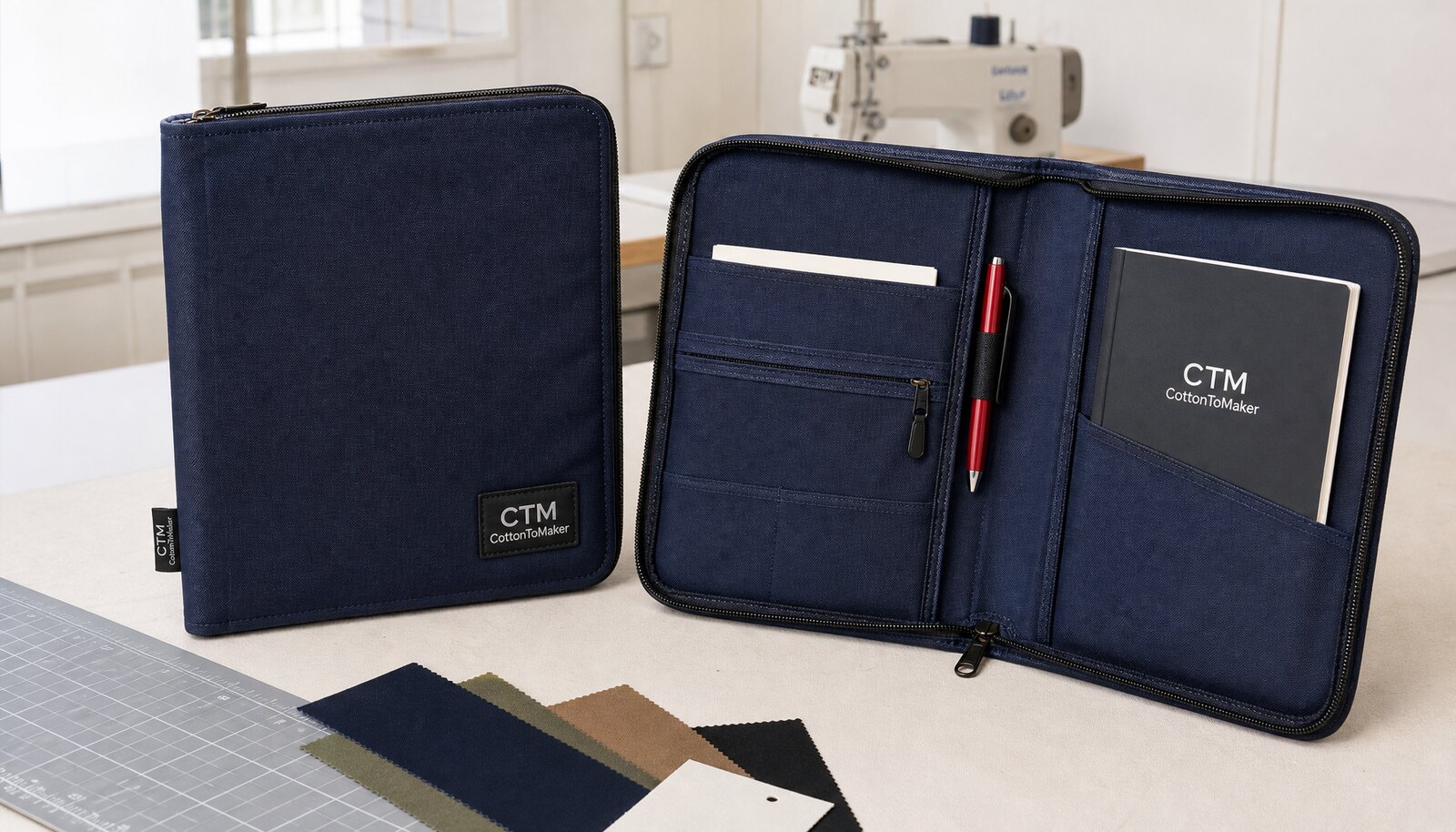
Why launch buyers use portfolio bags differently
Zippered portfolio bags for brand launches are not ordinary office carriers. They usually need to move a press kit, a product booklet, a tablet sleeve, a price sheet, and a few small inserts in one clean package. That means the bag has to look polished at first touch, pack quickly without a fight, and survive handling from the factory floor to the event table. A bag that looks good empty can still fail if the opening is too narrow, the zipper catches on the seam, or the body collapses when the contents go in.
For procurement, the real buying problem is not just decoration. It is how the bag behaves in the pack-out line, what it costs to decorate and carton-pack, and whether it arrives with a consistent shape for photography or handoff. If the launch kit is part of a brand reveal, the bag is part of the presentation system. That means the RFQ has to cover appearance, load, and logistics together, or the supplier will optimize only one of them.
- Define the actual contents before specifying the bag size.
- Treat the zipper, opening width, and carton pack as launch-critical, not optional details.
- Use one approved use case per SKU to keep quotes comparable.
Construction choices that move cost and appearance
The fastest way to narrow the field is to choose the construction before you compare prices. A flat sleeve is cheaper and easier to pack, but it works only when the contents are slim. A gusseted portfolio bag gives more volume and a cleaner fit for brochures, notebooks, and tablet-sized items. Common launch sizes are around 25 x 33 cm for compact kits and 30 x 40 cm for larger presentation packs, with a 25 to 40 mm gusset when the contents need depth. If you want a more rigid look, ask for a card insert or 2 mm EVA back panel rather than overbuilding the whole bag.
Fabric weight matters because it changes both structure and print behavior. A 300D polyester body is a practical starting point for price-sensitive launch programs, while 600D polyester or 12 oz canvas gives more body and better visual coverage. If the bag needs a premium feel, a cotton canvas shell in the 10 to 14 oz range is common, but it can distort if the contents are heavy and the bag is not reinforced. For the zipper, a #5 nylon coil is usually enough for light to medium loads, while a wider bag with a fuller pack benefits from a #8 coil and a stronger stop at the end.
- Use a flat sleeve only when the launch contents are slim and predictable.
- Add structure with board or EVA before you add unnecessary heavy lining.
- Do not let the zipper size be an afterthought if the bag will be packed full.
Best materials and decoration methods by use case
For a volume launch where cost control matters, 300D polyester is the workhorse. It prints cleanly, stays light in shipping, and gives you a consistent base color across batches. It also works well when the brand wants a sharp logo rather than a textured surface. If the bag will be handled by media, distributors, or sales teams many times, 600D polyester is safer because it hides wear better and keeps the silhouette from collapsing. It is not as soft as canvas, but it reads more controlled in photos and is easier to standardize in production.
Canvas has a different role. A 10 to 12 oz canvas bag feels more tactile and can fit a retail or gift-led brand language, while 14 oz canvas creates a sturdier hand feel if the contents are heavy. Screen print is still the most economical method for a flat logo on large runs, especially when the artwork has one or two colors. Woven labels, sewn patches, and small embroidery all work, but each one changes labor, placement tolerance, and the risk of puckering. If the logo is small and the bag is thin, a sewn patch or side label often looks cleaner than embroidery.
- Use screen print for flat logos and large run efficiency.
- Use woven labels or sewn side labels when you want subtle branding.
- Avoid heavy embroidery on thin shell fabric because puckering shows fast.
How to read a quote without missing hidden cost
A quote that says only portfolio bag and a unit price is not useful. You need to see the body fabric, lining, zipper, puller, print method, stitch count, pack method, and whether the price includes inserts or reinforcement. The biggest quote gaps are often not fabric grade alone. They come from whether the factory includes an inner board, whether the print is one color or multiple colors, and whether packing is individual polybag, tissue wrap, or bulk carton only. Those choices change labor and damage risk, so they belong in the price comparison.
The MOQ line needs the same scrutiny. Some suppliers quote a small number, but the real minimum applies per color, per logo version, or per size. If your launch needs three colors and one for each region, a 500 piece quote can become 1,500 pieces very quickly. Ask every supplier to state the MOQ in a way that matches the production reality, plus the overrun range, sample fee, artwork setup fee, and payment terms. Without that, procurement will compare a clean quote from one supplier against a half-specified one from another.
- Normalize all quotes to the same Incoterm before comparing price.
- Request the same carton count, same packing method, and same print area from each supplier.
- Make sample fees, tooling, and overrun rules visible on the quote sheet.
Which sourcing route fits your launch timeline
Direct factory sourcing works best when the bag is part of a repeatable brand program. You get tighter control over fabric, zipper, print, and packing, and you can usually negotiate better on repeat orders. The tradeoff is that the factory will expect a cleaner spec sheet and may push back if the design is underdefined. Trading companies help when the launch basket includes several products and you want one point of contact, but the buyer needs to know whether the actual sewing happens in-house or at a subcontracted plant. If the supply chain is layered, the quote can hide where margin and risk are sitting.
Domestic decorators or regional assemblers are useful for small pilot runs, rush orders, or late-stage logo changes. They can be the right answer when the launch date matters more than the last dollar of unit cost. Another practical route is stock body plus local decoration. That is fast, but it only works when the stock bag already matches the intended size, hand feel, and color language. If the body is close but not right, the launch looks improvised, which is exactly what procurement is trying to avoid.
- Choose direct factory for custom structure, repeat orders, and better control.
- Choose domestic decoration for a small pilot or a rush launch.
- Use stock body plus local branding only when the base bag already matches the brand standard.
Sample approval should test the real contents
The first sample should not be judged empty on a desk. Pack it with the real launch contents and see what happens. A portfolio bag that will carry brochures and a notebook needs a different opening width than one that holds a tablet sleeve and insert card. Once the contents are inside, watch the zipper line, the shoulder or hand carry balance, and whether the side seam pulls open under weight. A design that looks good flat can become awkward once the bag is full, especially if the gusset is too tight or the lining steals too much internal space.
After pack-out, let the sample sit for a while and then open it again. This is where weak reinforcement shows up. If the zipper tape twists, the puller catches the binding, or the corners bulge, the construction needs revision before bulk. Keep a sealed reference sample, a packed reference sample, and photographs of the approved pack-out sequence. Those three items reduce disputes when the first shipment arrives and the factory says the bulk matches the sample while the buyer sees a different result.
- Test the sample with the actual contents and final packing sequence.
- Keep both a sealed reference sample and a packed reference sample.
- Approve only after opening, closing, and re-packing the bag several times.
QC points that prevent damage at the launch
The defects that matter most on launch bags are usually visible, not technical. Uneven zipper stitching, twisted handles, off-center branding, and poor seam reinforcement are the first problems buyers notice. Set tolerances before production starts, because a bag that is five millimeters short may still function, but a bag with a zipper that opens into the seam or a logo that is too high will look unprofessional in photos and on the event table. If the bag is going to press or retail partners, the aesthetic threshold is stricter than for a back-office document carrier.
The factory should be able to show line samples and maintain a golden sample at the sewing line. That sample is the practical reference for stitch density, zipper finish, label placement, and print position. During inspection, check for broken threads, stain marks, fabric shading, and any odd smell from coating or packing. If the bag uses a structured insert, inspect whether the panel is seated correctly and whether corners are dented from packing pressure. Those issues are minor on paper and expensive in a launch environment.
- Set size, print position, and zipper-action tolerances before bulk release.
- Inspect for stains, skipped stitches, and label misalignment under normal light.
- Use a golden sample at the line and on the incoming inspection bench.
Packing, cartons, and launch logistics
Packing is where many portfolio bag programs lose efficiency. A premium launch may need individual polybags, tissue wrap, or a clear protective sleeve, but overpacking can add weight and crush a structured front panel. If the bag is meant to arrive flat and be packed by the customer, keep the internal pack simple. If the bag is shipped already filled with inserts, confirm that the carton size can handle the final shape without deforming the zipper line or the corners. Good packing protects the product and keeps the launch team from repacking damaged units at the last minute.
Carton labeling matters more than many buyers expect. Each carton should identify the SKU, color, size, and quantity so the receiving team can route it without opening every box. Ask for pack photos before dispatch and verify gross weight if the shipment will move by air. For sea freight, focus on carton strength, stackability, and moisture protection. For air, compact packing often saves more than a minor fabric cost difference. If the bag includes inserts or cards, decide whether those items are packed at the factory or at the launch warehouse, because that choice changes both labor and damage risk.
- Keep carton labels simple but complete: SKU, color, size, and count.
- Confirm whether inserts, tags, and cards are packed at source or at destination.
- Match the pack method to the freight mode instead of using one universal standard.
Landed cost drivers buyers often underestimate
A clean unit price can hide a messy landed cost. Print setup, sample charges, zipper upgrades, board inserts, special pullers, and packing labor can all shift the real cost more than a small fabric change. In some cases, a stronger fabric with a simpler decoration method lands cheaper than a lighter fabric with embroidery and retail packing because the labor and rework risk are lower. Procurement should model the landed price on a fully packed SKU, not on the shell bag alone. That is the number that matters to the brand margin.
The other common mistake is comparing different quote bases. If one supplier quotes EXW and another quotes FOB, the spreadsheet is already misleading. Put all suppliers on the same basis, with the same pack method and the same overrun assumption, before you rank them. Then layer in freight, duty, inland delivery, and any warehouse handling. Buyers who do this early avoid the common launch problem where the cheapest factory quote becomes the most expensive delivered order.
- Compare quote bases only after you normalize Incoterms and packing.
- Model freight, duty, and inland delivery before approving the supplier list.
- Treat decoration labor as a major cost driver, not a minor add-on.
RFQ structure that gets comparable answers
A useful RFQ for zippered portfolio bags should fit on one page and leave little room for interpretation. State the target use case, final size, body fabric, lining, zipper, puller, logo area, pack method, target quantity, and required arrival window. Add a reference image if you have one, but do not let the image replace the spec. Suppliers interpret images differently, especially when they are deciding how much structure, stitch density, or print coverage is actually required. The clearer the RFQ, the less time procurement spends chasing revisions later.
The RFQ should also tell suppliers where they can suggest alternatives and where they cannot. You may allow a different zipper puller, a different lining color, or a lower-cost carton style if the visible result stays the same. But do not allow a supplier to change the bag width, reduce the print area, or substitute a materially thinner fabric without approval. That boundary helps buyers keep the launch look intact while still giving the factory room to propose a cheaper or cleaner build. It is the difference between a negotiation and a spec drift.
- Specify one final use case and one final size in the RFQ.
- Mark which substitutions are acceptable and which are not.
- Ask for quote validity, capacity by week, and sample lead time in writing.
Specification comparison for buyers
| Spec decision | Recommended option | When it fits | Buyer risk to check |
|---|---|---|---|
| Sourcing route | Direct factory with in-house sewing and printing | You need repeatable quality, custom dimensions, and a lower landed cost on 500 to 5,000 pcs | Confirm the factory actually controls the trim source, zipper grade, and print process, not just assembly |
| Sourcing route | Trading company that consolidates several factories | You are buying a mixed launch kit and want one contact for multiple SKUs | Ask which factory will sew the bags and whether the quote includes extra margin layers |
| Sourcing route | Domestic decorator or local assembler | You need a small pilot run, rush delivery, or final-stage branding close to the launch market | Expect fewer fabric options, higher unit cost, and less control over custom structure |
| Sourcing route | Stock body plus local logo application | The launch date is fixed and the body can be standard while the branding changes | Check shade consistency, zipper quality, and whether the stock body can handle the intended insert weight |
| MOQ strategy | One color, one size, one logo version per PO | You want the cleanest quote and the lowest setup cost per unit | Avoid spread across too many variants or the real MOQ becomes much higher than the headline number |
| Decoration route | Screen print on polyester or canvas | You need a clean logo, flat artwork, and a price that scales well in volume | Confirm print size, Pantone match tolerance, and wash or rub resistance if the bag will be reused |
| Decoration route | Woven label or sewn patch | You want subtle branding and a more premium retail feel | Check edge fray, stitch placement, and whether the patch crowds the zipper or handle seam |
| Freight route | Sea freight for volume orders | The order is large enough to absorb longer transit and lower unit freight | Protect against carton crush, moisture exposure, and missed launch dates if the calendar is tight |
| Freight route | Air or express for pilot orders | You only need a small initial delivery for PR kits, samples, or a staged rollout | Freight can exceed the product margin if the bag is bulky or the pack count is inefficient |
Buyer checklist before sampling
- Lock the final use case before RFQ: press kit, welcome pack, retail insert, or event handout.
- Choose one target size and one backup size so suppliers do not quote loosely similar bags.
- Specify fabric weight in GSM or oz, lining requirement, and whether the bag needs structure.
- State the zipper type, puller style, handle length, and any pocket or divider requirements.
- Send artwork in vector format and define the print area in millimeters, not just by visual reference.
- Ask every supplier to quote the same Incoterm, pack method, carton size, and overrun allowance.
- Request a pre-production sample packed with the actual contents that will ship in the launch kit.
- Set acceptable tolerance for size, print position, zipper action, and carton count before bulk production starts.
Factory quote questions to send
- What exact fabric, weight, and coating are you quoting, and can you state the GSM or oz clearly?
- What zipper size, tape type, and puller material are included in the price?
- What is the print method, how many colors are included, and what is the print area in centimeters?
- What is the MOQ by color, size, and artwork version, and can you mix colors within one order?
- Is the sample charge refundable on bulk, and what is the sample lead time?
- What packing is included, such as polybag, tissue, insert board, barcode label, and carton count?
- What is the standard production lead time after sample approval, and what changes it?
- Which Incoterm is this quote based on, and what is excluded from the price?
Quality-control points to confirm
- Measure finished width, height, and gusset against the approved sample and reject out-of-tolerance pieces that will not fit the launch contents.
- Check zipper movement across the full track, including the corners, and reject any bag with snagging, skipped teeth, or uneven stitching at the zipper tape.
- Inspect logo position, color density, and edge clarity on every print run, especially on dark fabric where flash or misalignment shows quickly.
- Pull-test handles and stress the side seams with the intended insert weight so the bag does not fail after pack-out.
- Open and close the bag multiple times to confirm that the puller, zipper stop, and lining do not catch or twist.
- Review carton packing, count accuracy, and label legibility so the warehouse can receive the order without repacking delays.
- Watch for oil stains, broken threads, needle damage, or fabric shading that will be visible in photos or on retail shelves.
- Confirm that the bulk sample matches the approved golden sample in fabric feel, zipper tone, and print finish before mass release.