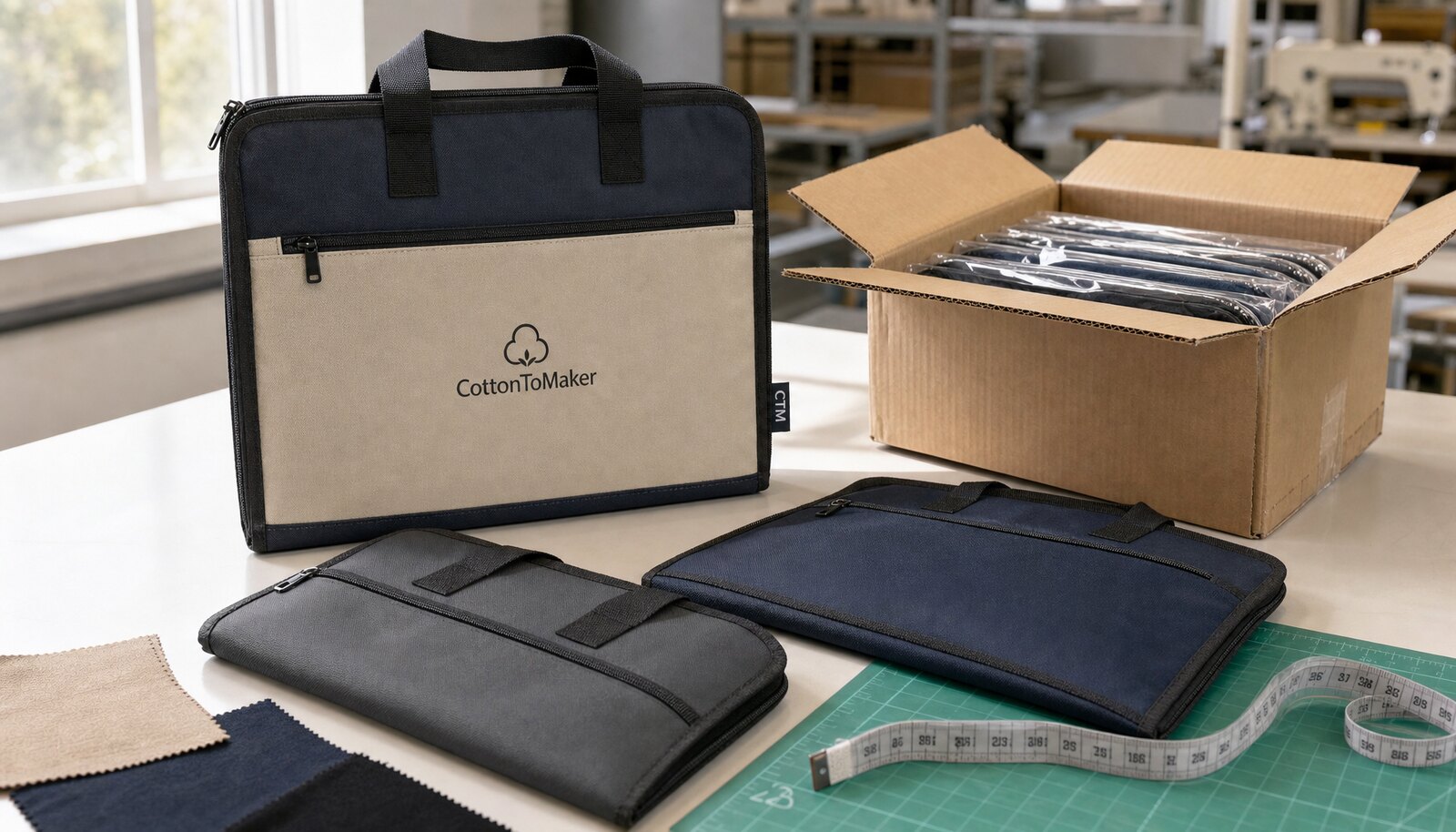
Why carton packing needs its own spec
Many buyers treat carton packing for zippered document bags as a minor note at the end of the purchase order. That is where avoidable cost and damage usually start. A document bag is flat, but it is not a simple flat item once you add zipper tape, webbing handles, foam interlining, front pockets, or printed branding. Small changes in thickness multiply quickly at carton level. Two suppliers can quote the same bag price and then deliver very different freight efficiency, carton damage rates, and receiving labor because the packing method was never standardized.
For procurement teams, the practical goal is not just to fit more pieces into a carton. The goal is to get a repeatable packed unit that protects the zipper, avoids logo blocking or rub, keeps gross weight inside warehouse rules, and makes carton counting easy at destination. If your RFQ only says packed in export carton, you are inviting assumptions. A better RFQ turns packing into a measurable production spec that can be checked before deposit release and again before shipment.
- Carton packing affects freight cost, warehouse handling, damage claims, and shortage control.
- Flat bags can still deform if the zipper head, gusset edge, or folded handle creates pressure points.
- The correct carton count depends on finished thickness, not just face dimensions.
- A packing spec should be approved the same way artwork and fabric are approved.
Start with the bag construction, not the carton size
The first packing decision should come from what the bag has to hold. For a document bag, buyers usually work from A4, legal, or laptop-compatible dimensions. A simple A4 zip file bag in 600D polyester with no gusset may pack tightly and evenly. A larger legal-size business bag with a 3 cm gusset, front slip pocket, and 1 inch webbing handles will not. If the factory starts by proposing a carton size before the approved sample is complete, the quote is still a planning estimate, not a reliable packing spec.
Construction details change how bags sit inside a carton. A single-layer non-woven or light polyester style compresses well. A padded style with EVA foam or PE foam keeps its thickness. Canvas styles with binding seams and heavier zipper tape can create uneven stacks if packed alternating in the same direction. That is why buyers should define the bag structure clearly before asking for pieces per carton. The right approach is sample first, carton test second, mass production third.
- List finished size as width x height x gusset in centimeters or inches.
- State whether the bag includes foam padding, lining, pockets, or internal dividers.
- Describe handle type: die-cut grip, short webbing handle, or shoulder strap.
- Call out zipper type and gauge if important: nylon coil, plastic tooth, single puller, or double puller.
Fabric weight and bag thickness decide real carton yield
For this product category, buyers often compare 600D polyester, 300D polyester, 16 oz canvas, and lighter PP woven or non-woven alternatives. The packing result is very different across those materials. A 600D polyester document bag with backing usually lands around 310-340 GSM finished weight and has moderate body. A 16 oz canvas style may sit around 540-560 GSM and is much less compressible, especially once the zipper binding and handle reinforcement are sewn in. If the supplier quotes the same 50 pieces per carton for both, the heavier style may end up overweight or cause top-layer seam impressions.
Ask the factory to separate base fabric weight from finished GSM if coating or lamination is used. Procurement teams sometimes compare a quote listed as 600D with another listed as 320 GSM and assume they are equal. They are not automatically the same measurement. Packing performance depends on the finished structure actually going into the carton. A stiffer coating can increase thickness and reduce recoverability after compression. That matters when goods travel by sea for several weeks and sit under stacked cartons.
- Economy document bags often use 300D or 600D polyester with a finished weight around 180-340 GSM depending on backing and lining.
- Premium reusable styles often use 12 oz to 16 oz canvas, roughly 400-560 GSM depending on finishing.
- Foam, lining, binding, and pockets can add more packing thickness than face fabric alone.
- Ask for sample-based carton counts, not only fabric-based estimates.
Choose unit packing that protects the zipper and the print
Unit packing is where many quote comparisons go wrong because suppliers present only the master carton spec. Individual packing has direct impact on damage and receiving speed. For most zippered document bags, one piece per clear polybag is the safest standard for dust control and count verification. The zipper should be fully closed, the puller tucked inward, and the handle folded flat inside the bag profile. If the handle sits on top of the front panel, it can emboss into fresh print or create a curved pressure line during long transit.
Not every order needs the same unit pack. Retail-ready programs may need barcode sticker placement, hangtags, tissue, or insert cards. Distributor stock programs often need simpler packing with outer carton marks only. If the logo is screen printed, curing time before bagging matters. If the logo is heat transfer, the risk shifts toward surface blocking under pressure and heat. A practical buyer spec should describe how the unit looks when packed, not only what material the polybag uses.
- Standard bulk recommendation: 1 piece per polybag, zipper closed, puller hidden, handles folded inward.
- For printed canvas, ask whether interleaving tissue is needed to prevent rub or offset.
- If using woven labels or rubber patches, check whether protruding trims create abrasion on adjacent units.
- Require suffocation warning text on polybags if your market requires it.
Set pieces per carton by weight limit, not by factory habit
Many factories default to a familiar carton count such as 50 or 100 pieces because that is easy for production counting. Buyers should reverse the logic. Start with your acceptable gross carton weight and receiving conditions, then let the supplier propose the piece count that stays within that range. For small to medium polyester document bags, 40 to 60 pieces per carton is common. For thicker canvas or padded styles, 20 to 30 pieces may be more realistic. The right answer depends on actual packed thickness and your warehouse handling rule.
This is especially important for importers shipping to multiple channels. A carton that works for full-container store replenishment may fail for marketplace prep, parcel forwarding, or manual upstairs delivery at distributors. Heavy cartons also increase the chance of carton blowout at the hand holes or bottom seam when dragged. A supplier quote should therefore include carton dimensions, net weight, gross weight, and count tolerance. If only dimensions are provided, you still do not know if the package is workable.
- Set a target gross weight range before quoting; many buyers aim for 12-18 kg depending on handling rules.
- Ask whether bags are packed all in one direction or head-to-toe alternating to reduce bulge.
- Request actual count confirmation after the pre-production sample is packed.
- Do not approve carton count based only on theoretical math from flat dimensions.
Printing method changes packing risk more than many buyers expect
On zippered document bags, the front panel is often the main branding area, so print choice directly affects packing method. Screen print is usually the best bulk option for simple solid logos because unit cost is stable on larger runs and the ink layer, when cured properly, handles flat packing well. Heat transfer works for multicolor artwork or lower MOQ programs, but the film layer can show blocking, gloss pressure marks, or edge lift if packed too quickly or compressed under heat. Embroidery looks premium but can create thread abrasion and back-side knot pressure if packed tightly face-to-face.
Buyers should not ask only which print method is cheaper. Ask how long the factory waits after printing before unit bagging, whether printed pieces are stacked with separators, and what rub test is used before packing approval. This matters even more when document bags are printed on coated polyester or dark canvas. A print that looks fine on the inspection table can still offset or scuff during sea transit if the packed stack traps heat and friction.
- Screen print usually suits bulk repeat orders with simple artwork and stable cost.
- Heat transfer suits lower MOQ or multicolor logos but needs stricter packing and cure checks.
- Embroidery can raise packed thickness and may need lower carton quantity.
- Request a packed printed sample, not only a loose printed panel approval.
Sample approval should include a packed carton test
A pre-production sample is incomplete if it proves only sewing and branding. For this product, buyers should also approve the packed condition. Ask for at least one full packed master carton using production-intent materials, including the final polybag size, fold method, carton board, and shipping marks. Then review whether corners crush, whether the top layer presses into the bottom layer, and whether the zipper line remains straight after 24 hours under normal stacking pressure. This is the closest low-cost check you can do before bulk risk becomes expensive.
If the shipment will move by LCL, courier, or multi-stop domestic forwarding, it is reasonable to ask for a simple drop and compression check. You do not need a lab narrative for every order, but you do need visible evidence that the chosen carton board and count survive ordinary handling. Buyers often spend time negotiating cents on unit cost and skip the carton test that would prevent a larger claims problem later.
- Approve one packed carton sample with actual count and actual bag fold method.
- Review packed sample photos from top, side, and opened condition after transit simulation.
- Check for zipper distortion, print marking, handle crease memory, and corner wear.
- For LCL shipments, ask whether stronger 5-ply or double-wall board is advisable.
Understand MOQ logic and how packing changes the quote
MOQ for zippered document bags is not just about sewing efficiency. It is also tied to fabric color, print setup, packaging material, and carton utilization. A supplier may quote a low MOQ on the bag itself but then add cost once you split the order into many colors, barcodes, or inner pack variants. If each color needs separate carton marks and lower carton counts to avoid mixed packing, the labor cost rises. That is why buyers should compare quotes using the same packing assumptions, not just the same bag spec.
Ask suppliers to break out the quote into bag cost, print cost, packaging cost, and any one-time setup items such as screens or transfer setup. You do not need confidential factory math, but you do need enough visibility to understand where the price changes if you move from naked bulk packing to individual polybag packing, or from 60 pieces per carton to 40. This makes re-quoting faster and prevents confusion when merchandising teams revise retail presentation halfway through sampling.
- MOQ may differ by bag color, print artwork, and packing version even when the sewing pattern stays the same.
- Screen print usually needs setup by artwork and color count.
- Special barcode labels, insert cards, and retail packing often raise MOQ or unit cost.
- Ask for a separate line item for packaging if you expect later changes.
Lead time depends on packing complexity, not only sewing capacity
Buyers often ask for sewing lead time and forget that packing itself can become the bottleneck. A plain 600D document bag with one-color print and simple polybag packing can move through finishing quickly once materials are in house. A version with multiple color assortments, barcode labels, inserts, and strict carton assortment rules will slow down at the end of the line even if sewing output is strong. If the factory must wait for print cure or for final approval of shipping marks, your ex-factory date can slip without any cutting or stitching delay.
The useful question is not only what the total lead time is, but what each stage depends on. Ask for timing by material booking, lab dip or color approval if relevant, sample confirmation, printing, sewing, inspection, and packing. For repeat programs, buyers can often save time by freezing the approved packing spec and shipping marks from the prior order. That removes one of the easiest last-minute delay points.
- Ask for lead time by stage, not just a single total number.
- Packing with inserts, barcode sorting, or mixed color assortments usually adds labor days.
- Printed goods may need a holding period before final polybag packing.
- Frozen repeat-order packing specs help reduce avoidable schedule slips.
Write acceptance criteria for loading, labeling, and receiving
A good carton packing guide ends at destination, not at factory sealing. Your receiving team needs a clear basis to accept or reject the shipment. That means shipping marks must match the purchase order, cartons must show piece count and style or color code, and random carton weights should fall within the approved tolerance. If your business uses third-party logistics providers, make sure their barcode or ASN requirements are reflected in the production packing instructions, not sent as an afterthought after final inspection.
Loading conditions matter too. If cartons are packed to full height but soft at the center because of uneven bag stacks, bottom-layer cartons may crush during container loading. If you use pallets, specify pallet size, overhang tolerance, stretch wrapping, and whether slip sheets are required. If you load floor stacked, insist on tight carton dimension control so the container stows cleanly. These details are not glamorous, but they directly affect shortage claims, receiving time, and retailer chargeback risk.
- State carton mark format, PO number, style code, color code, carton number, and piece count.
- Set carton weight tolerance and count tolerance before production starts.
- Clarify whether shipments are palletized or floor loaded.
- Require final packed carton photos before dispatch if the shipment is split across SKUs.
Specification comparison for buyers
| Spec decision | Recommended option | When it fits | Buyer risk to check |
|---|---|---|---|
| Outer fabric for standard office document bag | 600D polyester with PVC-free backing, about 310-340 GSM finished weight | Good for economical bulk programs, school supply, conference packs, distributor stock | Finished GSM varies by coating; ask whether quote is base fabric weight or finished weight |
| Outer fabric for premium reusable file bag | 16 oz canvas, about 540-560 GSM | Better for retail or brand programs that want structure and longer reuse | Heavy fabric reduces units per carton and can push carton weight above receiving limits |
| Inner unit packing | 1 piece per self-adhesive polybag with suffocation warning, zipper closed, handle folded inward | Best when mixed carton confusion, dust control, or barcode scanning matters | Polybag opening size and bag fold method must be consistent or carton count checks become difficult |
| Carton count per master carton | 40-60 pieces for medium polyester document bags; 20-30 pieces for heavier canvas styles | Keeps cartons stackable and hand-liftable for most warehouse teams | Do not accept only a carton size without net and gross weight confirmation |
| Logo print on front panel | Screen print for solid artwork, heat transfer for multicolor small runs | Screen print is usually better for bulk repeat orders and lower unit cost | Fresh prints can block or rub if packed too fast; request curing and packing gap details |
| Carton board | 5-ply export carton with edge crush strength matched to shipment mode | Suitable for LCL, courier samples, and normal sea freight stacking | Ask if quote assumes single-wall or double-wall board; LCL damage risk rises with light board |
Buyer checklist before sampling
- Define finished bag size, gusset if any, handle style, zipper position, and whether the bag must hold A4, legal, or laptop documents before asking for carton planning.
- State the outer fabric with usable detail: for example 600D polyester with PVC-free backing at about 320 GSM finished weight, or 16 oz canvas at about 550 GSM.
- Specify logo method and location because screen print, transfer print, embroidery, woven label, and rubber patch each change packing pressure and drying time.
- Request both unit packing and master carton packing in the quote: pieces per polybag, pieces per inner box if used, pieces per carton, carton dimensions, net weight, and gross weight.
- Set a maximum gross carton weight acceptable for your warehouse, distributor, or marketplace prep team; many buyers target 12-18 kg depending on handling rules.
- Ask for packed sample photos showing one open carton, one closed carton with shipping marks, and one flat-packed unit so the fold method is visible.
- Confirm whether the supplier quotes carton count based on exact finished bag thickness or only a planning estimate before sample approval.
- Include drop test or stack-load expectations when shipping by LCL or when cartons will sit under heavier cargo in a consolidator warehouse.
- Require barcode, carton mark, and assortment logic if multiple colors or artworks will share one shipment.
- Add receiving tolerance rules for carton shortage, overage, print rubbing, zipper deformation, and carton crush so claims are easier to settle.
Factory quote questions to send
- What is the quoted fabric specification in finished form, including base material, coating or lamination, and approximate finished GSM?
- How many pieces fit per export carton after actual sample packing, and what are the resulting carton dimensions, net weight, and gross weight?
- Does the quoted packing include individual polybags, desiccant, tissue, insert cards, hangtags, inner dividers, or only naked bulk packing?
- How is the bag folded before packing, and will the fold create zipper wave, corner creasing, or logo cracking on the front panel?
- How long after printing or heat transfer does the factory wait before polybag packing and carton sealing?
- What carton board grade is included in the quote: 3-ply, 5-ply, or double-wall, and is it the same for courier samples and bulk production?
- If the bag has a long webbing handle or shoulder strap, how is it restrained inside the unit bag to prevent zipper distortion during transit?
- What is the MOQ by color, by logo artwork, and by packing variation, and which cost items change if the order is split across SKUs?
- Can the supplier provide a packed pre-production sample with shipping marks and actual carton weights before mass production starts?
- What is the standard shortage or overage tolerance, and how does the factory count finished goods before carton sealing?
Quality-control points to confirm
- Check finished bag dimensions and capacity before packing approval; a 5-10 mm size drift can change carton quantity and gross weight.
- Verify zipper closes smoothly after the bag is folded and packed; some packed methods put side pressure on coil zippers and create wave or snagging.
- Confirm print cure and rub resistance before polybag packing by dry-rub and light scratch testing on the actual production fabric.
- Inspect handle attachment and seam allowance because burst seams often appear after cartons are compressed, not during table inspection.
- Weigh random packed cartons from early production and compare against approved packing spec; carton overfill is a common source of crush and warehouse complaints.
- Review shipping marks, barcode placement, color assortment labels, and carton count accuracy before final sealing.