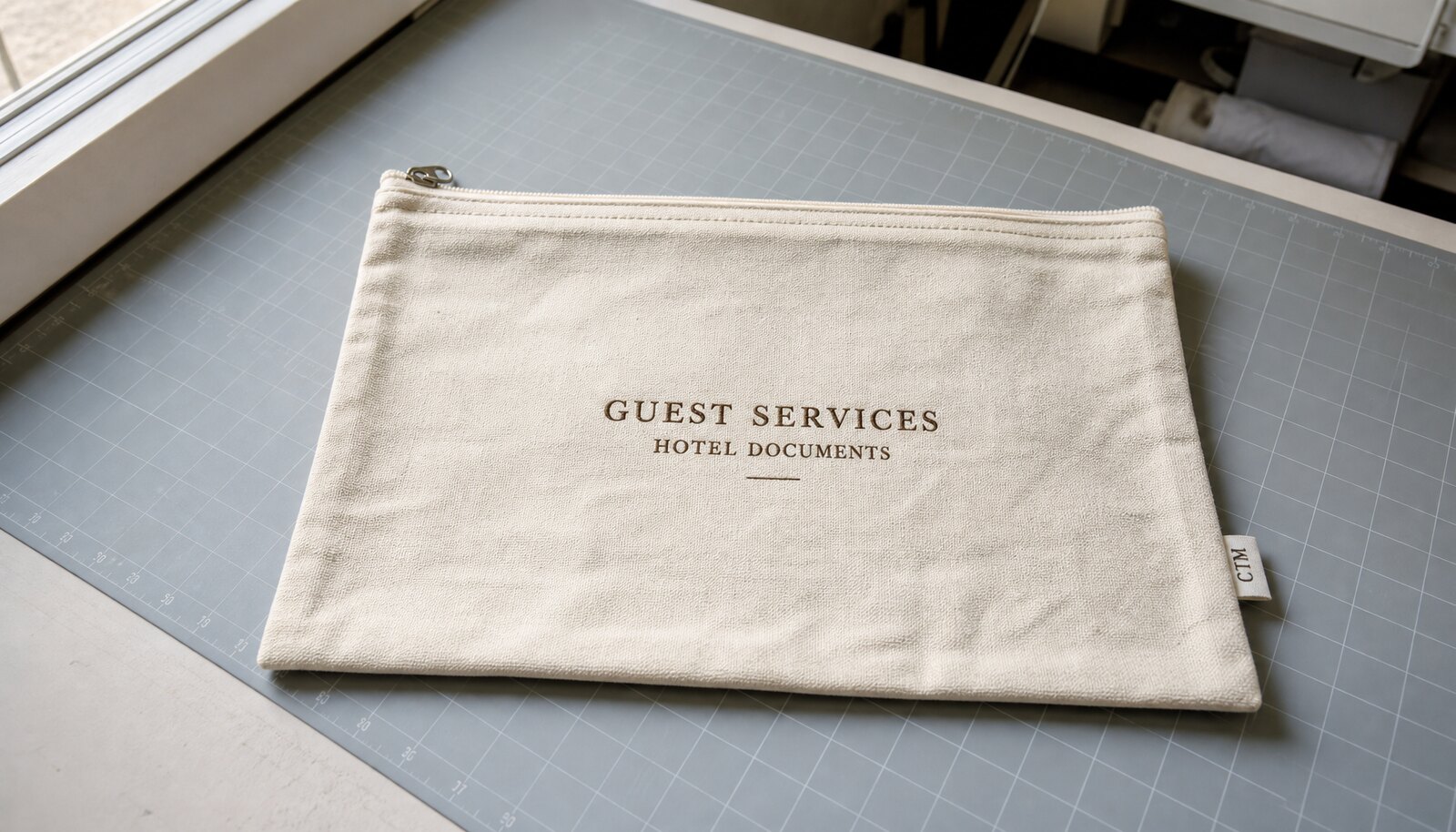
What hotel buyers actually need from this bag
A zipper document bag for hotels is not just a branded pouch. In practice, it has to carry guest paperwork, welcome letters, invoices, stationery, spa vouchers, or back-office files without looking cheap after a few uses. The bag is handled by front desk teams, housekeeping, and guests, so the construction has to survive repeated opening, folding, and stacking. If the bag is for room delivery, presentation matters more than raw capacity. If it is for back-office use, durability and wipe-clean handling matter more than appearance.
The first mistake is to start with artwork instead of use case. A hotel buyer should define where the bag will live, what document size it must hold, and how much structure the bag needs to keep its shape in transit. A slim A4 document bag for a conference desk is a different product from a thicker zipper pouch used in a welcome kit. The tighter the use case, the easier it is to quote accurately and avoid an expensive rework after sampling.
- Front desk use usually needs a clean face panel, fast zip action, and a presentation-friendly finish.
- Guest-room use should prioritize a tidy profile and a bag that does not snag on linen or stationery.
- Back-office use can tolerate simpler branding if the bag is rugged and easy to wipe down.
Choose the right fabric and structure
For hotel document bags, the most common body choices are cotton canvas, polyester canvas, and blended or recycled fabrics. A practical starting point is 8 oz to 12 oz cotton canvas, roughly 227 GSM to 340 GSM, depending on how stiff you want the bag to feel. Eight-ounce canvas works for lighter welcome packs and lower cost programs. Ten-ounce fabric is the balanced option for most hotel buyers. Twelve-ounce material gives a better hand feel and hides the contents more effectively, but it adds cost and can make the bag feel too bulky if the bag is only meant to hold paper.
If the hotel expects moisture resistance, easy cleaning, or a more technical look, 600D polyester or a lined polyester-cotton structure may be a better route. A simple lining can improve appearance and keep the zipper tape from showing through, but lining also adds sewing steps and therefore cost. For a crisp shape, ask whether the factory will use interfacing or a light internal stiffener. For document bags, too much padding is a mistake because it creates a pouch that looks like a cosmetic bag rather than a business accessory.
- 8 oz canvas: light, cost-sensitive, suitable for simple welcome packets.
- 10 oz canvas: the most practical middle ground for hotel document use.
- 12 oz canvas: premium look, better opacity, higher cost and more body.
- 600D polyester: better for wipe-clean use and humid destinations.
- Lining or interfacing: useful when the bag needs a neater shape, but it should not make the bag overbuilt.
Branding that survives real hotel handling
The logo method matters because hotel bags are not display-only items. They are folded, stacked, brushed against key cards, and sometimes carried with pens or metal clips inside. Screen printing works well for simple one- or two-color logos on flat canvas panels, but the print needs to be placed where the zipper and side seam will not distort it. Heat transfer can handle more complex art or smaller runs, but the buyer should review rub resistance and edge lifting before approving bulk. For premium positioning, a woven label, sewn patch, or embossed PU badge often lasts longer than a large printed block.
Placement is as important as the decoration method. A small CTM sample logo on the side label is useful during sampling because it shows where the brand will sit on the finished product without forcing a large front-panel print too early. For hotel programs, a modest logo often performs better than oversized decoration. Keep the art away from the zipper line, keep enough clear space from seams, and confirm the color on daylight proof, not only on a digital render. If the bag must match a chain brand guide, ask for a strike-off or a physical print card before bulk approval.
- Use screen print for bold, simple artwork with stable color demand.
- Use heat transfer when the logo has multiple colors or fine detail.
- Use woven or sewn labels when you want better wear resistance and a more finished look.
- Avoid placing key logo elements across seam lines or zipper curvature.
Compare supplier routes before you compare prices
The right supplier is not always the cheapest quote. For zipper document bags for hotels, the best route depends on how much control you need over fabric weight, zipper grade, and packing. A direct factory is usually the strongest choice when the hotel wants a repeatable spec, especially if the bag will be reordered for multiple properties. A hotel amenity supplier is easier to manage if the bag is just one item in a larger room supply program. A promotional distributor can be useful for marketing-led projects, but that route often hides the real construction quality until the sample arrives.
The comparison table below is meant to keep quotes honest. Two suppliers can quote the same named product while selling different realities: one may use a heavier canvas, a better zipper, and a more careful carton pack; the other may trim all three and still look cheaper on paper. Ask each supplier to quote from the same spec sheet, the same artwork file, the same Incoterm, and the same packing assumption. If they cannot quote on equal terms, they are not comparable.
- Direct factory is best when the bag spec is custom and repeat orders are expected.
- Hotel suppliers are convenient for bundled procurement but can obscure the real maker.
- Local converters are useful for urgent reorders, but sewing quality must be verified separately.
- Stock importers can be fast, but they are rarely the best fit for a branded hotel program.
What really drives MOQ and unit cost
MOQ is usually driven by material planning, not by a random factory preference. A supplier needs enough volume to cut fabric efficiently, set up the print screen or transfer, and use zipper components without creating leftover stock. If you ask for a standard size, stock fabric color, and a common zipper color, the MOQ can stay relatively modest. Once you require a custom-dyed fabric, custom puller, special lining, or multiple logo placements, the MOQ rises because the factory has to buy and hold more custom materials.
For hotel buyers, the smart approach is to separate pilot runs from rollout volume. A pilot property or single hotel can often be done with a smaller order if the factory uses stock fabric and standard zipper parts. Chain rollout pricing usually improves once the size, print, and packing are frozen. Do not compare unit price alone. A lower quote can lose its advantage if the supplier charges extra for sampling, uses oversized cartons, or quotes only the bag body while excluding label application and inner packing labor.
- Fabric choice changes cost more than most buyers expect, especially when moving from 8 oz to 12 oz canvas.
- Print color count affects setup cost and can change the economics of small runs.
- Custom zipper pulls, woven labels, and special carton marks usually add both cost and lead time.
- Pilot orders should use stock materials where possible so the MOQ stays practical.
Sample approval should test the bag, not just the artwork
A useful sample process has three parts: material confirmation, workmanship confirmation, and packing confirmation. The pre-production sample should show the actual fabric, zipper, logo position, and final dimensions. If the factory only sends an art proof, that is not enough. Hold the sample with an A4 sheet or Letter-size paper inside, zip it fully, and see whether the documents catch on the corners or stretch the bag out of shape. If the bag will be used in guest rooms, also check whether the profile still looks neat after it has been folded and reopened a few times.
The approval sample should also tell you what the bulk will look like under normal handling. That means checking stitching at the zipper ends, the stress points at any pull tabs, and the way the logo sits relative to the seam. A good sample does not need to be perfect in every cosmetic detail, but it should set a realistic acceptance standard. If you accept a sample with slight puckering or weak zipper alignment, the factory will treat that as the benchmark for bulk production.
- Test the zipper at least several times by hand before approving the sample.
- Insert the real document size, not just a blank sheet, to confirm fit and corner clearance.
- Approve the exact logo placement and the actual production fabric, not a substitute swatch.
- Keep the signed sample or a high-resolution photo set as the bulk reference.
Packing is part of the product, not an afterthought
For hotel use, packing should support both storage and distribution. If the bags go into guest rooms, a clean inner polybag can protect the surface from dust and handling marks. If the hotel team will open and distribute them internally, a simple bulk pack may be better because it reduces waste and unpacking time. The right answer depends on how the bags move through your operation. Add a barcode sticker, size label, or property code if the order will be split across multiple hotels or floors.
Packing also affects damage rates. Soft bags can be crushed if cartons are overfilled, while stiff bags can crease if the carton is too loose and the contents shift in transit. Ask the factory to state carton dimensions, net weight, and gross weight in the quote. If the destination is humid, include a moisture barrier or desiccant plan. For airport or long-haul shipments, carton strength and outer labeling matter because re-handling in transit can damage both the bag shape and the print finish.
- Use individual polybags when appearance at the room level matters.
- Use bulk packing when the bags are distributed internally before use.
- Keep carton fill tight enough to protect shape but not so tight that the zipper bends.
- Match the packing format to the hotel’s receiving process, not only to freight efficiency.
Plan the timeline around approvals, not just sewing
A realistic schedule starts with sample approval, not with production start. Standard sampling can take about 5 to 10 days if the materials are already available. Bulk production for a straightforward hotel zipper document bag often sits in the 20 to 35 day range, but that can stretch when the order needs custom fabric, custom zipper parts, special packing, or artwork revisions. If the order crosses holiday shipping windows or fabric mills are already busy, the safest plan is to add buffer before the hotel opening date.
The schedule risk is usually not the sewing line. It is late artwork approval, unclear packaging instructions, or a change to the zipper or label after the sample has already been signed off. Freeze the artwork early, approve the pre-production sample quickly, and keep the carton mark language simple. If you are sourcing for several properties, stage the rollout by property group so one delay does not hold the full program. For repeat orders, lock the approved spec into the vendor file and make sure the factory keeps the same materials on record.
- Build time for sampling, not only bulk sewing.
- Expect longer lead time if the program uses custom fabric, special pulls, or multiple print colors.
- Do not release production before the signed sample and carton spec are both approved.
- Keep a buffer for ocean freight, customs clearance, and internal hotel receiving.
Build the RFQ so quotes can be compared on one basis
A strong RFQ for zipper document bags for hotels is specific enough that the supplier can quote without guessing. It should state the finished size, fabric weight, zipper type, logo method, color count, packing format, order quantity, destination, and requested delivery window. If the bag must fit A4 documents, say so directly. If the hotel needs a premium look, define whether that means heavier canvas, a cleaner lining, a woven label, or a sturdier zipper. The more concrete the brief, the less room there is for a supplier to simplify the build and still call it compliant.
When the quotes arrive, compare landed cost, not just the unit price. Add sample costs, print setup, carton costs, packing labor, inland freight, and any special handling charges. If one supplier offers a lower base price but omits packaging or provides a lighter zipper, that quote is not truly cheaper. For hotel buyers, the best supplier is the one that can repeat the same spec reliably, not just the one that makes the first PO look low.
- Quote on the same size, fabric GSM, zipper spec, and packing format.
- Ask for sample fees, bulk lead time, and payment terms in the same response.
- Compare incoterms carefully so freight and duty are not hidden in the gap.
- Keep the approved sample and quote together in one file for reorders.
Specification comparison for buyers
| Spec decision | Recommended option | When it fits | Buyer risk to check |
|---|---|---|---|
| Direct zipper bag factory | Best for custom size, zipper grade, lining, and repeat hotel programs | You need a made-to-order bag and can approve a sample before bulk | Confirm who owns pattern making, print setup, and final QC so no detail gets lost between sales and production |
| Hotel amenity supplier | Best for one-stop procurement when bags sit inside a wider room supply order | You already buy stationery, amenities, or welcome kits from one vendor | Check whether the bag is truly in-house or outsourced and whether the spec was simplified to protect their margin |
| Promotional products distributor | Best for branded welcome kits and marketing-led property launches | The bag is part of a campaign and the buyer wants a single managed PO | Watch for generic construction, weak stitching, and unclear factory origin |
| Trading company | Best for buyers who want a single contact across multiple product categories | Your team lacks time to manage separate factories | Confirm the actual maker, whether the trader is changing the spec, and who answers quality claims |
| Local printer or converter | Best for fast replenishment, pilot hotels, and small runs | You need a quick turnaround and local delivery matters more than unit cost | Make sure the shop can sew cleanly, not only print well, and test zipper durability before release |
| Stock importer | Best for back-of-house document storage or short lead-time needs | No logo, or only a simple side label, and dimensions can be standard | Risk of color drift, inconsistent sizing, and leftover stock being mixed across lots |
| Audited offshore factory | Best for lower unit cost on repeat programs with stable forecasts | You can forecast volume and ship by sea rather than air | Verify sample quality first; low quotes often assume looser packing, thinner fabric, or a lighter zipper |
| Hybrid source: factory body plus local branding | Best when the bag body is fixed but hotel artwork changes often | Multi-property rollout with frequent logo or room-data updates | Confirm artwork handoff, print alignment, and whether local branding affects the final dimensions or lead time |
Buyer checklist before sampling
- Final finished size with allowance for A4, Letter, envelopes, and room stationery
- Fabric type and GSM or ounce weight, plus whether lining or interfacing is required
- Zipper spec: coil size, tape color, slider finish, and puller style
- Logo method, artwork file type, print colors, and exact placement on the panel or label
- Packing spec: individual polybag, inner count, carton count, and carton mark format
- Target MOQ, expected reorder quantity, and whether stock colors are acceptable for pilots
- Intended use: front desk, guest room, back office, or conference kit
- Destination, Incoterm, and target delivery date tied to the hotel opening or rollout plan
- Sample approval owner and the exact documents required for sign-off
- Any special requirements: moisture resistance, recycled material content, or chain-specific brand rules
Factory quote questions to send
- What exact finished size and fabric GSM are you quoting, and what tolerance will you hold in bulk?
- Which zipper type and size are included, and is the slider standard or custom?
- What is the MOQ for stock fabric and stock zipper parts, and what changes the MOQ if we customize color or label?
- Can you quote sample cost, sampling lead time, and the number of revisions included before bulk production?
- Which print method do you recommend for our logo, and what are the setup charges for each method?
- What packing format do you propose for hotel use, and how many pieces per carton do you recommend for safe transit?
- What is your bulk production lead time at our order quantity, and what stage usually delays shipment?
- Which inspection standard do you use, and can you share photos or video of a similar finished bag?
- Can you quote on the same Incoterm for all suppliers so we can compare landed cost fairly?
- If we need a repeat order, what details do you keep on file to protect size, color, and branding consistency?
Quality-control points to confirm
- Finished size must stay within the agreed tolerance so the bag still fits A4 or Letter documents without forcing the zipper
- Fabric weight must match the approved spec closely enough that the body does not feel flimsy or overbuilt compared with the sample
- Zipper must run smoothly across the full length with no jamming, skipping, or misalignment at the ends
- Main seams, zipper seam, and any handle or pull-tab attachment need reinforced stitching with no open stitches or skipped bars
- Print or label placement must match the approved artwork location and stay clear of seam distortion and zipper interference
- Color must match the approved sample under daylight, not just under factory lighting
- No loose threads, oil marks, broken needles, fabric snags, or dirty packing should appear in bulk cartons
- Carton packing must protect the bag shape and keep the order count accurate, with carton marks readable and consistent