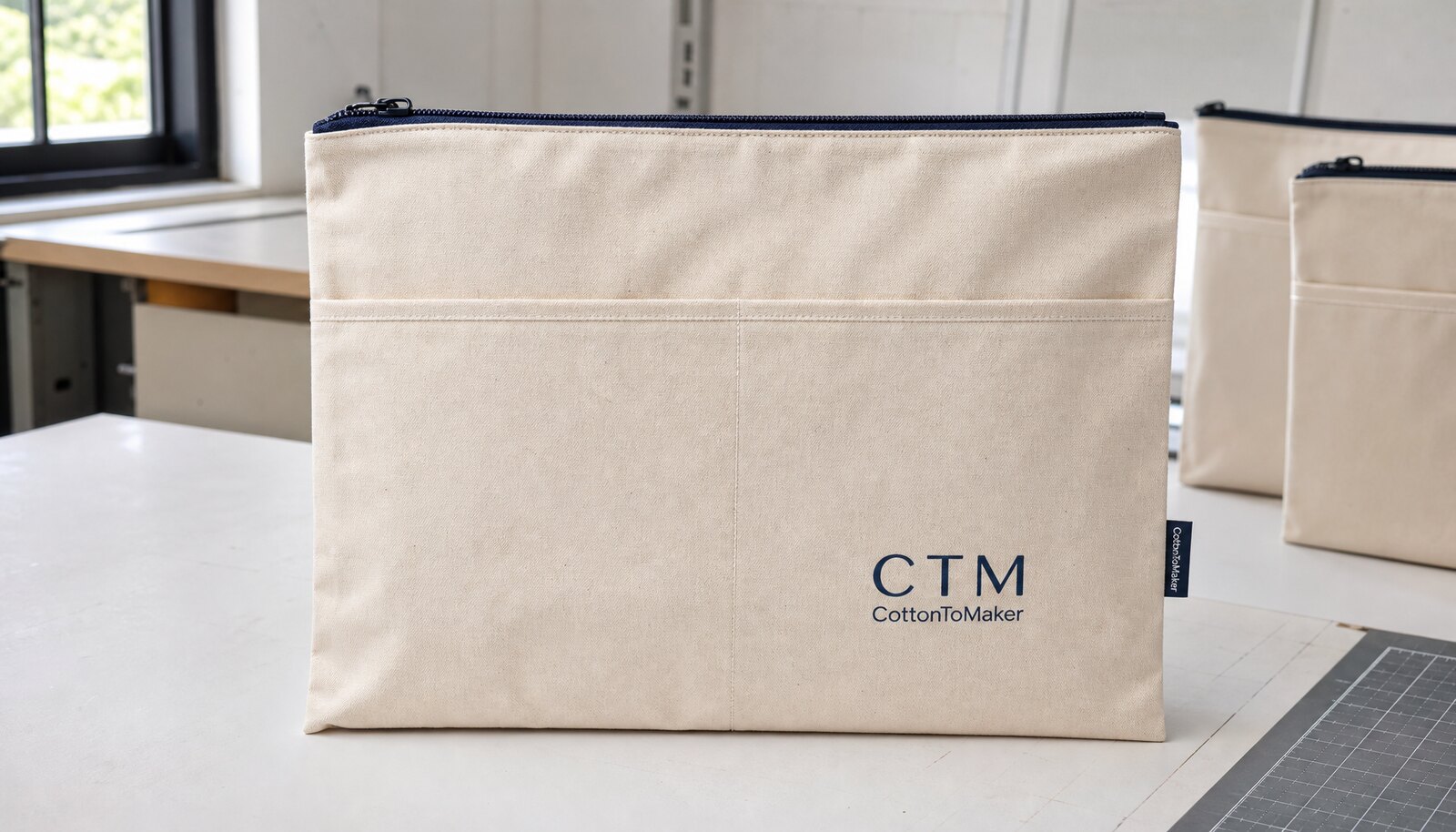
What Event Buyers Actually Need From a Zipper Document Bag
Zipper document bags for events are usually asked to do three jobs at once: keep papers flat, move quickly through a busy handout table, and still look acceptable when the attendee keeps using them after the event. That sounds simple until you test the bag against real use. A conference pack often carries A4 or letter-sized inserts, a notebook, a pen, a badge holder, and sometimes a brochure stack or tablet sleeve. If the bag is too soft, corners curl and the contents look cheap. If the bag is too thin or the zipper binds, the giveaway becomes a complaint.
The first buying mistake is treating every event bag as the same item. A one-day trade show handout has different requirements from a premium board meeting kit or a retail-ready conference accessory. Some buyers need a bag that is only used once and stacked in cartons as efficiently as possible. Others need a reusable pouch that will be zipped dozens of times and still keep the print clean. Start the project by defining the job the bag must do, not the color or the logo. That one decision drives fabric weight, zipper grade, gusset depth, and even packing density.
- Use case first: registration pack, document holder, conference kit, or reusable organizer.
- Do not spec size by name alone; measure the exact content stack you expect to ship.
- Treat zipper function as a core requirement, not a cosmetic trim.
Spec Choices That Change Cost and Function
For body material, the usual buyer-friendly options are cotton canvas, polyester oxford, recycled PET fabric, and nonwoven for very low-cost programs. A cotton canvas bag in the 8 oz to 12 oz range, roughly 270 to 400 GSM, gives a better premium feel and a stable print surface. In practice, 8 oz works for lighter event kits where cost matters, 10 oz is a common middle ground for branded reuse, and 12 oz is safer when the bag will carry thicker paper loads or be reused often. Polyester in 300D to 600D is useful when you need wipe-clean handling or more shape retention. Nonwoven can work for very short-life promotions, but it tends to look and wear like a disposable item.
The closure and reinforcement details matter as much as the fabric. A #3 nylon zipper is usually enough for light document loads, but many buyers step up to a #5 nylon zipper when the bag will be used repeatedly or when the zipper path is long. Metal zippers add a more premium feel, yet they can increase weight and cost without improving the buyer experience if the bag is mostly for paper. For structure, a gusset in the 3 cm to 5 cm range is often the sweet spot for events because it holds brochures without turning the bag into a bulky portfolio. Reinforce the top corners and zipper ends with bar-tacks or tighter seam construction, especially if the bag has to survive stacking, sorting, and repeated opening on a registration desk.
- 8 oz canvas suits lighter kits; 10 oz is the practical default; 12 oz is for heavier reuse.
- Use polyester when shape retention and wipeability matter more than a natural textile look.
- Choose zipper size based on real load and frequency of opening, not on perceived luxury alone.
Print and Branding Choices That Survive Event Handling
The print method should match both the artwork and the expected handling. Screen printing is usually the most efficient choice for simple logos, one or two spot colors, and medium to high volume. It gives solid opacity on canvas and keeps unit cost under control once setup is absorbed. Heat transfer is more flexible for detailed artwork, gradients, or smaller runs, but it needs a cleaner artwork file and careful adhesion testing on the actual fabric. Embroidery and woven labels can look strong on premium bags, yet they can distort lighter fabrics or create a raised finish that does not suit a flat document bag. If the bag uses synthetic fabric, a sewn patch or embossing can be a better brand solution than a heavy print.
Where the brand mark sits matters almost as much as the method. Event bags are handled fast, stacked by the dozen, and often photographed in poor light. That means you need a logo placement that is visible at normal viewing distance and not too close to the zipper seam, which can distort registration. Ask the factory to show the logo on the actual bag panel, not just on a flat artwork proof. If the bag includes a woven side label or a small printed logo on the back panel, keep it simple and legible. Small type, thin lines, and low-contrast colors often disappear once the fabric texture and stitching enter the process.
- Screen print for simple logos and better unit economics at volume.
- Heat transfer for detailed artwork or lower quantities, with a sample wash or rub test.
- Woven labels and embroidery work best when the bag is meant to feel premium, not disposable.
Compare Sourcing Routes Before You Choose the Supplier
The same zipper document bag can come from very different sourcing routes, and the route changes your risk profile more than the artwork does. Factory direct is the best fit when you need a controlled spec, repeat orders, or custom trim details such as a special puller, lining color, or side label. A trading company can help if your team wants one contact for multiple items in a conference kit, but that convenience is only useful if the trader gives you real factory visibility. Stock bag plus local print is attractive when the event date is fixed and the design is simple, because it cuts development time. A local decorator on imported blanks is useful for smaller runs, but you pay for speed and flexibility with less material choice.
Use the sourcing route to decide where you will tolerate variation. For example, if the event bag is a disposable handout, a stock route may be the most rational option even if the fabric is not the best on paper. If the bag is part of a premium branded program, you need a factory that can manage cutting, sewing, printing, and packing in one process so the color and size do not drift between vendors. Buyers often lose money by comparing only ex-factory price. The cheapest quote can turn expensive if it comes from a route with poor sample control, weak packing discipline, or unreliable dispatch timing.
- Factory direct gives the most control when size, print, and trim all matter.
- Stock and local print routes win on speed, not on material flexibility.
- Comparing supplier routes is more useful than comparing only unit price.
How MOQ Really Moves on a Custom Bag Program
MOQ is rarely driven by the bag body alone. It is usually driven by the number of setup changes the factory must absorb: fabric color, zipper color, print colors, label type, lining, and packing configuration. If you want a plain canvas bag with a single-color print and a standard zipper, many factories can work with a lower minimum than they would on a bag that needs custom-dyed fabric, a branded metal puller, and a special inner pocket. Each extra decision creates more material loss, more operator setup time, and more changeover risk. That is why two bags that look similar on the sales sheet can have very different minimums in production.
For event buyers, the useful way to negotiate MOQ is to separate development quantity from bulk quantity. A small preproduction run or sample order can confirm size, artwork position, zipper action, and packing count. Once the sample is approved, the bulk order can move at the better unit economics that come from a full production run. If you know the event date is fixed, ask the factory what production slot they can actually hold after approval. A vague promise of short lead time is not the same thing as a confirmed schedule. The right question is not only how many pieces they can make, but when they can start cutting the approved fabric.
- MOQ rises with custom fabric, custom zipper color, multiple print colors, and special packaging.
- Use a sample run to settle the spec before committing bulk quantity.
- Ask for a real production slot, not only an estimated lead time.
What a Useful Factory Quote Must Show
A usable quote should break the bag into cost parts. You want fabric spec, zipper type, print method, sewing labor, packing method, and carton details listed separately or at least clearly referenced. If the supplier sends one lump sum without defining the material or artwork revision, you cannot compare quotes with confidence. One factory may be pricing 10 oz canvas with a #5 nylon zipper and a woven side label, while another is pricing a lighter 8 oz body with a cheaper zipper and no reinforcement. Those are not equivalent offers, even if the unit price looks close.
The quote should also reveal the commercial terms that become hidden costs later. Ask for the sample fee, tooling or screen setup fee, overrun and underrun tolerance, incoterm, carton count, carton size, and whether the bulk price assumes one color print or multiple colors. In event work, shipping and packing decisions often change the real cost more than the bag itself. A slightly higher ex-factory quote can still be the better procurement decision if it includes more stable production, better packing efficiency, and less chance of a rework loop before the event ships.
- Require a line-by-line or clearly itemized quote whenever the spec is custom.
- Confirm the exact revision of the artwork and bag drawing used for pricing.
- Do not compare unit prices until packing, sample, and freight assumptions are visible.
QC Thresholds That Catch the Common Failures
The common failures on zipper document bags are predictable: the zipper catches at the corner, the print shifts off center, one side panel is cut shorter than the other, or the seam puckers under load. A generic AQL inspection will not catch all of that if the acceptance standard is too loose. Build the QC target around the bag's job. If the event kit contains stacked A4 paper, the bag needs to keep its shape and open smoothly. If the bag is reusable, then zipper function and seam strength matter more than on a short-life giveaway. Specify the tolerances in the sample stage and use the same reference sample for final inspection.
For dimensional control, a practical target is plus or minus 0.5 cm on smaller finished dimensions and plus or minus 1 cm on larger bodies, unless the bag has a rigid insert or a very tight retail spec. For print, define the placement tolerance and the acceptable shade range before production starts. Functional checks should include zipper cycling, seam integrity, and visual alignment of the logo against the panel edges. If the bag uses a woven label or side label, check that the label is centered, straight, and sewn without twisting. A bag that looks acceptable at a glance can still fail if the zipper seam distorts the opening or if the logo lands too close to a seam line.
- Test zipper smoothness and function on the actual finished bag, not only on the tape sample.
- Lock size and print tolerances in writing before bulk production starts.
- Use one sealed reference sample for both in-line and final inspection.
Sample Approval: What to Inspect Before Bulk Cutting
A sample is not just a logo check. It is the only point where you can still fix a wrong proportion, a weak zipper pull, or a bad closure path without paying for a full batch of mistakes. Ask for a preproduction sample that uses the intended fabric, zipper, print method, and packing style. Do not approve a paper proof or a hand-made photo sample if the production bag will be sewn differently. For event bags, the sample should be checked with real inserts, because the way the bag closes under load matters more than how it looks empty.
When you review the sample, use actual documents or a representative stack of event inserts. Check whether the bag closes cleanly, whether the print sits straight once the bag is filled, and whether the seams hold the shape when the zipper is zipped to the end. Verify the trim color against the approved artwork and confirm that the inner packing matches the way the event team will receive the bags. If the bag is part of a larger kit, the sample should be reviewed with the other kit components so the supplier cannot later blame fit issues on another vendor. Once approved, keep the sealed sample and label it with revision number, date, and buyer name.
- Approve a preproduction sample built from production materials, not a mock-up.
- Test the bag with real inserts and a realistic closure cycle.
- Label the sealed sample with revision control so later disputes are easier to resolve.
Packing, Cartons, and Delivery Timing
Packing is where event buyers often lose time and margin. If the bags are going straight into conference kits, bulk packing may be better than individual polybags because it saves labor and carton volume. If the bags are going to retail shelves or end-user distribution, individual polybags with barcode labels may be necessary. The point is to match packing to downstream handling, not to default to the factory's usual method. Overpacking can crease the print, distort the zipper line, and add unnecessary freight cost. Underpacking can leave you with dirty bags or missing pieces when the cartons are opened on site.
Lead time should be read as a chain of dependent steps, not a single promise. A realistic timeline includes artwork signoff, sample approval, material reservation, cutting, sewing, printing, finishing, packing, and export booking. If the fabric color is custom or the zipper puller is special, those items can add more time than the sewing itself. For event programs with a fixed delivery window, ask the supplier to identify the longest lead-time item and the approval deadline that protects the shipment. The best schedule is the one that survives a small correction without pushing the event date.
- Choose bulk pack for kit assembly, individual pack for retail or end-user distribution.
- Confirm carton count, carton size, and net gross weight before booking freight.
- Build a buffer around artwork approval and trim sourcing, not only around sewing time.
Write the RFQ So Suppliers Can Price It Correctly
A strong RFQ for zipper document bags for events should read like a production brief, not a marketing request. State the end use, finished size, gusset depth, material, zipper type, logo method, packaging count, delivery destination, and target arrival date. Include at least one dimensioned sketch or reference sample photo and mark the logo placement clearly. If there is an acceptable substitute for a fabric or zipper, name it in advance. That gives the factory a commercial path to quote without guessing, and it gives procurement a cleaner basis for comparison.
When comparing quotes, calculate landed cost instead of only the factory number. Include sample freight, carton volume, inland transport, import charges if applicable, and the cost of any rework risk you can already see in the quote. An inexpensive bag that arrives late or needs a second print run is not a win. For event buyers, schedule reliability often has a real budget value because a missed delivery can force emergency sourcing or kit assembly labor at a far higher rate. Good RFQs reduce that risk because they make the supplier accountable for a clear spec, not an open-ended expectation.
- Attach a spec sheet, artwork file, and reference sample photo if available.
- State the delivery window in calendar terms, not only in weeks.
- Compare offers on landed cost, schedule risk, and acceptance quality, not price alone.
Specification comparison for buyers
| Spec decision | Recommended option | When it fits | Buyer risk to check |
|---|---|---|---|
| Factory direct OEM | Best for custom size, zipper color, print, and packing control | You need a repeat program or a branded event kit with firm specs | Confirm they actually sew and print in-house, not only broker the order |
| Trading company route | Useful when you need one contact to coordinate multiple factories | Your team lacks local sourcing bandwidth or needs a mixed product bundle | Watch for hidden margin, vague QC ownership, and weaker line-by-line cost visibility |
| Stock bag with local print | Fastest route for short deadlines and simple logos | The event date is fixed and design changes are minimal | Check stock quality, zipper smoothness, and whether the print will survive handling |
| Local decorator on imported blanks | Good for small batches and urgent domestic delivery | You need lower minimums and can accept fewer fabric choices | Landed cost can climb quickly, and blank supply can change without notice |
| Integrated bag factory with in-house print | Best balance of price, schedule, and process control | You want one supplier to manage cutting, sewing, printing, and packing | Verify print capacity does not create a bottleneck after sewing is finished |
| Recycled-material specialist supplier | Use for sustainability-led events or brand campaigns | Your buyer brief needs recycled content or a lower-impact material story | Color consistency, lead time, and certification documents need closer review |
| Low-cost marketplace seller | Only for sampling or ultra-basic promotionals | You need to test a concept before committing volume | Quality can vary by batch and the sample may not match the bulk run |
| Premium event-kit supplier | Best when the bag is part of a higher-value conference set | You need presentation quality and controlled packing details | Avoid over-specifying trim and packaging if the bag itself is the main value driver |
Buyer checklist before sampling
- State the event use case: registration pack, brochure holder, conference kit, or repeat-use document pouch.
- Lock finished size, gusset depth, and closure type with a measured reference sample, not only a photo.
- Choose the fabric by duty level: 8 oz to 12 oz canvas, 300D to 600D polyester, or equivalent GSM.
- Confirm the print method, number of colors, and the exact artwork placement on the bag body or label.
- Ask for zipper type, zipper size, puller style, and whether the color must match the bag or contrast by design.
- Request a line-by-line quote with fabric, trim, print, sewing, packing, carton data, and tool or sample fees.
- Approve a preproduction sample before bulk cutting, then keep a sealed reference sample for inspection.
- Define carton count, inner pack method, and delivery terms so the factory cannot improvise near ship date.
Factory quote questions to send
- What exact fabric, GSM or ounce weight, and finish are included in this quote?
- Which zipper type, size, tape color, and puller style are you pricing?
- How many logo colors are included, what print method will you use, and what is the setup fee?
- What is the MOQ for this exact spec, and what part of the spec is driving that MOQ?
- What are the finished size tolerance, print placement tolerance, and acceptable defect rate?
- Can you provide carton dimensions, pieces per carton, gross weight, and packing method?
- What is the sample schedule, sample fee, and courier cost for approval samples?
- What lead time applies after artwork approval, and what production step usually causes delay?
Quality-control points to confirm
- Finished size must stay within the agreed tolerance, with gusset depth measured on the sealed sample.
- Zipper must open and close smoothly for at least 20 cycles without snagging, jumping, or exposed teeth issues.
- Print must sit in the approved position, with no blur, cracking, smudging, or obvious shade shift.
- Stitching must be straight and tight, with no skipped stitches, broken thread, or loose seam ends at stress points.
- Bag body must be free of major fabric flaws, oil marks, dye streaks, or cut-panel mismatch.
- Handles or reinforcement points must carry load without distortion if the bag is meant for repeated event use.
- Packing count must match the carton mark and inner pack plan, with no mixed sizes or mixed colors unless approved.
- The approved reference sample must be held on file and used for final inspection, not replaced by a later revised sample.