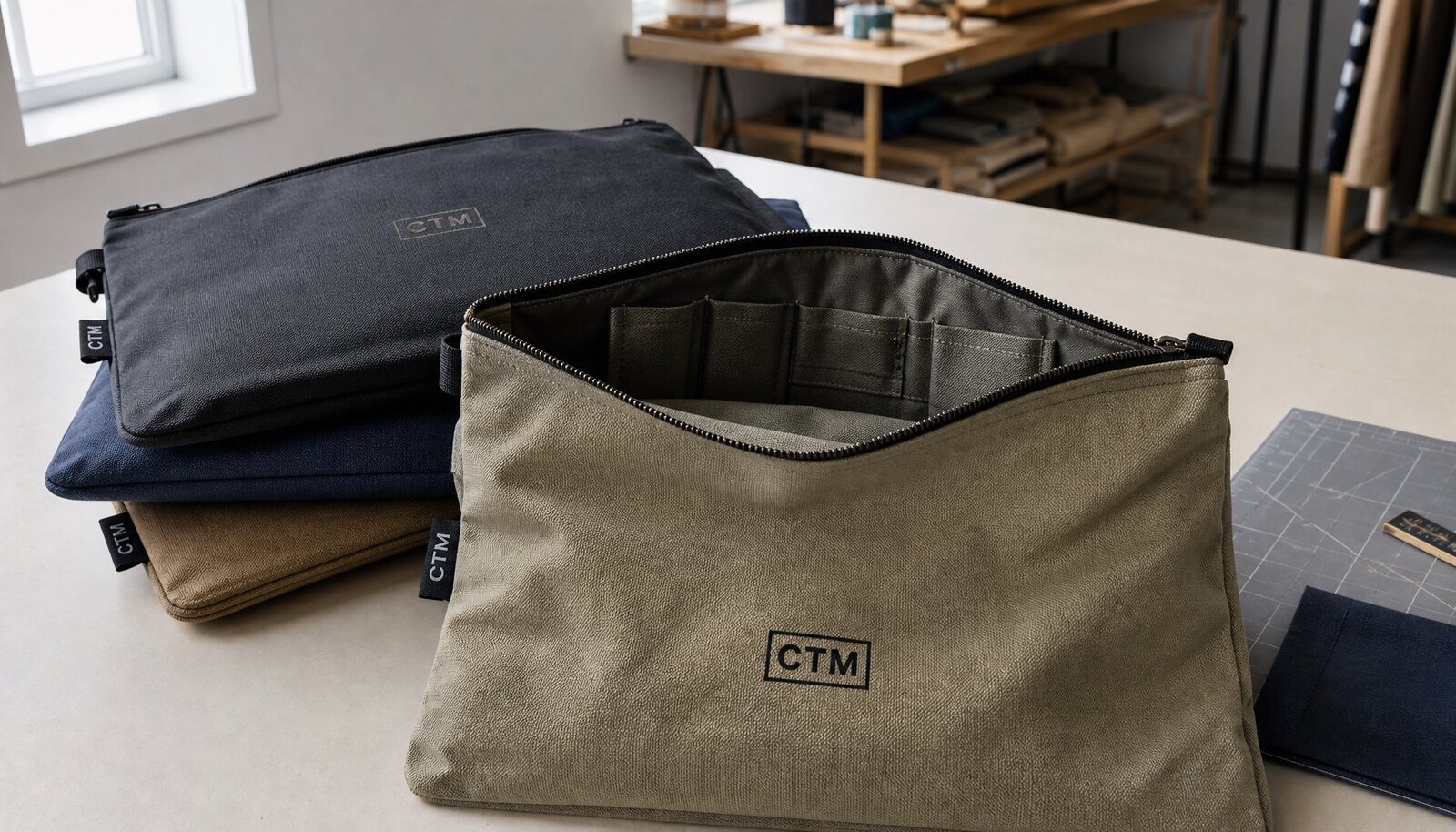
What buyers usually get wrong with event conference bags
The biggest sourcing mistake with zipper conference bags for events is treating them like simple giveaways instead of working carry items. Once the bag has to hold a brochure set, notebook, charger, water bottle, and maybe a tablet, the zipper, handle reinforcement, fabric body, and packing method all start affecting the user experience. A bag that looks fine flat on a sample table can fail once it is loaded and carried across a venue.
For procurement teams, the real issue is not just unit price. It is whether the quoted construction will survive the event schedule, the distribution method, and the brand image your client expects. A cheaper quote can become expensive if the zipper jams, print rubs off, or the bag arrives creased and deformed because it was packed without structure.
- Conference bags need both visual presentation and basic carry performance.
- The main cost drivers are fabric weight, zipper grade, print complexity, and finishing labor.
- The right quote should be readable by a buyer, not only a merchandiser.
Choose the bag construction before you compare prices
For most event programs, the practical starting point is a polyester or canvas zipper bag with a structured rectangle shape. Common outer fabric choices are 300D polyester for budget event kits, 420D polyester for a better hand feel, and 12oz canvas when the buyer wants a more premium, reusable impression. If the bag must hold a tablet or thicker inserts, a 2–3 mm foam layer or a stiffened base helps the bag stand upright and improves perceived value.
If the quote includes lining, ask whether the lining is 210D or 230D polyester and whether the inside seams are fully covered. Lining adds labor and improves finish, but it also adds sewing time and can increase scrap if the factory is not used to producing clean internal structures. For a strict cost target, an unlined bag with neat edge binding may outperform a poorly made lined bag.
- 300D polyester: low cost, lighter body, good for short-term event use.
- 420D polyester: better balance of appearance and durability for conference kits.
- 12oz canvas: stronger perceived value, usually higher print and sewing cost.
- Foam or cardboard base: useful when the bag must stand up on tables or in retail display.
Print method changes both cost and brand accuracy
For zipper conference bags for events, simple one- or two-color logos usually work best with screen printing because the setup cost is manageable and the print is clean on flat panels. If the artwork has gradients, small type, or multiple colors, heat transfer can deliver better detail, but the buyer should check for cracking, glossy finish, and wash resistance if the bag will be reused. Embroidery gives a premium look on canvas or thicker polyester, but it adds stitch density, cost, and potential puckering on thin fabric.
Woven labels and sewn side patches are worth considering when you want discreet branding instead of a large front print. They can reduce risk when the artwork is complex, but they still need approval on size, edge finish, and placement. The quote should specify whether decoration is single-sided or double-sided, because that affects labor, setup, and material usage more than many buyers expect.
- Screen print is usually the best value for flat, simple logos.
- Heat transfer suits multicolor artwork, but check cracking and gloss.
- Embroidery works on thicker bodies, not thin shell fabrics.
- Ask for exact print size and placement in centimeters, not just “logo on front.”
How to read supplier quotes without missing hidden cost drivers
A proper quote should break down the material, decoration, packing, and freight assumptions clearly enough that you can compare one supplier to another. If one quote is much lower, the reasons are usually visible in the spec: lighter fabric, smaller zipper, thinner handles, simpler packing, or a looser QC standard. Buyers should be suspicious of any quote that only gives a single unit price without clarifying fabric GSM, zipper type, or packaging method.
Below is a practical way to compare sourcing routes for event conference bags. It helps procurement teams decide whether to buy direct from a factory, use a trading company for mixed orders, or buy from a stockist when timing is tight.
- Confirm whether the quote is ex-works, FOB, or includes delivery to a consolidation warehouse.
- Compare pricing at at least two order tiers, such as 500 pcs and 1,000 pcs.
- Look for setup charges on print screens, embroidery digitizing, or sample development.
- Check whether individual polybags, carton labels, and master cartons are included.
Supplier route comparison for zipper conference bags
Different sourcing routes fit different buying problems. Direct factories are usually best when your bag spec is fixed and repeatable. Trading companies can be useful if you need mixed products in one shipment or if your internal team wants one contact point. Stockists can save the event date when you need a fast print on a standard bag, but they usually give you less control over exact fabric and construction.
Use the table below to compare the route, not just the bag. The wrong route can create a price illusion: a low quote that later grows through sample revisions, delayed approvals, or spec substitutions. Buyers who manage conference programs every year usually prefer a repeatable factory spec because the total landed cost becomes easier to predict.
Sample approval should focus on use, not just appearance
A sample for event bags should be tested like a carry item. Load it with the actual brochure set, notebook, badge holder, and any gift item that will go inside. Check whether the zipper tracks smoothly when the bag is full, whether the handles feel balanced, and whether the logo remains legible when the front panel flexes. A flat tabletop inspection alone misses most real failures.
When approving a sample, lock down the details that are expensive to correct later. That includes logo size, print position, thread color, zipper tape color, handle drop length, and whether the bag should ship folded flat or pre-shaped. If your project has multiple stakeholders, record the approved sample with photos and notes so the factory does not interpret comments loosely during mass production.
- Test the bag when loaded to realistic event weight.
- Check zipper pull strength and seam integrity at stress points.
- Record one approved physical sample or a signed photo sheet before bulk.
- Do not move into bulk until the sample and artwork are aligned in writing.
QC thresholds that prevent the most common event-bag complaints
The common complaints on conference bags are not usually catastrophic; they are the small defects that hurt brand presentation. Crooked prints, loose threads, uneven stitching, dirty panels, and badly packed cartons are the issues that event teams notice first. A good QC note defines measurable limits so the factory knows what will be accepted before production starts.
For a medium-volume order, set practical tolerances: finished size within ±0.5 cm on smaller bags and ±1.0 cm on larger sizes, clean edge finishing, no visible broken stitches on the front panel, and smooth zipper function across sampled units. If the bag has a lining, insist that the inside seams are not frayed. If it is unlined, make sure the raw edges are intentionally finished, not left as accidental exposure from weak workmanship.
- Reject zipper units that snag, split, or stop short at the end.
- Reject obvious print misalignment or low-opacity logos on dark fabric.
- Inspect reinforcement at handle joints and stress seams.
- Check for odor, stains, and color shade variation before carton sealing.
Packing and carton details matter more than many buyers expect
Event bags are often packed in a way that looks efficient on paper but creates problems on arrival. If the bag body is soft, bulk packing can save carton volume but cause wrinkles, compressed logos, and bent zipper lines. For premium events or retail use, an individual polybag with a tidy fold and a protective insert usually gives a better opening impression and reduces claims from the event team.
Ask the factory to quote packing both ways when possible: individual polybag packed versus bulk packed. This reveals the real cost of presentation and lets you decide whether it is worth paying for a cleaner handover. Also confirm carton count, outer carton dimensions, gross weight, and whether a barcode sticker or shipping mark is required. These details affect freight planning and warehouse intake.
- Individual polybag improves presentation but adds labor and material.
- Bulk pack lowers unit cost but can crease the bag and soften brand impact.
- Carton count should match the event distribution plan and warehouse handling method.
- Outer carton marks should be approved before shipping.
Lead time, MOQ logic, and landed cost planning
MOQ is not just a factory preference; it is usually tied to fabric purchasing, print setup, and sewing efficiency. For a custom zipper conference bag, many factories need 500 to 1,000 pcs to justify a fully custom run, especially if the bag includes a print screen, a custom zipper pull, or a specific lining color. Lower quantities are sometimes possible, but the unit price often rises because the fixed labor and setup costs are spread over fewer pieces.
A realistic production timeline usually includes artwork confirmation, sample making, sample approval, bulk fabric and trim purchase, production, QC, and final packing. Even when a factory can sew quickly, the schedule still depends on how fast the buyer signs off on the sample and how much margin exists for rework. For event programs, it is safer to build a buffer rather than treat the quoted lead time as the last possible day.
- Common custom MOQ: 500–1,000 pcs depending on decoration and fabric.
- Rush orders usually require either simpler specs or a higher price.
- Lead time starts after sample approval, not after the first email.
- Land freight, carton volume, and packing style can change total landed cost more than the sewing price.
A buyer workflow that reduces quote gaps and production mistakes
The most efficient buying process is simple: lock the spec, request a quote against the spec, approve a sample, then release bulk. Problems happen when the buyer sends artwork first and spec details later, because the factory then quotes on assumptions. That creates a gap between the quote and the final sample, which is where many event projects lose time and margin.
For procurement teams and distributors handling repeat conference programs, keep a one-page spec sheet that includes fabric GSM, size, zipper grade, print area, handle length, packing method, and acceptance criteria. This document shortens the quote cycle and makes annual reorders easier to compare. If the supplier changes any material on reorder, the deviation becomes obvious immediately.
- Use one master spec sheet for quotes, sampling, and reorder control.
- Do not rely on product photos alone to define the build.
- Keep approval notes with artwork, sample photos, and carton details together.
- Compare every reorder against the previous approved spec, not just the price.
Specification comparison for buyers
| Spec decision | Recommended option | When it fits | Buyer risk to check |
|---|---|---|---|
| Outer fabric | 300D–600D polyester or 12oz canvas | Most conferences, training events, and trade show kits where the bag needs shape and repeated handling | Too light a fabric may wrinkle and collapse; too heavy can raise freight and unit cost without improving perceived value |
| Main zipper | Nylon coil zipper with self-lock slider; #5 is usually enough, #8 for oversized bags | Standard document and tablet carry bags, or bags with thicker contents | Low-grade zippers split at the ends or catch on lining; confirm smooth pull test and zipper tape color consistency |
| Print method | Screen print for simple logos; heat transfer or embroidery for multicolor or premium branding; woven label for subtle branding | Screen print works for volume and flat logos; embroidery suits premium conference kits; woven label suits understated executive packs | Complex artwork may lose detail in screen print; embroidery adds thickness and may distort on thin fabric; get a decorated sample before bulk |
| Lining | Unlined or 210D lining for cost-sensitive programs; 210D–230D lining for premium feel and easier interior finishing | Unlined for giveaway events; lined for corporate conferences, dealer meetings, or retail resale | Unlined bags can show seam allowances and thread tails; lined bags need cleaner inside stitching and more labor |
| Internal structure | No foam for budget, 2–3 mm foam or cardboard base for shape retention, optional file pocket or tablet sleeve | Events where the bag carries brochures, a notebook, charger, and small gifts | Extra inserts increase thickness and packing volume; too much structure can make the bag bulky and raise carton cost |
| Handle style | Webbing handles stitched through reinforcement patches, 50–60 cm total drop for shoulder carry | Attendee kits that will be carried between sessions or through airports | Short handles make the bag look cheap and reduce usability; weak handle bar tacks are a common failure point |
| Supplier route | Direct factory for custom specs; trading company for mixed SKUs or low-volume consolidation; local stockist for urgent replenishment | Direct factory fits stable repeat orders; trader fits one-off multi-item orders; stockist fits urgent event deadlines | Middlemen can hide fabric substitutions; insist on actual spec sheet, production photos, and confirmed packing details |
| MOQ strategy | 500–1,000 pcs for custom print, lower only when using stock fabric/color or one-color print | Events with tested demand and one fixed design | Low MOQ can mean higher price, slower production, or weaker quality control; compare against actual material and setup costs |
| Packing route | Each bag folded in a polybag with carton protection; bulk pack only if the event team will re-pack locally | Retail-ready distribution or branded conference kits | Loose bulk packing can save money but risks wrinkles, scuffs, and missing accessories; confirm carton marks and quantity tolerance |
Buyer checklist before sampling
- Final artwork in vector format with one approved Pantone or CMYK target and logo placement dimensions.
- Confirmed bag size, fabric GSM, zipper grade, handle length, and any internal pocket or lining requirement.
- Target order quantity, acceptable MOQ, and whether the supplier is quoting factory-direct or via trader.
- Packaging requirement: individual polybag, tissue, insert card, barcode sticker, or bulk pack.
- Target event date, buffer time for sampling, color approval, and shipping delays.
- Acceptance criteria for stitching, zipper pull test, print alignment, and odor/cleanliness.
Factory quote questions to send
- What exact fabric, GSM, and coating are you quoting, and will you show a spec sheet before sampling?
- Is the zipper nylon coil, resin, or metal, and what size slider and tape width are included in the quote?
- What is the MOQ by color and by logo method, and how does the unit price change at 500, 1,000, and 3,000 pcs?
- Does your quote include one pre-production sample, digital artwork setup, and packing into individual polybags?
- What are the carton dimensions, gross weight estimate, and outer carton quantity for export packing?
- What production lead time starts after sample approval, and what margin do you keep for rush rework or QC issues?
- Can you share photos or video of a previous similar bag order, including stitching, zipper finish, and packed cartons?
Quality-control points to confirm
- Measure finished size tolerance within ±0.5 cm for small bags and ±1.0 cm for larger conference bags.
- Check zipper operation for at least 10 open-close cycles per sampled bag without snagging, tooth separation, or end-stop failure.
- Inspect print registration, color density, and edge sharpness; reject obvious ghosting, cracking, or excessive ink hand feel.
- Verify handle reinforcement stitching, especially at stress points and bar tacks, with no skipped stitches or loose thread tails.
- Check lining seam cleanliness, pocket alignment, and absence of exposed raw edges unless unlined construction was approved.
- Confirm fabric defects such as stains, broken yarns, shade variation, and coating marks are below the agreed AQL limit.
- Review carton packing count, polybag sealing, and label accuracy before shipment release.