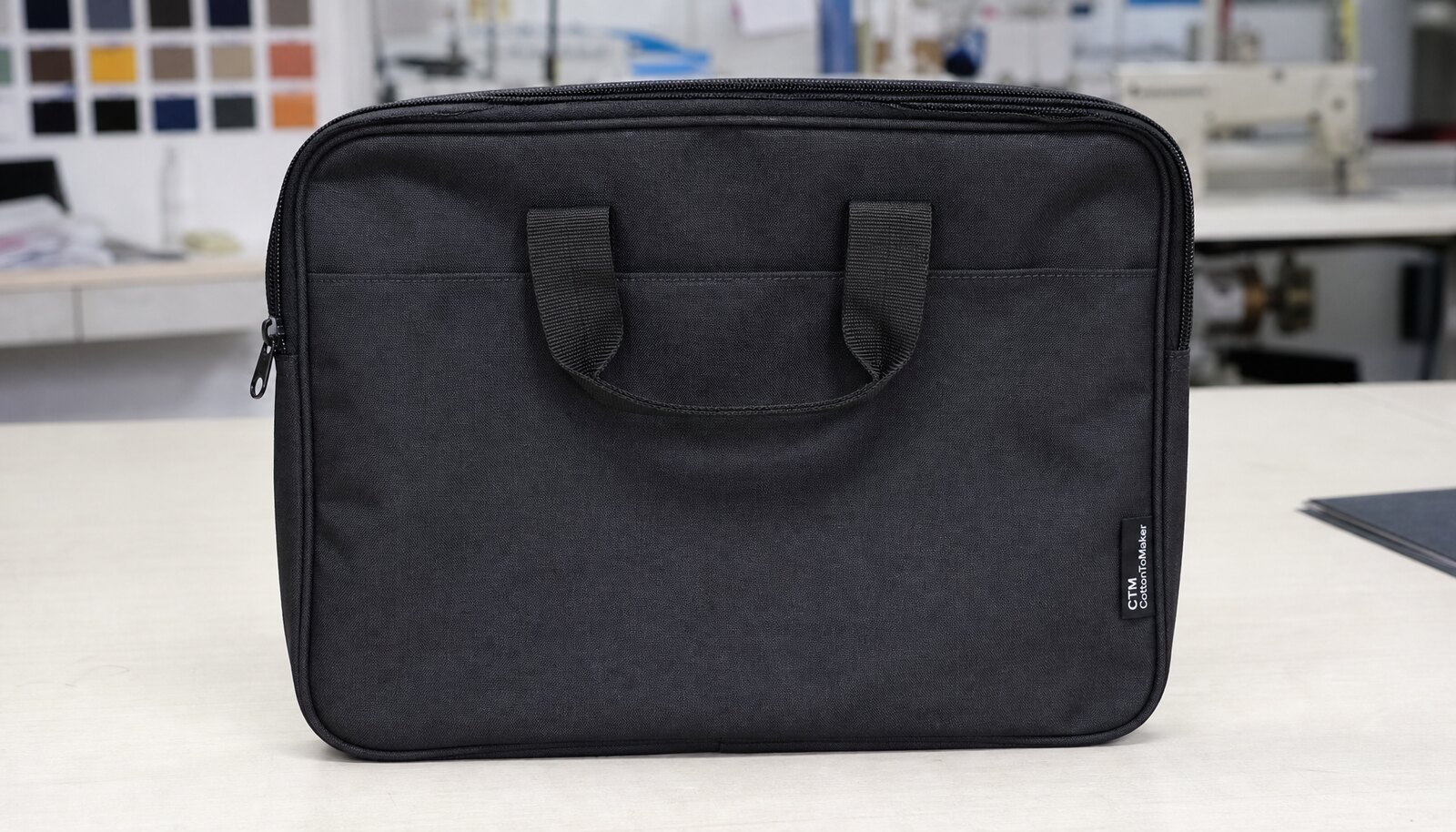
Why zipper conference bags for ecommerce need stricter sourcing rules
A zipper conference bag sold through ecommerce is not the same object as a giveaway tote handed out at a booth. Once it moves through pick-and-pack, parcel transit, warehouse stacking, and customer handling, the zipper, seams, and packing format all become part of the product spec. If the brief is loose, the supplier can still make something that looks acceptable in a sample photo while missing the functional details that matter in fulfillment.
That is why a buyer should think about use case before artwork. Is the bag carrying printed handouts, a laptop sleeve, a kit with samples, or a light retail assortment? Will it be sold as a standalone product, bundled with another item, or inserted into a box? The answer changes the required structure, zipper grade, carton count, and even the fold direction. A bag that needs to sit cleanly on a shelf has different requirements from a bag that only needs to survive one outbound shipment.
For zipper conference bags for ecommerce, the brief should always include the contents, target load, channel, and failure cost. A supplier cannot price the right fabric or reinforcement level without that context. If the bag is likely to be returned when the zipper snags or the logo shifts, then the buyer needs to treat those features as commercial risks, not cosmetic preferences.
- Define the contents in actual items or target weight, not only as a generic conference bag.
- State whether the bag must stand upright, lay flat, or fit inside a mailer or carton.
- Separate retail-facing bags from one-time fulfillment inserts, because the quality target is not the same.
Lock the product class before you ask for price
Most quote problems start with a vague size brief. A practical product range for zipper conference bags for ecommerce is usually one of three classes. A flat document carrier is built for papers, notebooks, and a few light accessories. A mid-depth kit bag can hold a catalog stack, charger, notebook, and samples. A structured retail-style bag needs enough body to keep a clean silhouette after shipping and after repeated use. Each class implies a different fabric weight, reinforcement pattern, and zipper choice.
A useful starting point for a flat carrier is around 35 to 40 cm wide, 25 to 32 cm high, and 4 to 8 cm deep. A larger kit bag often sits closer to 38 to 43 cm wide, 30 to 35 cm high, and 8 to 14 cm deep. If the bag carries a tablet or any item that can flex the front panel, the buyer should specify the target load and decide whether a lining, foam insert, or board insert is needed. Those choices move cost more than most logo decisions.
The details that matter most are the ones buyers often leave out of RFQs. Handle drop affects comfort and also affects how much room there is above the zipper track. Gusset depth affects carton size and freight. Finished weight affects how the bag feels in hand and whether the bag is worth the freight cost. If the brief does not include these values, the supplier will fill in the blanks with assumptions, and the quotes will not be comparable.
- Use a flat carrier spec for documents and short-duration event kits.
- Use a deeper or reinforced build when the bag must hold weight, devices, or multiple inserts.
- Set a target finished weight if the bag is part of a premium retail offer, because the hand-feel changes quickly.
Construction benchmarks buyers can actually quote
For body fabric, polyester is usually the simplest commercial choice because it prints cleanly and gives stable results across repeat orders. A 300D to 420D polyester build works for lighter bags and lower-cost ecommerce programs. A 600D polyester body is a more forgiving default when the bag carries heavier contents or when the buyer wants better abrasion resistance. Canvas can work well too, but once the GSM rises, the bag can become heavy and expensive to ship, so the buyer needs to keep an eye on landed cost rather than only on appearance.
If recycled content is required, do not stop at the word recycled. Ask whether the factory is using recycled polyester yarn, recycled canvas, or a blended construction, because each one changes hand-feel, color consistency, and supply risk. Ask the supplier to identify what document set supports the claim. That usually means a supplier declaration at minimum, and, where the program requires it, traceability or certification documents that match the exact material used in bulk. If the claim will appear on the product page or packaging, it should be supported before bulk production starts.
The zipper is not a minor component. A nylon coil zipper is often the safest default because it runs smoothly and tolerates normal folding better than more brittle options. Zipper size should match the thickness and depth of the bag; a larger zipper may be justified for a stiff or heavily loaded build, but it can add bulk and cost. The spec should also lock puller style, tape color, zipper end reinforcement, and whether the opening is single or two-way. Handle anchors and zipper ends should have extra reinforcement, because those are the first places weak sewing shows up after use.
- State fabric weight in denier or GSM, not only as light, medium, or premium.
- Lock zipper type, zipper size, puller style, and tape color in the tech pack.
- Specify handle reinforcement and zipper end finishing, because those are common failure points.
- If the bag must hold a known load, write that load into the spec and test to it.
Print method should follow fabric, artwork, and order size
A clean logo can still become a bad bag if the print method is wrong for the substrate. For a simple one- or two-color mark on polyester, screen print is usually the most efficient choice when the order is large enough to spread setup cost. For detailed art, multiple colors, or smaller launch volumes, heat transfer or direct-to-film can be more practical because they reduce screen setup complexity. Sublimation can work on suitable synthetics when the buyer wants a more integrated look, but it is not a universal answer and should only be used when the fabric and artwork are appropriate.
What matters most is that the buyer approves print on the actual fabric, not on a paper mockup. Fabric texture changes ink density, edge sharpness, and color appearance. If the logo must sit on the front panel for ecommerce photography, the buyer should define the print placement and acceptable shift before bulk starts. If the logo is on a side label or woven patch, ask for the exact label construction, size, and stitch method. Small details like these often influence both perceived quality and defect rate more than an oversized graphic.
A supplier that understands commercial print should be able to show a strike-off, confirm the print system used, and explain what visual changes to expect on the real substrate. If the design uses a brand color, the buyer should ask how color matching will be controlled and what tolerance is acceptable between sample and bulk. For a product that will be sold online, even a small shift in print location or saturation can make the listing photo and the received item feel disconnected.
- Use screen print for simple marks and repeatable higher volumes.
- Use heat transfer or DTF when artwork is complex or the order is still small.
- Approve a strike-off on actual fabric before bulk, not only a PDF proof.
- Define logo placement and acceptable shift in the spec sheet.
How to compare supplier routes without getting trapped by a low unit price
The best quote is the one that prices the same product on the same terms. That sounds obvious, but zipper conference bags for ecommerce are often quoted with different assumptions about fabric, zipper grade, print setup, packing, and inspection. If one supplier is quoting a factory-direct build and another is quoting a stock body with a print add-on, the two prices are not comparable even when the product names look similar.
A direct factory is usually the strongest route when the program needs control over material purchase, sewing quality, print registration, and carton packing. A trading company can still be useful if the buyer wants one contact point and multiple product categories in the same sourcing program, but the buyer then needs to verify where the bag will actually be made and who is responsible if the first sample misses the target. A stock importer can be fast and cost-effective for a simple launch, but the moment the buyer changes size, lining, or zipper grade, the advantage can disappear.
The hidden cost categories are easy to miss. Setup charges for print or labels, carton artwork, packing fees, sample fees, and repacking after inspection all affect the landed number. A low FOB quote may also hide a weak zipper, outsourced print, or a fabric substitute that only becomes visible when the bulk goods arrive. Procurement teams should compare the same incoterm, the same packing assumption, and the same inspection standard before they decide that one source is cheaper.
- Ask who actually cuts, sews, prints, and packs the bag.
- Compare the same spec sheet and the same incoterm across every supplier.
- Treat any quote that skips fabric, zipper, or packing detail as incomplete, not competitive.
- Ask for a tiered price break so hidden setup cost is visible.
MOQ, sampling, and price breakpoints
MOQ is usually a reflection of setup cost, not a random supplier preference. Fabric purchase, print screens, custom labels, custom pullers, and carton artwork all take time and money to prepare. That is why a supplier may accept a smaller order, but the unit cost jumps when the order is too small to spread setup overhead. For zipper conference bags for ecommerce, the real break point is often where setup cost is absorbed, not where the buyer simply reaches a round number.
The right way to ask for quotes is to request tiers at the quantities you might actually buy, such as 500, 1,000, and 3,000 pieces, or whatever fits your forecast. That lets you see where the cost drops sharply and whether the lower price depends on a weaker spec, simpler packing, or longer lead time. A second breakpoint often appears in packing and freight. A bag that looks cheap at the factory can become expensive once it is folded into a larger carton, crosses a dimensional-weight threshold, or loses pallet efficiency.
Sampling should move in a controlled sequence. Start with a prototype or mockup that confirms proportions. Then approve a pre-production sample with the actual zipper, fabric, print, and label. If the bag is going to ecommerce, add the packed version as a final step so the folding method, unit pack, and carton mark are also approved. A sample that looks correct but ships badly is not a finished approval, because the operational risk is still open.
- Request quote tiers at the quantities you actually forecast, not only at the MOQ.
- Approve the bag on actual materials, not on substitute components.
- Treat packing as part of sample approval, because ecommerce damage starts there.
- Watch for a second cost break at freight and carton efficiency, not only at production setup.
Packing for ecommerce and warehouse distribution
Packing is where many otherwise good bags become expensive to sell. For ecommerce, the bag should fold in a repeatable way that avoids a hard crease across the front panel and keeps the zipper from scuffing the fabric. The unit pack should be defined in the RFQ, including whether the bag goes in a polybag, whether a tissue sheet or insert board is needed, and where the barcode or SKU label should sit. If the product page is sensitive to presentation, even a small folding inconsistency can create complaints that have nothing to do with the sewing quality.
Master carton rules matter just as much as the unit pack. Ask the supplier for carton dimensions, gross weight, net weight, and carton count so you can understand warehouse handling and freight impact before the goods are shipped. If your 3PL or warehouse has a lift limit, write that into the spec. If the shipment will be palletized, ask for the pallet pattern and whether the cartons stack cleanly without crushing the bag structure. For long transit or humid conditions, moisture protection should also be explicit rather than assumed.
The buyer should also decide whether the bag is retail ready or warehouse ready. Retail-ready packaging often needs a cleaner fold, stronger outer presentation, and more precise barcode placement. Warehouse-ready packaging can be simpler, but the box count and dimensions need to be optimized for receiving and storage. A supplier that can show a packing mockup or cartonization plan will usually give a more usable quote than one that only prices the sewn bag.
- Specify the folding method and whether a tissue sheet, insert board, or moisture barrier is needed.
- Lock barcode, SKU, and carton mark placement before bulk.
- Ask for carton dimensions and gross weight so freight is priced on reality, not guesswork.
- Check that the carton count fits your warehouse handling limits and storage pattern.
QC thresholds that prevent avoidable ecommerce returns
A useful QC plan needs clear defect definitions, not just a promise to inspect carefully. Start with a written inspection standard based on ANSI/ASQ Z1.4 or ISO 2859-1. A practical baseline for a branded ecommerce bag is no critical defects, AQL 2.5 for major defects, and AQL 4.0 for minor defects. If the bag is being sold as a premium retail item, tighten the major defect tolerance further. The factory should know these thresholds before cutting starts, not after the first carton is packed.
For inspection, first article approval should cover at least a small visible sample set, then the bulk lot should be checked with a standard sampling plan. The buyer should measure finished dimensions, zipper function, print position, stitching quality, carton condition, and packed count. Zipper testing should not be symbolic. Open and close each sampled bag at least 10 times, and on a few units from the lot, repeat the cycle enough times to reveal sloppy alignment or weak puller attachment. If the bag carries a known load, test at that weight rather than at an arbitrary light fill.
The most important defect categories are usually easy to define. A critical defect is a zipper that separates, a seam that opens, the wrong artwork, or the wrong SKU in the carton. A major defect is size out of tolerance, visible print shift, broken bartack, or a zipper that snags under normal use. A minor defect is usually cosmetic, such as a stray thread or small fold mark, as long as it does not affect saleability. Write those definitions into the PO so the supplier is judged on the same language the buyer uses.
- Use a written AQL plan and make sure the factory sees it before mass production.
- Inspect at least 5 units at first article stage and confirm the same result in bulk sampling.
- Set size tolerances in advance, commonly plus or minus 0.5 cm for smaller bags and plus or minus 1.0 cm for larger bodies.
- Require a zipper cycle test, load check, and carton verification on sampled units.
- Treat wrong artwork, zipper failure, and seam opening as critical or major defects, not cosmetic issues.
Recycled content, compliance, and logistics proof points
If sustainability is part of the buying brief, the claim must be documentable. Ask the supplier what exactly is recycled, whether it is yarn, fabric, or blended input, and which documents support the claim. A supplier declaration is a starting point, but procurement teams should also ask for the traceability documents that match the exact production run when the claim will be used in marketing or on the product page. Recycled content can change color consistency and hand-feel, so the buyer should also check dye-lot variation and make sure the sample and bulk are being sourced from the same material path.
The same discipline applies to print and logistics claims. If the supplier says the print is durable, ask what system is being used and request a strike-off on the final fabric. If the supplier says packing is optimized for ecommerce, ask for carton dimensions, unit count, net and gross weight, and a packing mockup. If the quote is DDP, make the duty, tax, and destination assumptions explicit. If the quote is FOB or EXW, ask for the freight estimate separately so the landed number can be compared fairly.
A buyer should also make sure the supplier can support the export paperwork cleanly. That includes the product description, carton labels, and any local documentation needed by the destination market. None of this is glamorous, but it is where otherwise solid bag programs turn into delays. The cheapest unit price does not matter if the cartons arrive without the right marks, the material claim cannot be supported, or the shipping weight was guessed instead of measured.
- If recycled content is required, ask for the exact material claim and the documents that support it.
- Do not accept a sustainability statement without a traceability trail that matches the bulk lot.
- Require carton dimensions, net weight, gross weight, and packing mockup for logistics planning.
- Separate product price from freight and duties so the landed cost is visible.
The RFQ should force one comparable answer
A strong RFQ does more than ask for a quote. It forces every supplier to price the same bag on the same basis. That means one spec sheet, one incoterm, one print method, one packing format, one QC standard, and one quantity ladder. When those inputs are fixed, the real differences between suppliers become visible: who owns the material purchase, who controls the print, who can hold tolerance, and who can ship without last-minute repacking.
If a supplier cannot answer the basics in a single quote, the order is not ready. Buyers should ask them to confirm the exact fabric, zipper, and label spec; the production lead time after sample approval; the carton count; the inspection standard; and the document set for any recycled-content claim. That is the shortest path to a usable comparison. It also reduces the risk of late changes that turn a cheap quote into a costly correction cycle.
The goal is not to over-engineer a zipper conference bag for ecommerce. The goal is to remove the assumptions that create avoidable margin loss, rework, and returns. When the brief is specific and the quote request is structured, the factory can price the real product, and procurement can make a decision based on facts instead of inference.
- Use one spec sheet and one quote format for every supplier.
- Freeze the product, print, packing, and QC standard before award.
- Ask for the documents you need later, now, while the supplier is still pricing the order.
- If the supplier changes assumptions, make them rewrite the quote.
Specification comparison for buyers
| Sourcing route | Typical MOQ / lead time | Pricing signal | Defect-risk tradeoff |
|---|---|---|---|
| In-house factory with sewing, print, and packing under one roof | Often 500-3,000 pcs; 25-40 days after sample approval if materials are ready | Look for line items for fabric, zipper, print setup, and packing; the best quote usually gets cleaner as volume rises | Lowest coordination risk if the same plant controls material purchase, print registration, and final release |
| Trading company coordinating one main factory | Often 300-2,000 pcs; 30-45 days depending on factory allocation | Useful when they show the factory name, the same spec sheet, and the same carton plan across revisions | Moderate risk because corrections may pass through two parties before bulk is fixed |
| Stock body plus custom print | Often 100-1,000 pcs; 7-20 days for stock bodies with simple print | Low setup cost, but any change in size, lining, or zipper grade can erase the savings | Higher lot-to-lot variation if stock dimensions or zipper substitution are not locked |
| Recycled-material specialist supplier | Often 1,000+ pcs; 35-55 days if recycled yarn or fabric must be reserved | Expect extra cost when recycled yarn, traceability paperwork, or color matching adds steps | Lower ESG claim risk if documentation matches the material actually used |
| Domestic short-run decorator | Often 25-250 pcs; 5-15 days for simple builds | Best for artwork testing, but the unit price usually stays high once you compare landed cost | Low freight risk and fast revision cycles, but limited fabric and hardware options |
| Low-cost offshore factory with outsourced print | Often 1,000+ pcs; 35-60 days because of extra handoffs | A low FOB number can hide print rework, repacking, or third-party handoffs | Highest defect risk if print, sewing, and packing are split across vendors |
Buyer checklist before sampling
- Define the exact use case: conference handout, ecommerce retail bag, kit bag, or document carrier.
- Lock finished width, height, gusset depth, handle drop, and target filled weight before requesting quotes.
- Specify fabric in denier or GSM, plus lining, coating, and whether recycled content is required.
- State the zipper type, zipper size, puller style, and whether the opening needs a single top zip or a two-way zipper.
- Choose one print method and one print placement before the supplier prices the order.
- Ask for a pre-production sample on the actual fabric, actual zipper, and actual label or patch.
- Request tiered pricing at the quantities you will actually buy, so you can see the real break point.
- Add the packing format to the spec, including unit polybag, carton count, barcode placement, and any pallet requirement.
- Write inspection rules into the PO, including size tolerance, zipper function, stitch standard, and acceptable defect levels.
- Ask for landed-cost assumptions, not only ex-works price, so freight and warehouse handling are visible.
Factory quote questions to send
- What exact fabric, lining, zipper, puller, and label construction is included in the quoted price?
- Is the quote based on EXW, FOB, or DDP, and which charges are excluded?
- Can you quote the same specification at 500, 1,000, and 3,000 pieces so I can see the break point?
- What setup charges apply for print, woven labels, custom pullers, or carton artwork?
- Will you provide a prototype, a pre-production sample, and a final gold sample for approval?
- What can change between sample and bulk without requiring a new approval cycle?
- How will the bags be packed for shipping, including folding method, polybag size, unit count, and master carton dimensions?
- What is the standard production lead time after sample approval, and what usually delays it?
- Which inspection standard do you use, and can you share the defect criteria before production starts?
- If recycled content is required, what documents can you provide to support the claim on the product page or packing copy?
Quality-control points to confirm
- Use a written inspection plan based on ANSI/ASQ Z1.4 or ISO 2859-1, with a baseline of no critical defects, AQL 2.5 for major defects, and AQL 4.0 for minor defects; tighten major defects to 1.5 for premium retail programs.
- For first article approval, inspect at least 5 units from the pre-production sample or pilot lot, then confirm the same result on the first bulk carton pull.
- Measure finished dimensions against the approved spec and set tolerances in advance, commonly within plus or minus 0.5 cm for smaller bags and plus or minus 1.0 cm for larger bodies.
- Test zipper function on every sampled unit with at least 10 open-close cycles, checking for snagging, separation, uneven travel, and puller failure.
- Inspect seam finish, handle anchor bartacks, zipper end reinforcement, and side seams for skipped stitches, loose threads, or weak back-tacks.
- Verify print placement, registration, and color against the approved strike-off or sample, not against a PDF proof.
- Run a simple load check at the intended working weight and confirm the bag does not deform, split, or distort the zipper opening.
- Check packing quality, carton count, barcode accuracy, and carton condition, because ecommerce damage often comes from packing and transit rather than sewing alone.