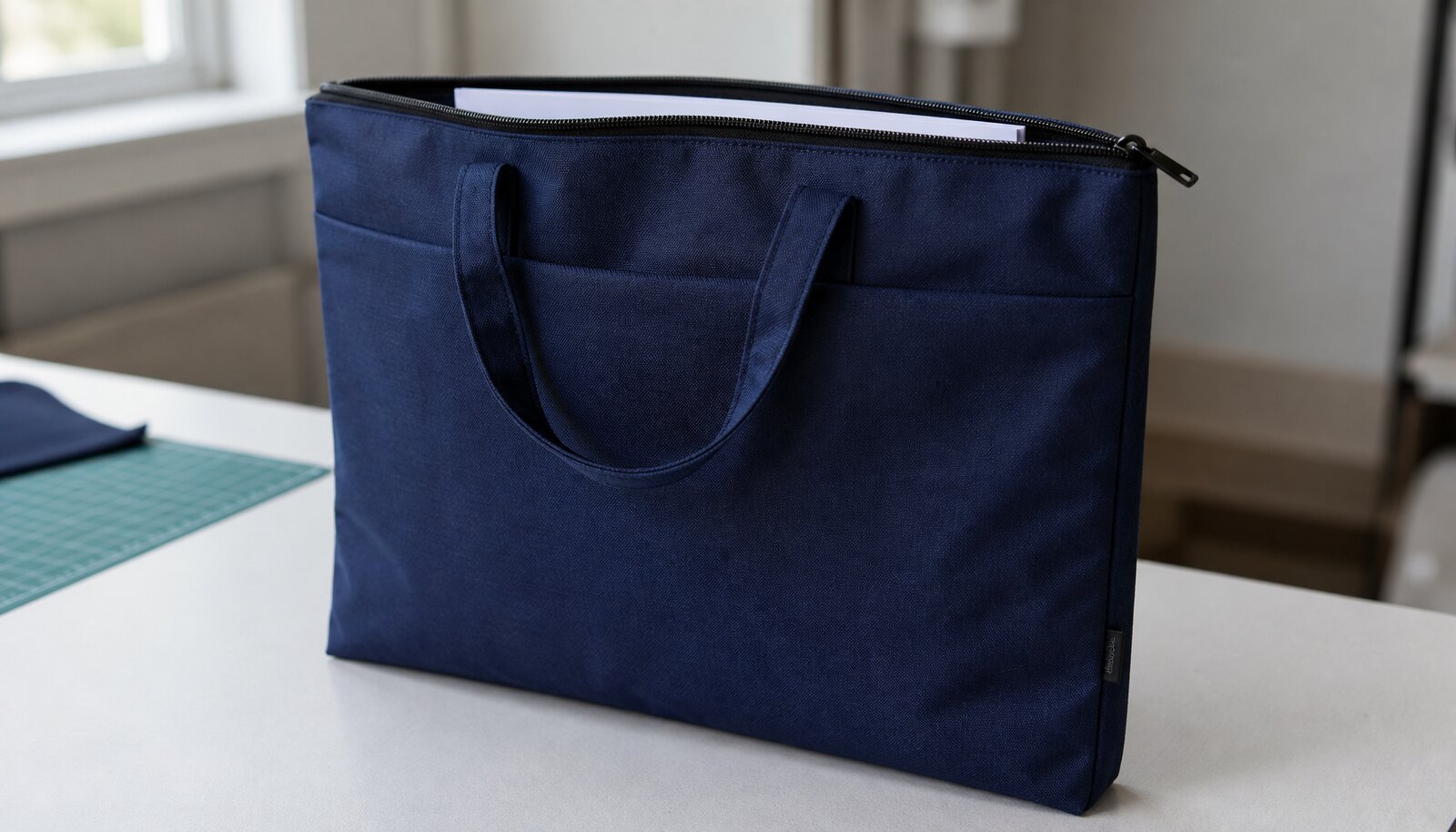
Start With the Use Case, Not the Product Name
Zipper conference bags are often treated as a simple promo item, but procurement gets better results when the brief begins with how the bag will actually be used. A conference handout bag, a staff event bag, and a client-facing welcome kit may all look similar in a catalog, yet they fail for different reasons. One order needs low cost and quick packing. Another needs a neater profile, stronger handles, and cleaner branding because the bag will be seen on a registration desk or carried into meetings. If the brief only says "zipper conference bags," suppliers will usually quote their default construction, which may be too weak, too bulky, or too plain for the job.
Define the contents before you define the shell. An A4 document kit creates a different shape requirement than a bundle of brochures, notebooks, and a tablet. A charger, power bank, or earphones may add point-load stress at the base or zipper corners. A buyer who knows the contents can set the right gusset depth, the right zipper length, and a handle drop that feels natural in hand. This also helps the factory decide whether the bag needs a softer promotional build or a more structured corporate build that keeps its shape on a table.
A practical brief should answer four questions: who will use the bag, what it must carry, how long it must last, and how it will be distributed. If the bag is for a one-day internal conference, cost and delivery timing may matter more than premium materials. If it is for a recurring annual event, repeatability matters more than shaving a few cents from the unit price. If it will be handed to clients or media guests, visual consistency and defect control become more important than a small material upgrade. Those trade-offs should be visible in the RFQ, not left to supplier assumptions.
- List the actual contents, not just the event name.
- State whether appearance, durability, or cost is the top priority.
- Decide whether the order is a one-off event run or a repeat program.
Choose the Build Spec Before You Ask for a Quote
Most pricing differences come from structure, not just artwork. For standard corporate use, 300D polyester is the lower-cost starting point, especially when the bag will mainly carry papers and a notebook. It can be suitable for light handout kits, but it usually looks less rigid and can wrinkle more easily. 600D polyester is a more common procurement choice when the buyer wants the bag to hold shape better, survive repeated handling, and present a cleaner silhouette. It is not automatically "premium," but it is usually the safer middle ground when the bag has to look presentable on a desk and in transit.
The inside construction matters as much as the outer shell. A lining such as 190T or 210D polyester is often used for smoother internal finish and easier packing. Light interfacing or foam, often in the 2 to 4 mm range depending on the pattern, can improve body and reduce collapse, but too much reinforcement raises the cost and can make the bag bulky to ship. A buyer should ask the supplier to quote the outer fabric, lining, reinforcement, and stitching density separately enough to understand where the money is going. If the factory only gives a single lump sum, the quote is harder to compare and easier to manipulate with hidden downgrades.
The zipper spec is a frequent source of mismatch. For a zipper conference bag, number 5 nylon coil is a practical default for many builds because it balances smooth operation and cost. A heavier zipper may be better if the bag will carry more weight or if the opening is large and needs extra stiffness, but it can increase price and weight. Metal zippers can look more premium, yet they are not always the best choice for frequent use because the feel, corrosion risk, and cost profile are different. The right choice is the one that matches the load, handling frequency, and price tier you want to buy.
- Ask for fabric, lining, and reinforcement as separate line items if possible.
- Use 600D polyester when the bag must hold shape and survive repeated use.
- Keep zipper and handle specs explicit so suppliers do not substitute cheaper parts.
Branding Choices That Hold Up After the Event
Branding can be where a conference bag looks either carefully specified or improvised. Screen printing remains the most useful method when the logo is simple, flat, and limited in colors. It usually gives good value for corporate programs because setup is straightforward and the result is clean on a large front panel. The risk is that small text, thin strokes, and seam-crossing art can weaken the final appearance. If the artwork is more detailed, the buyer should ask for a real proof on the chosen fabric rather than relying only on a digital file.
Woven labels and sewn side labels are often better when the bag is expected to be used beyond the event. They are more durable in repeated handling and can look more finished when the front panel is already busy with pockets or zippers. Patches can work for premium programs, but they add process complexity and should be treated as a separate cost and quality decision, not a free upgrade. Heat transfer can support more complex artwork, but the buyer should ask how the supplier tests for edge lift, cracking, and abrasion after packing and folding. If the print is decorative but not highly durable, the buyer should know that before the purchase order is issued.
Logo placement deserves its own approval step. A design that looks centered in software may shift once the bag is sewn, especially near zipper lines, side seams, curved corners, or pockets. Buyers should insist on a printable area that leaves enough margin from stitching and hardware. If the same bag is going to multiple regions or distributors, specify Pantone references where color accuracy matters, and ask how the supplier controls shade variation across repeat orders. A weak print or misaligned label can undermine an otherwise acceptable bag, especially when the bag is used in front of customers or at a formal event.
- Use screen print for simple artwork and strong visual contrast.
- Use woven or sewn labels when repeated handling is expected.
- Keep artwork away from seam lines unless the factory proves the placement on sample.
How to Compare Supplier Quotes Without Getting Misled by the Unit Price
The easiest way to lose money on zipper conference bags is to compare quotes that are not built the same way. One supplier may price a 300D body with a light zipper and no meaningful reinforcement. Another may be quoting 600D fabric, a better lining, reinforced handles, and packing that is ready for export. If those numbers are compared only as unit prices, the cheaper offer may actually be the more expensive one after rework, replacement, or shipping damage. Procurement should force every supplier to quote the same build, the same packing, and the same delivery term before any price comparison is made.
A good RFQ should ask for price breaks by quantity and by version. A one-color logo, a two-color logo, or a second branding position can change the labor and setup cost. A black zipper tape and a color-matched zipper tape may also differ. If the factory cannot explain why a change in zipper size, lining weight, or print method changes the quote, the pricing may be based on guesswork rather than a controlled bill of materials. That is a warning sign, especially for buyers who need repeat orders or a fixed annual budget.
Landed cost is the number that matters. The factory price is only one piece of the total. Add sample fees, freight, customs duty, inland delivery, inspection, and any rework risk if the supplier is known to be loose on packing or labeling. For planned programs, sea freight is usually the better option because it keeps the budget stable. Air freight can be justified for urgent small runs, but it often removes the saving that looked attractive at origin. Buyers should ask all suppliers to quote the same incoterm so the comparison includes the real route to destination rather than only ex-factory pricing.
- Do not compare unit price until fabric, zipper, branding, and packing match.
- Request price breaks by quantity and by logo version.
- Compare all suppliers on the same incoterm and shipment basis.
MOQ, Lead Time, and When a Small Run Makes Sense
MOQ is rarely arbitrary. It is usually tied to fabric purchasing, print setup, zipper sourcing, and sewing efficiency. A supplier can often accept a lower MOQ when using stock material, a standard zipper, and a single logo position. The minimum rises when the buyer requests special colors, custom zipper pulls, multiple print locations, or unusual packing. That is why procurement buyers should separate "must-have" features from "nice-to-have" details before they ask for a quote. A small order with too many custom variables may end up more expensive than a larger, simpler run.
A small run makes sense when speed or flexibility matters more than full custom control. If the event is close, a stock bag body plus local logo application can be the most practical option. The trade-off is less choice in fabric, color, or trim. For a repeat annual program, it usually pays to lock a custom pattern and the same reference sample for reorders, even if the first order is slightly more work. That gives the buyer a stable benchmark for later quote rounds and reduces the chance that a second batch will quietly change.
Lead time should be treated as a sequence, not a single number. Material confirmation, sample approval, production, packing, and shipping each take time. Most schedule slips happen when artwork is still changing after the sample has been shown or when a supplier has not actually secured the requested material. Buyers should ask which step is the schedule gate and what happens if a color or zipper is not available from stock. For event-driven orders, build in buffer time between approval and shipment. A bag that is cheap but late is usually not a good buy.
- Under 300 pcs often works best with stock bodies plus local branding.
- 500 to 2,000 pcs is usually where a direct factory quote becomes more efficient.
- Treat sample approval as a hard schedule gate, not a soft milestone.
Sample Approval That Prevents Rework Later
A useful sample process has more than one stage. The blank prototype checks size, proportions, zipper line, and handle placement. The pre-production sample checks the actual bulk materials, stitch behavior, and print result. The golden sample becomes the reference for bulk production and final inspection. If the factory only sends a digital proof or a paper sketch, the buyer still does not know how the zipper feels, how the body stands when loaded, or whether the artwork sits correctly in relation to the seams. Those are production questions, not design questions.
Approve the sample against real use. Put the intended contents into the bag and check the opening, the zipper path, and the way the bag rests when full. A conference bag often looks good empty and awkward once filled with documents or a tablet. The buyer should also check the handle drop in hand, not just on a table, because a strap that feels acceptable in the sample room may be uncomfortable when the bag is carried all day. If the order includes a pocket or divider, verify that those features still function when the bag is filled, not only when it is empty.
Once the sample is approved, lock the spec. That includes fabric shade, logo size, zipper type, thread color where visible, handle length, pocket layout, and carton mark text. If any of those items are left open, the bulk order can drift. For repeat programs, keep the approved sample stored with the purchase history and reorder code so later buying teams do not have to rebuild the spec from scratch. A good golden sample saves time on every future order.
- Use a blank prototype for dimensions and construction shape.
- Use a pre-production sample for material and print approval.
- Use a golden sample as the inspection reference and reorder benchmark.
QC Criteria Buyers Can Actually Put in the PO
QC guidance is most useful when it is specific enough to inspect. For zipper conference bags, the first check is dimensional accuracy against the approved sample. Buyers should write the accepted tolerance into the order so there is no argument later about what "close enough" means. The second check is sewing quality at stress points: handle anchors, zipper ends, side seams, and bartacks. These are the areas most likely to fail in ordinary use. The third check is the zipper itself, which should travel smoothly without catching the lining or requiring excessive force at the corners.
Cosmetic quality matters because these bags are often handed out in public settings. A crooked logo, visible oil mark, dirt spot, twisted panel, or mismatched label can make a lot of otherwise acceptable bags unusable for a formal event. Buyers should ask for print registration control, shade control, and a visual defect review before packing. If the order is large, a third-party final inspection is worth considering because it checks both product condition and carton readiness. A sewing-line checkpoint alone can miss errors introduced during folding, packing, or carton labeling.
It helps to set practical acceptance rules, not vague expectations. For example, define what counts as a major defect versus a minor defect: broken zipper, torn seam, missing logo, or wrong size should be major. Loose threads, small fold marks, or a minor wrinkle may be minor if they do not affect use or visual acceptability. The exact AQL numbers should be aligned with the buyer’s quality policy and order risk, but the defect definitions should be written clearly in the PO or QC attachment. The more precise the rule, the less room there is for debate after goods are packed.
- Write dimensional tolerance into the order before bulk production.
- Treat handle anchors, zipper ends, and side seams as high-risk inspection points.
- Define major and minor defects in the PO so acceptance is not subjective.
Packing, Cartons, and Landed Cost Control
Packing is not a cosmetic afterthought. The way zipper conference bags are folded affects whether the zipper track stays straight, whether the front panel creases, and whether printed graphics arrive scuffed or flattened. Buyers should tell the supplier which side to fold inward and whether the logo must remain visible or protected during shipping. If the bag has foam or a structured body, folding the wrong way can create an unnecessary crease that is hard to remove. This is one of the easiest places for avoidable waste to enter the order, because the bag may be perfectly sewn but still arrive looking tired.
Polybags, insert cards, and desiccant add labor and cost, so they should be used for a reason. If the bags will be stored for a long period, handled through several logistics steps, or shipped on a humid route, inner protection may be worth it. If the event is local and the bags will be distributed quickly, a simpler pack-out may be enough. Carton size matters too, because large cartons increase freight volume and can be awkward for warehouses to handle. Ask for carton quantity, gross weight, carton dimensions, and master carton marks before approving the quote. A low unit price can disappear once packaging inflates freight or causes receiving delays.
The landed cost conversation should include route, not just origin price. A factory quote that looks attractive may become uncompetitive after inland freight, customs clearance, inspection, and destination delivery are added. Buyers often save time by requesting all quotes on the same incoterm, then comparing the full landed number rather than only the factory gate cost. For planned conference programs, sea freight usually gives the best balance of cost and timing. For urgent orders, air freight can work, but only if the buyer accepts the freight penalty and the supplier can still pack the goods well enough to survive expedited handling.
- Specify fold direction so print, zipper, and shape are protected in transit.
- Use inner packaging only when storage, humidity, or scuff risk justifies it.
- Request carton dimensions and gross weight before comparing landed cost.
Factory Capability Checkpoints Procurement Should Ask For
Commercial credibility improves when the supplier can show how the bag will actually be made. Buyers should ask whether the factory handles cutting, sewing, printing, zipper insertion, and packing in-house or whether parts of the process are subcontracted. That matters because more handoffs usually mean less control over timing and consistency. If a factory outsources the print, for example, the quoted lead time may not reflect the real production bottleneck. It is reasonable to ask for a process flow, recent production photos of a similar build, or evidence that the team has worked with the same structure before.
Capability should also be tested against the specific order. A factory that can sew a basic document pouch may not be the right source for a zipper conference bag with reinforced handles, a lined interior, and aligned branding. Buyers should ask what machine set and stitching methods are used for bartacks and seam reinforcement, how the zipper end is finished, and how the factory controls panel alignment during sewing. If the supplier cannot explain those steps in simple terms, that is a sign they may not control the build as tightly as a procurement buyer needs.
Compliance and documentation should be part of the discussion when the bags are shipped into stricter markets or through larger corporate procurement channels. Buyers should ask whether the supplier can support basic material declarations, packing lists, and country-specific labeling if needed. If there are sustainability requirements, avoid vague claims and ask for the actual material basis, such as recycled content documentation or the factory’s own certificate trail where available. Do not accept a generic green statement without something that can be checked. Procurement credibility is better served by a modest but documented claim than by an impressive but unsupported one.
- Ask whether key processes are in-house or subcontracted.
- Request process photos or a sample production record for a comparable build.
- Do not accept sustainability claims without documentation or a traceable material basis.
A Practical RFQ Format for Better Quotes
A strong RFQ is not long, but it should be complete enough that two suppliers can quote the same item with minimal interpretation. The first page should show the finished size, gusset depth, target contents, and a simple drawing or tech pack. The second should state the outer fabric, lining, reinforcement, zipper spec, logo method, and any pocket or divider. The third should cover packing, carton marks, quantity by color, sample requirements, delivery term, and target ship date. If the supplier receives only a product name and a logo file, they will fill the gaps with their own standard build and the quotes will not be comparable.
The buyer should also state what not to change. If the conference team wants a flat front panel because it photographs well on a registration table, say that. If the bag must remain light enough for hand distribution, say that. If the logo must stay centered with specific clearance from the zipper line, say that. These are not decorative details; they are the things that determine whether the final product fits the event. A good RFQ reduces the number of follow-up questions because the factory can see the trade-offs from the start.
A useful rule is to attach a one-page spec summary and a separate visual reference. The summary carries the numbers; the reference carries the look. Buyers often waste time because they rely only on pictures or only on text. For zipper conference bags, both matter. The picture shows the intended silhouette and logo placement, while the spec sheet prevents the supplier from interpreting the product as a generic promo pouch. That is the difference between getting quotes that are easy to compare and getting a pile of numbers that all describe slightly different bags.
- Attach a drawing or tech pack with finished dimensions.
- State exact logo area, print method, and color reference.
- Include packing, destination, incoterm, and target ship date in the same RFQ.
Specification comparison for buyers
| Spec decision | Recommended option | When it fits | Buyer risk to check | Commercial note |
|---|---|---|---|---|
| Sourcing route | Direct factory with cutting, sewing, and logo application under one roof | Best for custom programs, repeat orders, and tighter QC control | Confirm whether printing, zipper sourcing, and packing are truly in-house or subcontracted | Usually the cleanest route for stable annual reorders |
| Small-run route | Stock bag body plus local logo application | Works when you need under 300 pcs or a rush delivery | Color choice, zipper style, and panel size are often fixed | Lowest setup cost, but limited design freedom |
| Program route | One factory, one golden sample, one reorder code | Fits recurring conference kits and distributor programs | Without locked reference specs, later batches drift in size and trim | Best for buyers who need repeatability across years |
| Fabric route | 600D polyester with 210D lining for standard corporate use | Good balance for most business conference bags | A thin liner or light shell can collapse under document load | Common mid-tier option; usually better presentation than 300D |
| Budget route | 300D polyester with simple lining and standard nylon zipper | Appropriate for light handouts and cost-sensitive events | Check whether the bag still holds shape when filled | Usually the lowest price tier, but weaker body recovery |
| Premium route | 600D polyester, reinforced handles, firmer base, cleaner branding | Useful for client-facing kits and staff use | Extra structure adds weight and can increase freight cubic volume | Often the best value when appearance matters as much as unit cost |
| Branding route | Screen print for flat logos; woven or sewn label for durable branding | Best when artwork is simple and repeated handling is expected | Small text, gradients, and seam-crossing artwork can fail visually | Choose the method that matches the wear pattern, not the sales pitch |
| Sample route | Pre-production sample made with bulk fabric, zipper, and lining | Needed when the build, artwork, or packing is new | Paper proofs hide fit, hand feel, and stitch issues | Golden sample should be tied to QC and reorder control |
| Inspection route | Third-party final inspection at packed-carton stage | Useful for export, retail, and distributor orders | Sewing-line checks alone miss packing and carton issues | Add AQL terms if the order is time-sensitive or high value |
Buyer checklist before sampling
- Final bag size, gusset depth, and handle drop shown in a simple drawing or tech pack
- Expected contents, including A4 folders, brochures, tablets, chargers, or notebooks
- Body fabric, lining, and any foam or interfacing target in GSM or mm
- Zipper size, zipper tape color, pull style, and any nylon or metal preference
- Logo file, print method, Pantone reference, and maximum print area
- Packing spec, inner quantity, carton size target, and carton marking text
- Target order quantity by color and by logo version
- Destination, incoterm, required inspection level, and latest acceptable ship date
Factory quote questions to send
- What exact body fabric, lining, and reinforcement are you quoting, and is that construction identical across all prices you send?
- Is the zipper number 5 nylon coil, a heavier coil, or a metal option, and is the puller included in the unit price?
- Which logo method is included, and how does the quote change if I move from one color to multiple colors or a second print location?
- Is the sample made from the same bulk fabric, zipper, and lining, or is it only a visual prototype?
- What is the MOQ per color, per logo version, and per packing configuration?
- What packing is included, including polybag, desiccant, insert card, inner count, and carton marks?
- What is the production lead time after sample approval, and which step is most likely to slip if materials change?
- Can you share production photos, a similar inspection report, or factory capability evidence for a comparable zipper conference bag build?
Quality-control points to confirm
- Measure finished length, height, and gusset against the approved sample and set a written tolerance before production starts.
- Check zipper travel at least several cycles per bag on sampled units; the zipper should not snag lining, buckle at corners, or separate under normal pull force.
- Inspect handle anchors, side seams, and top seams for even bartacks, no skipped stitches, no loose thread ends, and no seam puckering at stress points.
- Confirm logo placement, size, and color against the approved artwork and golden sample, especially where seams or zipper lines can shift alignment.
- Reject panels with visible fabric defects, heavy shade variation, oil marks, needle damage, or contamination that will be visible in conference use.
- Load the bag with intended contents and confirm the bag stays functional when filled; it should not buckle, tip excessively, or distort the zipper opening.
- Verify packing count, carton labels, inner packs, and master carton condition before shipment release.
- Check fold direction so the print is not crushed and the zipper track is not bent during storage or transit.