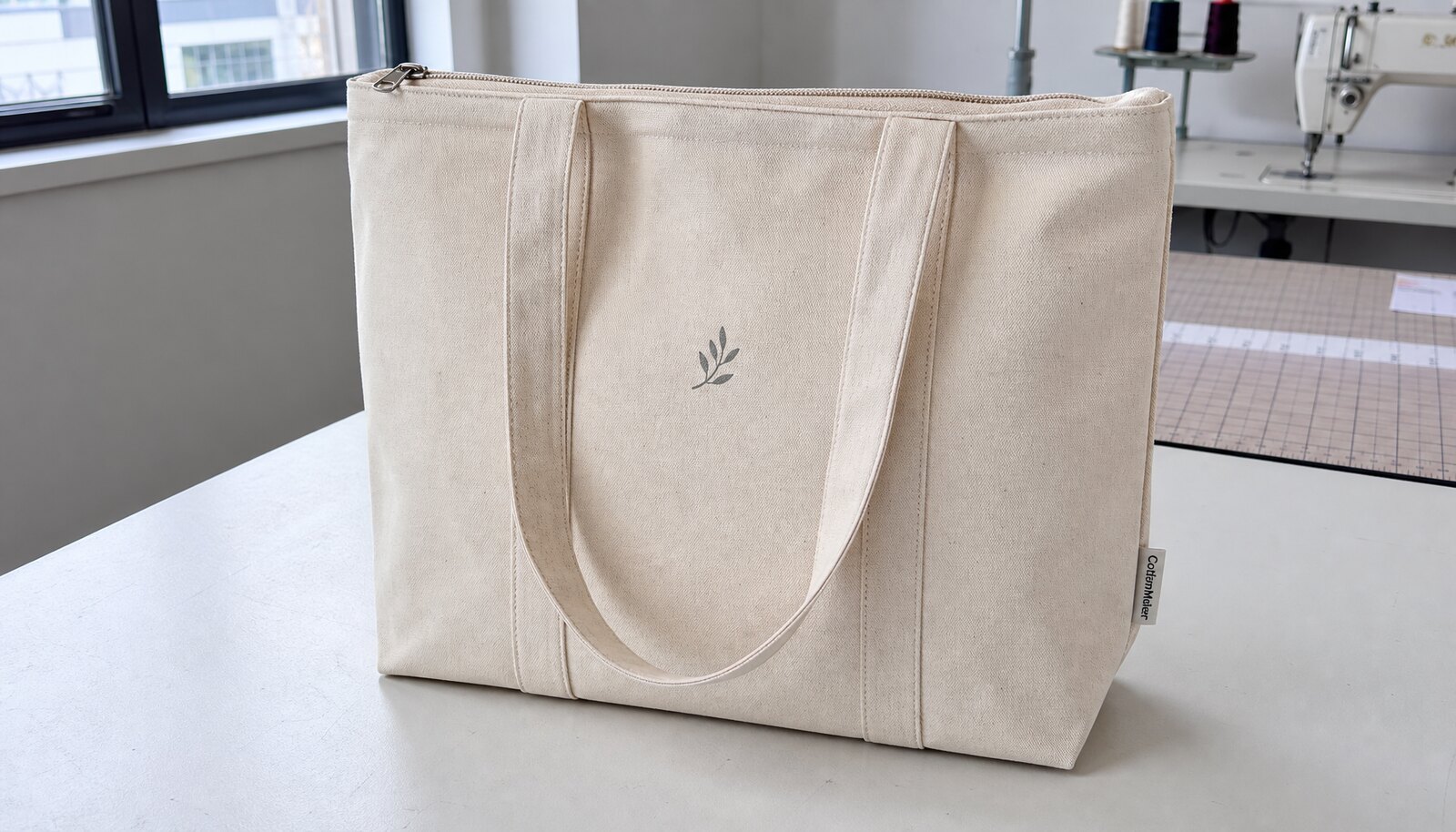
Why zipper canvas tote bags for retail need a tighter brief than an open-top tote
A zipper changes the buying job. An open-top canvas tote is mainly judged on body construction, print quality, and the way it hangs on a shelf. Once a zipper is added, the buyer has to control the opening, the top edge, the zipper line, and the way the bag behaves after packing and handling. That makes zipper canvas tote bags for retail a more sensitive sourcing item than many buyers expect.
For retail, the bag has to perform in three places: on shelf, in transit, and in the customer’s hand. On shelf, it needs to look intentional and hold its shape. In transit, it needs to pack without crushing the zipper track or distorting the print. In use, it needs to open and close smoothly and keep its handle reinforcement intact after repeated carrying. If any one of those points fails, the product can be downgraded quickly by store teams or by end customers.
That is why procurement teams should treat the tote as a finished assembly, not as a decorated canvas body. Fabric, cutting, zipper selection, reinforcement, decoration, packing, and carton efficiency all interact. If a supplier only talks about canvas weight and unit price, but not about zipper installation or packed-carton behavior, the quote is not ready for comparison yet.
Start from the retail job: gift, lifestyle, add-on, or bundle insert
Before asking for quotes, define what role the bag plays in the retail assortment. A gift-shop tote, a fashion lifestyle tote, a cosmetics bundle insert, and a checkout add-on item do not need the same specification. The use case decides how much structure, print coverage, and zipper durability you actually need. It also tells the factory how to balance appearance, sewing time, and freight volume.
A gift item may need a clean front panel, simple decoration, and neat packing. A lifestyle tote may need a firmer body and a zipper that still feels smooth after repeated use. A bundled retail item may care more about flat pack efficiency, barcode placement, and carton consistency than about a premium hand feel. If the buyer does not define the use case, the supplier will usually fill the gap with its own assumptions, and quotes will become hard to compare.
A workable internal brief should answer four questions: what will the bag carry, how visible will it be on shelf, how much handling will it see before first use, and what price tier does it need to support? Those answers drive the fabric weight, zipper type, handle build, decoration method, and packing format. Without them, the sourcing team will spend time chasing the wrong tradeoffs.
Comparison table: what most changes the retail outcome
For buyers, the biggest differences rarely come from the outer size alone. They come from the combination of fabric, zipper, construction, and packing format. The table below is a practical comparison of the decisions that most often change the customer experience and the landed cost.
Use it to narrow your RFQ before you compare factory pricing. It is not enough to ask for a canvas tote with a zipper; the quote has to show which construction path the supplier is actually pricing.
- Write decisions in measurable language, not only descriptive wording.
- Ask for sample photos plus one physical approval sample for important orders.
- Keep quotation, sample approval, and inspection notes tied to the same spec version.
Canvas weight, weave, and finish: choose the fabric for the actual shelf job
For most retail tote programs, the practical finished fabric range is usually 12 oz to 16 oz canvas. That range covers softer carry bags, more structured retail totes, and heavier-feeling branded items. But the printed number alone is not enough. A buyer needs to know whether the supplier is quoting finished fabric weight after treatment or only greige weight before finishing, because those two numbers can point to very different actual fabrics.
A 12 oz finished canvas usually works when the goal is a lighter hand, lower sewing resistance, and a price point that can support volume retail. A 14 oz canvas is often the best middle ground: it keeps a cleaner body shape, usually prints well, and still sews reliably on normal production lines. A 16 oz canvas makes sense when the bag needs to feel more substantial, stand more upright, or carry heavier contents. The tradeoff is that heavier cloth usually needs more careful needle selection, stronger reinforcement, and tighter process control at the zipper top and handle points.
Heavier fabric is not automatically better. Weave density, yarn quality, finishing method, and shrinkage behavior matter just as much as the nominal weight. A poorly finished heavy canvas can twist, shrink unevenly, or create seam distortion after sewing. A well-prepared midweight canvas can look cleaner and behave better in production than a heavier but unstable cloth. That is why buyers should ask for the approved fabric swatch, the finished weight, and any prewash or pre-shrink detail before comparing one supplier’s quote with another’s.
The other issue is printability. If the retail design depends on sharp logos or small text, the fabric surface and finish matter as much as the weight. Some rougher canvases take print in a more textured way, which may be acceptable for a craft look but not for a clean brand presentation. Ask for a strike-off on the actual fabric color, not just a digital mockup. The way ink sits on canvas often tells you more than the spec sheet does.
Zipper selection: the hardware choice that affects sewing and returns
The zipper is the part most likely to generate a complaint if it is underspecified. For retail canvas totes, nylon coil zippers are usually the most practical starting point because they run smoothly, sew more easily on canvas, and tend to be less sensitive to minor alignment variation than some other zipper builds. Metal zippers can support a more premium or rugged look, but they usually cost more and require tighter sewing control.
Do not accept a quote that only says “nylon zipper.” Buyers should ask for zipper gauge or size, coil type, tape width, end-stop method, and puller material. Two zippers that both look acceptable in a sample photo can behave differently in bulk if the tape is thin, the puller plating is weak, or the end stops are inconsistent. If the zipper is too light for the bag size, the pull can feel cheap or catch at the corners. If it is too heavy for the fabric, the top edge can wrinkle or distort.
For a retail program, smooth zipper travel matters more than visual finish alone. A bag may pass a quick visual check but still fail after repeated opening if the coil catches at the corner or the puller feels rough in hand. Ask the supplier to state the zipper spec in the quotation and to identify whether the same zipper lot, or a controlled equivalent, will be used for production. If the supplier can replace the approved zipper without approval, the sample loses much of its value as a control document.
Construction details that separate a sellable tote from a problem tote
Retail buyers often compare tote prices by size and print, but construction details are what drive the hidden cost. The zipper insertion method, seam allowance, handle reinforcement, and inside edge finish decide whether the bag feels like a complete retail product or a rushed sewn item. A lower unit price can hide a missing reinforcement step or a simpler seam finish that may not survive use.
Handle attachment is one of the most important details. A self-fabric handle can look clean and retail-friendly, but only if the fold, stitch path, and reinforcement are consistent. X-box stitching or bar-tack reinforcement should be sized and placed deliberately, not casually. If the handles drift off center or the reinforcement is too small, the bag can look uneven and may fail sooner under load. The same applies to the zipper top seam. If the seam line waves or the opening is not square, shelf presentation suffers immediately.
Inside finishing also matters because buyers and end users see it when they unzip the bag. Bound seams, neat overlock finishing, and trimmed loose threads help the product feel more considered. Lining is not always necessary, but if the brand position is higher or the bag will carry delicate items, a clean inside finish can improve perceived quality. The goal is not to add features for their own sake. It is to match the construction to the retail tier without wasting cost on details the customer will not value.
How to compare supplier quotes without getting trapped by unit price
Two quotes can look close on paper and still represent very different products. The only way to compare them fairly is to separate the cost drivers: fabric, zipper, decoration, sewing operations, finishing, packing, and export terms. If those items are not named clearly, the lower quote may simply be missing reinforcement, using a lighter canvas, or excluding packing labor. That is not a better offer; it is an incomplete one.
A useful RFQ should ask the supplier to break out the finished canvas specification, zipper specification, print method, handle build, internal finishing, and carton pack. It should also state whether sample charges apply and whether those charges are refundable against bulk order quantity. This matters because some suppliers price samples low and then recover cost through higher bulk pricing, while others price the sample honestly and keep the production price stable. Without that visibility, the buyer cannot compare the real landed cost.
Export terms also change the picture. EXW is not directly comparable to FOB, CFR, or DDP. A low factory quote can become expensive once domestic transport, port charges, export handling, and import-side costs are added. Procurement teams should ask suppliers to quote the same term across shortlisted options and to name what is included. If one supplier includes barcode stickers, carton marks, and retail polybags while another does not, the apparent savings may disappear during receiving or in the distribution center.
One more point: pricing should be checked against the factory’s process reality. If the supplier claims a strong price but cannot explain how the zipper is installed, how the handles are reinforced, or how the bags are packed, that quote is too thin to trust. A good price should be attached to a believable production plan.
A quote structure that helps you compare apples to apples
A good quote should read like a production plan, not a marketing message. It should include finished size, canvas weight, fabric color, zipper type, puller style, print process, handle length, reinforcement method, inside finish, packing format, MOQ, sample charge, lead time, and export term. For retail programs, it is also useful to ask for carton dimensions, pieces per carton, gross weight, and a rough container loading estimate. Those details help the buyer judge whether the offer is actually efficient at scale.
If the supplier cannot give carton dimensions or pieces per carton early, that is a warning sign. Tote bags are bulky, and carton efficiency can matter as much as unit price. A tote packed too loosely may occupy more freight space than expected. A tote packed too tightly may show fold lines, zipper distortion, or print cracking when unpacked. Good packing is not just protection; it is also a freight planning tool.
The quote should also separate one-time and recurring costs. Sample fees, printing plates, embroidery digitizing, special zipper sourcing, custom labels, and carton artwork may all be separate from the recurring unit price. Buyers often miss this and compare unit cost while ignoring setup charges. For smaller retail programs, setup cost can be the difference between an acceptable test order and a margin problem.
If you are sourcing multiple colors or art versions, ask for a price ladder. Many factories will quote one quantity but not explain the impact of splitting the order across colorways. That split can change cutting efficiency, dye lot planning, and packing labor. A clean quote should make those effects visible instead of hiding them inside one blended number.
Supplier route decision: direct factory or trading company?
The right supplier route depends on how much control you need and how fast you need to move. Direct factory sourcing is usually the better choice when the tote is a private-label retail item with repeat seasons, color control, and a need for stable sewing quality. You get a clearer line of accountability on fabric, cutting, sewing, and packing. That matters when the zipper line and handle reinforcement need to match the golden sample exactly.
A trading company can be useful when you need speed, a broader supplier search, or a lower-friction way to source across several styles. That can help if the program is exploratory or if you are trying to build a small assortment quickly. The tradeoff is that you must verify who is actually making the bag, how the sample was produced, and whether the final factory will be the same one that runs bulk production. If the sample comes from one source and the bulk comes from another, the risk of mismatch rises sharply.
The practical test is evidence, not promises. Ask for sewing line photos, recent shipment carton photos, and a sample of a similar tote style from the same production site. Ask who controls zipper sourcing, thread sourcing, and label application. Ask for the latest incoming material inspection method and what records they keep when a fabric or zipper lot changes. If a supplier cannot explain how the order is monitored after the PO is placed, the buyer should assume the quality burden will shift back to procurement during inspection and claims.
MOQ planning, color strategy, and unit economics
MOQ should be viewed as a production planning rule, not just a number on a quote. For zipper canvas tote bags for retail, a practical starting point is often 1,000 to 3,000 pieces per style, but that range depends on how much setup is required and whether the supplier has stock fabric, stock zippers, and standard packing materials. A complex program with custom fabric, multiple print positions, and unique labels may need a higher MOQ to stay commercially sensible. A simple stock-fabric tote may go lower, but the buyer should ask what changes in price and lead time come with the smaller run.
Color planning has a direct effect on finished cost. If you split the order into too many shades too early, the factory may need separate dye lots, extra cutting coordination, and more carton complexity. That can raise both unit cost and operational risk. In many retail programs, it is smarter to keep one construction and vary only the print or label, or to limit colorways to the ones the sales plan can actually support. A broad palette may look good in a presentation, but it creates inventory risk when the bags arrive.
If a brand wants seasonal color changes, ask whether the supplier can use stocked fabric shades or whether new dyeing is required. Stock shades can reduce lead time, but the color range may be limited. New dyeing gives more control but often adds time and makes sample approval more important. Buyers should also ask if the MOQ is by color, by artwork version, or by total style quantity. Those distinctions change the real commercial commitment.
For retail procurement, a small difference in unit cost can be outweighed by freight and fulfillment cost. A bulkier bag may look inexpensive at the factory but cost more in transport and storage because of carton volume. When you compare offers, include freight space, carton count, and receiving labor in the decision, not just the ex-factory price.
Specification comparison for buyers
| Decision point | Practical buyer choice | Why it matters for retail | What to verify in quote or sample |
|---|---|---|---|
| Supplier route | Direct factory for repeat programs | Best when zipper alignment, reinforcement, and seasonal consistency matter | Verify the actual production site, sewing line, QC process, and whether the sample and bulk order come from the same factory |
| Supplier route | Trading company for sourcing flexibility | Useful when you need multiple style options or faster market coverage | Confirm the real factory, the escalation path for defects, and how spec changes are controlled |
| Canvas weight | 12 oz finished canvas | Works for lighter retail, gift, and checkout-add-on programs | Ask whether weight is finished fabric weight, and check shrinkage, weave density, and print clarity |
| Canvas weight | 14 oz finished canvas | Often the best middle ground for structure and price | Check stitch performance, seam flatness, and whether the zipper top distorts on sewing |
| Canvas weight | 16 oz finished canvas | Better for a more substantial shelf look or heavier carry load | Verify machine capability, seam allowance, and whether the line can sew the fabric without puckering |
| Zipper type | Nylon coil zipper | Usually the most practical choice for smooth retail use | Confirm zipper size/gauge, tape width, puller style, end stops, and lot consistency |
| Zipper type | Metal zipper | Can support a more premium or rugged look | Check smooth travel, plating quality, and whether the zipper is compatible with the canvas weight |
| Handle build | Self-fabric handles with X-box or bar-tack reinforcement | Clean appearance and acceptable load performance when sewn correctly | Ask for stitch count, reinforcement dimensions, thread type, and loaded pull-test criteria |
| Decoration | 1-2 color screen print | Usually the most efficient method for repeatable retail logos and simple graphics | Approve strike-off on actual canvas color and check opacity, edge clarity, and cure resistance |
Buyer checklist before sampling
- Freeze the finished size, gusset depth, zipper length, handle drop, and target carry load before requesting final quotations.
- Specify canvas as finished fabric weight, weave type, color, shrinkage expectation, and any prewash or pre-shrink requirement.
- Send vector artwork, Pantone references, print placement dimensions, and the minimum line width or text size you can accept.
- Request a pre-production sample made from the same canvas, zipper, thread, and label that bulk production will use.
- Ask the supplier to identify the zipper gauge/size, coil type, puller style, end-stop method, and whether a named zipper brand is available.
- Define carton pack, polybag need, barcode placement, carton marks, and whether mixed colors can ship in the same carton.
- Set an inspection standard in advance: AQL level, defect classifications, and which defects are automatic rejection.
- Require production photos of cutting, zipper insertion, handle reinforcement, and final packing before shipment release.
- Confirm export terms, payment schedule, lead time start point, and who pays for sample charges, revisions, and any third-party testing.
- Keep the signed golden sample linked to the PO so the factory knows the approved reference and the bulk target.
Factory quote questions to send
- Is your quoted canvas weight the finished fabric weight after treatment, or only the base greige weight?
- Which zipper specification will you use, including zipper gauge/size, coil type, puller material, and end-stop method?
- Can you name the zipper supplier or brand, and will you use the same zipper lot throughout the bulk order?
- How many sewing operations are included for zipper insertion, top seam sewing, handle attachment, and reinforcement points?
- What are the sample charges, how many revisions are included, and are sample fees refundable against bulk order quantity?
- What is the MOQ by style and by color, and does the MOQ change if we use stocked fabric or stocked zipper components?
- What export term is quoted, and what exactly is included in the price: EXW, FOB, CFR, or DDP?
- What carton dimensions, pieces per carton, gross weight, and container loading estimate are you quoting?
- What is your defect tolerance standard for stitching, print registration, zipper function, stain marks, and size variance?
- What in-process checks do you run on zipper insertion, handle reinforcement, and final packing before shipment?
Quality-control points to confirm
- Finished size tolerance: hold length, height, and gusset within ±0.5 cm for smaller bags and within ±1.0 cm for larger tote sizes unless the approved spec allows otherwise.
- Canvas weight tolerance: target no more than ±5% from the approved fabric specification unless the supplier can justify a wider factory standard in writing.
- Stitching standard: no skipped stitches, broken thread, open seams, or loose ends at visible stress points; seam puckering should be minimal and not distort the bag shape.
- Stitch density: agree a stitch-per-inch or stitches-per-3cm target on critical seams and use it consistently across the body, zipper top, and handle reinforcement.
- Handle reinforcement: require X-box or bar-tack reinforcement to match the approved sample; perform a loaded pull test on a sample unit before bulk release.
- Loaded pull test: test a sample bag with a realistic retail load for the end use, hold for a fixed period, and inspect for seam opening, stretching, or handle shift.
- Zipper function: run at least 10 full open-close cycles on sample inspection units; for bulk checks, inspect smooth travel, end-stop security, and no snagging at the zipper tape or seam edge.
- Zipper gauge and alignment: zipper should sit straight, close evenly, and not wave across the opening; the zipper tape should not be twisted or exposed beyond the approved tolerance.
- Print quality: no major misregistration, heavy bleeding, flaking, pinholes, or image distortion; approve against an actual fabric strike-off under daylight or D65 lighting.
- Color control: compare bulk fabric and print color to approved physical references, not only screen files; set an acceptable shade band before production.