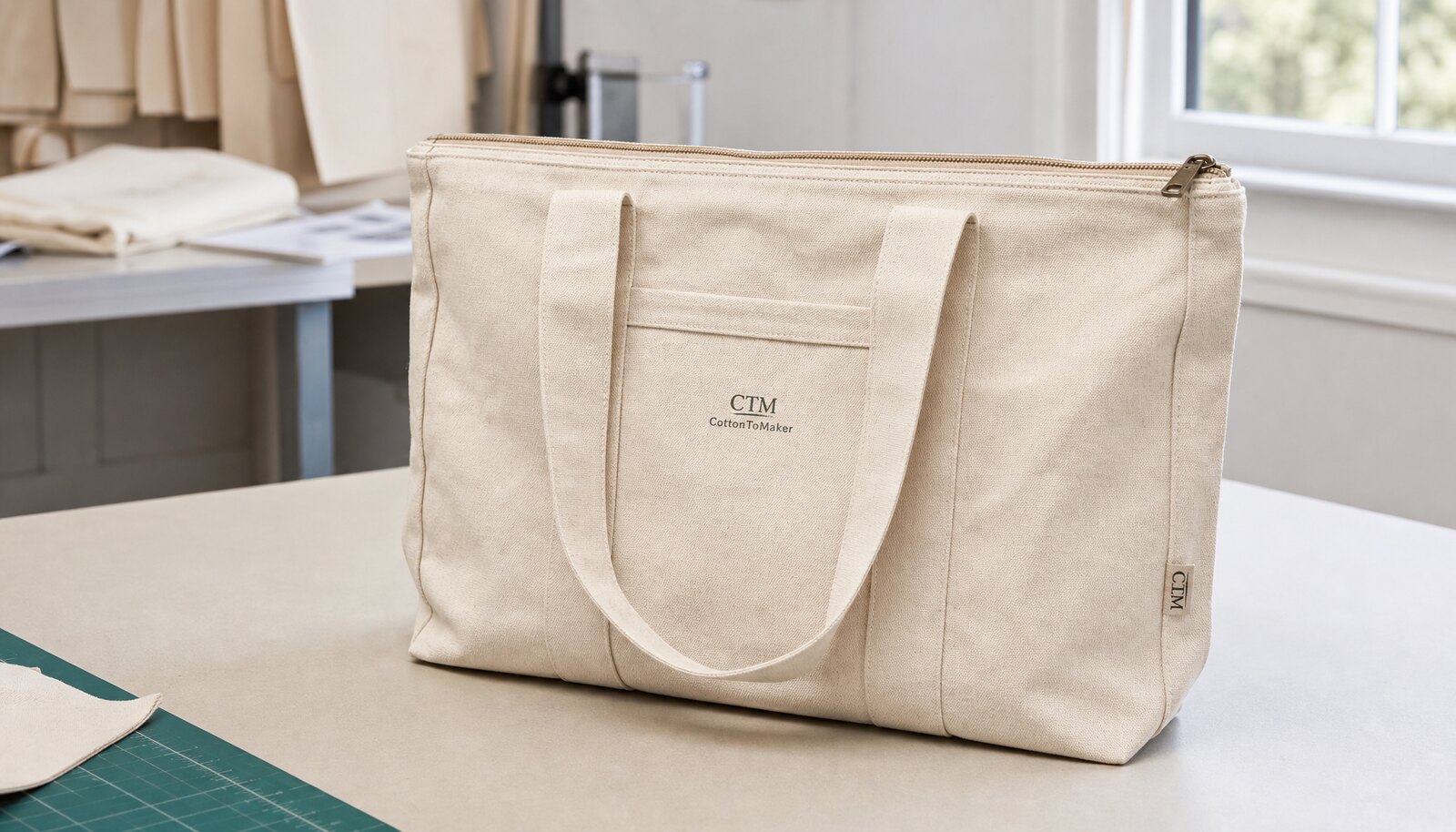
What hotels are actually buying when they order zipper canvas tote bags
For hotel procurement teams, zipper canvas tote bags for hotels are rarely just “gift bags.” They usually have a specific operational job: carry bags for welcome amenities, retail bags for spas and gift shops, or branded holders for event kits and VIP arrivals. Those use cases sound similar on paper, but they create different expectations for fabric body, zipper quality, logo visibility, and packing format. A bag used in a spa boutique has to look clean on a shelf. A bag used in guest-room delivery can be more utilitarian, but it still needs to look intentional when a guest opens it.
The most common mistake is to write a vague RFQ such as “canvas tote with zipper and logo” and assume the factory will fill in the details correctly. The factory will fill them in, but often according to its own cost assumptions. That is how buyers end up with a bag that is too limp, a zipper that feels cheap, or a logo that looks off-center because no placement rule was written down. In hotel sourcing, ambiguity becomes product variance. The more specific the use case, the less likely you are to receive a bag that is technically “close” but commercially wrong.
A better procurement approach is to define the end use first. Is the bag being handed out once, resold, or stored and reissued? Will it hold toiletries, slippers, brochures, or heavier retail items? Will guests carry it outdoors? If the answer includes repeat use or resale, the bag must behave more like a small branded product than a disposable amenity carrier. That changes the acceptable fabric weight, zipper grade, print method, and quality threshold.
For this reason, hotel buyers should treat the tote as a miniature specification project, not a generic accessory order. That mindset makes quote comparison easier, because every supplier is being measured against the same intended application. It also reduces disputes after sample approval, when a buyer realizes too late that “canvas” can mean several very different material and construction choices.
In practical sourcing terms, there are three hotel use profiles to separate before requesting quotes: guest amenity carry, spa or retail presentation, and event or welcome-package distribution. The right product can overlap across all three, but the trade-offs are not identical. A retail-facing tote needs cleaner finishing and stronger visual appeal. A back-of-house amenity tote can be simpler, but the zipper still has to open smoothly and the seams still need to hold under handling.
If the hotel is buying for multiple properties, one more decision matters: standardization. A chain program may want one base tote spec across all locations, with only a different logo or color variant. That makes reordering simpler and reduces approval work later. If each property wants a slightly different size or print placement, ask whether the operational value is worth the extra cost and inventory complexity. Customization is useful only when it serves a real hotel workflow.
The most useful buyer question is therefore not “Can you make a tote?” It is “What exact job will this tote perform in our hotel operation, and what failure would be unacceptable?” That question narrows the spec quickly. A tote for retail resale needs stronger presentation and cleaner finish. A tote for amenity distribution needs predictable packing and lower unit cost. A tote for VIP gifting needs enough premium feel to match the guest experience.
Once the use case is clear, the rest of the sourcing discussion becomes measurable rather than subjective. The buyer can compare fabric, zipper, print, carton spec, and sample quality against one commercial purpose instead of a vague idea of “good quality.”
- Typical hotel use cases: welcome-kit carrier, spa retail bag, in-room merchandise bag, event gift bag, and VIP amenity bag.
- The bag must balance appearance, durability, and storage efficiency more than a fashion tote would.
- A good RFQ defines the end use first, then the structure, then the decoration method.
- If the bag will be resold, assume guests will judge the zipper, stitching, and print quality more harshly than internal hotel staff will.
- For multi-property programs, decide whether you need one standard tote spec or property-specific variants before quoting.
Fabric choice: how to specify canvas weight, finish, and appearance without confusion
Canvas weight is the first commercial decision that affects perceived quality, unit cost, and freight. For hotel programs, 12 oz canvas can work for light amenity use, but many buyers prefer 14 oz because it gives the bag better body, helps it stand on a counter, and hides packing wrinkles more effectively. If the tote is expected to carry bottles, toiletries, brochures, or retail items, 14 oz to 16 oz is usually safer. At the upper end, the bag feels more premium, but fabric cost and shipment weight increase. That matters if the hotel or distributor is comparing landed cost across several item categories.
The problem is that many quotes use the word “canvas” without stating the basis clearly. One supplier may be quoting 12 oz natural canvas, another 14 oz pre-shrunk canvas, and a third a looser weave that looks heavier in a photo but performs differently in production. Ask for the weight in oz or gsm, and ask how it was measured. If a mill ticket, fabric spec sheet, or sample swatch is available, request it. Procurement teams do not need the supplier’s entire textile dossier, but they do need enough data to compare like with like.
The finish matters almost as much as the weight. Natural canvas, bleached canvas, and dyed canvas behave differently under indoor lighting and print. Natural fabric often looks more artisanal and can fit hotel brands that want a calm, earthy aesthetic. Bleached or whiter canvas usually gives cleaner logo contrast and reads more premium in photographs. Dyed canvas can be appropriate for brand colors or retail programs, but dye consistency becomes a separate quality issue. Ask whether the cloth is pre-shrunk if dimensional stability matters, especially if the tote will be ironed, boxed tightly, or packed with inserts.
Weight alone does not tell the full story. Two 14 oz canvases can feel different if one uses a tighter weave and the other uses a looser yarn structure. In procurement terms, that means you should also ask about the hand feel, weave density, and whether the surface is brushed, washed, or otherwise finished. A smoother surface supports cleaner printing; a rougher surface can give a more natural look but may reduce print crispness. The supplier does not need to provide laboratory language if it does not have it, but it should at least describe the fabric in a way that the buyer can match against the approved sample.
For buyers who want a cleaner retail feel, specify the hand and finish, not just the weight. A tighter weave and cleaner surface help the logo print more crisply. If the supplier cannot explain the weave or finish, the quote may be based on a commodity cloth that looks acceptable in a sample but feels weak in bulk. This is where direct factory sourcing can help, because the buyer can often ask for fabric alternatives by price and finish level rather than accepting a single generic canvas description.
There is one caveat to keep in mind: the right weight depends on end use, not a universal rule. A hotel welcome kit may be perfectly served by 12 oz if the contents are light and the bag is only used briefly. A spa retail tote may justify 14 oz or even 16 oz because the guest will judge it as part of the merchandise. So the best specification is not “use 14 oz because it is better.” It is “use the lightest weight that still gives the bag the body, print clarity, and load performance required by the hotel program.”
If you want a quick way to reduce supplier confusion, define four fabric variables in the RFQ: weight, color, finish, and whether pre-shrinking is required. That short list often prevents more production errors than a long paragraph of general quality language.
The practical rule is simple: define weight, weave feel, finish level, and color family in writing. Otherwise, the supplier can meet the word “canvas” while missing the commercial look the hotel actually needs.
- Common buyer ranges: 12 oz for light use, 14 oz for balanced hotel programs, 16 oz for more premium or heavier-load use.
- Ask for fabric in oz or gsm, not both unless the factory confirms the conversion method.
- Clarify whether the cloth is natural, bleached, dyed, pre-shrunk, or finished for a smoother print surface.
- If color consistency matters, request lab dips or approved swatches before bulk fabric cutting.
- Ask whether the supplier can provide a fabric reference from the actual mill or at least a stable internal spec code.
Zipper build and bag structure: where low-cost quotes usually cut corners
The zipper is the part guests touch first, so it should not be treated as an afterthought. For hotel tote programs, a nylon coil zipper is usually the safest default because it slides smoothly, tolerates regular use, and is less likely to snag canvas edges. Metal zippers can look premium, but they add weight, cost, and corrosion risk if the plating or finish is poor. If the bag is going to humid environments, pool areas, or long storage periods, the safer engineering choice is usually a well-made nylon coil zipper with a puller that is easy to grip.
When comparing quotes, ask for more than “zipper included.” Specify zipper length, zipper tape color, puller material, and top-stop style. A supplier may substitute a lower-cost zipper that technically closes the bag but does not glide well under guest handling. That is a common weak point in lower-priced offers. Hotel buyers should also clarify whether the zipper is intended to close fully edge to edge or leave a small opening at the ends, because that affects loading access and the finished look.
A good procurement discussion should also include zipper grade or brand examples, even if the supplier is quoting an equivalent alternative. For instance, some factories will work with known zipper systems or regional equivalents that are more predictable than unbranded stock components. The buyer does not need to dictate a single global brand if the budget does not require it, but it should know whether the zipper is a basic commodity slider or a tested component with stable sourcing. That distinction matters when the program is repeated over time.
Bag structure should be chosen for the use case, not copied from a fashion tote. A single-compartment tote is simpler to make, easier to pack, and more stable in production. Add an inner slip pocket only when there is a real hotel function for it, such as room key separation, spa receipts, or an insert card. Gussets can improve volume and shelf standing, but they increase pattern complexity and can change the look of the logo panel. Some buyers want a base gusset only; others need side gussets to improve usable space. Decide that before RFQ, because each structure changes fabric yield and sewing time.
The handle attachment deserves special attention. If the tote is expected to hold glass bottles, amenity packs, or retail goods, ask for bartacks or reinforcement at the handle joins and at zipper ends. Those are the stress points where a weak bag fails first. If the supplier proposes narrow seam allowances or minimal reinforcement to reduce cost, request a line-by-line explanation. A lower quote is not useful if the bag starts to deform or fray after a few guest interactions.
Stitch density is worth stating in the spec sheet because it helps compare factories that quote similar-looking bags with different workmanship. As a practical procurement reference, many buyers use a range of about 7–9 stitches per inch on the main seams, with localized reinforcement at stress points. That is not a universal rule, but it is a useful benchmark when reviewing samples and photos. If the stitching looks sparse or uneven, ask the supplier to show the seam from the inside and explain the production setting.
In hotel sourcing, structure is not only about appearance. It affects production yield, durability, carton efficiency, and the final user experience. That makes zipper type and construction details some of the most important items in the specification sheet.
- Prefer nylon coil zipper for smooth use and lower snag risk.
- Specify zipper length, puller shape, tape color, and whether the zipper should be color-matched to the canvas.
- Ask for bartacks or reinforced stitching where handles join the body.
- Use a pocket only when there is a defined operational reason; otherwise it adds cost and defect risk.
- Ask for zipper grade or brand examples, not just “zipper included.”
Logo and branding methods: matching decoration to quantity, budget, and hotel presentation
For hotel orders, the logo method should be chosen by quantity, artwork complexity, and the finish the brand wants guests to see. Screen printing is usually the best-value option for simple one-color or two-color logos on canvas. It is cost-efficient at medium and larger volumes, and it can look clean if the artwork is prepared correctly. For many hospitality buyers, that is the sweet spot: enough branding visibility to support the hotel identity without overcomplicating production.
Woven labels and sewn labels are useful when the brand wants a more refined presentation or when it wants to reduce the risk of cracking associated with certain print inks. These methods work best when the logo can be simplified and placed consistently. Embroidery can look premium, but it adds density and cost, and it can distort on lighter canvas if the backing is not right. It also changes the hand feel at the logo area, which may matter if the tote is packed flat or stacked in inventory.
Transfer printing and digital print can be appropriate for more detailed artwork, but hotel buyers should use them carefully. Not every transfer finish tolerates repeated folding, humid storage, or abrasion against other items during packing. On rough canvas, detailed art can lose sharpness faster than expected. If your artwork is simple, a single-color print or sewn label is usually a safer procurement choice than a more decorative method that introduces additional failure modes.
The most useful RFQ question is not “Can you print the logo?” It is “Which decoration method gives us the best balance of appearance, durability, and cost at our quantity?” That framing forces the supplier to explain trade-offs instead of simply offering the cheapest decoration path. It also helps buyers avoid overpaying for a premium method that does not add real value to the hotel guest experience.
For brand-sensitive programs, ask for logo placement dimensions in millimeters, not only in “centered” language. Define the distance from top edge, side seam, or pocket edge so the factory does not interpret placement loosely. Small differences are visible on a tote front panel, especially when the hotel logo is simple and the canvas is a light natural shade.
Another practical issue is curing and rub resistance. Printed canvas can look perfect at approval and still fail in packing if the ink is not fully cured. Ask the factory how it checks cure or adhesion before packing, and request a rub test method if the print is heavy or contains solid blocks of color. A hotel buyer does not need a laboratory report for every run, but it should at least know that the supplier has a defined method for preventing ink transfer onto folded bags or tissue.
If the bag is a guest-facing retail item, you may also want to think beyond the logo itself. A woven side label, a neat inner label, or a simple hangtag can elevate the program without making it look overdesigned. These details should only be added if they support the hotel’s presentation standard and stock-keeping process. Every extra piece is a cost item and a potential packing step, so each one should have a purpose.
For many hotel programs, the best branding package is still the simplest one: clean screen print, consistent placement, and a quality canvas surface that does not fight the artwork.
- Best value for many hotel programs: one-color screen print on the front panel.
- Best for premium presentation with less cracking risk: woven label or sewn label.
- Avoid detailed full-color graphics unless the factory has proven canvas print capability and sample approval.
- Specify exact logo placement in millimeters and approve it on a physical sample.
- Ask how the printer checks for ink cure or rub resistance before packed goods leave the factory.
Supplier sourcing options: direct factory, trading company, or mixed route
Not every sourcing route works the same way for zipper canvas tote bags for hotels. A direct factory is usually the best fit when you need repeat orders, exact fabric control, and the ability to lock one specification across multiple hotel locations. Direct sourcing is also helpful when the buyer needs to compare the effect of fabric weight, zipper grade, and packing format on the real FOB price. If the bag will be replenished seasonally or used across a chain, the ability to keep the spec stable matters more than saving a little time on the first quote.
A trading company can be useful when the order is small, the artwork is still changing, or the buyer needs access to multiple accessories and packaging formats under one contact. The trade-off is visibility. Some trading companies can manage the process well, but the buyer should still insist on written disclosure of the actual manufacturing source, material grade, and component equivalents. Without that, the quote may look convenient but leave the hotel team exposed to substitutions during production.
A mixed route is sometimes the most practical model for hospitality buyers: use a trading partner for sampling and consolidation, but require a named factory and frozen spec before bulk. This can work when procurement needs speed but still wants control. It is not a shortcut around specification discipline. It only works if the buyer keeps the same approval standards it would use with a factory-direct order.
The easiest way to verify supplier capability is to ask for proof that fits the work, not broad marketing claims. Request a sample photo set with measurements visible, a pre-shipment carton photo, a packing photo, and an explanation of how the factory controls component substitutions. If the supplier says it has hotel experience, ask what it typically controls for hospitality orders: logo placement, barcode labels, polybag thickness, carton marks, or color consistency. The answer should be specific. Vague claims of “high quality” are not evidence.
You can also benchmark credibility by asking a supplier to quote from an actual spec sheet rather than a product description. Give the same size, canvas weight, zipper type, print position, carton count, and packing requirements to every bidder. A capable factory should answer clearly, item by item, and flag any conflicts in the spec. A weaker supplier may quote quickly but miss small details, which is a sign that it is responding from habit rather than from controlled production planning.
For hotel procurement, the best supplier is the one that can repeat the approved sample with the fewest uncontrolled variables. That is often more important than the lowest first quote. If a supplier cannot explain where the canvas comes from, what zipper it uses, or how it labels cartons, the buyer should treat that as a capability gap, not a paperwork issue.
One more practical test: ask how the supplier handles a mid-production change. For example, if the hotel asks to adjust the zipper color or add a woven tag after approval, can the factory estimate the effect on cost and lead time without guessing? Suppliers that manage change well usually manage the original order well too. That is useful because hotel programs often move from one season or property to another with only small changes.
In other words, sourcing route matters, but documentation discipline matters more. The route should support the spec, not replace it.
- Direct factory: best for repeat orders, tight spec control, and lower landed cost.
- Trading company: useful for smaller or faster orders, but verify the true maker and component grades.
- Mixed route: can work if the buyer freezes the spec before bulk production.
- Ask for evidence of repeatability, not just a single good sample photo.
- Benchmark bidders using the same written spec and same packing requirement.
How to compare quotes on a landed-cost basis, not just unit price
When hotel buyers compare quotes, the biggest mistake is focusing only on the FOB unit price. A bag that looks slightly cheaper on paper can become more expensive once setup charges, sample revisions, packing, carton size, and freight are added. For zipper canvas tote bags, weight and packing density also matter because canvas is relatively bulky and every extra gram or overlarge carton affects cube. That is especially relevant if the hotel is importing by air or consolidating with other items in a mixed shipment.
A proper comparison should break the offer into material, decoration, labor, packing, and risk. Material includes canvas weight and zipper grade. Decoration includes print setup, plate charges, or embroidery digitizing. Labor covers sewing complexity and any reinforcement details. Packing includes individual polybags, tissue, insert cards, labels, and carton marks. Risk includes the chance of delay if the supplier is waiting on zipper material or if the artwork needs multiple revisions. If a quote does not reveal these categories, it is too early to compare meaningfully.
For procurement teams, the most useful request is an itemized quote template. Ask each supplier to state the following in writing: fabric weight, zipper type, logo method, packaging format, carton size, gross weight, sample charges, tooling or screen fees, and the number of days after sample approval. Then compare on the same basis. If one supplier includes a zipper upgrade and another does not, you do not yet have a fair comparison. The difference may be hidden in materials, not in pricing efficiency.
This is also where a buyer should test the supplier’s honesty about substitutions. Ask what may change during production without prior approval. For example, will the factory swap the zipper supplier if stock runs short? Will it change the canvas source if one mill is delayed? Will it substitute a similar puller or use a lower-cost inner carton? These are the kinds of details that separate a clean supplier from one that is merely responsive during sampling.
A useful benchmark is not only what a quote includes, but what it leaves out. If one offer is lower because it excludes the sample, the master carton, or the size sticker, it will not stay low once the program is finalized. Similarly, a quote that assumes very light packing may save on paper but create damage or wrinkles that force repacking at the hotel side. Procurement should look at the cost of the item in the condition it will actually be received and issued.
This is also where region and factory type matter. Smaller workshops may quote aggressively but need more supervision on packing consistency or print control. Larger export factories may have more stable processes but a higher starting price. The right decision depends on the hotel’s tolerance for deviation, the number of properties involved, and whether the order is a one-off or a repeat program. There is no universal cheapest route; there is only the route with the best total cost and control for your use case.
The landed-cost mindset is what turns a tote quote into a procurement decision. It protects budget, but it also protects brand consistency, which is what the hotel guest ultimately sees.
- Compare on the same basis: same fabric weight, same zipper grade, same print method, same packing.
- Ask for unit price, sample cost, setup cost, carton size, and gross weight separately.
- Use carton dimensions and gross weight to estimate freight impact before selecting the supplier.
- Confirm which components can be substituted without approval and require written pre-approval for any change.
- Treat a lower quote as incomplete until you know whether it includes packing, cartons, and setup fees.
Buyer comparison framework: direct factory vs trading company vs mixed sourcing
Hotel buyers often need to decide between direct factory sourcing, a trading company, or a mixed sourcing route. The right answer depends on order size, customization, lead time, and how much control the buyer needs over fabric and zipper components. The table below compares the most common routes using procurement criteria that matter for hotel programs, not just sourcing theory.
Use this comparison to narrow your supplier list before requesting final quotes. If a supplier cannot match the recommended spec range or cannot confirm the pack method in writing, it is better to reject the quote early than to spend weeks revising samples and artwork. The goal is not the cheapest headline price. It is the lowest-risk bag that still fits hotel presentation standards and replenishment realities.
| Procurement criterion | Direct factory | Trading company | Mixed route | |---|---|---|---| | Spec control | Highest if the buyer freezes the spec and confirms fabric, zipper, and packing in writing | Medium; good if the trading company is disciplined, but details can pass through several hands | Medium to high if the buyer keeps approval authority before bulk | | Fabric source visibility | Best chance of getting mill or internal fabric references | Often weaker unless the supplier discloses the maker and fabric line | Good if sampling is coordinated by a trading partner but bulk is locked to a named factory | | Zipper and trim control | Stronger ability to specify zipper type, puller finish, and backup equivalent | Varies; some trading companies rely on whatever component source is available | Good if the buyer approves the exact component list before production | | Sample consistency | Usually strong once the factory understands the final spec | Can be good, but the sample may not reflect final bulk component sourcing unless confirmed | Strong if the same factory that makes bulk also approves the pre-production sample | | Quote transparency | Usually clearer on raw materials, sewing, and packing; still verify what is excluded | Can bundle items for convenience, which may hide setup or packing differences | Can be clear if the buyer demands an itemized quote from the actual maker | | MOQ flexibility | Often best for stable repeat business, but not always for tiny orders | Sometimes easier for smaller or mixed orders | Useful for small-to-medium pilots before moving into a factory-direct repeat program | | Lead time stability | Best for repeat orders once the line is set; delays still happen if trims or fabric are late | Can help coordinate, but delays may be harder to trace | Flexible, but only if change control is disciplined | | Audit and verification | Easier to audit the production site and packing process directly | Requires extra diligence to verify the true manufacturing location | Best when the buyer can verify both the coordinator and the final maker | | Risk of silent substitution | Lower if change approval is written into the PO | Higher unless the buyer explicitly forbids substitutions | Moderate; depends on how strictly the buyer locks the spec | | Best fit for hotels | Chain programs, reorders, and branded retail bags | Small launches, fast sourcing, or buyers who need coordination support | Pilot orders that may scale after the spec is proven |
- Use direct factory for chain reorders and tight component control.
- Use a trading company when speed or coordination matters, but verify the maker and every component grade.
- Use a mixed route only if the pre-production approval is truly locked before bulk.
- Ask the supplier to identify the exact production site and who owns the final quality sign-off.
- Do not accept a quote that cannot explain fabric, zipper, and packing at the same level of detail.
Sampling and approval: what the pre-production sample must prove
For custom hotel tote orders, the sample is not just for visual approval. It should prove fabric hand feel, zipper smoothness, seam strength, logo placement, and packing method. A blank sample is useful for confirming size and construction, but it does not solve branding risk. A printed sample on actual production fabric is the better checkpoint before bulk sewing starts. If the logo sits too high, the zipper tape color is off, or the handle drop feels awkward, that should be fixed at sample stage, not discovered after production begins.
A proper approval note should capture measurements and visible details. Record finished size, gusset width, handle length, zipper opening length, print placement distance from edge, label location, and whether the sample is accepted with comments or requires revision. If the hotel brand has strict visual standards, take photos of the approved sample next to a ruler and keep the record with the PO. That prevents disputes when cartons arrive and the fabric naturally shows variation batch to batch.
It also helps to ask for a material pre-check before sewing. A supplier can send fabric photos, zipper photos, and component images before the full sample is made. That does not replace the sample, but it can catch obvious mismatches earlier. For example, if the zipper puller finish is too shiny, or the fabric tone is warmer than the approved swatch, the buyer can correct direction before the factory spends time on sewing. This is especially useful when orders are seasonal and the delivery window is tight.
For hotels, sample approval should be tied to use context. A tote that looks good on a table may not work well if it has to be stacked in storage, handed out at check-in, or sold in a retail shelf display. Ask for a flat-lay photo, a held-in-hand photo, and a zipper-open photo. Those three views often reveal more practical issues than a single front-facing image.
There should also be a clear rule on what counts as approval. If the sample is “approved with comments,” specify which comments are mandatory before bulk starts and which are merely notes for the current run. For example, a buyer may accept a slightly softer handle but require a corrected logo height. If that distinction is not written, a factory may treat all comments as optional and ship the wrong interpretation of the approved sample.
The safest approval process is simple: verify size, confirm materials, test the zipper, inspect the logo, and record everything. If the sample process is rushed, the bulk order becomes the real sample, and procurement loses control.
- Approve a sample made from the same fabric weight and zipper type intended for bulk.
- Measure print placement and overall dimensions on the physical sample, not from a drawing only.
- Keep written approval notes with photo evidence before bulk production starts.
- Request flat-lay, open-zipper, and in-hand photos to assess practical usability.
- Specify which comments are mandatory fixes before bulk and which are only notes.
QC thresholds that protect hotel buyers from avoidable defects
Quality control for zipper canvas tote bags for hotels should focus on the defects guests and hotel staff will notice first. Uneven stitch lines, weak handle attachments, visible glue marks, zipper snags, and off-center logos are the common reject points. Hotels may accept a natural canvas look with minor weave variation, but they do not accept sloppy finishing. Because these bags are handled repeatedly, the stress points matter more than decorative details.
Set acceptance thresholds before production. For example, stitch consistency should be visually even along the main seams, zipper operation should be smooth for repeated cycles, and print should sit within an agreed tolerance from the panel edge. If the order is large, consider inline inspection or a pre-shipment inspection that checks workmanship, count accuracy, carton marking, and random zipper operation. A small defect rate on paper can still create a visible problem if the bags are going into a branded hotel environment.
The most useful QC checklist for buyers starts with simple physical checks. Look inside the seams for loose threads and broken stitches. Check that bartacks or reinforcement points are present where the handles meet the bag body. Open and close the zipper several times to see whether the slider catches or pulls unevenly at the top stop. Inspect the print for ghosting, smudge, or placement drift. Smell the bag for any strong chemical odor, especially if it was printed or treated after sewing. These are the kinds of issues that can trigger guest complaints even when the bag technically meets the dimensions.
For larger programs, it is wise to define which defects are critical, major, and minor before the factory starts. A critical defect might be a broken zipper or a stained bag. A major defect could be a print out of position or a wrong size. A minor defect might be a loose thread that can be trimmed. This structure helps the supplier understand where the line is and gives the inspector a practical tool for release decisions. If the buyer does not define severity, the factory and inspector may both underreact to a defect that would be visible in a hotel setting.
It also helps to tie acceptance criteria to use case. A tote intended for spa retail should have cleaner print edges, tighter folding, and better carton presentation than a tote used only for internal amenity delivery. A bag handed to a guest at check-in must look clean on first touch, because that is the moment when quality is judged. If the first guest impression matters, then stains, odor, zipper drag, and visible seam puckering should all be treated as avoidable defects rather than “acceptable variance.”
QC is not only about catching bad bags. It is also about catching the wrong assumptions early, especially when hotel teams are buying on a deadline. The earlier a defect is identified, the less likely it is to become a bulk rejection or a rushed rework shipment.
- Main reject items: broken stitches, zipper failure, strong odor, print misplacement, staining, wrong size, and incorrect packing.
- Use a simple AQL or buyer-specific inspection standard for shipment release.
- Ask the supplier to sort and rework visible defects before packing if the issue is caught early.
- Define critical, major, and minor defects before production so everyone applies the same standard.
- Treat zipper drag, handle strain, and ink transfer as guest-facing failures, not minor cosmetic issues.
Packing, carton loading, and shelf presentation for hotel operations
Packing is often treated as an admin detail, but it changes both cost and appearance. Flat packing keeps cartons compact and reduces freight, which helps distributors and importers. For hotel room drops or retail presentation, each tote may need an individual polybag and a size sticker so staff can handle inventory cleanly. If the bag includes a printed logo, make sure the print is protected with tissue or a folded insert if the ink needs curing protection. Otherwise, fresh print can transfer or scuff during packing.
Carton count should fit the hotel’s replenishment rhythm. A 20-piece inner pack can work for storage and distribution, but it may not be ideal if the bags are going directly to guest rooms in smaller lots. Ask for master carton dimensions and gross weight early. A bag with heavier fabric and a metal zipper may look perfect on sample day but become expensive to air freight if the carton is overbuilt or the pack count is inefficient. That is why a quote without packing details is not complete enough for procurement comparison.
Carton spec deserves more attention than many buyers give it. For export shipments, a five-ply carton is common for this type of tote, but the right specification depends on carton size, bag weight, and stacking height. A useful target is to keep gross carton weight at a level that warehouse teams can still handle comfortably, while protecting the bags from crush during transit. If the tote program will be moved through mixed logistics, ask whether the supplier can add corner protection, tape reinforcement, or an inner poly liner if needed.
Shelf presentation is another reason to be specific. If the tote will be displayed in a spa shop or hotel boutique, ask whether the supplier can fold it to a consistent size, add a barcode sticker, or insert a branded card. If the bag is only for internal distribution, skip unnecessary retail packing and keep the format efficient. A hotel program should not pay for retail aesthetics it will never use.
The best packing instruction is the one that matches the receiving workflow. If a hotel receives goods through a central warehouse, flat-packed cartons may be ideal. If the tote goes directly to a gift shop or spa counter, a cleaner retail-ready pack may be worth the added cost. That choice should be deliberate, not accidental.
One practical note: packing is also where many cosmetic problems are created, not solved. Over-compressed stacks can crease canvas sharply, and rough carton handling can leave dust or edge marks on light-colored fabric. If the tote is white, bleached, or pale natural, ask for a packing method that minimizes surface contact. Simple instructions on interleaving, fold direction, and polybag size can reduce a lot of avoidable damage.
In short, packing is part of the product. It influences freight, labor, inventory handling, and presentation. Treating it as a separate afterthought is how good bags arrive in awkward cartons that no one wants to handle.
- Flat pack is usually best for freight efficiency; retail-ready presentation may require extra packing steps.
- Define whether each bag needs a polybag, tissue, barcode sticker, insert card, or hangtag.
- Match inner pack quantity to the hotel’s receiving and issue process, not just supplier convenience.
- Request carton dimensions and gross weight before approval so logistics can estimate freight accurately.
- Ask for the carton material and any reinforcement if the program will be stacked, warehoused, or mixed with heavier goods.
Specification comparison for buyers
| Spec decision | Recommended option | When it fits | Buyer risk to check |
|---|---|---|---|
| Fabric weight | 14 oz / about 475–480 gsm canvas | Hotels wanting a balanced bag for guest use, spa retail, and repeat handling | Weight claims can vary by weave and finishing; ask for a measured spec or swatch before comparing quotes |
| Zipper type | Nylon coil zipper with metal puller or reinforced nylon puller | Most hotel programs where smooth opening and low snag risk matter | Low-cost zippers can jam, split at the end stop, or corrode if the puller finish is poor |
| Fabric source | Mill-sourced cotton or cotton-rich canvas with documented weight and lot reference | Programs that need repeat orders, color consistency, and stable hand feel | Without a fabric reference, factories may quote the same 'canvas' using different mills or lot quality |
| Stitch density | About 7–9 stitches per inch on main seams, with bartacks at stress points | Guest-facing totes carrying amenity kits, bottles, brochures, or retail purchases | Too few stitches can fray under load; too many can perforate lighter canvas and increase puckering |
| Bag construction | Single main compartment with optional inner slip pocket | Amenity kits, spa retail, and welcome bags where simple loading is preferred | Extra pockets increase sewing cost, packing time, and defect risk unless there is a real use case |
| Print method | 1-color or 2-color screen print; woven label for cleaner premium branding | When the logo is simple and the order quantity supports setup cost | Detailed full-color artwork can blur, crack, or require a higher MOQ on coarse canvas |
| Supplier route | Direct factory with hotel export experience | Programs needing exact specs, repeat orders, and lower landed cost | A low quote may omit zipper grade, carton spec, or inspection details |
| Sample stage | Pre-production sample plus material photos and zipper pull test | Any order with custom size, custom print, or new canvas weight | Skipping a true pre-production sample often leads to size, placement, and zipper disputes |
| Packing format | Flat packed with size sticker and polybag, then export carton | Retail-ready or hotel inventory held in storage | Over-packed cartons wrinkle fabric and can raise cube or air freight cost |
Buyer checklist before sampling
- Confirm finished size, gusset, handle drop, and zipper length in millimeters, not just in inches or a sketch.
- Lock fabric weight, weave, and color: for hotel use, note whether you want 12 oz, 14 oz, or 16 oz canvas and whether the cloth is bleached, natural, or dyed.
- Ask for the fabric source or mill reference if the supplier is quoting a specific weight or finish, especially when comparing multiple factories.
- Specify zipper type, puller finish, top-stop style, and tape color so the factory does not substitute a lower-grade closure.
- Decide whether the logo is screen printed, woven, embroidered, or a sewn-on label, and define the maximum number of colors.
- State packaging requirements clearly: individual polybag, tissue, insert card, size sticker, master carton count, and carton drop-test expectation.
- Request a pre-production sample and one photo set of bulk materials before sewing starts.
- Ask for carton dimensions and gross weight so the freight team can estimate cube and compare air versus ocean cost.
- Set an inspection standard for stitching, zipper smoothness, print alignment, odor, and fabric contamination before bulk shipment.
- Request a written spec sheet that repeats every approved detail: fabric, zipper, logo placement, label type, packing, and carton marking.
Factory quote questions to send
- What exact canvas weight, yarn count, and weave construction are included in your quote, and can you attach the fabric spec sheet, swatch reference, or mill ticket if available?
- Which zipper brand or equivalent grade are you quoting, and is the puller metal, nylon, or custom-branded?
- Does the FOB price include one logo print position, one color, and all setup charges, or are screens, plates, and sampling billed separately?
- What is your MOQ per color and per logo version, and does MOQ change if we switch from screen print to woven label or embroidery?
- What sample type will you provide before bulk production: blank sample, printed sample, or pre-production sample with actual materials?
- How many days are needed after sample approval, and which step is usually the bottleneck for this bag: fabric cutting, zipper sourcing, printing, or packing?
- What packing format, carton size, carton count, and gross weight are included in the quotation?
- If we request an inner pocket, zipper color matching, or custom hangtag, what cost increase and lead-time impact should we expect?
- What inspection standard do you use for stitch count, zipper function, print placement, carton condition, and carton drop resistance?
- Can you confirm whether your price includes carton marks, inner pack labels, and export cartons, or are those charged separately?
Quality-control points to confirm
- Fabric weight tolerance: target within ±5% of agreed gsm or oz weight for bulk fabric; if the weave is unusually loose or the fabric is heavily finished, record the actual hand feel as well as the stated weight.
- Stitching: check seam allowance consistency, no skipped stitches, and no loose threads at handles, zipper ends, or gusset corners.
- Stitch density: a practical target for many hotel totes is around 7–9 stitches per inch on the main seams, with denser reinforcement at handle joins.
- Zipper function: 10 consecutive open-close cycles on sample bags without snagging, splitting, tooth misalignment, or catch points at the end stop.
- Print alignment: logo centered within an agreed tolerance, usually within 5 mm on visible face areas for standard tote placement; define whether that tolerance applies to the stitched seam or the cut edge.
- Handle strength: verify bartacks or reinforcement points at the handle join, especially if the bag will carry hard items or amenity sets.
- Odor and contamination: no strong chemical smell, oil marks, metal rust, loose thread clumps, or cutting dust inside the bag.
- Packing accuracy: count by inner pack and master carton; verify color mix, size mix, and label accuracy against PO.
- Carton integrity: cartons should survive normal export handling without crushed corners, especially for sea freight and mixed-load consolidation.
- Zipper tape and top-stop finish: check that the zipper is sewn straight, stops are secure, and the slider does not expose sharp edges.