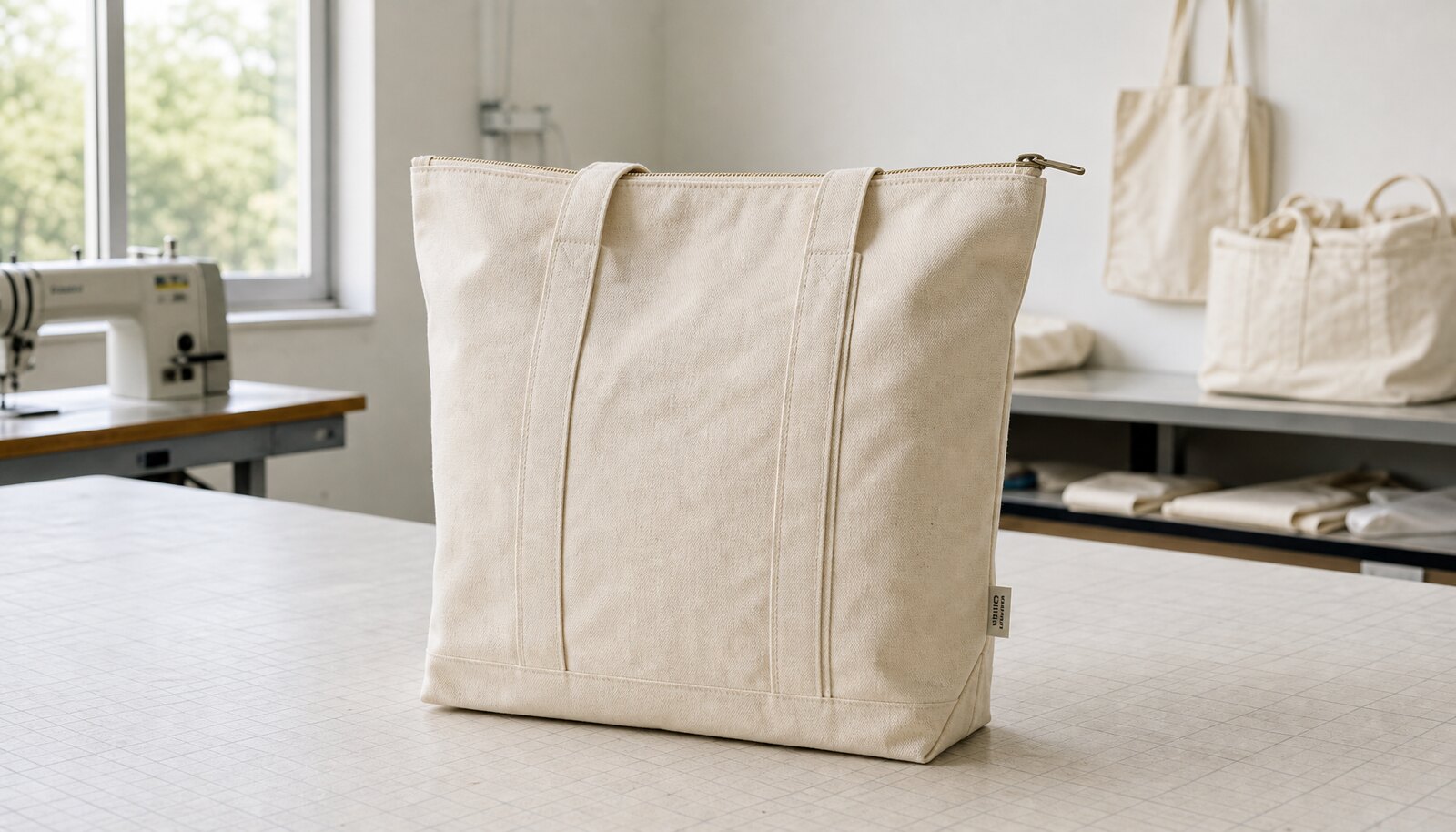
Why zipper canvas tote bags for ecommerce fail when the brief is too vague
Most sourcing problems start before the first sample. A buyer asks for zipper canvas tote bags for ecommerce, but the spec stops at size, logo, and color. That leaves the factory to decide the canvas weight, zipper grade, handle build, seam allowance, reinforcement pattern, and packing method. The quote may still arrive quickly, but the number is usually based on assumptions. Those assumptions are where later cost disputes, sample revisions, and production delays come from.
For ecommerce programs, the bag has to solve three different problems at once. It must look good on a product page, survive warehouse handling, and feel reliable to the end customer. If the zipper catches, the product looks cheap. If the canvas is too thin, the bag loses structure and creates returns risk. If the logo is printed too close to the zipper seam, the stitching can distort the artwork. This is why procurement teams need a spec that protects function, not only appearance.
A vague brief also creates comparison problems. One supplier may quote a 12 oz canvas bag with a standard nylon zipper and flat pack. Another may silently include heavier canvas, a custom zipper pull, and individual polybags. The unit price may look similar, but the commercial content is different. In buyer terms, that is not a clean comparison. A useful RFQ locks the build level first, then asks suppliers to price the same bag in the same commercial frame.
For ecommerce buyers, the safest thinking is to treat the tote like a small soft goods product, not a simple promotional item. That means defining the critical path: fabric, closure, handles, print, packing, inspection, and reorder stability. If the bag is part of a long-term assortment, the first quote should already reflect the intended repeat-order structure, not just a one-off sample build.
- Define the use case first: retail, gifting, grocery, subscription fulfillment, or promotional resale.
- Tie the order to a real load target and packing format rather than a generic “durable” request.
- Use one approved reference sample if possible; otherwise lock size, fabric, zipper, and handle separately.
Choose the canvas weight by use case, shipping method, and hand feel
For most zipper canvas tote bags for ecommerce, 12 oz to 16 oz is the practical range. The right choice depends less on trend and more on how the tote will be used. Twelve oz canvas works well when the bag must fold flat, ship efficiently, and stay cost-controlled. Fourteen oz is often the best balanced option for retail programs because it gives the bag more body without making it too stiff. Sixteen oz is better when the tote is meant to look more premium or hold heavier content, but it also increases sewing resistance and freight weight.
Procurement teams should ask how the factory measures fabric weight. Some suppliers quote the base cloth before washing, dyeing, or finishing; others refer to the finished fabric after treatment. Those are not interchangeable numbers. A canvas that seems thick in a hand sample may still distort around the zipper opening if the weave is loose or the finishing is uneven. This is especially important when the bag must stand on its own in ecommerce photography or arrive looking neat after flat packing.
The more useful question is not “what weight is best?” but “what weight fits the product promise?” A fashion tote sold as a premium accessory can justify heavier canvas and cleaner finishing. A subscription bag that is only used to hold an order, then stored, may do better with a lighter structure and tighter carton efficiency. Buyers should also ask whether the canvas is natural, bleached, dyed, enzyme-washed, or pre-shrunk, because these choices change color stability, shrinkage, and the final hand feel.
If the order will be reordered, weight consistency matters as much as weight selection. A factory that can source the same cloth across multiple lots is often more valuable than a supplier that offers a slightly lower first-price but cannot hold shade or texture from reorder to reorder.
- 12 oz is usually best for fold-flat, entry-price ecommerce bags.
- 14 oz is often the most balanced choice for retail value and structure.
- 16 oz makes sense when the bag is part of a premium assortment or needs higher load confidence.
- Ask whether the canvas is pre-washed or finished after weaving, because that affects shrinkage and final hand feel.
The zipper is the functional risk, so quote it as a real component
A zipper canvas tote is not just a tote with hardware added at the end. The zipper affects the cutting pattern, the top opening, the amount of seam bulk, and the time needed to sew each unit. A nylon coil zipper with a metal slider is usually the most practical production choice because it runs smoothly and is easier to sew into canvas than a stiff decorative zipper type. That does not mean metal zippers are wrong; it means they need more careful engineering and usually create more friction in production.
The buyer should specify more than zipper material. Length, tape color, slider finish, end stop style, and puller design all affect price and risk. A zipper that is too short leaves weak areas near the side seam. A zipper that is too long can create bulky corners and make the top edge difficult to finish cleanly. If the bag uses a branded pull tab or special color tape, those should be quoted separately so the team can see the true commercial impact.
It also helps to ask how the factory inserts the zipper. Some teams sew the zipper into a facing or binding, while others stitch directly into the top edge. Each method changes the look, the interior finish, and the chance of seam puckering. When zipper placement is close to printed artwork, the sewing line can shift the logo slightly. That is why the RFQ should include the artwork location measured from the zipper seam, not just a visual placement description.
For ecommerce, a smooth closure matters more than decorative hardware. Customers notice whether the bag closes in one motion. If the zipper sticks, splits, or bends at the ends, the tote feels lower quality even if the canvas itself is excellent. That is why buyers should ask for close-up sample photos and a simple functional test, not only beauty shots.
- Specify zipper length by finished opening, not just by bag size.
- Ask for a close-up of zipper ends, tape reinforcement, and inside seam finish.
- Confirm the slider material and whether the closure is tested under repeated open-close cycles.
- If the artwork sits near the top edge, ask for a sewing mockup or print placement proof.
Print method selection should follow artwork complexity and volume
Screen printing is usually the most economical route for simple logos, one to three colors, and medium-to-large orders. It is a good fit for cotton canvas because it generally gives strong opacity and a familiar retail look. The downside is that every color adds setup and alignment work. If the artwork is small, clean, and repeatable, screen print can be the strongest commercial option. If the artwork is detailed or has multiple tones, the buyer may need a different method.
Heat transfer is often used when the design is more complex or the order is short-run. It can handle more colors and fine detail, but procurement teams should pay attention to durability, sheen, and how the print behaves on textured canvas. A transfer that looks clean in a sample photo may still show edge lift or a plastic feel after folding. Embroidery can give a more premium impression, but it works best for small logos or limited coverage. On a thick canvas tote, dense embroidery near the zipper opening can pucker the fabric and change the way the zipper lies.
The best print decision also depends on where the artwork sits. A logo on the center front panel is much easier to manage than a mark close to the zipper line, because the zipper seam creates stiffness and can distort the print during stitching. If the bag has side labels, internal branding, or a secondary mark near the handle anchor point, the buyer should ask the factory which location is most stable in bulk production. A good supplier will tell you where the bag is easiest to control, not only what is possible in theory.
For ecommerce buyers, the print method should be chosen alongside the launch plan. If the design may change, screen setup charges can become expensive to revise. If the artwork is final and the volume is stable, screen print often gives the best landed cost. The question is not which method is trendy; it is which method gives the lowest risk for the order profile and the product page promise.
- Use screen print for simple repeat graphics and higher volume.
- Use heat transfer for short-run, multi-color, or detailed art where setup flexibility matters more than unit cost.
- Use embroidery only when the logo area is small enough to avoid puckering and when the premium look justifies extra labor.
- Measure artwork distance from the zipper and side seam so placement is consistent across samples and production.
Compare supplier routes by transparency, not just by price
Direct factories usually offer the best control for repeat zipper canvas tote bags for ecommerce because they can show where the bag is actually cut, sewn, printed, inspected, and packed. That matters. If the factory owns the sewing line, it is easier to control zipper alignment, stitch density, and top-edge finishing. If production is spread across subcontractors, the buyer may get a lower quote but less visibility when issues arise. For procurement teams, the issue is not “factory versus trader” in the abstract; it is who controls the real process.
Trading companies can still be useful. They may help buyers consolidate mixed SKUs, manage communication, or source accessory combinations that a small factory cannot handle smoothly. But the quote should be treated as a commercial bundle, not proof of production capability. Buyers should ask whether the trading company holds inventory, manages final inspection, or only passes the PO to a workshop. If the answer is unclear, the buyer should assume more risk and inspect more carefully.
Local converters can be the right answer when the timeline is short or the order is tied to domestic fulfillment. They may also be easier when packaging needs are specialized, such as hangtags, barcodes, or retail inserts. The tradeoff is often unit price. Local production can cost more, but it may reduce communication friction and shorten sample cycles. For urgent launches, that can be a worthwhile commercial exchange.
A practical comparison should therefore include lead-time credibility, process ownership, inspection visibility, and reorder stability. The cheapest quote is not necessarily the safest route if the supplier cannot explain how they will keep zipper tape straight, maintain shade consistency, or repeat the same spec six months later. For procurement, that repeatability is often the real value.
- Ask who cuts the canvas, who inserts the zipper, and who performs final inspection.
- Request the factory address, workshop photos, and a clear explanation of in-house versus outsourced steps.
- Use the same supplier route across comparison quotes so pricing and lead time are comparable.
- For repeat orders, prioritize process control and sample consistency over the lowest first-order price.
Read a factory quote as a cost map, not a single number
A useful quote for zipper canvas tote bags for ecommerce should separate the main cost drivers: fabric, zipper, handles, print, lining, labor, packing, and shipping terms. When these are bundled into one unit price, procurement loses the ability to see what changes during revision. The most common hidden costs appear when the buyer changes zipper color, adds a second print location, requests an insert card, or asks for barcode labels after the sample is approved.
The quote should also show whether the zipper is standard stock or custom sourced. Custom zipper tape color, branded pullers, or special slider finishes can increase both cost and lead time. Likewise, a lined bag is not just “a little more material.” It adds labor, extra seam steps, and more inspection points. If the quote does not show those differences, the team may think the supplier is expensive when the real issue is simply that the scope is broader than the comparison bag.
Another common trap is comparing quotes that use different commercial terms. EXW, FOB, and DDP are not the same number in practice. A low FOB price can become a higher landed cost once freight, export handling, and destination charges are included. The comparison should normalize the same incoterm, same carton quantity, same packing format, and same accessory set. If one supplier quotes 5,000 units and another quotes 10,000 units, ask whether the lower price reflects real efficiency or only better amortization of setup costs.
For procurement teams, the goal is not to squeeze every quote into a lowest-price spreadsheet row. The goal is to understand what you are buying so you can compare like with like. That includes knowing which items are standard and which are special, because the special items are where supplier margins, delays, and future reorder problems tend to hide.
- Ask for separate pricing for fabric, zipper, handles, print, lining, packing, and cartonization when possible.
- Normalize the same incoterm before comparing quotes.
- Watch for hidden setup charges on custom zipper colors, extra print locations, and packaging changes.
- If a supplier gives only one number, ask them to break out the materials and labor assumptions behind it.
MOQ logic should follow fabric stock, printing, and accessory availability
Buyers often hear one MOQ number and stop there, but zipper canvas tote bags for ecommerce usually have several MOQ drivers. Standard natural canvas with a standard zipper color may allow a lower minimum. Dyed canvas, custom zipper tape color, multiple print colors, lining, and special packaging can all raise the MOQ because the factory must source more components and run more setup steps. That is why a low MOQ quote may not mean low-cost production; it may simply mean the supplier is using stock materials and limiting customization.
The better RFQ asks for MOQ by component. This is more useful than asking for one blanket minimum because it shows where the order is becoming complex. If the factory says the zipper color requires a separate MOQ, procurement can decide whether to accept the standard color, redesign the bag, or increase the order volume. If the print color count is the issue, the team can simplify the artwork. If the carton spec is the problem, warehouse needs can be rebalanced against packaging cost.
There is also a commercial difference between “MOQ for the first order” and “reorder MOQ.” Some suppliers are willing to accept a lower launch quantity if they believe the design will repeat, while others will only quote a minimum that protects their setup cost. The reorder number can be more important than the launch number because it reveals whether the supplier has a stable process or is only flexible to win the first job.
A smart procurement team looks at MOQ alongside revision risk. If reducing MOQ forces the use of nonstandard fabrics, custom zipper colors, or unusual packing, the buyer may save volume but increase production uncertainty. In some programs, a slightly higher MOQ produces a cleaner, cheaper, and more reliable result overall. That is the kind of tradeoff a buyer should see before the PO is issued.
- Ask for MOQ by canvas color, zipper color, print color, and packaging format.
- Request pricing tiers at 1,000 / 3,000 / 5,000 / 10,000 pieces if the line may scale.
- Compare total landed cost, not just unit price, when low MOQ comes with extra setup fees.
- Clarify whether the MOQ changes for repeat orders versus the first development run.
Sample approval should test closure, shape, and print location together
A good sample review for zipper canvas tote bags for ecommerce should never focus only on the front view. The zipper needs to run smoothly from end to end. The opening should sit flat rather than twist. The logo should remain centered after the top seam is stitched. And the inside should be checked for loose threads, rough seam edges, or zipper tape that might rub against contents. These issues often appear after repeated handling, not in a staged sample photo.
The most useful sample test is practical. Close the bag with one hand. Open and close it several times. Put in a typical load that matches your ecommerce use case. Set the bag upright and see whether it keeps its shape. Then fold it the way it will be packed for shipping. If the zipper pull creates a hard crease, or if the top edge looks uneven once folded flat, the sample is telling you something important about the final user experience.
Sample approval also needs to separate cosmetic feedback from functional feedback. Color may be close enough on one lot and slightly different on another, but a zipper that catches or a handle that twists is not a minor issue. Buyers should mark sample comments by component: fabric, zipper, stitch, print, label, and packing. That level of detail helps the factory fix the right thing without guessing. It also makes later production follow-up much easier.
When the bag is intended for retail resale, request a clean sample with the final trim package, not a half-finished prototype. A prototype can prove the concept, but it does not always reflect production stitch lines, final packing, or the exact zipper behavior that mass sewing will create. Procurement should approve what will actually ship, not just what looks good on a worktable.
- Test zipper function on the actual sample, not only on a mockup.
- Approve the sample in daylight and in warehouse lighting if color matching matters.
- Write sample comments by component so the factory can correct issues cleanly.
- Check how the bag folds for packing, because fold marks often affect customer perception.
Quality control needs acceptance criteria, not just a general inspection promise
Quality control for soft goods is strongest when the buyer defines acceptable and unacceptable outcomes before production starts. For zipper canvas tote bags for ecommerce, the most important QC items are zipper function, seam quality, handle reinforcement, print durability, measurement tolerance, and carton pack accuracy. A supplier that says it will “check quality carefully” is giving a helpful sentiment, not a usable inspection standard.
A stronger QC plan states what counts as a major, minor, or critical defect. For example, a zipper that fails to close smoothly, separates under normal use, or jams at the seam intersection is a functional defect. Skipped stitches at the top opening, a handle that shifts after a practical pull test, or a print that is visibly misregistered can be treated as major defects. Small thread ends or minor folding marks may be acceptable if they do not affect appearance or use. The exact threshold should match the product’s selling price and channel expectations.
Inspection methodology matters too. A supplier should not rely only on visual checks. Ask whether the factory performs in-process inspection during sewing, final random inspection before packing, and pre-shipment carton verification. For a larger order, it is reasonable to ask for random sampling rather than a 100% claim that is hard to prove. If the buyer uses an outside inspection firm, the factory should still be able to provide batch records, measurement points, and internal check results.
The best QC discussions include evidence, not just words. Buyers can ask for production photos of zipper insertion, top-edge stitching, and first-run output. They can also request fabric composition confirmation, dye lot records where relevant, and any test reports the factory already holds for material or accessory verification. That is how procurement moves from “please make it good” to a documentable acceptance process.
- Define major, minor, and critical defects before bulk production starts.
- Set tolerance limits for bag dimensions, zipper length, handle drop, and print placement.
- Ask for in-process inspection, final inspection, and pre-shipment carton verification, not just one end-stage check.
- Request evidence such as batch photos, measurement records, and accessory confirmation documents.
- If the order is retail-facing, include a simple rub or handling check for the print and surface finish.
Sourcing verification should go beyond photos and one approved sample
One of the biggest risks in sourcing zipper canvas tote bags for ecommerce is believing that factory photos prove factory capability. They do not. Photos can show sewing machines, sample rooms, and finished bags, but they do not tell you whether the plant actually owns the line that will make your order. Procurement teams should ask who cuts the canvas, who handles zipper insertion, who inspects the final goods, and whether any step is outsourced. That question alone often reveals how much control the supplier really has.
A useful verification process includes asking for recent production photos that match your build type, not generic bag images. Look for close-ups of the zipper end, inside stitching, seam alignment, handle anchors, and carton packing. If the supplier claims specialty capability, ask for supporting evidence such as material composition confirmation, supplier declarations, test reports, or third-party certificates where applicable. Not every order needs formal lab testing, but the buyer should know what evidence exists and what is only verbal assurance.
If a factory says it can match a specific canvas hand feel or color, ask how it controls shade. Some suppliers use stored swatches, some use Pantone references, and some rely on visual matching. Those are very different systems. Similar logic applies to zipper hardware and pullers. If the factory cannot explain its material sourcing path, there is a greater chance of inconsistency on reorder. Procurement does not need to turn every order into a lab project, but it should know what level of verification is available if the buyer wants repeatability.
A practical vendor audit does not need to be elaborate. It can be a short checklist: who owns the sewing line, what percentage of work is in-house, how incoming materials are checked, what inspection tools are used, how defective panels are handled, and how batch traceability is recorded. Those answers are often more helpful than general claims of “good service” or “high quality.”
- Ask for photos of the actual production line that will handle the order, not only the sample room.
- Request evidence for material composition, zipper sourcing, and any existing test reports or certificates.
- Verify who controls cutting, zipper insertion, finishing, inspection, and packing.
- Ask how the factory tracks shade lot, accessory lot, and batch traceability for reorders.
Specification comparison for buyers
| Spec decision | Recommended option | When it fits | Cost / lead-time impact | Buyer risk to check |
|---|---|---|---|---|
| Fabric weight | 12 oz to 16 oz cotton canvas, with the weight stated in oz or GSM and tied to the finished wash state | Best for retail-ready ecommerce totes that need structure, print clarity, and a premium hand feel without becoming too heavy | Heavier fabric raises material cost, sewing resistance, and freight weight; pre-washed canvas can extend lead time if dye lots need matching | If the fabric is too light, the bag may collapse and wrinkle; if too heavy, the bag can feel bulky for fold-flat fulfillment and may stress the zipper seam |
| Zipper type | Nylon coil zipper with a metal slider, standard tape color where possible | Suitable for high-volume sewing, smoother closure, and lower defect risk than stiff decorative zipper types | Standard zipper colors reduce sourcing time; custom tape or branded pulls add setup time and may raise MOQ | Check zipper length, end reinforcement, and whether the slider jams at the side seam or catches lining/facing |
| Handle construction | Self-fabric handles for a cleaner brand look, or cotton webbing handles for higher load confidence | Use self-fabric for fashion and gift retail; use webbing when load confidence and lower stretch matter more than visual softness | Webbing is often faster to source; self-fabric handles may require extra cutting, folding, and stitching labor | Handle attachment is a common failure point; verify reinforcement stitch pattern, stitch density, and seam allowance |
| Print method | Screen print for simple logos and repeat orders; heat transfer for short-run multicolor artwork; embroidery only for small premium marks | Choose based on artwork complexity, order quantity, and whether the design sits close to the zipper seam | Screen print usually has the best unit economics at scale; heat transfer may reduce setup but can add durability risk; embroidery adds labor and may slow production | Print distortion near the zipper, wash durability, and color consistency are the main concerns |
| Lining | Unlined for lowest cost; cotton or poly-cotton lining for cleaner interiors and better perceived value | Use lining when the bag is sold at a higher price point, needs a neat interior, or carries smaller items | Lining adds labor, materials, and inspection time; it can also increase sample revision cycles | Poorly attached lining can hide stitching defects, interfere with zipper operation, or create bulk at the top edge |
| Bottom structure | Flat sewn bottom for efficiency, or light gusset around 10 to 15 cm for more usable volume | Use a modest gusset when the tote must stand a little better or hold boxed ecommerce goods | More structure means more pattern complexity, more sewing time, and potential carton-size changes | Too much gusset on light fabric can make the bag sag; too little gusset may limit functional capacity |
| Supplier route | Direct factory with tote specialization for repeat programs; trading company only when coordination value is clear | Best when the design will be reordered, revised, or quality-controlled across multiple production runs | Direct factory pricing is usually more transparent; trading companies may add margin but can help with consolidation or communication | Verify who actually cuts, prints, sews, inspects, and packs the goods before comparing prices |
| Packing method | Flat pack with agreed folding method, insert card if needed, and standardized carton spec | Ideal for ecommerce warehousing, carton density, and clean shelf presentation after unpacking | Tighter packing can improve freight efficiency but requires clearer folding instructions and better zipper protection | Loose folding, inconsistent carton fill, or crushed zipper pulls can create customer complaints and repacking work |
| MOQ logic | MOQ tied to fabric stock, print colors, zipper color, and finishing complexity rather than one blanket number | Best for launch testing, SKU variety, and staged replenishment | Lower MOQ may still carry high setup fees; custom materials can raise lead time even if unit quantity is small | Watch for low MOQ claims that hide expensive setup charges or force the buyer into stock-only options |
Buyer checklist before sampling
- Confirm finished size, gusset depth, handle length, zipper length, and whether the zipper closes edge-to-edge or stops before the side seam.
- Specify canvas weight in oz or GSM, and state whether that weight is pre-wash, post-wash, or after finishing.
- Name the print method, print area, number of colors, and required artwork distance from the zipper seam.
- State the intended use case: grocery, fashion retail, gifting, subscription fulfillment, or promotional resale.
- Set a practical load target in kilograms and ask the factory to confirm whether the handle and zipper area are built for that use.
- Approve zipper sample action: smooth pull, no catching at seam ends, no visible puckering, and no teeth misalignment.
- Define packing format, individual polybag requirement, insert card size, carton pack count, and barcode placement.
- Ask for first-output photos showing zipper alignment, top-edge stitching, print registration, and handle reinforcement before bulk continues.
- Request a written lead time split between sample, material sourcing, bulk production, inspection, and export packing.
- Ask for a defect standard or inspection basis, not just a promise of “good quality.”
Factory quote questions to send
- What canvas weight do you recommend for this bag size, and is the quoted weight before or after finishing or washing?
- Which zipper construction will you use: nylon coil, molded, or metal, and what is the slider material and finish?
- Can you confirm the zipper length relative to the finished opening, and how are the zipper ends reinforced?
- Is the handle construction self-fabric, webbing, or folded tape, and what reinforcement stitch is used at the seam ends?
- What is your MOQ by fabric color, print color, zipper color, and packaging format?
- Can you quote separate prices for unlined, lined, and gusseted versions so we can compare cost tradeoffs?
- What print method do you recommend for our artwork, and what setup charges, screen charges, or color-change charges apply?
- Can you provide a sample timeline and tell us whether the sample includes zipper function approval and final color matching?
- How will the goods be packed for ecommerce fulfillment, and what carton size, carton weight, and carton count do you propose?
- What QC checks do you perform on zipper function, seam strength, print durability, and carton pack accuracy before shipment?
Quality-control points to confirm
- Zipper opens and closes smoothly for at least 20 full cycles on a sample pull test without snagging, splitting, or catching at seam intersections.
- Top seam around the zipper tape should show even stitch density, no skipped stitches, no thread breaks, and no puckering that distorts the opening.
- Handle anchor points should use reinforced stitching and hold a practical load test that matches the intended use case, not just a visual check.
- Print registration should remain within the agreed tolerance and should not crack, smear, or peel after rubbing and folding.
- Bag dimensions should stay within agreed tolerance, especially opening width, gusset depth, body height, and handle drop.
- Canvas surface should be free of oil stains, broken yarns, holes, hard creases, and shade variation beyond the accepted lot standard.
- Cartons should match the packed quantity, protect zipper pulls from crushing, and preserve the agreed folding direction.
- Pre-shipment inspection should include random checks on zipper tape alignment, inside stitching, label placement, folding consistency, and carton mark accuracy.
- Acceptance criteria should be written before production begins, including the allowed defect rate for major, minor, and critical defects.
- If the order is for retail resale, add a simple rub test or functional handling test to confirm the bag still looks acceptable after normal use.