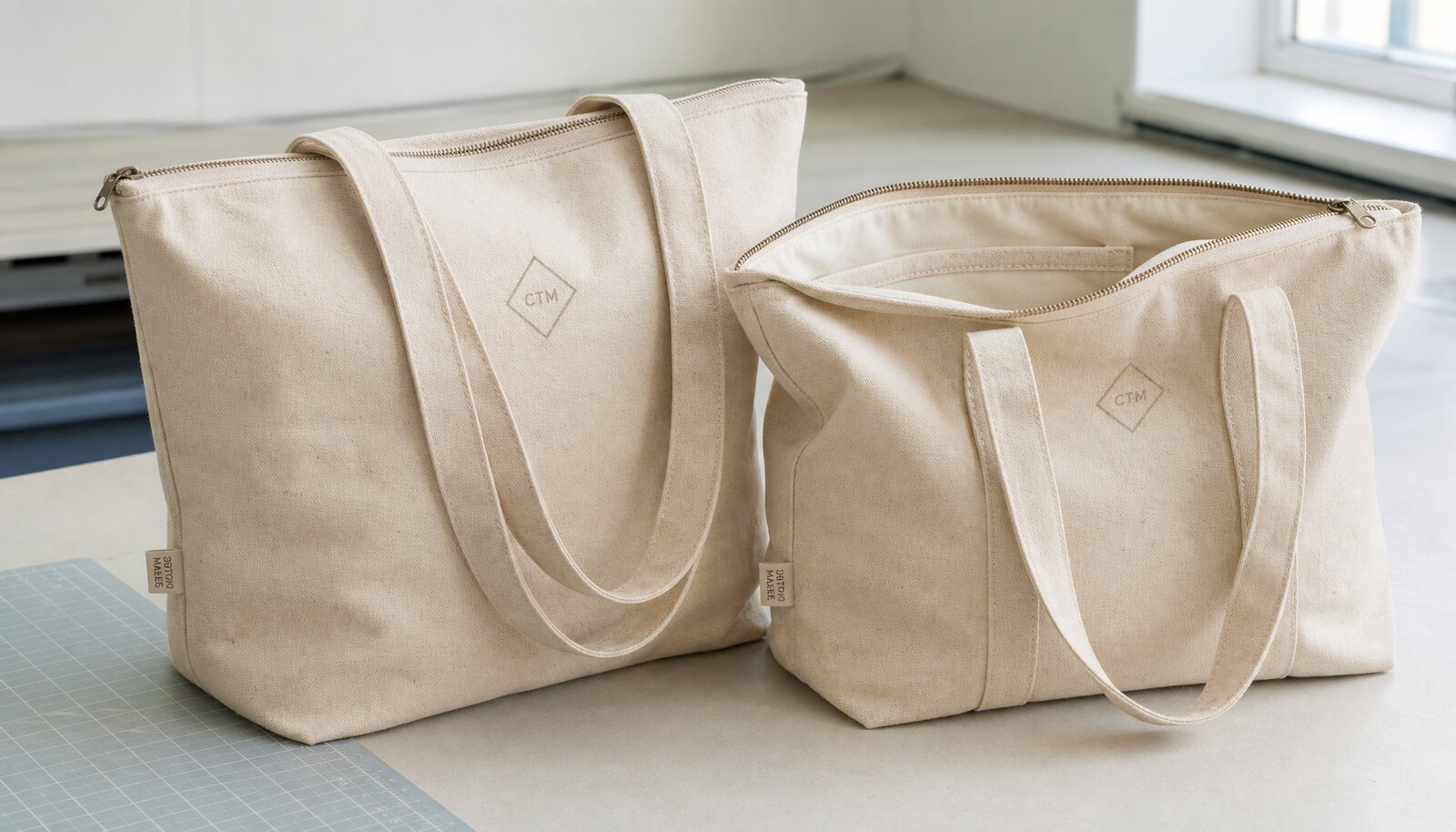
What a zipper canvas tote bag buyer is really buying
A zipper canvas tote bag is not just a canvas tote with a closure added on top. The zipper changes the sewing sequence, the usable opening, the packing method, and sometimes the whole cost structure. If you buy it like a standard open-top tote, you can end up with poor zipper alignment, a tight mouth opening, or a bag that feels awkward at retail.
For procurement teams, the real buying decision is whether the bag needs to protect the contents, look premium on shelf, or simply reduce spill risk during transport. That answer drives the fabric weight, zipper style, lining choice, and printing method far more than the artwork does.
- Retail use usually needs a cleaner finish, tighter stitching control, and a zipper that closes smoothly after packing.
- Promotional use can tolerate simpler construction, but only if the quote clearly separates bag body cost from print and zipper cost.
- If the bag will carry laptops, catalogs, cosmetics, or gift items, the opening width and reinforcement matter as much as fabric GSM.
Choose the right canvas weight before talking about print
Most zipper canvas tote bags are quoted in the 10–16 oz range, or roughly 340–540 GSM depending on the supplier’s measurement method. For a standard retail bag, 12 oz canvas is often the practical middle ground: sturdy enough to hold shape, not so heavy that sewing and zipper insertion become expensive. If the brand wants a firmer silhouette, 14 oz or 16 oz gives a more substantial handfeel and hides the zipper line better.
The wrong fabric weight creates problems that show up after approval, not before. Light canvas can ripple around the zipper, especially near the top corners. Very heavy canvas can make the top edge bulky and can slow down production if the factory’s sewing line is not set up for thicker seams. Always tie fabric weight to use case, not to a marketing statement about durability.
- For everyday retail totes, 12 oz canvas is a common starting point.
- For premium merchandising or gift programs, 14–16 oz may justify the extra cost.
- If the bag is large, increase fabric weight or reinforcement at the handle and zipper junction.
Zipper construction drives the real user experience
A zipper can make the bag feel secure or cheap. Nylon coil zippers are common because they run smoothly and are easier to sew into canvas seams. Metal zippers can look more premium, but they add weight, cost, and more risk of edge stiffness if the bag is not designed around them. For most bulk programs, a quality nylon coil zipper with a decent slider is the safest purchasing choice.
The buyer should care about zipper length, stop position, slider puller style, and the exact opening width after sewing. If the zipper is too short or sewn too deep into the seam, customers will complain that the bag is hard to load. If it is too long, the top edge can lose structure or expose weak stitching at the ends.
- Specify zipper tape color, slider finish, and puller length if brand appearance matters.
- Ask for a run test on samples; one smooth sample does not guarantee a stable bulk lot.
- Check whether the zipper is inserted before or after lining attachment, because that affects finish quality and lead time.
Print method should match order size, artwork complexity, and selling price
For zipper canvas tote bags, print method is usually a cost and quality tradeoff. Screen print is efficient for simple one- or two-color logos, especially when the design repeats across a larger order. If the artwork has many colors, gradients, or small text, heat transfer or digital transfer can work better for short runs, though the surface feel and durability may differ.
The important sourcing point is placement. A zipper changes the available print zone, so artwork near the top edge can distort if it crosses seams, zipper tape, or folded facings. Many quote disputes come from artwork that looked fine on a flat mockup but was never adjusted for the actual sewn bag.
- Screen print: best for clean logos, lower unit cost at volume, and strong visual consistency.
- Heat transfer: useful for short-run multi-color designs, but confirm rub resistance and long-term adhesion.
- Embroidery: suitable for premium branding, but test backing thickness and panel distortion near the zipper.
What drives MOQ and why low MOQ is not always cheaper
MOQ for zipper canvas tote bags is usually driven by fabric stock, zipper sourcing, print setup, and whether the factory is cutting from common stock or buying special materials. A factory may offer a low MOQ for natural canvas with a simple print, but raise the threshold if you want custom dyed fabric, a specific zipper color, or private packaging. Buyers should never compare only the headline MOQ without seeing the hidden setup cost.
A lower MOQ often comes with a higher unit price because the factory spreads cutting, printing, zipper preparation, and QC overhead across fewer pieces. If you are testing a new retail SKU, that may still be the right move. If you already know the bag will repeat, a slightly higher MOQ can reduce the landed cost enough to change your margin.
- Ask whether MOQ is by style, color, print version, or carton configuration.
- Check if the supplier can combine colors or artwork versions in one bulk run.
- Look at setup charges separately from unit price so the quote is comparable.
How to compare supplier quotes without getting misled by the unit price
A good quote for zipper canvas tote bags should show the bag body spec, zipper specification, print method, packing, and lead time in a way that lets you compare like for like. If one supplier quotes 12 oz canvas with a basic nylon zipper and another quotes 14 oz canvas with reinforced corners and a branded puller, the cheaper unit price is not automatically better. It may just be thinner, slower wearing, and less suitable for retail display.
When reviewing quotes, build a simple landed-cost view: ex-factory price, internal packing, cartons, sample cost, inland movement, and expected defect risk. Even a small difference in zipper quality can change the true cost if the bag has to be reworked or relabeled. Procurement teams should request evidence, not just numbers, from each supplier route.
- Compare the same fabric weight, same print count, and same zipper type across all quotes.
- Watch for quotes that exclude lining, inner labels, or custom packing and then add them later.
- If a supplier cannot explain seam construction or zipper spec, treat the quote as incomplete.
Supplier options: direct factory, trading company, or local converter
For zipper canvas tote bags, the best sourcing route depends on how custom the bag is and how much control you need. A direct factory is usually the strongest option for repeat programs because it gives you better visibility into sewing quality, zipper sourcing, and bulk scheduling. A trading company can be useful when you need mixed product sourcing or faster communication, but you should verify whether they control production or only pass along the order. Local converters may be good for very small runs or urgent replenishment, but cost per unit can be higher.
The sourcing route matters because zipper bags are more sensitive to production discipline than open-top totes. If the supplier lacks in-house control of cutting and zipper insertion, you may see inconsistent opening width, crooked top edge stitching, or mismatched print placement. Buyers should match the supplier type to the order complexity, not just the price.
- Direct factory: best for stable repeat orders and detailed QC control.
- Trading company: useful for multi-item procurement, but require proof of actual factory line control.
- Local converter: good for urgent small batches, but often less competitive on scale.
Comparison table: sourcing routes and what each one really gives you
The table below is more useful than a basic spec sheet because it compares sourcing routes by the risk points that matter in zipper canvas tote bags: control of zipper quality, print placement, packing, and cost transparency. For an RFQ, this is often the first filter before you even discuss artwork.
If you are launching a new bag, start with the route that matches your risk tolerance. If the SKU must be consistent across several seasons, a direct factory usually gives the cleanest path to stable quality and repeatability.
- Write decisions in measurable language, not only descriptive wording.
- Ask for sample photos plus one physical approval sample for important orders.
- Keep quotation, sample approval, and inspection notes tied to the same spec version.
Sample approval: the stage where most buyer mistakes are still fixable
Before bulk production, insist on a sample that reflects the real zipper, real fabric weight, and real print method. A flat artwork proof is not enough. The sample should show how the zipper sits when closed, how the bag opens when loaded, whether the top edge stays straight, and whether the print area survives the sewn construction without distortion.
Good sample approval is practical, not ceremonial. Open and close the zipper repeatedly, load the bag with the approximate product weight, and inspect the inside seam finishing. If the zipper pull catches at the corner or the bag collapses at the top edge, the issue should be fixed in the sample stage, not after 10,000 pieces are packed.
- Compare the sample against a written approval sheet with size, color, fabric weight, zipper type, and print position.
- Approve only after checking the bag both empty and loaded.
- Keep one sealed golden sample signed and dated for bulk reference.
Packing, carton design, and lead time controls
Packing for zipper canvas tote bags should protect the shape and keep receiving simple. Flat pack works for most programs, but the bag must be folded in a consistent way so the zipper edge does not crease the print area. For retail-ready delivery, add a size label, barcode sticker, and clear polybag if your channel requires it. For warehouse bulk, carton count and carton dimensions matter because they affect freight efficiency and storage space.
Lead time is often underestimated because zipper sourcing and print approval can both delay the schedule. A realistic project should allow time for sample approval, pre-production confirmation, bulk sewing, inspection, and carton packing. If the zipper color or fabric color is custom, material booking can become the longest lead-time item, not sewing.
- Confirm whether cartons are test-stitched or merely taped; heavy bags can break weak cartons in transit.
- Ask for carton packing count that balances handling ease and freight density.
- If the bag includes a printed logo near the top edge, require a folding method that avoids print cracking.
Specification comparison for buyers
| Spec decision | Recommended option | When it fits | Buyer risk to check |
|---|---|---|---|
| Main fabric weight | 12 oz canvas for balanced handfeel and cost | Retail bags, promotional programs, standard carry use | Too light can sag under zipper tension; too heavy can raise cost and make sewing harder |
| Premium fabric weight | 14–16 oz canvas for a firmer body | Higher perceived value, structured retail SKUs, gift sets | Need stronger sewing setup and more careful zipper alignment to avoid puckering |
| Zipper type | Nylon coil zipper with metal puller | Most retail and bulk programs | Cheap zippers fail on smoothness; confirm tape color, slider quality, and cycle expectation |
| Closure design | Top zipper with full-length opening | When product security or dust protection matters | If opening is too narrow, end users dislike access; verify mouth width and zipper stop placement |
| Printing method | Screen print for simple artwork, heat transfer for multi-color short runs | Simple logos, event bags, controlled artwork cost | Print distortion near seams and zipper edge; confirm safe print zone and wash/rub tolerance |
| Bag structure | Simple unlined body or partial lining depending on retail level | Unlined for lower cost, lined for better finish and item protection | Unlined bags may show seam allowance and zipper tape; lining adds cost and lead time |
| Supplier route | Direct factory with sewing and printing in-house | Best for repeat orders, custom specs, and tighter cost control | Need proof of real production capacity, not a trading-only quote |
| MOQ strategy | Tiered MOQ by fabric/color/print complexity | Useful when testing a new SKU or retail launch | Low MOQ can hide setup fees; compare landed cost, not only unit price |
| Packing method | Flat pack with size label and carton barcoding | Ecommerce, distributors, and warehouse receiving | Bulk compression can crease printed areas; verify carton pack count and inner packing method |
Buyer checklist before sampling
- Lock the finished size, usable opening width, gusset depth, and handle drop before requesting quotes.
- Specify fabric weight in ounces or GSM, plus whether you want natural, bleached, dyed, or printed canvas.
- State zipper preference: coil, metal-look, nylon, with puller style and color requirement.
- Define print location, number of colors, and whether artwork crosses seams, zipper tape, or side panels.
- Request a sample of zipper operation, seam strength, and color match before bulk approval.
- Confirm carton pack count, polybag requirement, barcode label, and master carton dimensions.
- Ask for lead time by stage: sample, pre-production, bulk, and shipment booking.
- Compare quotes on the same basis: fabric, zipper, print, lining, packaging, and inland handling.
Factory quote questions to send
- What exact canvas weight, weave count, and finish are you quoting for zipper canvas tote bags?
- Which zipper brand, slider type, and stop construction are included in the price?
- Is the quoted price based on printed, blank, lined, or unlined bags?
- How many print colors are included, and what is the setup charge per color?
- What is the MOQ by color and by artwork version, and how does price change at each tier?
- Can you share sample photos or a pre-production sample before bulk cutting?
- What carton pack quantity, carton size, and outer mark are included in your packing quote?
- What is your production lead time after sample approval, and what events can delay it?
- What QC standard do you use for seam strength, zipper smoothness, and print placement tolerance?
Quality-control points to confirm
- Fabric weight tolerance: confirm canvas within an agreed range, typically ±5% unless the order is very price sensitive.
- Zipper function: slider must run smoothly from end to end with no snagging at the seam allowance or zipper ends.
- Stitching density: major load seams should use consistent stitch length and no skipped stitches at handles or zipper corners.
- Handle attachment: reinforce stress points with bar-tacks or dense backstitching where the handles join the body.
- Print registration: artwork should stay within the approved placement window and not collide with zipper tape or seam lines.
- Color consistency: natural canvas and dyed canvas should be checked against the approved lab dip or reference sample.
- Odor and cleanliness: no oil marks, broken threads, metal filings, dust, or cutting debris inside the bag or carton.
- Packing accuracy: count, label, and carton marks must match the PO, especially for multi-color or multi-SKU orders.