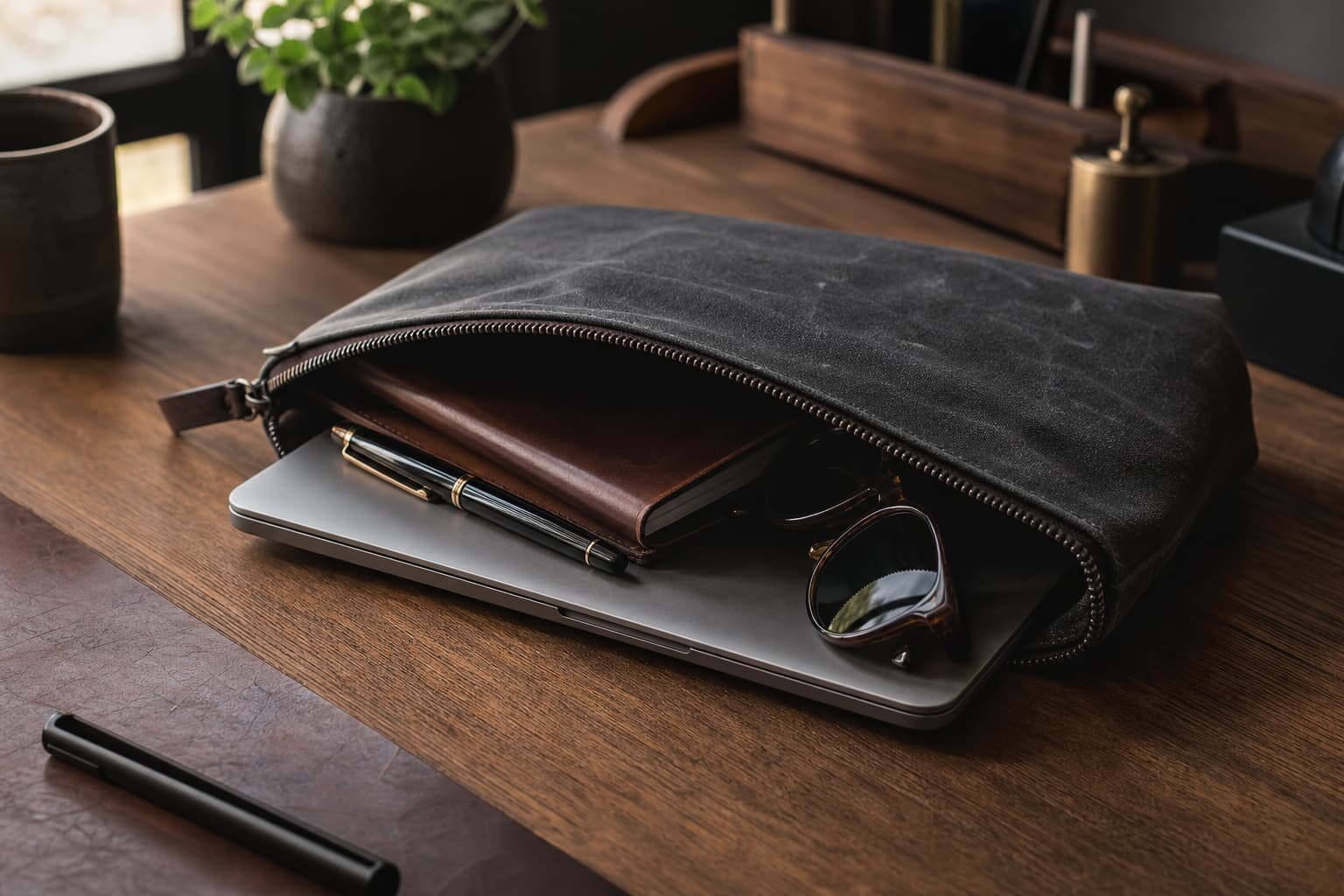
Why the photo packet matters
A zipper business bag can look simple on paper and still fail at the logo stage. The usual problem is not the artwork itself but the placement: a logo lands too close to the zipper, crosses a seam, sits lower than the buyer expected, or shifts from one side of the bag to the other after the factory interprets the brief. A photo packet turns the placement into something the buyer and factory can see the same way. That matters more than a long email thread, because logo position is a visual decision with production consequences.
For procurement teams, the packet is a control document, not a marketing asset. It should show what the bag looks like before approval, what area is reserved for decoration, and what is not acceptable. If you are sourcing multiple zipper business bag variants, use one packet per style code and one packet per logo method. That keeps a quote for a 12 oz canvas business bag with screen print from being mixed up with a 300D polyester bag that needs heat transfer or a woven side label.
- Use the packet to lock the visible placement, not just the logo artwork.
- Treat every distinct logo position as a separate sourcing decision.
- Keep one approved packet tied to one PO, one style code, and one decoration method.
What belongs in the packet
A useful photo packet should do more than show a nice front view. Include the bag closed, open, front-on, back-on, side-on, and from a diagonal angle that reveals the zipper line and the top seam. Add close-ups of the decoration area and the nearby construction details such as binding, pocket opening, seam allowance, and zipper tape. A ruler, measurement card, or printed grid should appear in at least one image so the factory can read scale, not guess it. If the bag has a lining, inner pocket, or hanging loop, show those too because they can affect where the logo can safely sit.
The packet should also note what kind of sample the buyer wants back. If you need a photo of the strike-off, say so. If you need a physical preproduction sample with the final zipper puller and final label, say that clearly. A packet that only contains one glamour shot leaves too much room for interpretation. A packet that contains clear views and a short note for each view gives the supplier fewer chances to place the logo on the wrong panel or quote the wrong production method.
- Front view, back view, side view, open-bag view, and zipper-closed view.
- Close-up of the logo zone with ruler or scale reference.
- Notes on which panel is approved, which panel is prohibited, and what must stay visible after packing.
Set the logo zone before you ask for quotes
Do not ask factories to quote a zipper business bag until the logo zone is defined. A supplier can usually price the same body in several ways, but the quote changes once the logo must sit in a specific place, avoid a pocket, or clear a curved zipper line. If the artwork is meant for the front panel, define the distance from the top edge, from the side seam, and from the zipper pull travel path. If the artwork belongs on a side tab or label, define the width, stitch margin, and whether the label can wrap around a seam.
This is where many RFQs fail. Buyers often send a logo file without explaining whether the mark is centered, left aligned, or placed low for an understated look. For canvas bags, a front panel printed in the upper third behaves differently from a lower corner logo that sits near the bottom seam. For polyester bags, a transfer placed over a curved pocket may wrinkle after folding. The packet should state the no-go zones first, then the approved zone, then the acceptable tolerance.
- Give the factory a centerline, a top-edge distance, and a side-edge distance.
- Mark every seam, zipper track, pocket opening, and binding line that the logo must avoid.
- State whether the placement must be identical on both sides or only on the front panel.
Choose the print or label method by fabric
Logo placement and logo method are linked. A 10-16 oz cotton canvas business bag can usually accept screen print cleanly if the artwork is simple and the panel is flat enough. Heavier canvas, twill, or dense woven polyester can support embroidery, but only if the logo area has enough flat space and the backing will not make the bag bulky. Smooth synthetic fabrics are better suited to heat transfer or a sewn patch when the artwork is detailed or multicolor. The right choice is not the fanciest method; it is the method that survives sewing, packing, and day-to-day use without distorting the logo.
Ask for fabric weight in both oz and GSM where possible. For cotton canvas, 10 oz, 12 oz, and 16 oz references are common ways to discuss body weight, while many buyers also want GSM for direct comparison. For polyester business bags, 300D and 600D are common shorthand. If the factory cannot tell you how the decoration behaves on the exact fabric, ask for a sample on the same body cloth rather than a generic swatch. A logo that looks sharp on a test card can still fail when applied to the actual zipper bag body.
- Screen print fits simple logos and flat panels with enough open area.
- Embroidery fits premium looks but needs space, stabilizer, and a clean backing plan.
- Heat transfer fits smooth synthetics and detailed art, but needs adhesion and abrasion checks.
- Woven labels and patches are useful when the buyer wants subtle branding or a premium finish.
Build the quote so setup costs are visible
A serious quote for a zipper business bag should separate the bag body from the logo work. If the supplier sends one lump sum, you cannot tell whether the quote changes because of fabric weight, zipper quality, placement complexity, or decoration method. The buyer should ask for line items that show the bag body, zipper, puller, lining, logo setup, sample charge, and packing format. That makes it easier to compare suppliers who may be quoting the same bag with very different assumptions.
MOQ logic matters just as much as the unit price. One logo method may need a screen or plate that is cheap to repeat but expensive to set up. Another may need digitizing, woven label tooling, or a minimum number of patches. A bag with two logo positions may be quoted as one style or as two styles depending on how the factory tracks production. Make the supplier tell you whether the MOQ changes with the number of logo colors, the number of placement zones, and the bag color selected by the buyer.
- Request separate costs for body, decoration setup, sample, packing, and carton marks.
- Ask whether one logo placement or multiple placements changes the MOQ.
- Ask whether the quote includes one strike-off, one revised strike-off, or only bulk production.
Sample approval checks that actually matter
The first sample should be judged like a production sample, not like a show sample. Measure the logo from a fixed edge, usually the top seam or side seam, and compare it with the packet. Check the closed bag, then open the zipper and check again, because some placements look centered only when the bag is closed. A front-panel print may sit correctly at rest but drift visually once the bag is stuffed or folded. Photograph the sample in the same angles you used in the packet so later revisions can be compared without argument.
Do not approve a sample because the artwork itself looks clean if the placement is off by a few millimeters. On zipper business bags, a few millimeters can be enough to make the mark collide with the zipper tape, disappear into a seam, or look lopsided next to a pocket edge. Typical buyer tolerances should be written into the packet or approval note. Screen print may allow a wider visual tolerance than a woven label or a logo stitched close to a seam, but every method still needs a clear pass or fail rule.
- Measure centerline, edge distance, and height from top seam.
- Check the bag both closed and open.
- Confirm color, registration, stitch density, and any backing or adhesive residue.
- Approve only after the final zipper puller, label, and packing method are in place.
Bulk production controls and acceptance criteria
Once the sample is approved, the factory still needs controls during bulk production. Ask for a first article check on the first sewn pieces and a photo of the first decorated bag before the run continues. If the logo placement is off, it is cheaper to stop early than to correct hundreds or thousands of units later. For larger orders, ask the supplier to keep one approved sample at the line and one at the quality station so operators can compare the actual placement against the reference without opening older cartons.
Lead time should be discussed in two parts: sample lead time and bulk lead time. A common mistake is to assume the quote timing includes artwork confirmation, screen making, strike-off, and any required corrections. If the logo method changes after sample approval, the schedule usually resets. Buyers should also understand that a complex placement near a seam, zipper, or pocket can slow the line because operators must handle the bag more carefully to avoid misalignment or print distortion.
- Set a first article approval before bulk sewing continues.
- Keep one signed sample at the factory and one with the buyer.
- Separate sample lead time from bulk lead time in the RFQ.
- Treat placement changes after approval as a new revision, not a casual edit.
Packing and shipping can change the logo look
Packing matters because a zipper business bag is often folded, nested, or compressed before shipping. If the decorated area is placed where the fold line lands, the print can crease or the embroidery can flatten. If the bag is packed too tightly in a polybag, the front panel may pick up a pressure mark that looks like a logo defect even when the decoration itself is fine. The buyer should tell the factory whether the decorated face must stay flat, whether a tissue insert is needed, and whether the logo should remain visible through the bag or be protected from rubbing.
Carton marking also matters for replenishment and retail programs. Ask for the outer carton mark, inner polybag count, and whether any barcode or SKU label will sit near the decorated face. If the bag has a side label or woven tab, make sure the packing method does not twist it inward. For retail buyers, a neat fold line can be as important as the logo itself, because a crooked fold can make a perfectly placed mark look incorrectly positioned when the carton is opened.
- Avoid fold lines across the decorated area.
- Specify polybag count, carton count, and any tissue or insert needs.
- Confirm the logo remains visible and undamaged after packing and carton compression.
Common RFQ mistakes and how to avoid them
The most common mistake is sending one logo file and assuming the supplier will know where it belongs. The second is failing to state the fabric weight, because a logo that looks acceptable on one canvas weight may sit differently on another. Another frequent issue is mixing several zipper business bag variants in one request without separating the placement rules. A supplier may quote the body correctly but move the logo because the sample photos did not prove which panel was approved. Buyers also forget to ask for a close-up of the decorated area, which makes it hard to judge stitch density, edge sharpness, or registration.
A cleaner process is simple: create one photo packet, one written placement note, and one approval sample for each SKU. If the buyer wants side-label branding on one version and front-panel print on another, separate them at the RFQ stage, not after sampling begins. The goal is not to burden the factory with paperwork. The goal is to make the quote comparable, the sample repeatable, and the bulk run boring in the best possible way.
- Do not rely on a single lifestyle photo to define placement.
- Do not skip fabric weight, zipper type, and panel dimensions.
- Do not mix front print, side label, and pocket branding in one vague instruction.
- Do not approve a sample without a ruler photo and a signed reference.
Specification comparison for buyers
| Spec decision | Recommended option | When it fits | Buyer risk to check |
|---|---|---|---|
| Front-panel screen print | One- to two-color print on 10-16 oz canvas or similar textured fabric | Best for simple logos, larger artwork, and moderate to high repeat volume | Check print bleed, ink hand feel, cure quality, and exact distance from zipper and seams |
| Embroidery on upper panel | Dense embroidery with stabilizer on heavier canvas or twill | Best for premium business bags where a textured mark is acceptable | Check puckering, stitch density, reverse backing, and whether the logo fits the available flat area |
| Woven side label | Small woven label stitched into side seam or side panel | Best for subtle branding, low-profile corporate gifts, or repeated reorders | Check fold direction, seam allowance, label visibility, and whether the label distorts when packed |
| Heat transfer on smooth body fabric | Transfer print on 300D or 600D polyester and coated synthetics | Best for multi-color logos or when screen setup is not economical | Check adhesion, abrasion resistance, and whether the surface texture accepts the transfer cleanly |
| Deboss or patch branding | Debossed PU patch or sewn-on synthetic leather patch | Best for elevated presentation bags or executive-style business bags | Check patch size, relief depth, cracking risk, and whether the patch placement conflicts with zipper travel or top stitching |
Buyer checklist before sampling
- Confirm the exact bag style, dimensions, fabric weight in oz or GSM, and whether the logo will go on the front panel, pocket, side panel, or label tab.
- Send a placement photo packet with front, back, side, open-bag, closed-bag, and close-up views that include a ruler or measurement reference.
- State the logo method you want first, then allow alternates only if the supplier quotes the same visual outcome and sample approvals.
- Ask for MOQ by logo method, color count, and bag color, because one decoration method can change setup cost and minimum order more than the bag body itself.
- Request quote line items for body fabric, lining, zipper, puller, logo setup, sample charge, packing, and carton marks instead of a single lump sum.
- Approve one physical sample or sealed preproduction reference before bulk starts, and keep the approved sample linked to the PO.
- Define placement tolerance, print color target, stitch density, and any no-go zones around zippers, seams, pockets, rivets, and binding.
- Specify packing format, polybag count, carton count, and whether the logo must remain visible or crease-free after folding.
- Confirm sample lead time and bulk lead time separately, because the art approval and strike-off stage often drives the schedule more than sewing capacity.
- Ask the factory to label every revision clearly so front-panel changes do not get confused with side-label or pocket-placement revisions.
Factory quote questions to send
- Which logo method is quoted first, and what alternate methods are available without changing the visible placement?
- What is the MOQ by logo method, bag color, and print color count?
- What fabric weight, weave, or denier is included in the quote, and is it the same material shown in the photo packet?
- Does the quote include logo setup, screens, plates, embroidery digitizing, or woven label tooling as separate line items?
- Are sample charges, strike-off charges, and courier costs included or excluded?
- What placement tolerance will you hold for the approved logo position, and how will you measure it?
- Will you send a photo of the first approved sample with a ruler and the same lighting angle used in the packet?
- What is the expected sample lead time and bulk lead time for this specific logo method?
- How will the bag be packed for shipment so the logo is not creased, rubbed, or hidden by folds?
- Can you quote the same bag with two logo placement options so procurement can compare cost, MOQ, and risk side by side?
Quality-control points to confirm
- Logo centerline and edge distance match the approved packet within the agreed tolerance, especially on front-panel placements near zippers or pockets.
- Artwork sits flat without skew, blur, broken stitches, ghosting, or misregistration between colors.
- Print color or thread color matches the approved reference under normal indoor light, not only under showroom lighting.
- No logo overlap with zipper teeth, seam allowance, binding, bartacks, darts, or fold lines created during sewing or packing.
- For embroidery, stitch density is consistent and the backing does not create hard ridges or excessive puckering on the face fabric.
- For woven labels, the fold, stitch count, and label orientation match the approved sample and do not twist after packing.
- The decorated area survives rub checks, light flexing, and reopening of the zipper without cracking, peeling, or lifting.
- Carton and polybag packing do not crease the decorated area, block the logo, or leave pressure marks from overstuffing.