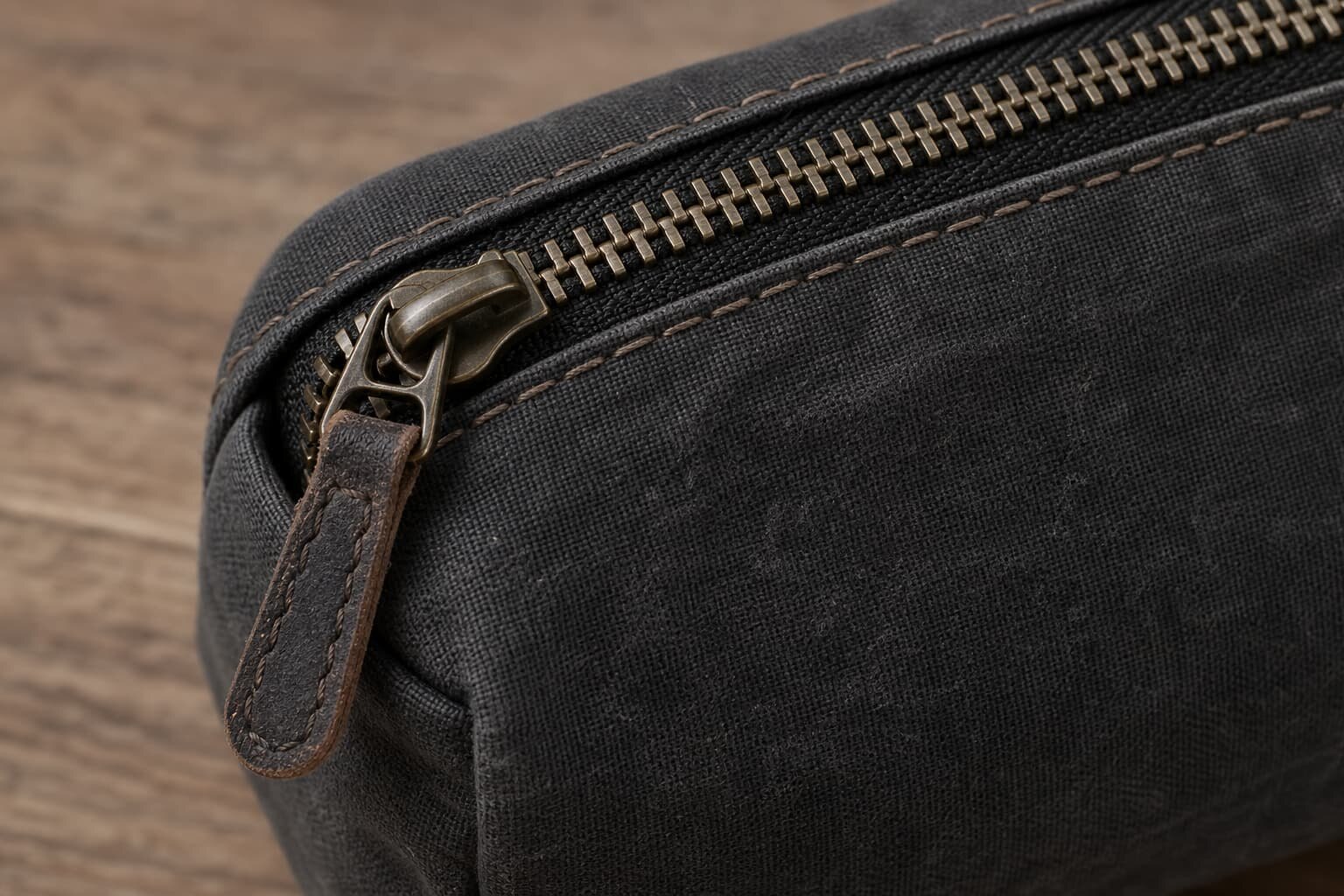
Why logo-placement disputes happen on zipper business bags
A zipper business bag is not a flat board. The front panel moves when the zipper is sewn in, when foam or board inserts are added, and when the side gusset pulls under load. A logo that looked centered on a loose sample can land lower, closer to a seam, or slightly skewed once the bag is fully assembled. That is why supplier claims about placement often break down after bulk delivery: the buyer is judging the finished bag, while the factory is defending a sample that did not reflect the final structure.
The real problem is usually the reference point, not the logo itself. If the factory measures from a cut edge and the buyer measures from a sewn seam, the two sides are not speaking the same language. Good claim evidence must show the exact bag, the exact measurement method, the exact artwork size, and the exact stage of production. Without that chain, a placement dispute turns into opinion instead of a traceable production issue.
- A soft front panel can move after the zipper is attached.
- A logo near a seam looks different once the bag is stuffed or packed flat.
- Artwork size changes can make the same position appear wrong.
- One hero photo is not enough if it does not show the reference point.
What counts as usable claim evidence
A useful evidence pack starts with the approved artwork, a dimensioned placement sketch, and the signed pre-production sample. Add a close-up photo with a ruler in frame, the style code, the batch code, and the approval date. That combination shows what was promised and what was approved before bulk production began. If a buyer later raises a placement claim, this is the file that decides whether the factory made the wrong move or whether the sample spec was too loose to control.
Evidence should also show the bag at more than one stage. Ask for a flat photo of the blank body, a photo after logo application, and a final photo before packing. On zipper business bags, the shape changes after sewing and again after packing, so one stage alone does not prove the final result. If the supplier only provides a polished studio shot, you still cannot tell whether the logo sat correctly on the production unit or only on a selected sample.
- Approved artwork file with final logo size.
- Dimensioned placement sketch with reference points.
- Signed pre-production sample or strike-off.
- Ruler photo with date and style code.
- Batch code or lot number tied to the photos.
- Pre-pack and post-pack photos from the same unit.
Choose the placement method based on bag construction
On 300D to 600D polyester bags, screen print or heat transfer usually gives the clearest placement control because the front panel is broad and the logo can be measured from a fixed seam or centerline. On 12 oz canvas, a woven label, embroidery, or PU patch may make more sense because the fabric texture is more visible and the brand may want a heavier, more premium look. The wrong method creates false claims: the logo may be in the right location but still look uneven if the panel texture, stitch pull, or coated surface distorts the visual field.
The bag build should decide the method, not just the unit price. Thick foam, lining, internal pockets, and zipper tape all affect how much the panel moves during sewing. If the logo sits close to a pocket edge or side seam, a sewn label or patch may hold position better than a large print that depends on a perfectly flat face. For buyers, the question is not only what looks good in a sample room, but what can be repeated across thousands of bags without drift.
- 300D polyester: lower cost, faster print control, but watch panel stretch.
- 600D polyester: stable enough for most print or patch placements.
- 12 oz canvas: good for embroidery or woven label branding.
- Coated or structured panels: check adhesion and stitch pull before approval.
Lock the placement spec into the RFQ
Do not ask a factory to place a logo based on vague words like front center or lower right. Give dimensions from fixed references such as the top seam, side seam, zipper end, handle stitch point, or pocket edge. For a zipper business bag, the most stable reference is usually a sewn seam or zipper tape junction, not a raw cut edge that can shift during trimming or seam allowance correction. If the reference point is unclear, the claim will be unclear too.
Put tolerances in the RFQ before quotes come back. For a simple print on a flat 600D panel, a practical target may be plus or minus 3 mm from the agreed centerline and plus or minus 5 mm from the agreed height reference. Sewn labels and patches can sometimes carry a slightly wider band, but only if the material build makes tighter control unrealistic. The goal is not to demand impossible precision; it is to define the acceptable window before pricing, sampling, and approval begin.
- State the logo size in millimeters, not only in artwork terms.
- Name the exact reference point for height and sideways position.
- Say whether the measurement is taken on a flat bag or a stuffed bag.
- Include tolerance limits for both placement and logo size.
Prove the position at the sample stage
The pre-production sample is the first real proof, but only if it uses the final fabric, final zipper, final lining, and final logo method. A loose print strike-off on a separate fabric swatch does not prove the logo will sit correctly on a finished bag. Ask the factory to mark the placement on the actual sample pattern, sew the full bag, then photograph that same unit after assembly. That shows whether the placement still works when the panel becomes a three-dimensional product.
A good sample review uses more than one view. Review one bag laid flat, one bag lightly stuffed, and one close-up with a ruler in frame. That combination shows whether the logo moves after structure is added and whether the visual position still matches the approved sketch. If you approve only a digital mockup or a clean render, you have no evidence that the factory understood how the final bag would behave under sewing tension, zipper pull, and packing pressure.
- Check the logo on the exact fabric and zipper build you plan to buy.
- Review the bag flat and lightly stuffed.
- Require a ruler in the close-up photo.
- Confirm the sample code and approval date on every image.
Control bulk production and packing
Bulk production should not assume the sample will stay correct forever. Ask for first-article inspection on the first 20 to 50 finished units, especially if the logo sits near a seam, gusset, or pocket edge. A factory that checks only after packing may miss the movement caused by folding, compression, or carton stacking. If the supplier cannot show the first articles before release, the buyer loses the best chance to catch drift while rework is still cheap.
Packing can change what the buyer receives. If printed panels rub against each other, the logo can scuff or transfer. If a woven label sits on a fold line, it can crease and look off-center even when sewn correctly. For repeat orders, keep the packing method the same as the approved sample: same polybag size, same fold direction, same tissue or divider, same carton count, and same outer marks. That consistency matters because packing is often the last step before the buyer sees the bag and opens the dispute.
- Ask for pre-pack photos of the exact production lot.
- Check fold direction so the logo is not pressed against another bag.
- Use tissue, PE sheet, or a divider if printed surfaces can rub.
- Keep carton count and outer marks consistent across all lots.
Compare quotes on the same evidence basis
A usable quote separates the blank bag from the logo work. If a supplier sends one total number, you cannot tell whether the placement cost includes artwork prep, screen or plate setup, operator time, sample revisions, or extra packing protection. Ask for a line-by-line quote so you can compare factories using the same logo method and the same evidence package. Otherwise, the cheapest quote may simply be the one that hides the most process steps.
MOQ logic also changes the unit economics. Screen print usually carries lower setup and works well for larger runs. Woven labels, embroidery, and PU patches often need higher setup or a higher minimum because of outsourced parts, machine time, or extra finishing. For a lower MOQ, a supplier may look cheaper until the buyer adds sampling, setup, and placement-proof costs. Compare the total landed quote logic, not just the blank bag price, and make sure the quote states the lead time after PPS approval.
- Request separate lines for blank bag, logo setup, sample revision, and packing extras.
- Ask whether the MOQ changes by artwork color count or logo method.
- For simple print, a sample often takes about 5 to 10 days.
- For embroidery or patch work, sample and bulk lead times are usually longer.
The most common mistakes buyers make
The biggest error is approving a logo on an unstructured mockup and then expecting the same position on a finished bag. The second is changing artwork size after sample approval without rechecking the placement. A smaller logo can look too high, and a wider logo can cross a seam even if the original position was correct. Buyers often think the factory moved the logo, when in fact the spec changed and nobody recalculated the placement.
Another common failure is missing documentation. If the photo has no ruler, no date, no style code, and no lot number, it is only a picture, not claim evidence. Keep the approved sample, measurement sheet, and production photos together. When a factory changes a machine, a subcontractor, or a packing method, the file should show exactly when that change happened. Otherwise the buyer cannot isolate whether the issue came from sewing, printing, or handling after production.
- Do not approve a mockup as if it were a finished bag.
- Do not change artwork size without re-approving the placement.
- Do not accept placement photos without a ruler or style code.
- Do not lose the packing photos, because they often explain final damage.
A practical workflow for repeat orders
The cleanest process is simple: RFQ with dimensioned placement, sample with actual fabric, approval with signed evidence, bulk inspection with lot code, and full archive for reorders. If a claim appears later, the buyer should be able to open one file and see the same artwork, the same reference point, the same photo angle, and the same packing method. That record is what turns a complaint into a traceable production question instead of a debate over memory.
For repeat programs, keep a master record by style code and season. If the brand changes the logo size, placement, zipper color, or panel fabric GSM, treat it as a new control point rather than a casual update. That discipline prevents disputes, speeds quote comparison, and gives procurement a stronger position when asking a factory to correct a placement miss. The goal is not only to win a single claim, but to stop the same problem from returning on the next order.
- Archive each order by style code and batch code.
- Keep one golden sample with the signed placement sketch.
- Reapprove the spec if the fabric, logo size, or packing changes.
- Use the same camera angle for every reorder photo set.
Specification comparison for buyers
| Spec decision | Recommended option | When it fits | Buyer risk to check |
|---|---|---|---|
| Front panel print | Screen print on 300D to 600D polyester with a dimensioned centerline | Best for direct logo visibility and low to mid MOQs | Check panel distortion after the zipper is sewn and the bag is stuffed |
| Side label or seam tab | Woven label sewn into binding or side seam | Best for subtle branding and repeatable placement | Check seam allowance variation and left-right symmetry |
| PU patch or embroidery | Sewn patch or embroidery on structured canvas or thick polyester | Best for a premium look and rough handling | Check needle pull, puckering, and edge lift during packing |
| Evidence package | Signed placement sketch, ruler photo, and batch-coded PPS set | Best for any program where claims may be disputed | Check that photo angle and measurement reference stay identical across samples and bulk |
Buyer checklist before sampling
- Confirm the logo size, placement reference, and tolerance on a dimensioned sketch before sampling.
- Approve the pre-production sample using the final fabric, zipper, lining, and logo method.
- Ask for ruler photos, date stamps, and batch codes on every approved sample photo set.
- Separate blank bag cost, logo setup, sample revision, and packing cost in the quote.
- Confirm MOQ and lead time by logo method, not just by bag style.
- Check the sample flat and lightly stuffed so panel distortion is visible.
- Lock folding direction, polybag size, carton count, and any tissue or divider needed to protect the logo.
- Save the golden sample and the full evidence pack for reorders and disputes.
Factory quote questions to send
- What is the exact reference point for logo placement on this zipper business bag?
- Is the sample made with the final fabric weight, zipper, lining, and reinforcement?
- What placement tolerance in millimeters do you accept for print, label, or patch?
- How many sampling revisions are included before bulk production starts?
- Can you quote the blank bag, logo setup, sample fee, and packing separately?
- What is the MOQ for this logo method and does it change by artwork color count?
- What lead time applies after PPS approval for the first bulk run?
- What photos or measurement records will you provide before packing and before carton closure?
- How do you prevent logo scuffing, transfer, or fold damage during packing?
- If placement drifts outside tolerance, what is the rework or replacement process?
Quality-control points to confirm
- Measure the logo from the agreed seam, zipper junction, or centerline, not from a cut edge.
- Inspect the first 20 to 50 finished units before the full run is released.
- Check the logo on a flat bag and on a lightly stuffed bag to see how the panel moves.
- Verify left-right symmetry for pairs, especially when the logo sits near a side seam.
- Confirm artwork size, color, and orientation against the signed pre-production sample.
- Inspect stitching density, patch edges, label corners, and any print edge lift.
- Review pre-pack and post-pack photos to catch scuffing, transfer, or fold distortion.
- Archive the batch code, date, inspector initials, and carton mark for every approved lot.