Why Line Release Evidence Matters for Zipper Business Bags
A zipper business bag looks simple on a quotation sheet, but most claims are created by small production decisions: a lighter fabric than expected, a zipper that waves after sewing, a logo placed too close to the top seam, or cartons that bend the corners during transit. Line release evidence is the proof package taken when the first finished pieces come off the production line. It tells the buyer whether the factory is actually making the approved bag, not only promising it.
For importers and distributors, this evidence is useful before there is a dispute. If the buyer only checks random final cartons, hundreds or thousands of bags may already be sewn with the same mistake. A proper line release file lets procurement stop production early, approve a controlled deviation, or correct the line before the defect becomes a container-level problem.
- Use line release evidence before mass sewing continues, not only before shipment.
- Connect the release file to the purchase order number, artwork version, and approved sample.
- Ask for measurements and photos together; photos alone do not prove tolerance.
- Treat missing evidence as a production risk, not as an administrative delay.
Define the Bag Before You Ask for Evidence
The factory cannot release a line against a vague description such as “black zipper document bag with logo.” The buyer must define the product in a way that can be checked on the cutting table, sewing line, print table, and packing area. The release file should refer to the same specifications used for the quote, sample, and purchase order.
For zipper business bags, the key decisions are fabric, structure, zipper grade, handle construction, logo method, dimensions, and packing. A small change in any of these can change both cost and performance. For example, a 600D polyester bag with PVC backing is not the same as a 300D promotional bag, even if both are black and both carry the same screen printed logo.
- Record finished size, such as 38 x 30 x 6 cm, separately from cutting size.
- State fabric as denier plus GSM range plus backing, not only “polyester.”
- Confirm whether the bag has lining, foam padding, cardboard insert, piping, or inner pocket.
- Specify zipper size and puller type, not just “zipper closure.”
- Attach the final artwork sheet with logo size, print color, and placement distance.
Fabric Evidence: GSM, Coating, Color, and Hand Feel
Fabric substitution is one of the hardest issues to prove after shipment because two fabrics can look similar in photos. The line release record should show what fabric roll was used for the first production pieces. For common zipper business bags, 600D polyester often sits around 230-280 GSM depending on coating and weave density. A cheaper 600D may feel limp, while a higher-density 300D with good backing may appear cleaner than expected. The buyer should not rely on the denier name alone.
Ask the factory to confirm whether GSM includes the PVC or PU coating. This matters when comparing quotes. One supplier may quote fabric body weight, while another quotes total coated weight. If the bag needs to carry catalogues, folders, sample kits, or event documents, the fabric must resist tearing around the handle and zipper seams. For canvas business bags, specify ounces per square yard, shrinkage control, and shade tolerance because natural cotton fabric has more visible lot variation than dyed polyester.
- Request a fabric swatch photo beside the approved sample or color card.
- Ask for roll number and fabric inspection status before cutting starts.
- Check whether coating is PVC, PU, PE, or laminated backing.
- For black bags, still confirm shade because different black lots can look mismatched under retail lighting.
- For canvas, ask whether the fabric is pre-shrunk, dyed, washed, or natural.
Zipper and Opening Checks That Prevent Common Claims
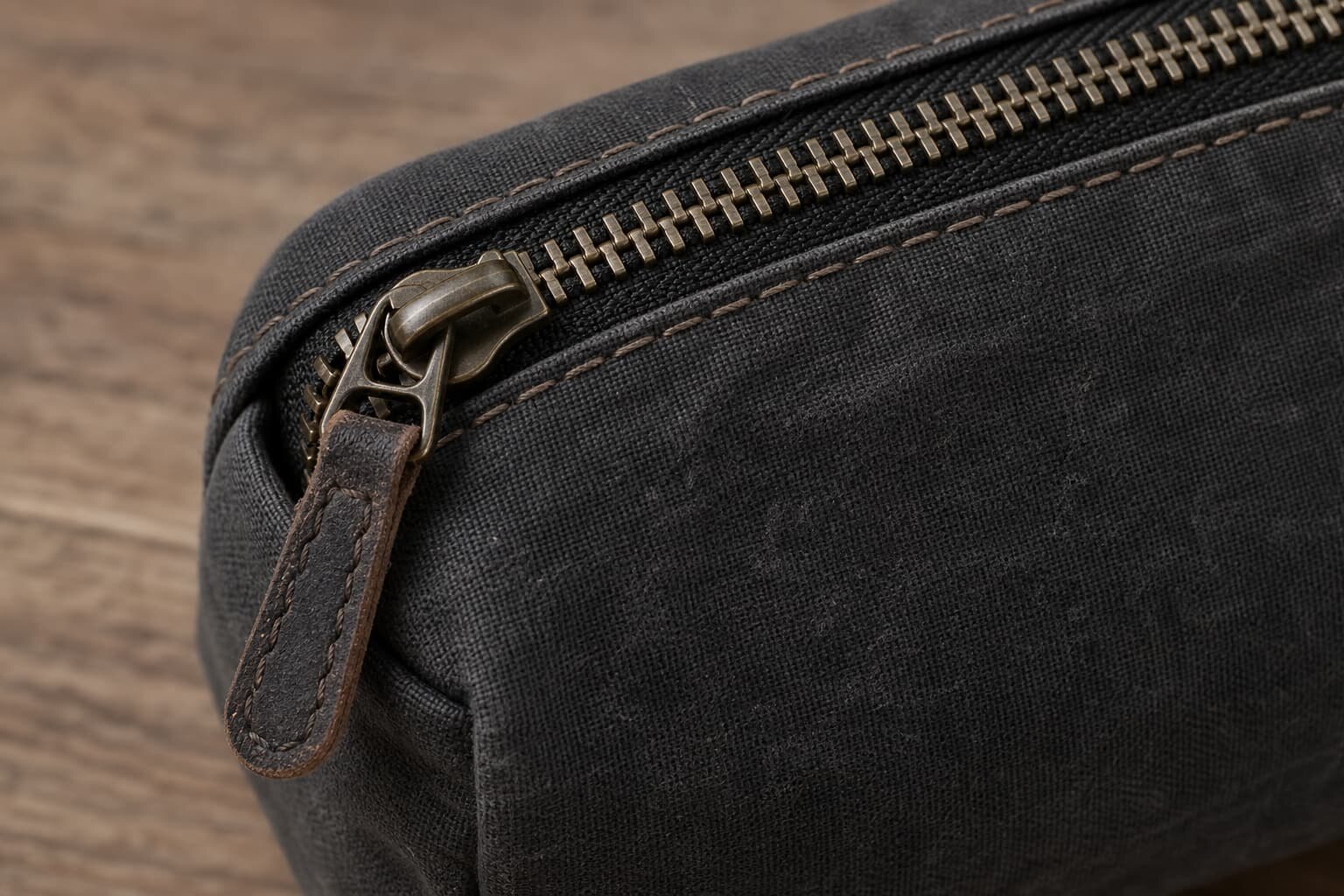
The zipper is the part users touch first, so a poor zipper creates immediate complaints even when the body fabric is acceptable. For most document-style business bags, a No.5 nylon zipper is practical. Larger bags or thicker canvas styles may require a stronger zipper. The release evidence should show the zipper tape, slider, puller, end stops, and how the zipper sits after top seam sewing.
Zipper business bags often fail because the zipper is pulled tight during sewing, causing a wavy top line, or because the ends are not secured cleanly inside the seam. Buyers should require short video or sequential photos showing smooth opening and closing on several first-line samples. A single perfect sample from the sample room does not prove the production line tension is correct.
- Check that zipper color matches the body fabric or approved contrast standard.
- Ask whether the zipper is nylon coil, resin, or metal; each has a different cost and feel.
- Confirm the slider does not catch fabric lining, binding, or loose thread.
- Check both zipper ends for open gaps, rough cut tape, and weak stop stitching.
- Test bags after packing trial because compression can bend the zipper line.
Logo Release Evidence: Print, Label, or Embossing
Logo problems are expensive because the bag may be usable but commercially unacceptable. For zipper business bags, the common logo methods are silkscreen print, heat transfer, woven label, rubber patch, embroidery, and embossing on leatherette trim. Screen print is usually the most efficient for simple one-color or two-color event bags. Heat transfer handles more detail but needs compatibility testing with coated polyester or canvas.
The release file must show logo placement on finished bags, not only printed panels before sewing. A panel can shift during stitching, piping attachment, or zipper assembly. If the logo is specified as 90 mm below the zipper and centered on the front panel, measure it after the bag is fully assembled. When the buyer allows tolerance, write it clearly, for example plus or minus 5 mm for placement and plus or minus 2 mm for print size.
- Ask for close-up photos of print edges, pinholes, smudges, and opacity.
- Require artwork version, Pantone reference or color standard, and logo dimensions.
- Check whether the quoted print cost includes one side or both sides.
- For woven labels, confirm fold type, seam allowance, and stitch position.
- For transfers, ask for adhesion and rubbing check on the actual fabric coating.
Sample Checks Before Bulk Line Release
A good sample process reduces line release arguments. The buyer should separate sales samples, pre-production samples, and first-line samples. A sales sample may show concept and workmanship, but it may be made with available fabric or sample-room accessories. The pre-production sample should use bulk materials or confirmed substitutes. The first-line sample proves the sewing operators, machines, cutting, printing, and packing method are aligned for actual production.
Do not approve a zipper business bag only by appearance. Check the use case. Will it carry paper documents, an event brochure pack, small electronic accessories, or retail gift items? A bag designed for light handouts should not be sold internally as a laptop bag unless the structure, padding, handle, and zipper have been designed for that load.
- Measure width, height, gusset, handle drop, zipper opening, and logo location.
- Load test the handle with a realistic buyer-defined weight, such as sample documents or catalogue sets.
- Check the inside seams for loose threads that can catch the zipper slider.
- Compare the first-line sample with the approved pre-production sample side by side.
- Keep one signed sample at the factory and one with the buyer or inspection agency.
MOQ Logic and Quote Data Behind the Release
MOQ is not only a sales number. For zipper business bags, MOQ can be driven by fabric roll length, dyeing minimums, zipper color, custom pullers, logo setup, cutting efficiency, and packing materials. A factory may accept a low order quantity if the buyer uses stock black 600D fabric and a standard zipper. The MOQ changes if the buyer needs a custom dyed fabric, special woven label, molded zipper puller, or printed retail carton.
The line release evidence should match the commercial assumptions in the quote. If the quote was based on stock 600D polyester and the buyer later expects heavier canvas, the line release will expose a mismatch but not solve the cost difference. Procurement teams should ask suppliers to break down the major quote drivers so comparison is possible between factories.
- Confirm the fabric type, GSM, and backing included in the unit price.
- Ask whether print setup, sample fee, and artwork adjustment are included or separate.
- Separate MOQ for bag sewing from MOQ for custom accessories.
- Request carton quantity and estimated gross weight because freight cost can change the landed price.
- Clarify whether lead time starts after deposit, artwork approval, material approval, or sample approval.
Packing Evidence: Protect the Shape Before Shipment
A zipper business bag can pass sewing inspection and still arrive with claims if packing is wrong. Flat-packed bags need enough carton space to prevent crushed corners, bent zipper lines, and permanent crease marks. Canvas bags may tolerate folding differently from coated polyester bags. If the bag has foam padding, piping, or a structured bottom, the carton size matters even more.
Packing release evidence should include photos of one individual packed unit, the carton loading method, carton markings, carton dimensions, pieces per carton, and gross weight. Buyers who distribute to retail stores or corporate events should also confirm whether each bag needs an individual polybag, barcode label, hangtag, desiccant, or warning text.
- Check whether the bag is packed flat, half-folded, or rolled; approve only one method.
- Avoid over-tight cartons that force zipper deformation.
- Confirm carton strength if the shipment will be palletized or stacked high.
- Ask for a photo of the first sealed carton on a scale.
- Make sure any barcode, item number, or carton mark matches the purchase order.
Acceptance Criteria for Line Release Claims
A claim is easier to resolve when the buyer has written acceptance criteria before production. Without criteria, the discussion becomes subjective: the buyer says the zipper looks wavy, the factory says it is normal, and the shipment schedule is already tight. For zipper business bags, define what is critical, major, and minor before the first pieces come off the line.
Critical issues normally include wrong fabric, wrong logo, broken zipper, unsafe sharp parts, and serious contamination. Major issues include visible logo misplacement, zipper catching, weak handle stitching, wrong packing quantity, or dimensions outside tolerance. Minor issues may include small thread ends, slight internal seam irregularity, or acceptable shade difference within the approved range. The buyer should decide which deviations can be accepted, repaired, discounted, or rejected.
- Use written tolerance for finished dimensions and logo placement.
- Define the maximum allowed loose threads and trim standard.
- Require repair and re-check for zipper catching or open seam ends.
- Do not accept mixed fabric lots unless shade difference is checked under consistent light.
- Record any buyer-approved deviation with quantity, photo, and date.
How Buyers Should Use the Evidence File
The release evidence file is not only for quality staff. Procurement should use it to compare supplier reliability, confirm quote accuracy, and reduce repeat mistakes. If one factory provides clear measurement photos, material data, and packing proof while another sends only a few beauty photos, the difference is operational, not cosmetic. The better evidence package usually means the factory understands export claims and production control.
Store the release file with the order documents. If a later complaint appears, the buyer can compare warehouse photos against the release file and final inspection report. This helps separate factory production defects from transport damage, incorrect storage, or buyer-approved changes. Over multiple orders, these records also help build a more accurate RFQ template for future zipper business bag programs.
- Name files by PO number, item number, sample version, and production date.
- Ask the factory to sign or confirm the release record by email before continuing bulk sewing.
- Use the evidence to update the next RFQ with clearer tolerances and material descriptions.
- Compare line release findings with final inspection results to identify recurring weak points.
- Keep rejected release evidence too; it explains why production was stopped or corrected.
Specification comparison for buyers
| Spec decision | Recommended option | When it fits | Buyer risk to check |
|---|---|---|---|
| Main fabric weight | 600D polyester at 230-280 GSM with PVC or PU backing | Common conference bags, document bags, promotion kits, and light laptop-style folders | Ask whether GSM is fabric only or fabric plus coating; low-density 600D can feel thin even when called 600D |
| Budget fabric alternative | 300D polyester at 150-190 GSM with light backing | Short-term events, low weight documents, price-sensitive distributor programs | Handle reinforcement and zipper stress points must be checked because the body may wrinkle or distort |
| Heavier appearance | 12 oz canvas or 16 oz canvas with zipper closure | Retail gifting, premium brand packs, reusable office bags | Canvas shrinkage, shade lot variation, and print edge bleeding need pre-production approval |
| Logo method | Silkscreen print for 1-3 solid colors on flat front panel | Most B2B logos, event branding, simple distributor marks | Confirm print position after sewing because panel movement can change the final logo distance to zipper and edges |
| Higher detail branding | Heat transfer or woven label sewn on front or side seam | Small text, gradients, QR-style graphics, or brand compliance programs | Transfers can crack on coated fabric; woven labels need approved size, fold, stitch position, and color tolerance |
| Zipper choice | No.5 nylon zipper with metal or molded puller | Normal document bag opening with frequent event use | Check zipper tape color, slider movement, puller plating, end stops, and whether zipper waves after top seam sewing |
| Packing method | Individual polybag plus export carton with bag flat-packed | Clean presentation for retail or distributor receiving | Over-tight cartons bend corners, deform zipper line, and create false claims that were actually packing damage |
Buyer checklist before sampling
- Confirm the approved sample code, sample date, and version number are shown in the factory line release file.
- Require front, back, inside, zipper, handle, side gusset, logo, and packing photos from the first finished pieces.
- Check finished dimensions after sewing, not only cutting dimensions; include tolerance for width, height, gusset, handle drop, and logo placement.
- Ask for fabric GSM, denier, coating type, color lot, and roll number used for the first production pieces.
- Require zipper pull test, smoothness check, and visual evidence that both ends are secured without open gaps.
- Compare print color, print size, and logo distance from zipper/edge against the approved artwork sheet.
- Ask for a defect count from the first-line inspection before allowing bulk sewing to continue.
- Check carton size, carton weight, pieces per carton, polybag warning text if needed, and whether the bag is packed flat or folded.
- Make sure quote assumptions match the released line: fabric, logo method, accessory grade, MOQ, sample approval, and packing are all part of cost.
- Keep line release evidence with the purchase order so later claims can be separated into factory defects, transit damage, or buyer-approved variance.
Factory quote questions to send
- What exact fabric will be used for bulk production: denier, GSM range, coating type, color standard, and available roll width?
- Is the quoted price based on 300D, 600D, canvas, nonwoven lining, foam padding, or any laminated structure?
- What zipper specification is included: size, material, tape color, slider type, puller type, and supplier grade?
- What logo method is included in the quote, and how many colors, print positions, setup charges, and approval samples are covered?
- What MOQ applies to the bag body, and is there a separate MOQ for dyed fabric, custom zipper pullers, woven labels, or printed cartons?
- How many pre-production samples and first-line release samples will be made before bulk sewing continues?
- What finished dimension tolerance and logo placement tolerance will the factory accept in writing?
- What packing method is quoted: individual polybag, master polybag, carton quantity, carton strength, inner cardboard, or tissue protection?
- What lead time starts after deposit, artwork approval, fabric arrival, or final sample approval?
- What line release evidence will be sent before bulk production continues, and who signs it on the factory side?
Quality-control points to confirm
- First-piece approval must compare finished bag against the signed sample, not only against the tech pack.
- Fabric GSM and coating should be checked before cutting because finished bags cannot reveal all material substitutions.
- Zipper opening must be tested across multiple pieces, including corners and end stops, because one smooth sample does not prove the line setup is stable.
- Logo placement should be measured after final sewing and pressing, especially when the logo is close to the zipper seam or side piping.
- Handle bartack, box stitch, or reinforcement stitching should be photographed clearly before packing hides stress areas.
- Packing compression should be checked with a real carton because zipper business bags can crease or bow when carton dimensions are too tight.
- Any accepted deviation should be written into the release record with photos, quantities affected, and buyer approval.