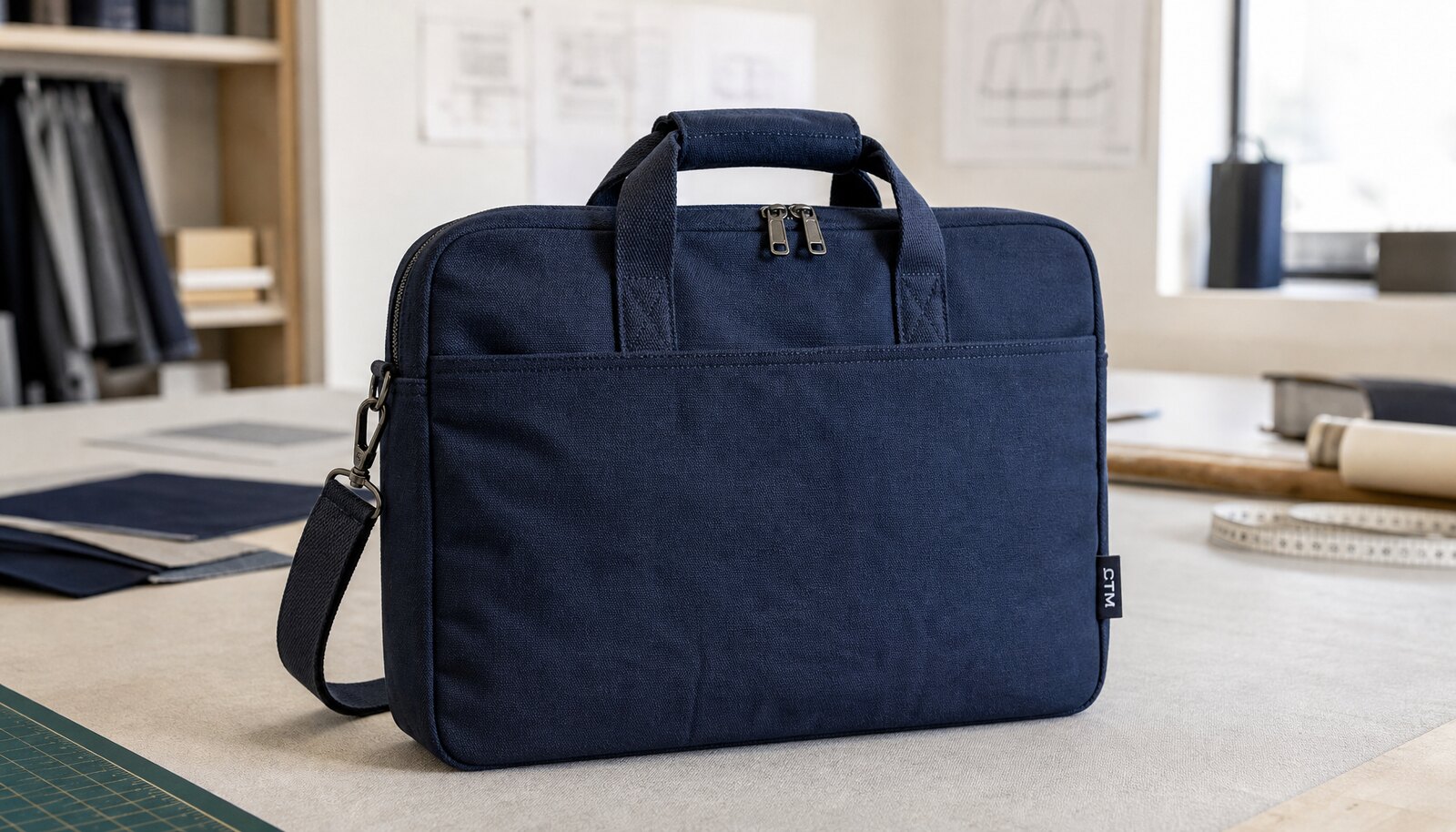
What a useful factory quote must answer
A zipper business bag factory quote is only useful when it answers the same question the buyer will ask again at approval: what exactly is being made, with what materials, and with what level of finish. If the quote only gives a unit price and a picture reference, the price is not comparable because each supplier may be assuming a different fabric weight, zipper grade, lining, or packing method.
For procurement teams, the real job is not to collect the lowest number; it is to remove hidden variables. A good quote should tell you how the factory built the price, what they treated as standard, and what would trigger a change order. That is the only way to compare one quote against another without discovering later that the cheaper offer excluded the zipper spec, the print method, or the carton packing you need.
- Ask for a line item on fabric, zipper, lining, printing, packing, and shipping terms.
- Require the factory to state what is included and what is not included in the base price.
- Make the quote match the same finished size and construction across all suppliers.
Start with the right bag spec, not the price
The first mistake in sourcing a zipper business bag is to describe the product too loosely. A business bag can mean a flat document bag, a structured briefcase-style carrier, a laptop sleeve with handles, or a soft tote with a zipper closure. Those formats use different fabric builds, different panel counts, and different sewing time, so the factory quote will swing even before branding is added.
Before you request pricing, define the finished size, the gusset depth, the closure orientation, and the internal layout. If the bag needs a padded laptop compartment, a sleeve pocket, a trolley sleeve, or a shoulder strap, call that out early. Factories can price a simple unlined zip bag quickly, but they cannot quote accurately if the buyer is still deciding whether the bag should behave like a folder, a briefcase, or a daily commute bag.
- State finished size in L x H x D, not only a reference photo.
- Confirm whether the bag must stand upright, lie flat, or support a laptop.
- List every compartment, pocket, and reinforcement point in the RFQ.
Fabric choice drives most of the spread
Fabric is usually the biggest cost driver in a zipper business bag factory quote. A 600D polyester body is often used when the buyer wants control, clean print results, and a structured but economical bag. A 12oz cotton canvas creates a more natural look and usually suits corporate gifts, retail, or lifestyle programs, while 16oz canvas gives the bag more body and a more premium feel but adds weight and freight cost.
When you compare quotes, do not just ask for the fabric name. Ask for the fabric weight or GSM, the weave, any coating, and whether the price assumes raw stock or dyed stock. A factory may quote a similar-looking canvas bag, but if one uses a lighter body fabric, a thinner interfacing, or a lower-cost lining, the unit price can look attractive while the bag feels underbuilt in hand.
- Ask for fabric weight in GSM or oz so quotes can be compared on the same basis.
- Check whether the fabric is coated, washed, laminated, or enzyme-treated.
- Confirm shrinkage risk and color lot variation before approving bulk production.
Branding method changes cost and risk
Logo decoration can change a zipper business bag quote almost as much as the fabric. A simple one-color screen print is usually the cleanest option for large areas and repeat programs. Woven labels and sewn side labels are better when the buyer wants a durable brand mark without print wear. Embroidery, patches, embossing on faux leather, and multi-color print all add labor, setup time, or extra materials.
The key buyer question is not which branding method looks nice on a mood board; it is which method fits the logo, the run size, and the bag material. For example, a bold logo on a flat canvas front panel may be easy to screen print, but a detailed mark with small text may need a woven label or a stitched patch to stay readable. The factory should quote the same artwork size, the same placement, and the same number of colors for every supplier you compare.
- Provide vector artwork and exact logo dimensions, not only a JPEG.
- Specify the print position in centimeters from the seam or top edge.
- Ask the factory to confirm whether the logo needs a screen, plate, or extra setup fee.
Zipper, lining, and hardware are not small details
Buyers often under-spec the parts that users touch every day. For a zipper business bag, the zipper size, coil type, puller design, and slider count all affect smoothness, durability, and appearance. A #5 coil zipper may be adequate for light document bags, while a #8 coil or molded zipper may be safer if the bag will carry a heavier load or is expected to survive frequent opening and closing in transit.
The same applies to lining and hardware. A thin 190T lining may be fine for a basic utility bag, but a 210D lining or light foam can improve structure and perceived quality. Handles, webbing, buckles, rivets, and D-rings should be specified as part of the quote because they affect both the feel of the bag and the factory's labor time. If those details are not written down, different factories will quietly make different assumptions.
- Ask for zipper size, puller style, and tape finish in the quote.
- State whether the bag needs a lined interior, foam padding, or board insert.
- Confirm reinforcement at handle anchors, corners, and strap attachment points.
MOQ and price tiers should be read as a system
MOQ is not just a factory gatekeeping number; it is usually the point where material purchasing, cutting efficiency, and setup cost become workable. If the order needs a special fabric color, a custom zipper puller, or multi-color print, the MOQ may rise because the factory has to buy more stock or pay more setup cost. That is why one supplier may offer a lower MOQ but a higher unit price, while another expects a larger run but rewards it with better efficiency.
Ask for tiered pricing so you can see where the factory crosses from trial production into repeat production. A clean quote should show pricing at different quantities, any surcharge for extra colors or artwork versions, and whether the same MOQ applies to every fabric choice. If you are ordering for retail, the lowest MOQ is not always the best option; a slightly higher MOQ with a stable price and better quality control often reduces risk on the first shipment.
- Request price breaks at realistic buying tiers, not just one number.
- Separate the MOQ for fabric, logo version, and packaging if they differ.
- Watch for hidden setup costs that make a low MOQ quote more expensive overall.
Sample approval prevents the expensive mistakes
The sample stage is where most zipper business bag quote problems should be caught. A buyer should not sign off on a bulk order until the sample confirms fabric hand feel, zipper movement, logo placement, stitch quality, pocket size, and the overall shape of the bag. If the sample is too soft, too shiny, too narrow, or too small for the intended device or documents, that issue will scale into every bulk unit.
A good workflow is photo sample first, then pre-production sample, then golden sample if the program is large enough to justify it. The approved sample should be marked and archived, because it becomes the reference for bulk inspection. Buyers should also confirm measurement tolerance in advance. For example, a small zip bag may allow a tighter tolerance than a soft canvas briefcase, but the key is consistency with the approved sample, not a vague promise of good quality.
- Inspect zipper action, seam symmetry, and logo placement on the physical sample.
- Check whether the sample uses the same material batch the factory plans for bulk.
- Keep one signed sample with date, stamp, and approval notes as the control piece.
Packing and carton data affect landed cost
A factory quote is incomplete if it ignores packing. For zipper business bags, the buyer needs to know whether each bag will be bulk packed, polybagged, tissue-wrapped, boxed, or packed with inserts such as silica gel or shape cards. Those choices affect unit labor, carton count, freight volume, and warehouse handling on arrival. Even a simple change from bulk pack to individual polybag can shift both cost and carton efficiency.
Carton data matters because freight and warehouse planning depend on it. Ask for master carton size, units per carton, gross weight, net weight, and shipping marks. If the bags will retail through a distributor or store chain, ask whether barcode labels, hangtags, or polybag suffocation warnings are required. Those details are easy to forget during sourcing and expensive to fix after production is complete.
- Request carton dimensions, carton quantity, and gross weight in the quote.
- Confirm whether the price includes inner bags, tissue, desiccant, or carton labels.
- Align packing style with the buyer's warehouse and retail requirements before bulk.
Lead time is a schedule problem, not a promise
Lead time in a zipper business bag factory quote should be treated as a schedule with stages, not one vague delivery promise. A supplier may quote a short production lead time, but that number can exclude sample approval, artwork confirmation, fabric sourcing, packaging material sourcing, or line-up time on the sewing floor. If the buyer needs a firm ship date, every stage should be visible in the quote or order confirmation.
The most useful way to manage lead time is to ask for separate timing for sample, pre-production approval, bulk production, and final packing. If the bag requires custom printing or a custom zipper puller, the factory may need extra time before cutting starts. Buyers should also confirm what happens if artwork is revised after sample approval, because even a small change can add days or weeks to the schedule.
- Ask the factory to separate sample lead time from bulk lead time.
- Confirm whether artwork approval freezes the schedule or can be revised once.
- Build buffer time for raw material sourcing, print setup, and final inspection.
How to compare quotes and write a cleaner RFQ
To compare zipper business bag quotes properly, normalize the spec before you compare the price. Make sure every supplier is quoting the same size, the same fabric weight, the same zipper spec, the same branding method, the same packaging, and the same delivery term. If one quote is missing any of those pieces, it is not a lower price; it is an incomplete price that will likely move later.
A cleaner RFQ also shortens the back-and-forth. The best files are not long, but they are precise: finished size, target quantity, fabric reference, logo artwork, packing request, sample need, and delivery window. Add one sentence on what matters most to you, such as appearance, durability, freight efficiency, or retail presentation. That gives the factory a way to optimize the quote around the real buying goal instead of guessing what the product is supposed to be.
- Compare apples to apples by using one master spec sheet for every supplier.
- Flag any quote that says similar to photo, as per sample, or other material without detail.
- Ask for a revision if the factory leaves out fabric weight, zipper spec, or packing data.
Specification comparison for buyers
| Spec decision | Recommended option | When it fits | Buyer risk to check |
|---|---|---|---|
| Main body fabric | 600D polyester with PU backing | Price-sensitive programs that still need structure and consistent print results | Check coating weight, fabric hand feel, and whether the bag collapses after packing |
| Main body fabric | 12oz cotton canvas | Mid-market retail, corporate gifting, and a more natural look | Watch shrinkage, shade variation between rolls, and heavier freight cost than polyester |
| Main body fabric | 16oz cotton canvas | Premium positioning, stronger body shape, and a more substantial carry feel | Confirm seam strength, actual finished weight, and whether the bag becomes too stiff for daily use |
| Branding method | 1-2 color screen print or woven label | Simple logos, repeat programs, and controlled artwork placement | Confirm curing, registration, and whether the logo will crack or shift after use |
| Structure | Light lining with board insert | Business folders, documents, tablets, and light laptop carry | Check stiffness versus bag weight so the quote does not hide extra material cost |
| Packing | Bulk pack with agreed carton spec | Wholesale and distributor shipments where unit packaging is not retail-facing | Confirm inner protection, carton compression strength, and shipping mark accuracy |
Buyer checklist before sampling
- Confirm finished size, gusset depth, and opening style before asking for price.
- State the fabric weight or GSM, coating, and color requirement in the RFQ.
- Lock the zipper spec, puller style, and any double-slider or lock option.
- Provide vector artwork, print size, print position, and Pantone references if needed.
- Specify lining, padding, pocket count, and whether a laptop compartment is required.
- Ask for tiered pricing by quantity, colorway, and logo version.
- Request sample type, sample lead time, and any sample charge or freight charge.
- Agree on packing method, carton count, master carton dimensions, and shipping marks.
- Set acceptable tolerances for size, color, logo placement, and stitch quality.
- Confirm the incoterm, payment terms, and the target ship window in writing.
Factory quote questions to send
- What exact fabric do you quote, including weight, weave, coating, and color availability?
- What zipper spec is included: coil size, tape width, puller type, and single or double slider?
- What is the MOQ by color, by print version, and by fabric type?
- What sample stage do you provide, and what are the charges for samples and freight?
- Can you quote the same bag with different lining or padding options as separate lines?
- What print method do you recommend for this logo, and how many colors are included?
- What are the lead times for sampling, pre-production approval, and bulk production?
- What packing method is included, and what are the carton dimensions and carton count?
- What tolerances do you hold for dimensions, logo placement, stitch alignment, and shade?
- What is excluded from the quote, such as tooling, artwork setup, inserts, or special packaging?
Quality-control points to confirm
- Measure finished size, gusset, and handle drop against the approved sample.
- Run the zipper repeatedly and check for snagging, skipped teeth, or uneven pull force.
- Inspect logo placement, print color, curing, and edge sharpness against the approved artwork.
- Check seam allowance, backtack strength, and stress points at handle anchors and corners.
- Verify fabric shade consistency across front panel, back panel, handles, and lining.
- Confirm lining attachment, pocket size, and padding placement if the bag is structured.
- Test handle webbing, shoulder strap hardware, and any rivets or reinforcement patches.
- Review loose threads, stains, broken needles, odor, and surface marks before packing.
- Check carton count, inner polybag spec, shipping marks, and moisture protection.
- Release bulk only after the golden sample or pre-production sample is signed off.