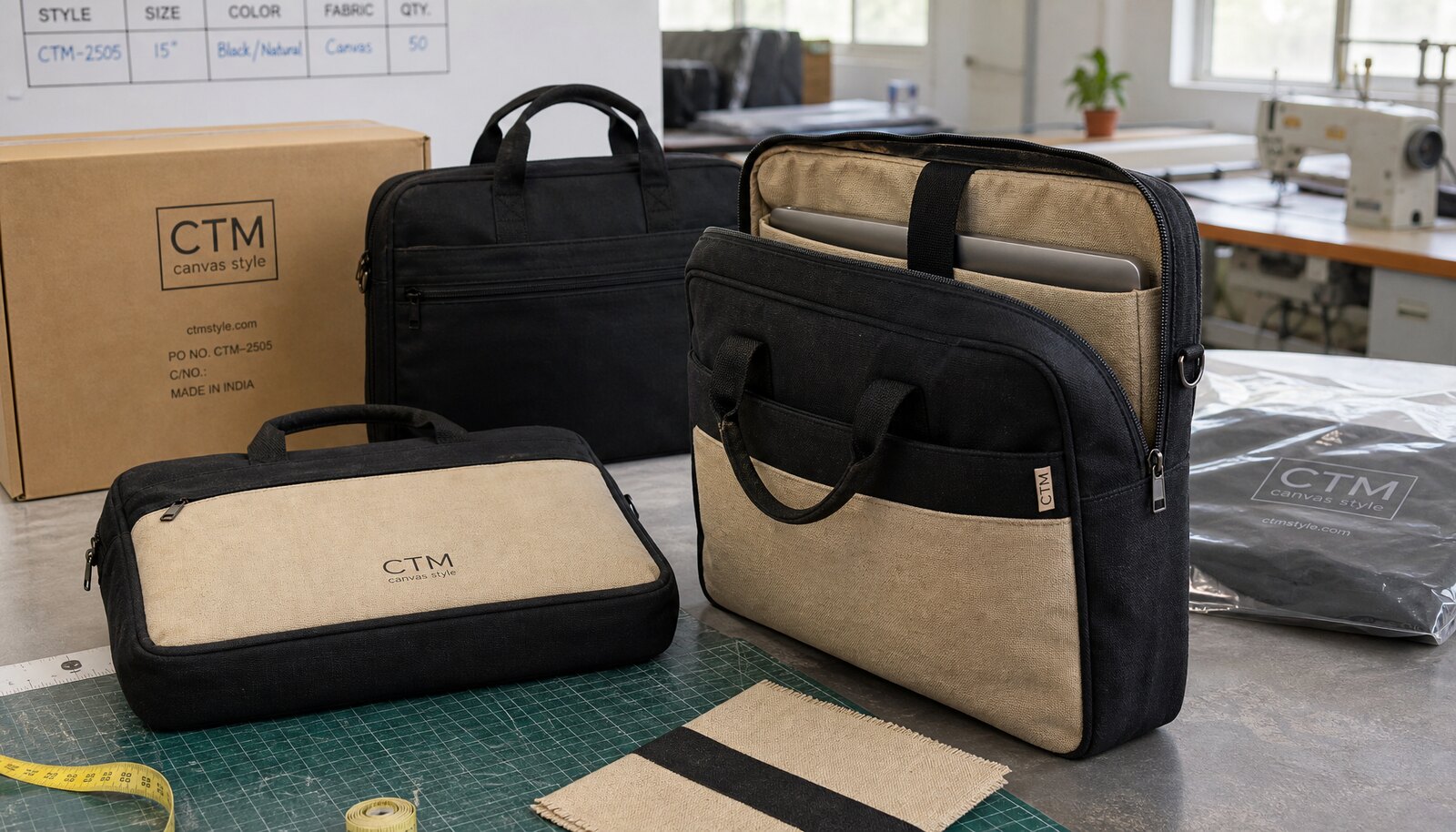
Why Freight Packing Decides the Real Cost
A zipper business bag is usually not damaged because the sewing line cannot make the bag. It is damaged because the packing plan was treated as an afterthought. Bulk freight creates long compression time, repeated carton handling, humidity exposure, and pressure from metal zipper pullers or buckles. If the buyer only asks for unit price and delivery date, the factory will choose a packing method that fits its normal cost target, not necessarily your warehouse, retailer, or brand presentation requirement.
For procurement teams, the packing specification must be part of the RFQ, not a final detail after production. The same bag can quote differently depending on carton strength, units per carton, sleeve type, desiccant, palletization, and fold method. A low unit price can become expensive if cartons collapse, bags arrive creased, retail labels are scuffed, or the import warehouse has to re-pack every unit.
- Use this guide when buying zipper business bags in bulk by sea freight, air freight, or distributor replenishment.
- Focus on the full packing system: unit protection, inner arrangement, master carton, pallet plan, moisture control, and carton marks.
- Treat packing as a cost and quality specification, not as a free factory default.
- Ask for packing data early so you can compare total CBM, carton handling cost, and receiving risk.
Start With the Bag Construction Before Choosing Packing
Zipper business bags are not all packed the same way. A thin 8 oz promotional cotton zipper document bag can be folded and packed tightly. A 16 oz canvas business bag with laptop padding, bottom gusset, metal slider, and front screen print needs more space and protection. The packing method should follow the physical risk points of the bag: zipper line, puller, logo panel, handle attachment, gusset corners, and any padded structure.
Fabric weight is one of the first variables to state in the RFQ. Cotton canvas is often described by oz, while many synthetic or blended business bags are described by GSM. For business bags, common working ranges include 10 oz cotton canvas for light conference bags, 12 oz for a more substantial promotional or retail item, and 14-16 oz for heavier corporate or laptop-style use. Polyester canvas, recycled PET canvas, or mixed fabrics may be specified around 300-450 GSM depending on stiffness and lining.
- For 8-10 oz cotton canvas, check crease control and logo abrasion rather than carton weight alone.
- For 12 oz canvas, balance a clean flat pack with enough room to avoid zipper pressure marks.
- For 14-16 oz canvas or padded styles, calculate gross weight carefully before fixing units per carton.
- For laminated, coated, or dark dyed fabric, test color rub and surface marking inside the packed carton.
- For bags with metal sliders, buckles, or rivets, separate hardware from printed panels during packing.
Set Carton Quantity by Weight, Volume, and Damage Risk
Many packing problems start with a simple question answered too quickly: how many bags per carton? A factory may propose 50 pieces per carton because it looks efficient on paper. That may work for a thin zipper pouch-style business bag, but not for a structured canvas zipper business bag with long handles and a padded divider. The correct quantity is the point where carton weight, carton strength, compression risk, and warehouse handling remain acceptable.
A practical target for many export cartons is around 12-18 kg gross weight, but your own receiving rules should decide the final number. Some retail distribution centers prefer lower carton weights. Some importers accept heavier cartons for palletized FCL cargo but not for LCL freight. If the bags are bulky, CBM may become the bigger cost driver than weight. Procurement should request carton dimensions and total CBM at quotation stage, then check whether the proposed carton count makes sense for the shipping mode.
- Ask for units per carton and gross weight before comparing supplier prices.
- Do not accept a quote that says only packed in export carton without dimensions.
- Avoid tall cartons that crush lower layers unless palletization and carton strength are specified.
- Check whether reducing units per carton lowers damage risk enough to justify slightly higher CBM.
- For air freight, compare dimensional weight, not only actual weight.
Choose Unit Protection Based on Logo and Retail Use
Individual unit protection is not only about keeping dust away. It protects the printed logo, zipper puller, hangtag, woven label, and fabric surface during the months between packing and final distribution. For zipper business bags sold through retail or issued at corporate events, a clean unit on arrival matters. For purely internal warehouse distribution, a simpler sleeve may be enough.
Common options include a clear polybag, recyclable polybag where available, paper sleeve, tissue wrap at hardware points, or no individual sleeve for low-cost bulk programs. Buyers should not choose only by environmental preference or cost. A paper sleeve can reduce plastic use but may not protect against moisture. No sleeve can be acceptable for rugged bags but increases dust and rubbing. If a front logo is screen printed, heat transferred, or digitally printed, direct contact with zipper pulls or rough canvas can create visible marks.
- For screen print logos, keep hardware away from the print face inside the stack.
- For heat transfer logos, test pressure marks after packed compression, especially on coated fabric.
- For embroidery, check whether thread texture rubs against adjacent bags or labels.
- For retail bags, specify whether hangtags and barcodes are inside the sleeve or attached outside.
- For plastic reduction programs, test paper sleeves under humidity before approving bulk packing.
Plan the Fold Method and Zipper Position
A zipper business bag may look fine in a sample photo but arrive with a hard crease across the front panel if the fold method is not controlled. The fold line should avoid the logo, zipper teeth, padded laptop area, and any stiff seam junction. If the bag has a gusseted bottom, pressing the gusset flat in the wrong direction can create uneven corners that do not recover well after unpacking.
The zipper position inside the carton also matters. When all zipper pullers sit in the same location, they create a pressure column inside the stack. That pressure can dent fabric, mark prints, or stress the slider. A simple packing instruction such as alternating zipper pulls left and right can reduce the risk. For high-value orders, ask the supplier to show the actual packed stack during sample approval instead of only showing the finished bag.
- Define whether the bag is flat packed, folded once, or lightly stuffed.
- Do not allow a fold line across the main logo unless approved on a packed sample.
- Alternate zipper pull direction when stacking multiple units.
- Use tissue or small protective paper at metal pullers when they contact fabric.
- Check that the zipper still runs smoothly after the bag has been compressed in packing.
Match Carton Strength to Freight Route
A strong bag inside a weak carton is still a weak shipment. For export zipper business bags, the carton must survive factory stacking, truck movement, port handling, container loading, and destination warehouse receiving. This is especially important for LCL shipments, where cartons may be handled more times and stacked with unrelated cargo. A 3-ply carton may be enough for light domestic movement, but heavier canvas business bags often need 5-ply export cartons.
Carton size should also be practical. Oversized cartons with too much air space collapse. Very tight cartons create compression damage and are difficult to reseal after inspection. If palletization is required, carton dimensions should fit pallet loading without overhang. When buyer routing guides specify carton labels, carton marks, or maximum carton weight, send those rules before the factory finalizes packing material.
- Use 5-ply cartons for heavy canvas, padded bags, LCL freight, or long sea routes.
- Avoid cartons with large empty headspace unless internal support is added.
- Specify carton gross weight limits in the PO or packing instruction.
- Ask whether carton straps, corner protectors, or pallet wrap are included.
- Request carton photos and carton mark proof before mass packing.
Control Moisture, Odor, and Hardware Corrosion
Cotton canvas, recycled cotton, and jute-trimmed zipper business bags can absorb moisture during production, storage, or sea freight. A bag may pass visual inspection at the factory but develop odor, mildew spots, or metal rust during a humid shipment. Moisture control should be discussed before production starts, especially when fabric is dyed, washed, laminated, or stored during rainy season.
Desiccant is useful, but it is not a complete solution if bags are packed damp. The factory should store fabric and finished goods in a dry area, avoid sealing hot or humid bags immediately after printing, and check cartons before loading. Metal zipper sliders, pullers, eyelets, rivets, and snaps should be compatible with the expected environment. If hardware finish quality is uncertain, request salt spray or basic corrosion resistance information from the hardware supplier as appropriate for your market.
- Do not pack bags immediately after wet processing, washing, or high-humidity storage.
- Allow printed panels to cure before stacking and sealing units.
- Use desiccant for long ocean freight, humid season production, and natural fiber bags.
- Check metal pullers and sliders for rust risk before approving bulk hardware.
- Inspect odor and moisture feel during pre-shipment inspection, not only stitching quality.
Build Packing Data Into the Quote Comparison
A useful supplier quote for zipper business bags should include more than FOB unit price. It should show the bag specification, packing method, carton data, total CBM, sample timing, production lead time, and what is included or excluded. Without that data, two quotes that look equal may have very different landed costs. One supplier may quote a lower bag price but use larger cartons, weaker packing, or no individual sleeve.
MOQ logic also connects to packing. Factories often set MOQ based on fabric purchase, dye lot, zipper color, lining material, logo setup, and carton efficiency. If your order is below a clean carton or fabric roll quantity, the factory may still accept it but spread setup and packing cost across fewer units. For repeat programs, ask for pricing at several breaks such as 500, 1,000, 3,000, and 5,000 pieces, with CBM shown for each level.
- Request unit price, packing cost if separate, carton quantity, carton size, gross weight, and total CBM.
- Ask whether the same price applies if carton quantity per master carton changes.
- Compare MOQ against fabric roll minimum, zipper color minimum, and logo setup requirement.
- Check if sample cost includes a packed sample or only an unpacked product sample.
- Separate optional costs: custom carton marks, individual barcode labels, pallets, desiccant, and retail sleeves.
Use Packed Samples to Prevent Bulk Surprises
A normal product sample tells you shape, fabric, zipper, sewing, and logo quality. It does not prove that the bag will survive bulk freight. For high-value orders or new suppliers, request a packed sample or at least a packing simulation using the approved fabric weight, zipper puller, logo method, sleeve, and carton layout. This is especially important when the bag uses a large front print, padded lining, or dark fabric that shows rubbing.
The packed sample review should be practical. Open the carton, remove the units, check fold recovery, inspect the logo surface, run the zipper several times, and verify whether the bag can be presented to a retail buyer without steaming or rework. If the sample needs special handling to look good, the bulk order probably needs a better packing plan.
- Approve both product sample and packing method before mass production.
- Check the first unit from the top, middle, and bottom of a test carton.
- Leave the packed sample compressed for several days when possible before judging crease recovery.
- Photograph the approved fold method and include it in the production file.
- If the factory changes carton size or units per carton, require buyer approval before shipment.
Final Inspection and Shipment Release Criteria
Pre-shipment inspection should include packing checks, not only AQL checks on bag workmanship. The inspector should verify carton count, carton marks, carton dimensions, gross weight, unit count per carton, sleeve condition, and internal bag orientation. If the inspection only opens finished bags without checking cartons, you may miss the exact issue that causes claims at arrival.
Set acceptance criteria in plain language. For example, no crushed master cartons beyond agreed tolerance, no wet cartons, no visible mold or odor, no zipper puller pressure marks on the logo panel, no incorrect SKU labels, and no carton weight above the buyer limit. These criteria make supplier discussion easier because both sides know what is being judged before cargo is booked.
- Measure carton size and weight against the approved quote data.
- Open random cartons from different pallet positions or production lots.
- Inspect zipper function after unpacking compressed units.
- Check logo panels for abrasion, transfer, dents, and color rubbing.
- Confirm all carton marks, barcodes, and PO details before container loading.
- Keep packed carton photos and loading photos in the shipment record.
Specification comparison for buyers
| Spec decision | Recommended option | When it fits | Buyer risk to check |
|---|---|---|---|
| Fabric weight for freight stability | 12 oz to 16 oz cotton canvas, or 380-450 GSM polyester canvas | Corporate laptop bags, conference bags, retail zipper totes, distributor stock programs | Light fabric may crease heavily in compression; very heavy fabric increases carton weight and freight cost |
| Bag shape inside carton | Flat packed with light tissue support at zipper pull and corners | Most zipper business bags without molded structure or thick padding | Over-tight flat packing can bend sliders, deform piping, or leave permanent fold marks |
| Individual protection | Clear recyclable polybag or paper sleeve with warning text where required | Retail or brand programs that need clean units on arrival | No individual sleeve may save cost but increases dust, rubbing, and logo abrasion during sea freight |
| Carton loading method | Same orientation stacks with zipper pulls alternating left and right | Bulk orders where logo panels must stay smooth | Random loading creates pressure points and can scratch metal sliders against print |
| Master carton strength | 5-ply export carton for long sea freight or heavy bags; 3-ply only for light domestic moves | Orders above 8-10 kg per carton, LCL shipments, mixed handling routes | Weak cartons collapse on pallets and cause claims that are hard to assign to carrier or factory |
| Carton weight target | Keep gross weight around 12-18 kg unless buyer warehouse allows heavier cartons | Importer warehouses, retail DCs, distributor rework teams | Overweight cartons increase labor risk, split seams, and may violate receiving rules |
| Palletization | Palletize for LCL, retail DC delivery, or high-value branded orders | Long routes, multiple transshipments, warehouse cross-docking | Non-palletized cartons may be cheaper but suffer corner crushing and carton loss in loose loading |
| Desiccant and moisture control | Use desiccant packs and moisture barrier planning for cotton, jute blend, or long ocean routes | Humid season production, cotton canvas bags, zipper bags with metal hardware | Skipping moisture control can lead to odor, mildew, rust spots, and rejected retail stock |
Buyer checklist before sampling
- Confirm final bag dimensions, fabric GSM or oz, padding thickness, zipper type, puller material, and logo method before approving packing.
- Ask the factory to quote carton size, gross weight, net weight, units per carton, CBM per carton, and total shipment CBM in the first quotation.
- Set a maximum carton gross weight based on your warehouse receiving rule, not only the factory's packing habit.
- Request a packed sample or packing photo set showing unit sleeve, fold method, carton layout, carton marks, and pallet plan if used.
- Check whether the logo panel, zipper pull, metal buckle, and woven label touch each other inside the carton.
- Specify whether bags are packed flat, folded once, or stuffed lightly, and define which fold marks are unacceptable.
- Require export carton strength suitable for LCL or FCL shipment, especially for 12 oz and heavier canvas zipper business bags.
- Confirm desiccant, ventilation, and moisture precautions for cotton canvas, recycled cotton, jute-trimmed, or mixed-material bags.
- Include barcode, SKU, PO number, carton number, country of origin, and any retailer carton marking rules in the packing instruction.
- Compare supplier quotes using total landed packing impact: unit price, carton CBM, units per carton, pallet count, and rework risk.
Factory quote questions to send
- What is the proposed individual packing method for this zipper business bag: polybag, paper sleeve, no sleeve, or custom retail packaging?
- How many units will be packed per export carton, and what are the carton length, width, height, gross weight, and net weight?
- Is the carton 3-ply, 5-ply, or reinforced export grade, and what bursting strength or edge crush data can you provide if required?
- Will the bags be packed flat, folded, or lightly supported, and where will the zipper pull sit inside the stack?
- Can you provide photos or a short video of the actual packing method during pre-production sample review?
- What is the estimated total CBM for the MOQ, for 1,000 pieces, and for one 20-foot or 40-foot container load if applicable?
- Does the quote include desiccant, inner cartons, palletization, corner guards, carton straps, or moisture barrier film?
- How does the packing change if we choose 10 oz, 12 oz, 16 oz canvas, padded laptop lining, or a metal zipper puller?
- What carton marks are included as standard, and is there an extra charge for retailer-specific labels or sequential carton numbering?
- What lead time is needed after packing artwork, carton mark, and final packed sample approval?
Quality-control points to confirm
- Measure carton dimensions and gross weight against the approved packing specification before shipment booking.
- Open at least one carton from the first packed lot to verify bag count, orientation, sleeve condition, and logo protection.
- Check zipper slider movement after compression by opening and closing the zipper on sampled packed units.
- Inspect front logo panels for transfer marks, abrasion, dents from pullers, or color rub caused by stacked hardware.
- Verify fabric odor, moisture feel, and any mildew signs, especially on cotton canvas above 12 oz and during humid months.
- Confirm carton marks match the purchase order, SKU, color, quantity, destination, and buyer routing requirements.
- Perform a carton drop or compression check when bags are heavy, cartons are tall, or shipment will move by LCL.
- Record packed carton photos, pallet photos, and seal numbers before cargo leaves the factory.