Why Zipper Bag Lead Time Is Often Misquoted
A zipper business bag looks simple on a quote sheet, but its lead time is controlled by several small decisions that buyers often leave open. Fabric weight, zipper tape color, logo method, lining, pocket structure, and packing format can each add separate approval and production steps. When these details are missing, a supplier may quote an attractive general lead time based on a basic stock fabric pouch, not the actual custom bag you intend to buy.
For procurement teams, the main problem is not whether a factory says 20 days or 35 days. The real question is what event starts the clock and what assumptions are included. A practical zipper bag lead time guide should separate sample approval, material purchasing, printing, sewing, packing, inspection, and export handover. That structure makes supplier quotes easier to compare and reduces the chance of a late shipment caused by a small unapproved detail.
- A lead time counted from deposit is not the same as a lead time counted from approved artwork.
- A lead time for blank bags is not valid for printed, embroidered, lined, or individually packed bags.
- A lead time for available fabric color is not valid for custom dyed cotton or custom zipper tape.
- A lead time for one SKU can change when the order has multiple sizes, logo versions, or packing rules.
Start With the Real Production Route
Before asking for a delivery date, define the production route. A typical cotton canvas zipper business bag may pass through fabric inspection, cutting, panel printing, curing, zipper preparation, sewing, trimming, quality control, packing, carton marking, and shipment booking. If the bag is lined or has inner compartments, there will be additional cutting and assembly steps. If it uses embroidery, the embroidery usually happens before final sewing, which changes the workflow.
The production route also affects which department owns the schedule. A simple unlined zipper document pouch with screen printing may be controlled by the print room and sewing line. A structured business bag with lining, gusset, custom puller, and retail packing may be controlled by material procurement first, then sewing capacity, then packing labor. Buyers get better answers when the RFQ asks the supplier to identify the bottleneck instead of asking only for one final lead time.
- Basic route: fabric in stock, cut panels, print, sew zipper, trim, inspect, bulk pack.
- Premium route: source fabric, source zipper, make lining, print or embroider, sew structure, inspect, individual pack.
- Retail route: add barcode label, warning label if required, paper insert, carton assortment, and carton drop check if specified.
- Distributor route: manage multiple logo versions and mixed cartons, which increases sorting and packing control time.
Fabric Weight and Material Availability
Fabric choice is one of the first lead time drivers. For zipper business bags, common cotton and canvas options include 180-220 GSM cotton for light document pouches, 280-340 GSM canvas for reusable business bags, and 10-12 oz canvas for more structured promotional or retail bags. Heavier fabric can improve perceived value, but it also affects cutting speed, sewing needle choice, seam bulk, carton weight, and how smoothly the zipper sits along the top edge.
Material availability must be confirmed by color and weight. Natural cotton, black, navy, and common beige canvas may be available faster than custom dyed colors. If the buyer requests a specific Pantone fabric match, the schedule may require lab dip approval, dyeing, drying, shrinkage control, and fabric inspection before cutting. For small or medium MOQs, a factory may recommend using available fabric colors to protect the delivery date.
- Ask whether the quoted GSM is actual measured weight or a catalog description.
- For natural cotton, confirm whether seed flecks, shade variation, and small slubs are acceptable.
- For dyed canvas, ask if colorfastness or rub testing is required for your market.
- For heavy canvas, check whether zipper ends and corners become too bulky after folding.
Zipper Specification Can Control the Schedule
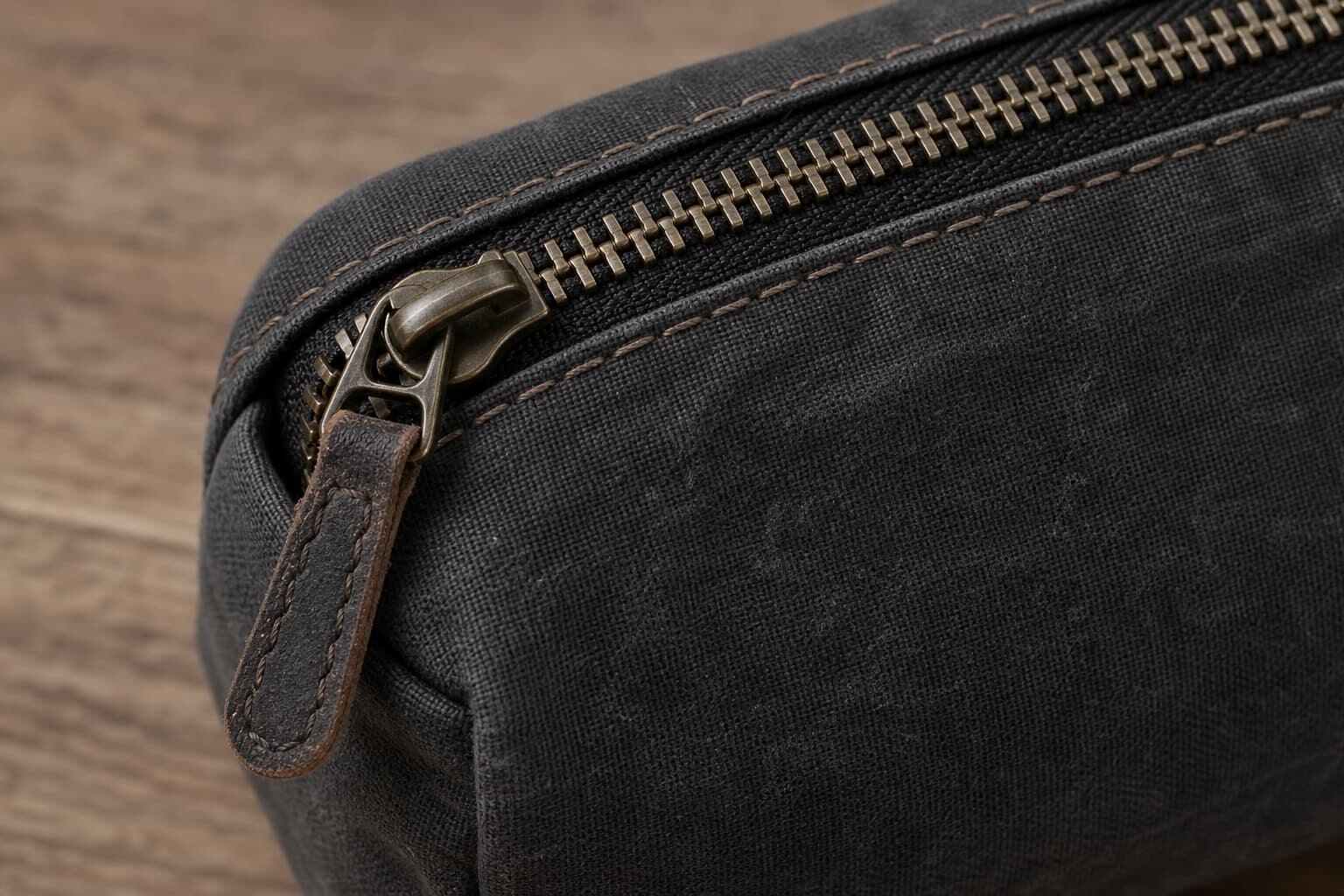
The zipper is not just an accessory. It is a functional component that affects opening length, user experience, reject rate, and lead time. Nylon coil zippers are usually the safest choice for cotton zipper bags because they are flexible, easy to sew, and available in many colors. Metal zippers can look more premium, but they add weight and may scratch documents or devices if the bag is used for office kits. Plastic molded zippers are less common for flat business pouches but may be used for sport or travel styles.
The most common schedule mistake is approving the bag body while leaving zipper details open. Zipper tape color, teeth color, slider finish, puller shape, and any logo puller should be settled before the factory buys materials. A branded metal puller or custom rubber puller may need tooling or supplier MOQ. Even if the bag factory can sew quickly, a special zipper can hold the order in material preparation for days or weeks.
- Use nylon coil zipper when the priority is smooth function, shorter sourcing time, and lower defect risk.
- Specify zipper tape color separately from fabric color; close colors may still look different under daylight.
- Confirm whether zipper length is measured by opening length or full zipper tape length.
- Ask for zipper pull strength and smoothness checks during inline inspection.
Printing and Logo Approval Timing
Logo method is another major timing point. Screen printing is efficient for solid logos and larger quantities, but it requires screen setup, ink matching, print testing, and curing time. Heat transfer works for gradients or detailed artwork, but buyers should check hand feel, edge quality, and heat press marks on cotton or canvas. Embroidery can create a premium business gift look, but it adds stitch file approval, thread color matching, and embroidery capacity before sewing.
For many zipper bags, the logo is printed on flat fabric panels before the zipper and side seams are sewn. That means artwork approval must happen early. If the buyer changes logo size after cutting or asks for a different print position after sewing begins, the factory may need to remake panels. A good RFQ should include vector artwork, Pantone references, print size, placement from edges, and whether slight fabric texture show-through is acceptable.
- Screen print: best for solid brand marks, campaign logos, and larger repeated runs.
- Heat transfer: useful for full-color designs, small text, or gradients, but needs wash and rub checks.
- Embroidery: suitable for 10-12 oz canvas or reinforced panels, less suitable for very thin cotton.
- Woven label or sewn label: good for subtle branding, but label MOQ and lead time must be checked.
MOQ Logic: Total Quantity Is Not Enough
Buyers often ask for 1,000 pieces and assume that MOQ has been met. For zipper business bags, MOQ may apply by fabric color, bag size, zipper color, print artwork, lining color, and packing type. An order of 1,000 pieces split into five fabric colors, two zipper colors, and four logo versions may behave like several small orders. That affects setup time, material waste, print screens, packing control, and inspection sampling.
A cleaner approach is to build the order around a stable base specification. Keep one fabric weight, one size, and one zipper color if delivery is tight. Then split the logo version only if necessary. If the buyer needs multiple sizes or colors for retail assortment, ask the factory to quote each variant as a separate line with its own MOQ, lead time impact, and setup charge. This prevents a supplier from quoting a blended average that becomes difficult to execute.
- Ask for MOQ by SKU, not only total order quantity.
- Separate one-time setup costs from recurring production costs.
- Confirm whether overruns or underruns are allowed, especially for custom dyed fabric.
- For repeat orders, ask which materials can be reserved or standardized to shorten replenishment lead time.
Sampling: What Must Be Approved Before Bulk Cutting
A sample is not only a sales tool. It is the production reference for cutting, sewing, logo placement, zipper handling, packing, and inspection. For a first order, buyers should approve a physical sample or at least a pre-production sample made with correct fabric weight, zipper type, logo method, and dimensions. If the supplier sends a sample in substitute fabric or substitute zipper, the buyer should treat it as a construction sample, not a full production approval.
The most useful sample comments are measurable. Instead of saying the bag looks good, confirm finished size tolerance, zipper opening length, print position, fabric shade, seam finishing, puller style, and packing method. If the bag is intended to hold a tablet, catalog, document set, cosmetics kit, or sales material, test it with the real contents. A bag that measures correctly when empty may become too tight when filled because zipper opening and corner depth are insufficient.
- Measure finished width and height after the zipper is closed.
- Check whether the zipper opens wide enough for the intended contents.
- Rub the printed logo lightly to check curing and surface adhesion.
- Inspect inside seams for loose threads, raw edges, or lining caught in the zipper.
- Approve carton packing only after confirming how the bag is folded or kept flat.
Packing and Carton Data Affect Final Days
Packing is often treated as the last step, but it can affect both cost and lead time. Bulk packing is faster and usually suitable for B2B giveaways, trade show distribution, internal sales kits, and warehouse repacking. Individual polybags, recycled paper bands, hang tags, barcode labels, or retail cartons require extra material sourcing and packing labor. Mixed cartons for distributors also need careful counting and carton mark control.
Procurement teams should request packing data before shipment planning, not after production is finished. Carton dimensions, gross weight, net weight, quantity per carton, and total carton count are needed for freight estimates and warehouse receiving. If the buyer has a carton weight limit, such as keeping cartons easy for manual handling, this must be stated before the factory packs. Heavy canvas zipper bags can quickly exceed comfortable carton weight if packed too densely.
- Bulk pack saves time but may need tissue or flat packing to reduce creasing.
- Individual packing improves distribution control but adds labor and material lead time.
- Barcode and carton labels should be approved before final packing starts.
- Carton quantity should match warehouse receiving needs, not only factory packing convenience.
A Practical Timeline for RFQ Comparison
When comparing supplier quotes, ask each factory to break the timeline into stages. A realistic example for a custom zipper business bag might include several days for artwork confirmation and sampling, additional time for fabric and zipper preparation, production time for printing and sewing, and final time for inspection and packing. The exact days will vary by factory capacity, order size, season, and specification, so the value is in the structure rather than one universal number.
The buyer should also clarify whether the schedule includes sample courier time, weekends, public holidays, and buyer approval waiting time. Many delays are not factory production delays; they are approval delays. If artwork is incomplete, the print proof is not approved, or carton marks are changed late, the factory cannot protect the original shipping date. Put decision deadlines into the purchase order or production schedule so both sides know when the next step must be released.
- Stage 1: RFQ clarification, artwork check, and sample plan.
- Stage 2: sample making, sample review, and written approval.
- Stage 3: material purchasing, fabric inspection, zipper confirmation, and print setup.
- Stage 4: cutting, printing or embroidery, sewing, trimming, and inline inspection.
- Stage 5: final inspection, packing, carton marking, shipping documents, and handover.
How to Prevent the Most Common Lead Time Mistakes
Most zipper bag delays are preventable. The biggest mistakes are vague specifications, late artwork changes, unconfirmed zipper details, unrealistic MOQ splits, and packing instructions sent after production. A factory can usually manage a stable order well, but it cannot make accurate promises when the buyer changes logo placement, adds lining, changes fabric color, or requests individual barcoding after the quote is accepted.
The best prevention method is to issue a production-ready RFQ. Include product drawing or reference photo, finished dimensions, fabric weight, zipper specification, logo method, artwork files, quantity by SKU, packing method, carton requirements, target delivery date, and inspection standard. Then ask the factory to confirm the lead time assumptions in writing. This turns the discussion from a general price quote into a working production plan.
- Do not approve bulk production from a photo if zipper function or lining quality is important.
- Do not compare a quote for 8 oz cotton with a quote for 12 oz canvas as if they are the same product.
- Do not leave zipper tape color to factory choice unless exact matching is not important.
- Do not add retail labels or individual packing after cartons are already planned.
- Do not book a fixed promotion date without buffer for sample approval and inspection findings.
Specification comparison for buyers
| Spec decision | Recommended option | When it fits | Buyer risk to check |
|---|---|---|---|
| Main fabric weight | 10-12 oz cotton canvas or 280-340 GSM cotton | Reusable document bags, retail gift sets, brand merchandise, conference kits | Heavier fabric can slow cutting and sewing, increase carton weight, and change the way the zipper lays flat |
| Lining choice | Unlined for simple pouches; 190T polyester lining for premium business bags | Unlined works for budget organizer bags; lining fits laptop accessories, sales kits, and retail presentation | Lining adds cutting, sewing, inspection, and sample approval time; poor lining tolerance can cause puckering near zipper ends |
| Zipper type | Nylon coil zipper for most cotton zipper bags; metal zipper only when style requires it | Nylon coil is smoother, lighter, and easier to color match; metal zipper gives a premium look for small runs | Custom zipper tape color, branded pullers, or metal finish changes can become the longest material lead item |
| Print method | Screen print for solid logos; heat transfer for gradients; embroidery for small premium placement | Screen print fits MOQ orders with simple brand marks; transfer suits complex artwork; embroidery suits heavier canvas | Print curing, color matching, and artwork proofing must be booked before sewing if print panel is printed flat |
| MOQ logic | Consolidate sizes and fabric color first, then split logo colors if needed | Best when buyers need several departments, campaigns, or distributor versions from the same base bag | Too many fabric colors, zipper colors, or sizes can turn one order into several small productions with separate setup time |
| Sample approval | Approve size set, zipper function, print color, packing, and carton mark before bulk cutting | Useful for new suppliers, new artwork, or first order under a retail compliance requirement | Approving only a logo image is not enough; zipper end finishing, seam allowance, and finished dimensions need physical confirmation |
| Packing format | Bulk pack for B2B handout; individual polybag or paper band for retail and kits | Bulk packing saves labor and carton volume; individual packing supports distribution, retail handling, and kitting | Packing changes made after sewing can delay final inspection and may require new carton size calculation |
| Inspection timing | Inline check after first 50-100 pieces plus final AQL inspection before shipment | Important for orders with printed panels, lining, multiple SKUs, or strict delivery windows | If defects are found only at final inspection, rework may threaten vessel closing or courier pickup dates |
Buyer checklist before sampling
- Confirm finished size with tolerance, not only flat pattern size, especially around zipper tape and boxed corners.
- State fabric type, GSM or ounce weight, color standard, and whether shrinkage or washing treatment is required.
- Lock zipper specification early: coil or metal, tape color, teeth color, puller shape, slider finish, and any logo pull requirement.
- Send vector artwork, Pantone references, print placement, maximum print size, and whether the panel is printed before sewing.
- Decide whether the bag is unlined, lined, padded, gusseted, or fitted with inner pockets before asking for production lead time.
- Ask the factory to separate sample lead time, material purchasing time, bulk production time, inspection time, and export packing time.
- Confirm MOQ by fabric color, zipper color, size, and print design, not only total order quantity.
- Approve a physical pre-production sample when zipper function, lining, embroidery, or retail packing is part of the order.
- Define packing method, carton weight limit, carton marks, barcode labels, and mixed-carton rules before bulk packing starts.
- Reserve buffer days for artwork correction, sample shipping, holiday periods, customs documents, and buyer-side approval delays.
Factory quote questions to send
- What is the normal lead time for sampling, material preparation, printing, sewing, packing, and final inspection for this zipper bag specification?
- Which item is likely to control the schedule: fabric dyeing, zipper sourcing, printing, embroidery, lining, packing, or factory sewing capacity?
- Is the quoted lead time counted from deposit, artwork approval, material approval, or pre-production sample approval?
- What MOQ applies separately to fabric color, zipper color, zipper puller, lining color, print design, and packing style?
- Can the logo panel be printed before sewing, and how many days are required for print proof, curing, and color approval?
- If the order has two sizes or multiple logo versions, will they run together or as separate production lots?
- What tolerance will the factory use for finished size, seam alignment, zipper opening, print position, and carton quantity?
- When can the first inline production photos or first 50-piece inspection report be provided?
- What is the latest date for changing artwork, packing, carton marks, or shipping marks without affecting delivery?
- What documents and packing data will be ready before shipment: packing list, carton dimensions, gross weight, HS code suggestion, and inspection photos?
Quality-control points to confirm
- Check finished dimensions after the zipper is installed because zipper tension can shorten the opening or distort the top edge.
- Test zipper movement on multiple pieces from the beginning, middle, and end of production, not only on the approval sample.
- Inspect zipper end bartacks, seam allowance, puller attachment, and corner turning for weak points that fail during repeated opening.
- Compare bulk fabric shade against approved swatch under consistent lighting, especially for natural cotton, dyed canvas, and jute blends.
- Verify logo color, print opacity, print position, curing, and rub resistance before printed panels move into sewing.
- Check lining attachment, inner pocket placement, loose threads, and seam puckering on lined zipper business bags.
- Confirm individual packing, barcode labels, carton marks, and mixed-SKU quantities against the purchase order before cartons are sealed.
- Run a simple use test by filling the bag with its intended contents, closing the zipper fully, and checking stress at corners and puller.