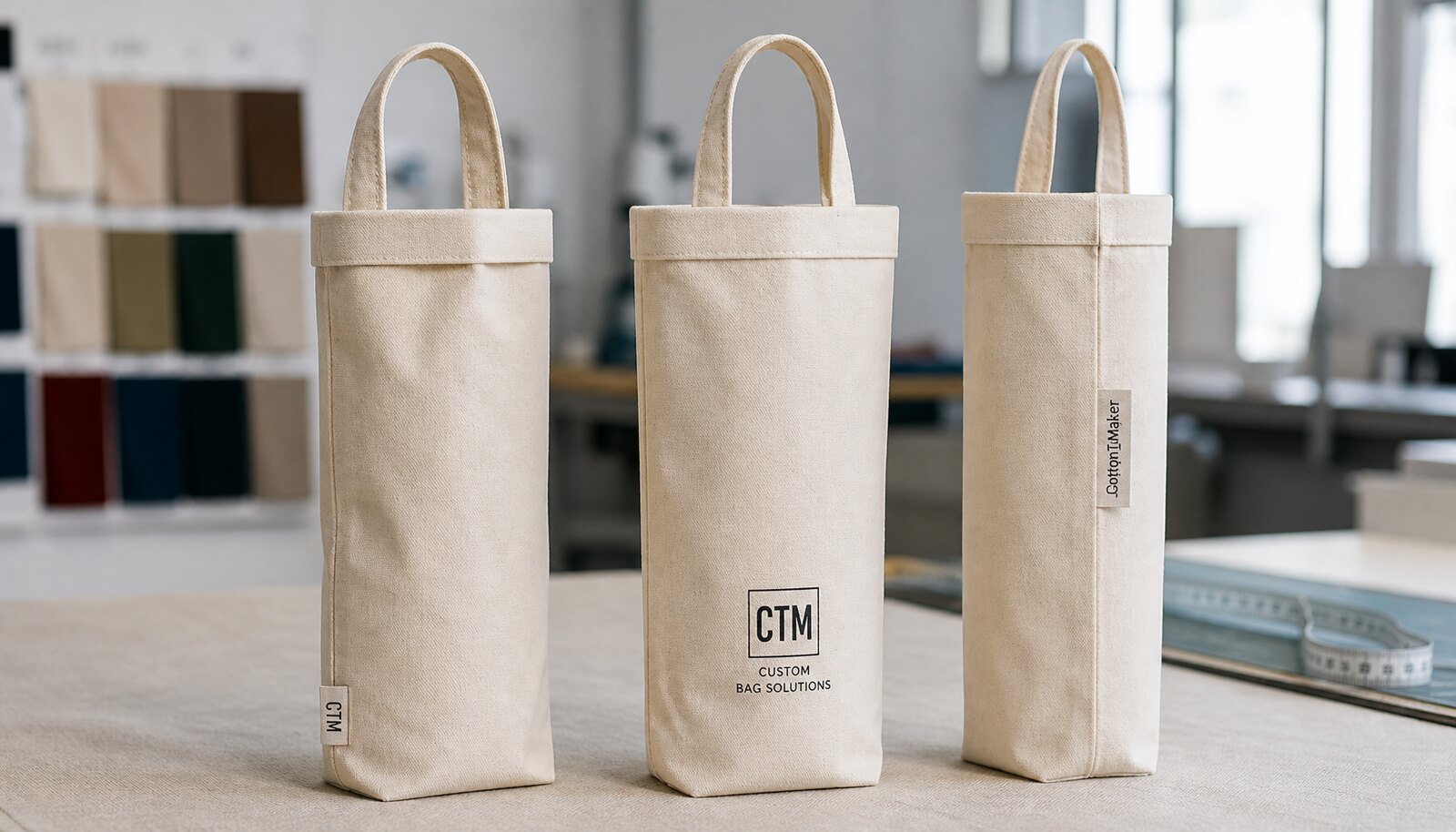
Why the Top Hem Fold Needs Its Own Supplier Note
For wine bottle bags, the top hem fold is not a small sewing detail. It controls the appearance of the opening, the strength around the neck area, the position of a drawcord or carry handle, and the final finished height. When buyers leave this detail open, two suppliers can quote the same bag size but deliver different constructions, different usable heights, and different visual quality.
A clear wine bottle bag top hem fold supplier note helps your RFQ compare like with like. It also prevents disputes after sampling, because the supplier can see whether you expect a simple promotional bag, a retail gift bag, or a premium canvas bottle carrier. The note should sit in the technical specification, not only in the artwork file or email comments.
- Use finished measurements after folding and sewing, not only cut panel dimensions.
- Define the fold type and fold depth in millimeters.
- Confirm whether the top hem also works as a cord channel.
- Show where the print starts after the hem is folded.
- Use the approved sample as the reference for bulk production.
The Buying Problem: Quotes Look Similar but Bags Are Not
Many importers receive wine bag quotes that show only size, fabric, logo, quantity, and price. The problem is that the top hem fold is hidden inside the sewing cost. A supplier using a narrow single fold may quote cheaper than a factory using a double fold with cleaner finishing. On a spreadsheet, both lines may read 'cotton wine bag with logo'. On the shelf, they do not look the same.
This matters most when the bag is used for winery retail, gift sets, corporate wine packaging, liquor distributors, hotel gifting, or seasonal supermarket promotions. A thin or uneven top hem makes the opening look unfinished and can expose raw fabric after handling. If a drawcord is added, the wrong fold depth can cause tearing, tight pulling, or a bulky neck that does not close cleanly.
- A low quote may hide reduced fold depth, lower GSM, fewer stitches, or no trimming.
- A taller cut panel may be needed to keep the same finished height after a double fold.
- Print placement can shift if artwork is measured before the top edge is folded.
- Packing compression can make a weak top hem look wavy when unpacked.
How to Write the Top Hem Fold Note in an RFQ
The supplier note should be short enough for the factory merchandiser to quote, but detailed enough for the sample room to follow. Avoid vague phrases such as 'nice top finish' or 'standard hem'. A better note gives the fold structure, finished size, stitch position, and tolerance. If the top hem forms a drawcord channel, state the cord diameter and opening position as well.
A practical RFQ note could read: 'Finished bag size 150 W x 350 H mm for 750 ml wine bottle. Top opening with 25 mm double fold to inside, top-stitch 3 mm from lower folded edge, no raw edge visible. Finished height measured from top folded edge to bottom seam. Artwork position measured from finished top edge. Tolerance +/- 5 mm on finished height, +/- 2 mm on hem depth.' This type of note reduces back-and-forth and gives every supplier the same quoting basis.
- For simple giveaway bags: 15-20 mm single or double fold may be enough if fabric is light and no cord is used.
- For retail cotton bags: 20-25 mm double fold usually gives a cleaner top opening.
- For cord channel bags: fold depth must fit the cord and allow smooth pulling.
- For heavy canvas: confirm needle size and stitch appearance because thick folds can become bulky.
- For printed bags: lock print position after the finished top edge is approved.
Fabric Weight and Construction Choices
Fabric selection changes how the top hem behaves. A 120-140 GSM cotton bag can work for short promotional use, but the top opening may feel soft and collapse around the bottle neck. A 160-180 GSM cotton bag gives better shape for common wine promotions. For higher perceived value, 180-220 GSM cotton, 10 oz canvas, or 12 oz canvas can support a more structured fold, especially when the buyer wants a visible retail-grade opening.
Jute, cotton canvas, non-woven, and laminated fabrics all fold differently. Jute can fray if not overlocked or folded properly. Canvas can become bulky at seam intersections. Dyed cotton may show needle marks if the top hem is unpicked during correction. When requesting quotes, ask suppliers to state the fabric weight they are pricing and how they finish the raw edge before the final fold.
- 120-140 GSM cotton: lowest cost, suitable for lightweight promotional bottle sleeves.
- 160-180 GSM cotton: common balance for branded wine gifting and distributor campaigns.
- 180-220 GSM cotton: better handfeel and cleaner top hem for retail presentation.
- 10-12 oz canvas: stronger and more premium, but bulkier at folded seams.
- Jute or burlap: needs careful edge control because loose yarns can escape at the top opening.
Print Method and Artwork Placement Around the Fold
Most wine bottle bags use screen print because it is reliable for cotton, canvas, and jute surfaces. Heat transfer can work for sharper multi-color artwork, but buyers should check handfeel, curing, and flexibility if the bag is folded tightly for packing. Digital print may be considered for lower quantities or complex artwork, but fabric texture and color can reduce sharpness. Embroidery is possible on heavier fabric, yet it can distort lighter panels and increase cost.
The top hem fold affects artwork more than many buyers expect. If the logo is placed too high, it may sit partly under the folded area, be distorted by sewing pressure, or disappear when the bottle neck gathers the fabric. For a standard 750 ml wine bag, many buyers keep the main print at least 60-90 mm below the finished top edge, depending on bag height and closure style. Always measure from the finished top edge after folding.
- Screen print: good for solid logos, one to four colors, stable bulk production.
- Heat transfer: useful for gradients or detailed graphics, but confirm wash and rub resistance if relevant.
- Digital print: flexible for short runs, but check color on natural cotton or jute.
- Embroidery or woven label: premium look, better on heavier fabric and simple artwork.
- Print strike-off should be reviewed on the actual fabric weight and color, not only on paper.
MOQ Logic: Why the Hem Fold Can Affect Minimums
MOQ is not only about total quantity. For wine bottle bags, the minimum can change by fabric availability, fabric dyeing, print setup, cord color, label type, cutting efficiency, and sewing method. A standard natural cotton bag with one-color screen print may have a lower MOQ than a dyed canvas bag with a double-fold cord channel and custom woven side label.
The top hem fold affects MOQ because it changes sewing time and operator skill. A simple single fold can run faster. A double fold with consistent depth requires better handling, especially on narrow wine bag widths. If the top hem also forms a cord channel, the factory must allow space for cord insertion, eyelets if used, or side openings. Buyers should ask whether the quoted MOQ applies per size, per design, per color, or per shipment.
- Natural cotton stock fabric can support lower MOQ than custom dyed fabric.
- One-color screen print usually has simpler setup than multi-color registration.
- Custom cord, metal eyelets, or woven labels can create separate accessory MOQs.
- Narrow bags with heavy fabric may require slower sewing to keep the fold straight.
- Mixed designs under one MOQ should be confirmed in writing before sampling.
Sample Checks Before Approving Bulk Production
A pre-production sample for a wine bottle bag should be checked with a real bottle, not only laid flat on a desk. Use the actual 750 ml, 1 L, champagne, spirit, or olive oil bottle if the bag is not for standard wine. Bottle diameter, shoulder shape, cap height, and neck finish all affect how the top opening sits. A bag that looks correct flat may become too short once the bottle is inserted.
Check the top hem with a ruler and by hand. The fold should be even around the opening, the stitch line should not wander, and no raw edge should be visible inside unless that was approved. If there is a drawcord, pull it several times with the bottle inside. The channel should not jam, and the side seam should not tear. Mark any change directly on sample photos and update the RFQ specification before mass production.
- Measure finished height from top folded edge to bottom seam.
- Measure opening width flat and after bottle insertion.
- Check hem fold depth at front, back, and both side seams.
- Confirm logo position after the bottle is inside the bag.
- Review bottom seam strength if the bottle weight is carried by the bag.
- Approve the packing fold method if the bag will be retail-packed or kitted.
Packing and Carton Details That Protect the Top Edge
Packing is often where a good sample becomes a poor shipment. Wine bottle bags are narrow, so the top opening can bend, curl, or crease if the factory forces too many pieces into one carton. Natural cotton and canvas can recover from light folding, but heavy pressure during sea freight can leave a wavy top hem. Jute may shed fibers if the opening rubs against rough carton edges.
Ask the supplier to quote a packing method, not just a carton quantity. For bulk distributor orders, flat packing in aligned bundles of 50 or 100 pieces may be acceptable. For retail programs, individual polybags, belly bands, hang tags, or carton dividers may be needed. If sustainability rules restrict polybags, request paper bands or carton liners, but still protect the top hem from dust and compression.
- Confirm pieces per inner bundle and pieces per export carton.
- Ask for carton dimensions, gross weight, and stacking recommendation.
- Keep openings aligned in the same direction to reduce twisting.
- Use moisture control for cotton, canvas, and jute during ocean shipment.
- Check carton marks against the purchase order and buyer routing guide.
Lead Time and Quote Data Buyers Should Compare
Lead time should be broken into sample time, sample approval, material preparation, printing, sewing, inspection, packing, and export handover. A supplier may quote a short production time based on available fabric, but custom dyeing, special cords, woven labels, or multi-color print approvals can extend the schedule. Do not compare only the final number of days without knowing what is included.
For quote comparison, ask suppliers to separate the commercial drivers. You need to know whether the price includes fabric cutting waste, screen setup, print strike-off, pre-production sample, top hem sewing method, accessory insertion, individual packing, carton marks, and inspection support. If one quote includes a double folded hem and another does not, the cheaper quote may become more expensive after corrections.
- Request unit price by quantity breaks such as 500, 1,000, 3,000, and 5,000 pieces if relevant.
- Separate sample charge, screen charge, mold charge, label charge, and freight for samples.
- Ask whether price changes if top hem fold depth increases from 15 mm to 25 mm.
- Confirm whether rejected samples or revised samples are charged separately.
- Check whether export carton packing is included or only simple bulk packing.
Acceptance Criteria for Production Inspection
Inspection criteria should be written before production starts. If the purchase order only says 'as approved sample', disputes become subjective. The approved sample is important, but inspectors also need measurable checkpoints. For top hem fold quality, include finished size tolerance, hem depth tolerance, stitch consistency, raw edge control, print alignment, and bottle fit.
For AQL inspection or internal receiving checks, pull samples from different cartons and production times. Do not inspect only the top carton. Wine bags are usually sewn in batches, and variation can appear when operators change rolls, thread cones, or shift teams. If the top hem is critical to retail appearance, photograph the acceptable and unacceptable examples and share them with the supplier before bulk sewing.
- Finished height tolerance: commonly +/- 5 mm unless the buyer sets tighter limits.
- Top hem depth tolerance: commonly +/- 2 mm for a visible folded edge.
- No exposed raw edge, loose thread, skipped stitch, or broken stitch at the opening.
- Logo position tolerance should be measured from the finished top edge.
- Bottle must insert and remove without tearing the side seam or deforming the opening.
- Cartons should not be crushed, wet, under-filled, over-filled, or mislabeled.
Specification comparison for buyers
| Spec decision | Recommended option | When it fits | Buyer risk to check |
|---|---|---|---|
| Top hem fold depth | 20-25 mm double fold with top stitch | Retail gift wine bags where the opening must look clean and resist fraying | If fold depth is not stated, supplier may use a narrow single fold that twists after packing |
| Fabric weight | 180-220 GSM cotton or 10-12 oz canvas for premium bottle bags | Single 750 ml bottle packaging, gifting, winery retail, or promotional sets | Low GSM can collapse around the bottle and make print registration look poor |
| Seam construction | Side seam plus bottom boxed or flat stitch depending bottle fit | Flat base for standing display, narrow tube for simple giveaway bag | Unclear base type can change packed height, carton quantity, and bottle stability |
| Print placement | Screen print 60-90 mm below top edge, confirmed after hem fold | Logo bags where artwork must sit clear of the gathered neck or top fold | Artwork measured from raw fabric edge may move after folding and sewing |
| Drawcord or handle option | Cotton drawcord inserted below folded top, or die-cut carry handle only if fabric is heavy enough | Gift closure, winery counter sale, or travel retail gift pack | Cord channel too close to top stitch can tear under bottle weight |
| Packing method | Flat pack with opening aligned, 50-100 pcs per inner bundle, moisture control for sea freight | Importer cartons, distributor stock, or retail kitting | Over-compressed packing can create permanent top hem creases and distorted openings |
Buyer checklist before sampling
- State the finished bag size, usable internal height, bottle size, and whether measurements are before or after the top hem fold.
- Define top hem construction: single fold, double fold, fold depth in mm, stitch line distance, and acceptable tolerance.
- Confirm fabric weight in GSM or oz, fabric composition, shrinkage allowance, and whether the fabric is washed, natural, bleached, dyed, or laminated.
- Request a pre-production sample showing the exact top hem fold, print position, cord channel or handle position, and packing fold method.
- Check that artwork placement is measured from the finished top edge, not the cut fabric edge.
- Ask for seam allowance, stitch density, thread color, and whether loose thread trimming is included before packing.
- Confirm MOQ by fabric color, print color count, bag size, and top hem construction because each can change cutting and sewing efficiency.
- Require carton packing details including pieces per carton, carton size, gross weight, moisture control, and carton marks.
- Set inspection criteria for top opening width, hem twisting, skipped stitches, frayed edges, print alignment, and bottle fit.
- Ask the supplier to separate quote data for fabric, printing, sewing complexity, accessories, packing, sampling, and mold or screen charges.
Factory quote questions to send
- What is the exact top hem fold method you are quoting: single fold, double fold, overlock plus fold, or folded cord channel?
- What finished top hem depth and stitch distance will appear on the production bag, and what tolerance do you accept?
- Is the quoted bag size measured finished after sewing, or is it based on cut fabric size before hem folding?
- Which fabric weight are you quoting in GSM or oz, and what is the expected shrinkage or size variation after fabric handling?
- Where will the logo be positioned in relation to the finished top edge, side seam, and bottom seam?
- Which print method is included in the quote, and are screen setup, color matching, strike-off, or curing checks included?
- Does the MOQ apply per total order, per size, per fabric color, per print design, or per packing style?
- What sample types can you provide before mass production: material swatch, print strike-off, fit sample, pre-production sample, or packing sample?
- What is your normal production lead time after sample approval and deposit, and what steps can extend it?
- What packing method is quoted, and will the top hem be protected from crushing or deformation during carton loading?
Quality-control points to confirm
- Finished top opening width must match the approved sample and allow the specified bottle neck to enter without forcing.
- Top hem fold depth should be consistent across the lot, with no raw edge exposure, rolling, twisting, or uneven stitch line.
- Logo placement must be checked from the finished top edge after folding, not from the cut panel edge.
- Fabric weight and handfeel should match the approved swatch; thin substitutions are common on low-priced quotes.
- Stitch density should be stable at the side seam, bottom seam, and top hem corners, with no skipped stitches or broken thread.
- Drawcord channel, if used, must allow smooth pulling without catching on seam allowance or top-stitching.
- Printed areas should not crack, bleed, transfer, or sit too close to the folded hem where sewing pressure may mark the ink.
- Packing should keep bag openings flat and aligned; excessive compression can create a permanent wavy top edge.
- Carton quantity, gross weight, and carton marks should match the approved packing plan and purchase order.
- Random bottle fit tests should be done using the buyer's actual bottle diameter, shoulder height, and cap or cork finish.