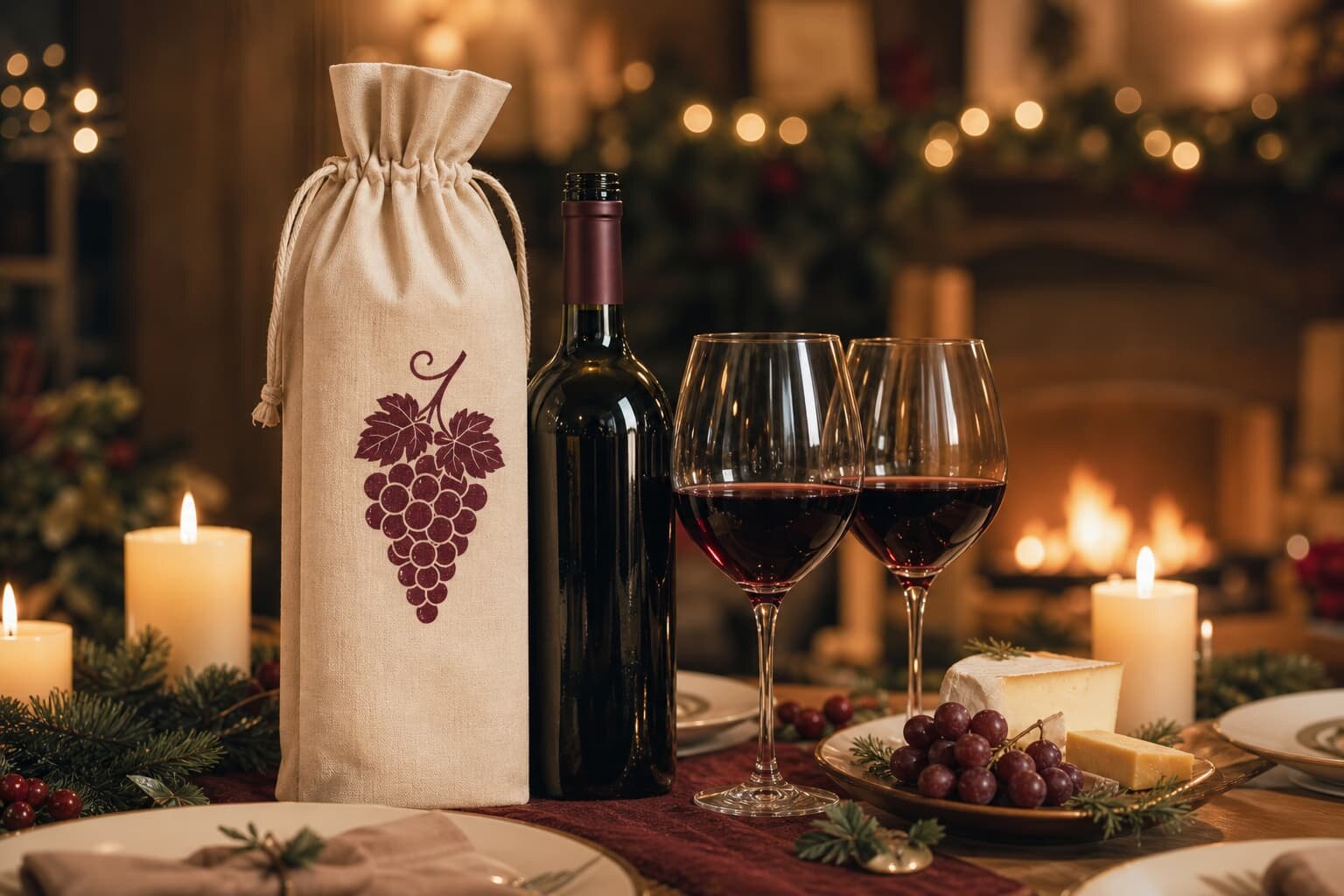
Why the Top Hem Fold Needs a Signoff File
For a wine bottle bag, the top hem fold is not only a neat edge. It controls the drawstring channel, the final bag height, the opening shape, the way the bottle neck shows, and the position of the printed logo. A small misunderstanding here can make a correct-looking fabric panel become a rejected finished bag after sewing.
A wine bottle bag top hem fold signoff file is the buyer-approved record that tells the factory exactly how the top edge should be folded, stitched, measured, and inspected. It should be part of the pre-production package together with artwork, fabric swatch, size spec, packing instruction, and carton mark file. Without this file, the supplier may quote one construction, sample another, and bulk sew a third version based on operator habit.
- Use it when the order has a drawstring closure, folded lip, bound top edge, or visible top stitch.
- Use it when artwork sits close to the upper part of the bag and height tolerance matters.
- Use it when comparing quotes from several suppliers that may not define finished size the same way.
- Use it when the importer needs evidence for internal approval, inspection, or claim handling.
The Buying Problem: Finished Size Changes After Folding
Many RFQs say only, for example, 15 x 35 cm wine bottle bag, natural cotton, one-color logo. That is not enough. If one factory treats 35 cm as the cut height and another treats 35 cm as the finished height, the two quotes are not for the same product. The first bag may finish shorter after the fold is sewn, while the second needs more fabric allowance and may cost slightly more.
This becomes more important on narrow bottle bags because the top fold consumes a noticeable percentage of the total fabric height. A double fold of 10 mm plus 20 mm uses around 30 mm of fabric before stitch margin and handling tolerance. If the buyer expects a 35 cm finished bag and the factory cuts 35 cm before folding, the result may be close to 32 cm finished height, depending on bottom seam and top construction.
- State finished width and finished height separately from cutting size.
- Ask the factory to show fold allowance in the pattern or production worksheet.
- Confirm whether bottom seam allowance is included in the quoted measurement.
- For bottle fit, measure the bag with the actual bottle or bottle drawing, not only flat on the table.
What to Include in the Signoff File
A useful signoff file is not a decorative approval sheet. It is a production control document. It should allow a sewing supervisor, merchandiser, inline QC inspector, and buyer-side inspector to reach the same conclusion when looking at the top edge. The file should include both a simple drawing and real sample photos with ruler measurements.
For most wine bottle bags, the signoff file can be a two-page PDF. Page one shows the technical drawing: finished size, top hem fold sequence, stitch line, drawstring channel height, cord exit, side seam direction, and artwork reference points. Page two shows the approved sample: front view, inside top view, side seam close-up, cord channel close-up, and measurement photos.
- File name example: CTM-wine-bottle-bag-top-hem-fold-signoff-natural-8oz-v3.pdf.
- Show first fold and second fold in millimeters, not only a written note saying folded top.
- Mark stitch distance from folded edge, such as 2 mm edge stitch or 6 mm channel stitch.
- Include the approved thread color, stitch type, and stitch density if appearance is important.
- Add buyer approval date, sample version, supplier name, and order reference.
Fabric Weight and Fold Behavior
The same fold specification behaves differently on 5 oz cotton, 8 oz canvas, jute, and laminated fabric. Light cotton around 140-170 gsm can fold cleanly with a narrow double fold, but it may look weak if the cord is thick or if the bottle is heavy. Canvas around 240-300 gsm gives better structure, but the folded side seam becomes bulky and needs correct needle size, thread tension, and pressing.
Jute and coarse burlap wine bags need even more care. A raw edge can shed fibers, while a tight double fold may crack, twist, or create a thick ridge at the side seam. If the order uses jute or cotton-jute blend, ask whether the top edge is double folded, overlocked then folded, bound with cotton tape, or lined. Each method changes cost, sewing speed, and appearance.
- Economy cotton: 4-5 oz or about 120-170 gsm, suitable for event giveaways and light retail gifting.
- Standard reusable cotton: 6-8 oz or about 200-270 gsm, better for winery branding and distributor stock.
- Premium canvas: 10-12 oz or about 340-400 gsm, stronger but may need a wider fold and heavier needle.
- Jute or burlap: often quoted by GSM or ounce equivalent; confirm edge finishing to reduce fraying.
- Laminated nonwoven or coated fabric: check whether heat or pressure affects crease recovery at the top fold.
Print Position Must Follow the Finished Edge
A common production mistake is approving artwork on a flat cut panel before the top hem is folded. Once the hem is sewn, the visible panel height changes. If the logo was measured from the cut top edge, it can move too close to the drawstring, become partly hidden when the bag is closed, or look unbalanced on the bottle.
For wine bottle bags, print position should usually be controlled from the finished top edge, bottom seam, or vertical center of the visible panel. The best method depends on the design. A winery crest near the upper front may need a minimum distance below the drawstring channel. A large retail logo may need to be centered between the bottom seam and the bottom of the top channel.
- Keep main print at least 45-60 mm below the finished top edge on standard drawstring wine bags.
- For screen print, check that the folded hem thickness does not stop the panel from lying flat on the print table.
- For heat transfer, avoid placing transfers across a thick fold or side seam ridge.
- For embroidery, confirm backing material and whether needle holes distort lighter cotton.
- For woven labels, specify whether the label is sewn into the side seam, top hem, or front panel.
MOQ Logic Behind a Small Wine Bag Order
Buyers often expect wine bottle bags to have low MOQ because the product is small. In reality, MOQ depends less on bag size and more on material, color, printing, cord, label, and packing. A natural cotton bag with one-color screen print may have a lower MOQ than a custom dyed canvas bag with matching cord, woven label, and retail barcode polybag.
When you compare quotes, separate the MOQ drivers. The factory may accept a lower sewing quantity if fabric is in stock, but custom dyeing, custom rope color, or printed retail packaging may have its own minimum. A clear top hem signoff file also reduces sample loops, which matters when the order quantity is not high enough to absorb repeated development work.
- Stock natural cotton usually has the easiest MOQ and fastest sampling path.
- Custom dyed cotton or canvas may require fabric mill MOQ, lab dip approval, and extra lead time.
- Pantone-matched drawcord can create a higher MOQ than the bag itself.
- Embroidery and woven labels may need setup charges even when bag quantity is modest.
- Retail packing with barcode labels, inserts, or individual polybags should be quoted separately.
Sample Approval: What to Measure Before Bulk Cutting
A wine bag sample should not be approved only because the logo looks good in a photo. Ask the factory to measure the same points your inspector will measure later. At minimum, check finished width, finished height, top hem width, channel height, cord length, print position, side seam width, bottom seam, and bottle fit after closure.
Use the actual bottle size if available. A 750 ml Bordeaux bottle, Burgundy bottle, sparkling wine bottle, and tall spirit bottle do not sit the same way. The shoulder height and neck shape affect how much fabric gathers at the top. If the bottle is wider than expected, the drawstring may pull the top channel under tension and expose uneven stitching.
- Approve one flat measurement photo and one bottle-in-bag photo.
- Check the top opening before and after pulling the cord closed.
- Measure from the finished top edge to the top of the printed logo.
- Inspect side seam bulk where the hem fold crosses multiple fabric layers.
- Confirm the approved sample is sealed or clearly labeled as the production reference.
Quote Data Buyers Should Request
A supplier quote for wine bottle bags should show more than unit price. If the top hem fold is not defined, a lower quote may simply be using less fabric, a single fold instead of a double fold, a narrower channel, cheaper cord, or looser tolerance. The difference may not be obvious until bulk goods arrive.
Request a quote sheet that connects construction to cost. Ask the factory to state fabric GSM, bag finished size, fold construction, print method, cord material, cord length, label details, packing method, carton quantity, sample charge if any, mass production lead time, and payment terms. If two factories quote different assumptions, ask them to re-quote against the same signoff drawing.
- Fabric: composition, GSM or ounce weight, color, stock or custom dyed.
- Sewing: top hem type, stitch type, stitch density, side seam and bottom seam method.
- Decoration: screen print color count, transfer size, embroidery stitch range, label method.
- Accessories: cord material, cord diameter, cord length, metal or plastic tips if used.
- Packing: pieces per inner polybag, carton size, gross weight, carton mark, pallet requirement if any.
- Lead time: sample days, approval waiting time, production days, packing days, and peak season risk.
Packing and Carton Handling Affect the Fold
The top hem can be approved correctly and still arrive looking poor if packing is too tight. Wine bottle bags are often folded flat in bundles, then packed by 50 or 100 pieces per inner polybag. If the carton is overfilled, the top edge can be crushed or sharply bent, creating wrinkles that are difficult to remove before retail use.
For premium bags, especially canvas or jute with a visible top fold, ask for packing photos before shipment. Confirm whether bags are laid flat, folded once, or rolled. If the bags are for retail sets, consider smaller inner packs to reduce handling damage. If they are for distributor stock, efficient flat packing may be acceptable as long as the hem is not compressed against carton corners.
- Define pieces per inner polybag and whether bags face the same direction.
- Avoid mixing approved sample versions or old top hem versions in the same carton.
- Check carton weight so warehouse teams can handle cartons without crushing lower layers.
- Use a carton mark file that matches the final item code, color, size, and quantity.
- Ask for pre-shipment photos showing bundle method and top edge condition.
Lead Time and Signoff Workflow
A practical wine bag schedule should include time for file confirmation, material check, sample making, buyer review, possible revision, bulk cutting, printing, sewing, trimming, packing, and final inspection. The signoff file should be approved before bulk fabric is cut and before panels are printed. If artwork is printed first and the hem changes later, the logo position may no longer match the approved layout.
For a straightforward stock cotton wine bag with one-color screen print, sampling can often move faster than a custom dyed or heavily decorated order. But buyers should still avoid approving by informal chat messages only. A signed PDF, email confirmation, or platform approval record tied to the final signoff file helps both sides avoid confusion when production moves from sample room to sewing line.
- Step 1: confirm RFQ data and bottle dimensions.
- Step 2: receive factory drawing and top hem fold proposal.
- Step 3: approve artwork position based on finished bag dimensions.
- Step 4: review physical or photo sample with ruler measurements.
- Step 5: freeze the signoff file before bulk cutting and printing.
- Step 6: use the same file for inline inspection and final inspection.
Specification comparison for buyers
| Spec decision | Recommended option | When it fits | Buyer risk to check |
|---|---|---|---|
| Top hem construction | Double fold 10 mm + 20 mm with lockstitch or chain stitch | Cotton, canvas, and linen-look wine bottle bags where a clean inside edge matters | If the fold allowance is not included in the pattern, finished height becomes short after sewing |
| Drawstring channel height | 25-30 mm clear channel after stitching | Single-bottle bags using 4-6 mm cotton cord, PP cord, or jute rope | A narrow channel causes cord drag, poor closure, and higher operator handling time |
| Fabric weight | 5 oz/170 gsm cotton for economy, 8 oz/270 gsm canvas for premium | Promotional wine gifting, retail bottle packaging, or reusable brand packaging | Heavy fabric needs larger fold radius; thick seams may crack print or create bulky side seams |
| Print position from top edge | Keep main logo at least 45-60 mm below finished top edge | Screen print, heat transfer, pigment print, or digital print on front panel | If artwork is measured from cut edge instead of finished edge, logo shifts upward after hem folding |
| Signoff file format | Annotated PDF plus editable AI/CDR/PDF artwork and sewn sample photos | Orders with buyer artwork, private label, retail carton marks, or distributor approval chain | Verbal approvals do not protect against disputes over fold width, cord exit, or finished bag height |
| Sample approval method | Measure sealed sample flat, with bottle inserted, and after drawcord closure | Wine bags supplied to wineries, gift sets, supermarkets, or event distributors | Flat-only approval misses top opening tension, bottle neck exposure, and drawcord bite |
| Packing specification | Flat pack with top hem not crushed; inner polybag by 50 or 100 pcs | Bulk export cartons for importers and distributors | Over-compression can set wrinkles on the hem and make retail handling look uneven |
Buyer checklist before sampling
- Confirm whether bag height is measured from cut edge or finished top edge after the hem fold.
- State the top hem fold construction in millimeters, including first fold, second fold, and stitch distance from folded edge.
- Add a cross-section sketch for the top hem, especially when drawstring channel, rope exit, or side seam overlap is involved.
- Lock the finished bag size tolerance, normally +/-3 mm for small cotton wine bags and +/-5 mm for thicker jute or canvas bags.
- Mark artwork position from the finished top edge, not from the fabric cut edge.
- Check that print curing, heat transfer pressing, or embroidery placement will not distort the folded hem.
- Approve cord diameter, cord length, knot style, and whether the cord exits from one side or both sides.
- Request photos of the first sewn sample showing ruler measurements at the top fold, stitch line, channel height, and side seam.
- Require the factory to include the top hem fold signoff file in the pre-production package before cutting bulk fabric.
- Confirm packing method so the folded top edge is not crushed, sharply bent, or mixed with unapproved sample versions.
Factory quote questions to send
- What fabric GSM or ounce weight are you quoting, and has the top hem allowance already been included in the cutting size?
- What is the exact first fold, second fold, channel height, and stitch margin for the top hem?
- Will the bag use a single-fold hem, double-fold hem, bound edge, or drawstring tunnel, and can you send a cross-section drawing?
- What is the finished size tolerance after sewing and pressing, and how will your QC team measure it?
- For printed wine bags, is artwork positioning measured from the finished top edge, bottom edge, or center line?
- What print method is quoted for this fabric: screen print, heat transfer, digital pigment, embroidery, woven label, or hot stamping?
- What MOQ applies to the fabric color, print method, cord color, and private label packaging separately?
- How many days are needed for material sourcing, sample making, buyer approval, bulk production, and packing after signoff?
- Can you provide a top hem fold signoff file with sample photos before bulk cutting?
- What carton size, pieces per inner polybag, gross weight, and carton mark format are included in the quotation?
Quality-control points to confirm
- Measure finished bag height from bottom seam to the final folded top edge, not to the hidden cut edge.
- Check top hem width at left side, center, and right side to catch twisting or uneven folding.
- Pull the drawstring through the full channel to confirm smooth movement and no needle catching.
- Inspect side seam intersection where the folded hem becomes thick and most likely to skip stitches.
- Compare printed logo position against the approved signoff file after the hem is sewn, not before folding.
- Check whether the bottle neck remains exposed as intended after the bag is pulled closed.
- Test seam strength with a filled bottle or equivalent load, especially on jute, linen-look, and canvas bags.
- Confirm stitch density, thread color, loose thread trimming, and backtack position at cord exit points.
- Review packing to ensure the hem fold keeps its shape and is not crushed by tight carton loading.
- Keep one approved sealed sample and one signed digital signoff file as reference for final inspection.