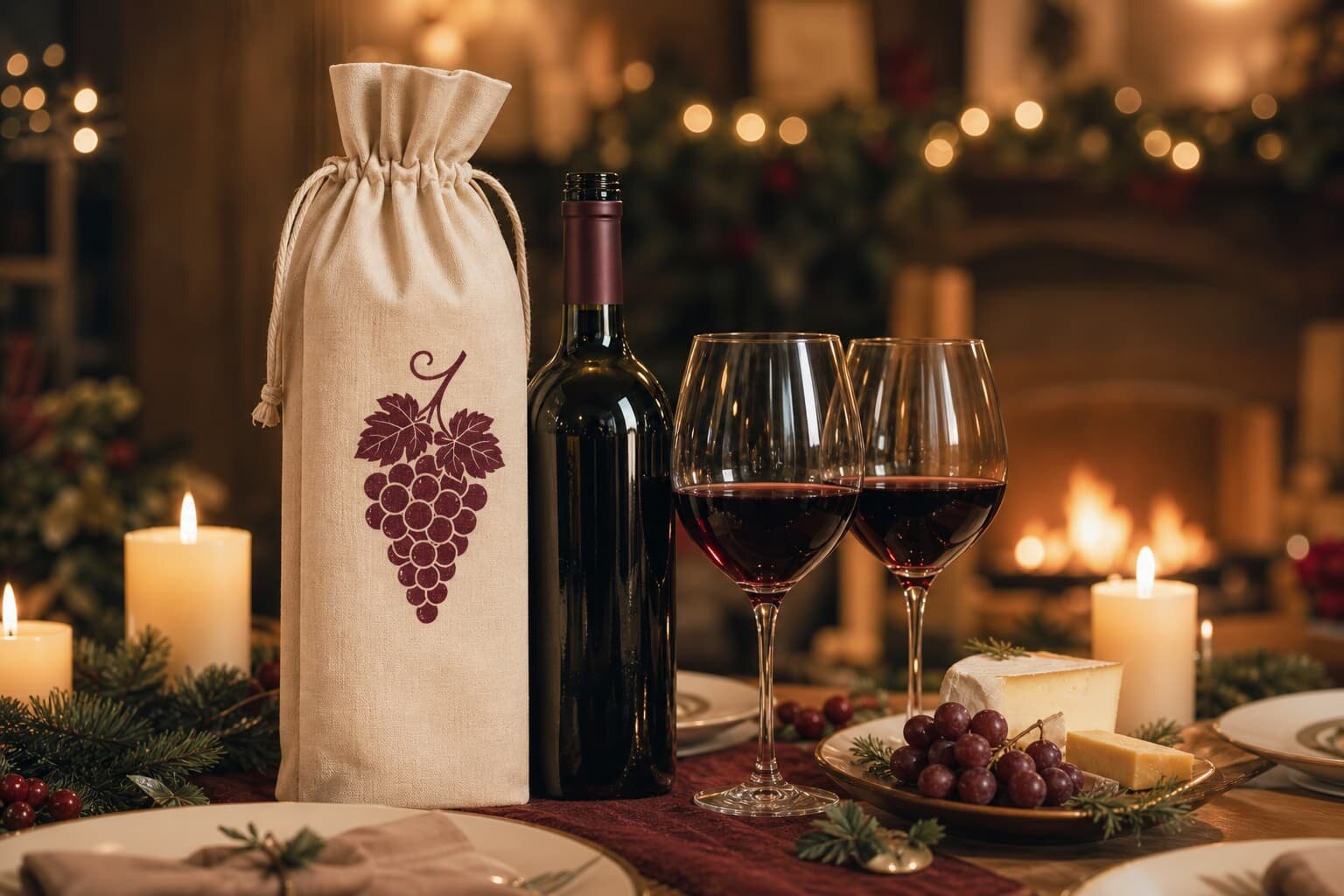
Why the Top Hem Fold Needs Its Own Quote Line
A top hem fold looks minor on a wine bottle bag, but it changes how the factory builds the bag and how the buyer should compare quotes. The fold adds fabric consumption, extra handling, more machine time, and a different finishing standard at the mouth of the bag. If one supplier prices a raw edge and another prices a double-fold enclosed hem, the numbers are not comparable, even if the bags look similar in a photo.
Buyers often lose margin here because the quote sheet only says wine bottle bag and the supplier fills in its own assumptions. A clean RFQ should tell the factory whether the hem is decorative, structural, or both. For example, a 20 mm single fold for a lightweight gift bag is not the same as a 30 mm double fold for a reusable retail bag. If the hem supports print placement or helps the bag hold shape, say so up front.
- List the hem depth in millimeters, not just top hem fold.
- State whether the raw edge must be fully hidden.
- Ask the supplier to separate fabric, labor, print, and packing in the quote.
Define the Bag Before You Ask for Price
The fastest way to get a useless quote is to ask for a wine bottle bag without a complete product definition. At minimum, the factory needs finished dimensions, fabric type, GSM, seam type, top hem fold depth, print area, and packing format. If the bag has a drawcord, cord stopper, insert card, gusset, or label, those details also belong in the first RFQ. Each item changes material use and sewing time, which means each item changes the final unit cost.
Finished size matters more than cut size in buyer discussions because the customer receives the finished bag, not the pattern. For a single-bottle bag, buyers should specify the intended bottle diameter and bottle height range, then confirm the target finished bag size with allowance for fit and shrinkage. A slightly oversized bag may be acceptable for bulk gifting, but it can look loose and retail poorly. A tight bag may look premium on paper but fail on thicker bottles or after washing.
- State finished size, not only pattern size.
- Describe the bottle profile the bag must fit.
- Add fabric shrinkage allowance if the bag is cotton or canvas.
Fabric, GSM, and Sewing Choices That Change Cost
For wine bottle bags, fabric weight is one of the biggest drivers of appearance and quote stability. A lightweight cotton around 140-160 GSM can work for simple giveaways, but it may feel soft and collapse under a heavier bottle. Many retail buyers prefer 180-220 GSM cotton canvas because it stands better, prints cleanly, and tolerates repeated handling. If the product needs a more rustic look, some buyers move to heavier cotton or jute-style material, but that changes the hem behavior, seam texture, and print quality.
Sewing construction also affects price more than buyers expect. A double-needle side seam, reinforced bottom corners, and a fully enclosed top hem fold take more time than a basic overlock finish. If you want a cleaner premium look, pay for it by defining it, not by assuming the factory will include it. If the bag will be reused or sold in retail channels, ask for seam construction details in the quote sheet, including stitch density, thread type, and whether reinforcement is added at stress points.
- Common buyer targets: 140-160 GSM for light promo use, 180-220 GSM for retail use, heavier only if the bottle and brand position justify it.
- Ask whether the fabric is pre-shrunk or raw and how much shrinkage the factory expects.
- Request seam details: overlock, single needle, double needle, or reinforced bar tack.
Print Method, Artwork, and Branding Limits
Print is where quote sheets often drift because the buyer says simple logo, but the factory hears different color counts, different coverage, and different curing steps. A one-color screen print on cotton is usually the most predictable option for a wine bottle bag, especially when the logo sits on a plain natural fabric. If the artwork has fine lines, halftones, or gradients, a different print method may be needed, and the quote should say that clearly. Woven labels, side labels, or heat transfer can also be better when the buyer wants a more controlled brand mark and less ink hand feel.
The buyer should lock down artwork size and placement before comparing quotes. A 60 mm logo on the front chest area is not the same as a large centered print or a side label placed in the seam. Ask the factory to quote the exact decoration method, the number of colors, the print area in centimeters, and whether setup charges are one-time or repeat on each reorder. This is especially important for buyers who expect to reorder in smaller quantities after a first seasonal launch.
- For a clean quote, specify logo size in millimeters or centimeters.
- State the number of print colors and the exact print position.
- Ask if screens, plates, or setup charges are separate from unit price.
MOQ Logic and How Factories Build the Unit Price
MOQ is not only about sewing capacity. It is also about fabric booking, print setup, labeling, and carton efficiency. A supplier may offer a low MOQ for a plain bag, then raise the MOQ sharply once you add a second print color or a custom woven label. Buyers should ask for MOQ by fabric color, print version, and packaging version, because those are often priced differently. If the order includes several bottle bag styles, check whether the factory allows mixed sizes under one material lot or whether each size must meet a separate minimum.
When comparing unit prices, do not focus only on the first line item. A quote that looks higher may already include the sample fee, print setup, and standard packing, while a lower quote may exclude all three. The real question is how the factory divides material, labor, print, packaging, and overhead. If the fabric is imported or the weave is specialty, material booking may be the biggest reason for a price gap. Ask the supplier to explain which part of the price changes at 500 pieces, 1,000 pieces, and 5,000 pieces so you can see the actual cost break.
- Ask for MOQ by color, artwork version, and packing format.
- Check whether setup charges are included or separate.
- Request tiered pricing so you can see where the unit cost really moves.
Sample Approval: What to Check on the First Piece
A good wine bottle bag sample is not just a photo or a folded piece of cloth. It should be the exact construction method the factory plans to use in production, with the same fabric weight, the same hem fold, the same print method, and the same label or cord details. The first sample is the moment to catch weak assumptions. If the hem is too narrow, the opening twists. If the print is too large, it distorts on the fold. If the thread is too light, the side seam may pucker after pressing.
Buyers should inspect the sample against a simple checklist and leave no room for verbal approval alone. Measure the finished width and height, check hem symmetry, confirm the print position relative to the seam, and test the bag with a representative bottle. If the bag is meant for retail or gifting, check how it looks after folding and packing, not just when it is hanging flat. A sample that meets size but looks sloppy in the packed state can still fail on shelf presentation.
- Measure finished size, hem depth, and print placement on the sample.
- Test fit with the actual bottle shape you sell.
- Keep one signed sample and one sealed duplicate for production reference.
Packing, Cartons, and Shipping Data That Affect the Quote
Packing is often treated as a small detail, but it can move both the quote and the lead time. A wine bottle bag may be flat packed, folded in bundles, polybagged per piece, or packed in larger sets for retail. Each method affects labor, carton count, and freight volume. If the buyer wants a more polished retail presentation, the factory may need to insert board, align folds, or add labels, all of which should be priced before approval. If the shipment is export bulk only, flat packing may be the better option because it cuts volume and reduces the chance of creases.
Carton data should be part of the quote sheet, not an afterthought. Ask for carton size, gross weight, units per carton, and whether carton marks are printed or applied by label. For procurement teams, this matters because container loading, warehouse receiving, and retail distribution all depend on the packing spec. A supplier that does not quote the carton spec may still deliver a usable bag, but the logistics cost can surprise the buyer later.
- Confirm pack method: flat, folded, polybagged, or bundled.
- Ask for carton size and units per carton before confirming freight.
- Include shipping marks, item code, and carton label position in the RFQ.
How to Compare Factory Quotes Without Missing Hidden Costs
The cleanest way to compare quotes is to line them up against the same spec sheet and then separate included items from excluded items. Do not compare one supplier's all-in quote against another supplier's bare sewing price. For a wine bottle bag top hem fold, hidden differences usually sit in the fabric GSM, print setup, seam reinforcement, packaging labor, and sample charge. If you only compare unit price, the cheapest quote may turn into the most expensive order once revisions, reprints, or repacking are added.
A buyer-friendly quote sheet should show the same data in the same order for every supplier. That means one line for fabric, one line for sewing, one line for print, one line for packing, and one line for any setup or tooling charges. If a quote is much lower than the others, ask which step is missing. If a quote is much higher, ask whether the factory assumed a heavier fabric or tighter quality standard. The goal is not to force every factory into the same price; it is to identify why the price differs.
- Compare like with like: same fabric, same hem, same print, same pack.
- Separate one-time setup charges from recurring unit cost.
- Ask the factory to state exactly what is excluded.
Common Production Mistakes and Acceptance Criteria
Most production problems on wine bottle bags are not dramatic; they are small deviations that become visible in bulk. The common issues are uneven top hem folds, print shift after sewing, loose seam tension, fabric shrinkage that changes final size, and packing that creates crooked fold lines. These are avoidable if the buyer sets acceptance criteria before bulk sewing starts. A factory should know the tolerance for size, the acceptable print shift, and the level of visible seam variation allowed on the finished bag.
Write the acceptance criteria in plain language. For example, the hem must be even across the opening, the logo must stay centered within a defined tolerance, and the bag must stand or hang without obvious twisting. If you plan to sell through retail channels, the bag should also look consistent when stacked or displayed in bundles. Buyers who skip acceptance criteria often end up arguing about what is acceptable after the order is already packed.
- Set tolerance for finished size, print alignment, and seam straightness.
- Define what counts as a reject versus a rework item.
- Record the signed acceptance criteria with the approved sample.
Final RFQ Workflow for a Clean Buy
A clean RFQ for a wine bottle bag top hem fold should move in a straight line: define the product, confirm the sample, compare complete quotes, then release bulk only after the factory signs the final spec. Procurement teams that work this way usually avoid the back-and-forth that turns a simple bag into a schedule problem. The most important part is to treat the top hem fold as a technical feature, not a decorative note. Once the hem, fabric, print, and packing are fixed in writing, the supplier can quote with much less ambiguity.
The best RFQs give the factory enough detail to build the right thing the first time, but not so much noise that the key data gets buried. Keep the quote sheet focused on the finished bag, the bottle it must fit, the decoration method, the packing requirement, and the approval process. If you later need a second version for a different market, create a separate line item rather than mixing two specs into one order. That keeps cost control and quality control much easier.
- Lock the final spec sheet before asking for the final price.
- Keep one RFQ version per product variant.
- Release bulk only after sample, quote, and packing data all match.
Specification comparison for buyers
| Spec decision | Recommended option | When it fits | Buyer risk to check |
|---|---|---|---|
| Fabric weight / GSM | 180-220 GSM cotton canvas | Most retail wine bottle bags that need a better hand feel and stable shape | Quote changes if shrinkage allowance, weave density, or prewash state is not stated |
| Top hem fold depth | 20-30 mm double fold with edge stitch | When the opening must look clean and resist fraying | Loose folds or raw-edge finishing if the fold width is not fixed in the RFQ |
| Print method | 1-2 color screen print or woven label for small logos | Simple branding with repeat orders and decent durability | Artwork size, color count, and placement can be quoted differently if not locked |
| Reinforcement point | Bar tack or dense backstitch at stress areas | If the bag will be reused, carried often, or packed for gifting | Cheap quotes may omit reinforcement at the side seam or hem ends |
| Packing format | Flat packed with bulk polybag and carton mark | When freight efficiency and warehouse counting matter | Fold direction, bundle count, and carton size can change carton load and labor cost |
| Sample approval basis | Pre-production sample against signed spec sheet | When the buyer needs line-by-line control before bulk sewing | Verbal approval without a measured sample often creates disputes later |
Buyer checklist before sampling
- Confirm finished bag size, not cut size, and note tolerance for width, height, and gusset if used.
- State fabric type, weave, and GSM or oz weight, plus whether the fabric is bleached, dyed, or natural.
- Define the top hem fold depth, fold direction, and whether the raw edge is fully enclosed.
- Specify print method, logo size, print position, Pantone target, and whether one or two sides are printed.
- Set the handle, drawcord, or no-handle requirement clearly, including cord diameter and end finish if relevant.
- Ask for MOQ by color, print version, and carton mix so you know where the real price break sits.
- Request a pre-production sample, not just a photo, before bulk approval.
- Ask for packing details: polybag spec, bundle count, carton qty, carton size, and shipping mark content.
- Require a production lead time split between sample, material booking, sewing, printing, and packing.
- Compare quotes only after every supplier prices the same spec sheet, not a verbal summary.
Factory quote questions to send
- What exact fabric weight, weave, and shrinkage allowance did you price?
- What is the top hem fold depth, and is the raw edge fully enclosed with one or two rows of stitching?
- Did you include one or two sides printed, and what is the print size in centimeters?
- What is your MOQ per color, per print version, and per order if the buyer changes only the artwork?
- What sample stage is included: development sample, pre-production sample, or production reference sample?
- What packing method did you quote: flat pack, folded insert, polybag, bundle, or carton divider?
- What carton quantity, carton size, and gross weight did you use for the freight estimate?
- What is excluded from the quote: plates, screens, hang tags, barcode labels, or outer master carton marks?
- What lead time applies after sample approval and after deposit receipt?
- What quality standard will you use for seam strength, print alignment, and dimensional tolerance?
Quality-control points to confirm
- Measure finished size after pressing so the top hem fold does not hide a smaller than quoted opening.
- Check that the hem fold is even, fully closed, and free from raw fibers along the edge.
- Inspect stitch density and backtack at side seams, hem ends, and any reinforcement points.
- Verify print position, color density, and rub resistance on the selected fabric weight.
- Check that shrinkage after washing or steaming stays within the agreed tolerance.
- Confirm every packing unit uses the correct fold direction, count, and polybag or bundle spec.
- Inspect carton marks, item codes, quantity labels, and master carton sealing before dispatch.
- Keep one signed sample and one sealed production reference set for dispute control.