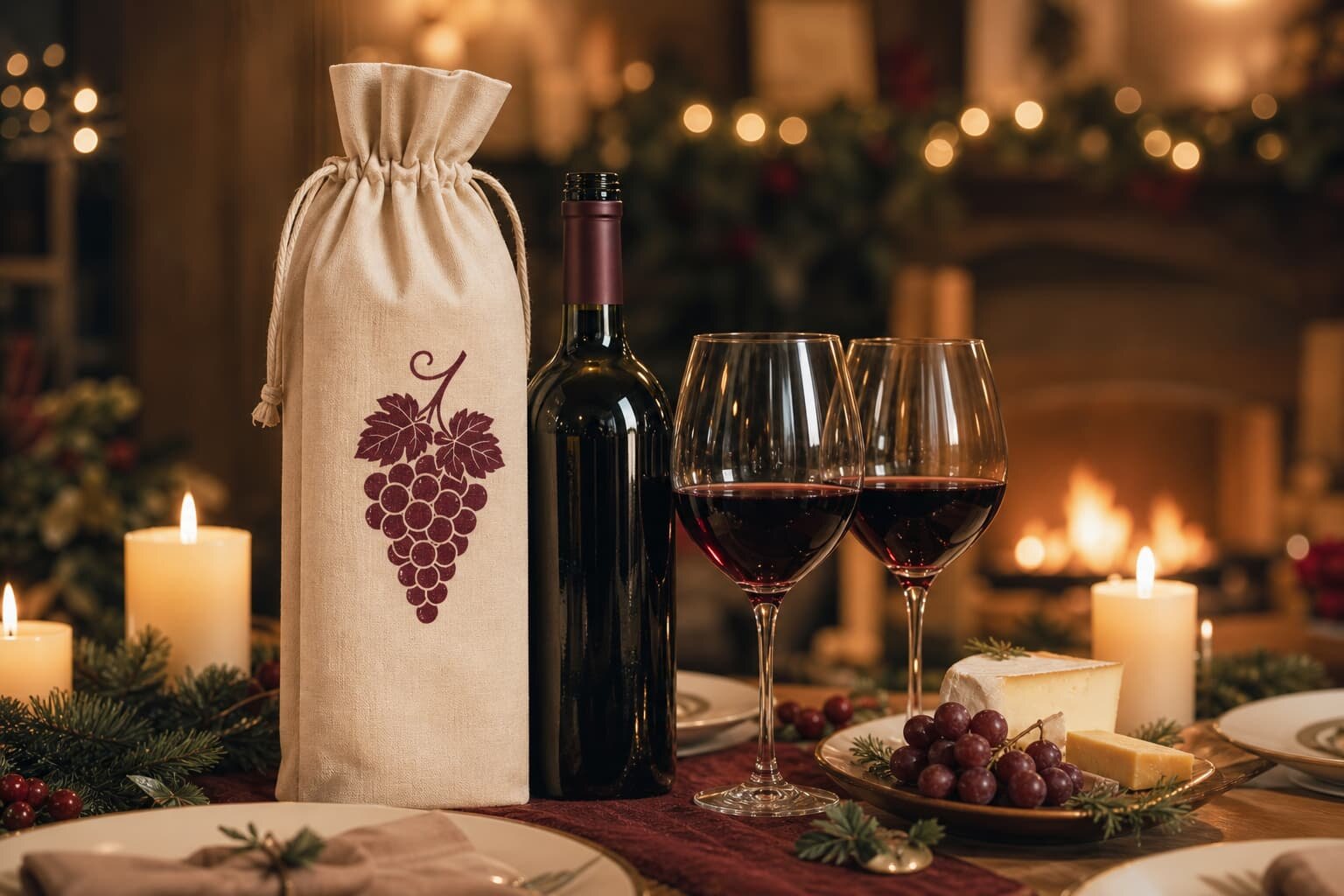
Why a Supplier Scorecard Matters for Wine Bottle Bags
Wine bottle bags look simple until procurement has to compare five quotes that all say 'cotton wine bag, logo print, good quality.' One supplier may quote 5 oz cotton with a thin rope drawstring, another may quote 10 oz canvas with reinforced seams, and a third may assume non-woven fabric because the target price is low. Without a scorecard, the lowest unit price often wins even when it is not the same product.
A wine bottle bag supplier scorecard checklist gives your team a controlled way to compare construction, material, print risk, MOQ, sample reliability, packing, and lead time. It is especially useful when the bag is part of a gift set, retail launch, winery program, distributor promotion, or holiday order where missed dimensions and weak handles create expensive downstream problems.
- Use the scorecard before sample approval, not only during final supplier selection.
- Score the quoted specification, not the supplier's sales presentation.
- Separate price score from risk score so a cheap but unclear quote does not look better than a complete one.
- Keep one approved scorecard with the purchase order so repeat orders use the same baseline.
Start with the Bottle, Not the Bag
The first mistake in wine bag sourcing is asking for 'a standard wine bottle bag.' Standard does not mean the same thing across markets. A 750 ml Bordeaux bottle, Burgundy bottle, Champagne bottle, ice wine bottle, and spirits bottle can require different width, height, bottom gusset, and closure allowance. If the bag is too narrow, the bottle rubs against the seams. If it is too tall, the drawstring closes awkwardly and the logo may sit too low.
Procurement should send the bottle drawing or a real bottle measurement together with the RFQ. If the bag must fit more than one bottle shape, state the largest bottle diameter and height, then ask the factory to confirm usable internal dimensions after seam allowance. For premium bags, it is better to approve fit using the actual bottle because shoulder shape and cap height affect how the bag looks when closed.
- List bottle height including cork, cap, foil, or stopper.
- Measure maximum bottle diameter at the shoulder or body, not only the base.
- Confirm whether the bag must stand upright when empty or only when loaded.
- Define if the logo should face the bottle label direction when displayed.
- Ask whether a flat bag, gusset bag, or boxed-bottom bag is being quoted.
Score Material and GSM with Real Use in Mind
Material choice should follow the selling channel and expected bottle weight. Non-woven wine bags can work for short-term promotions where cost is the main driver. Cotton and canvas are better for reusable gift packaging. Jute gives a rustic natural look but has a coarser surface, which affects fine logo printing. Kraft paper can look clean for retail gifting but needs proper handle reinforcement if the bottle is heavy.
For cotton wine bags, buyers commonly compare by oz or GSM. A light 5 oz cotton may be suitable for a drawstring sleeve, while 8 oz to 10 oz gives more body and a better print surface. For canvas or premium cotton, 10 oz to 12 oz provides stronger structure but increases cost and carton volume. Paper wine bags may range widely in GSM, and the handle patch or folded top edge matters as much as the paper number.
- Score 5-6 oz cotton as economical but less structured.
- Score 8 oz cotton as a practical middle option for many branded wine sleeves.
- Score 10-12 oz canvas higher for premium reuse and better shelf feel.
- Score jute carefully for natural look but lower fine-print accuracy.
- Score paper bags on handle reinforcement, lamination, and fold cracking, not just GSM.
Compare Construction Before Comparing Unit Price
Two wine bag quotes may look close in price but use different construction. A drawstring sleeve with side seams is not the same as a bottle carrier with handles and a reinforced bottom. A bag with a simple overlock seam is not the same as one with folded seams or binding. These details affect bottle safety, retail appearance, and complaint rate.
Your scorecard should include construction points that can be checked visually on a sample. Ask the factory to identify seam type, stitch density, drawstring material, handle width, reinforcement patches, bottom style, and label position. If the order includes multiple bottle formats, score each construction against the heaviest bottle, not the easiest one.
- Drawstring wine sleeve: lower cost, good for gifting, limited carrying strength.
- Handle wine carrier: better for retail purchase, needs handle pull and seam load testing.
- Boxed-bottom wine bag: better standing shape, higher sewing or forming complexity.
- Window bag: attractive for display, but PVC/PET window alignment and cracking must be checked.
- Divider bag for two bottles: requires stronger bottom and center divider stitching.
Print Method Should Match Artwork and Fabric Surface
Logo printing is one of the fastest ways for a wine bag order to drift from approved sample to disappointing bulk. Screen print is usually strong for solid logos and one to three colors. Heat transfer can handle finer detail and more colors, but buyers should confirm hand feel, edge durability, and adhesion. Foil print is attractive for holiday and premium wine packaging, but it needs a smoother surface and clear rub-test expectations.
The supplier scorecard should not simply ask whether printing is possible. It should ask whether the chosen print method is suitable for the material surface, logo size, and retail handling. A small serif logo on coarse jute may lose detail. A QR code on textured cotton may fail scanning if the ink spreads. Metallic ink on a crease line may crack. These are preventable if print risk is scored at RFQ stage.
- Request artwork proof showing exact logo size, placement, and distance from seams.
- Ask for a print strike-off on the actual bulk material, not a different fabric.
- Define Pantone references but allow realistic tolerance on natural fabrics.
- Test QR codes, barcodes, and small text after printing if they are functional.
- Check print adhesion with dry rub, light scratch, and fold handling where relevant.
Use MOQ Logic Instead of Asking for One Generic Minimum
MOQ is not only a supplier policy; it is often driven by fabric roll availability, dyeing minimums, print setup, cutting efficiency, label production, and packing labor. A natural cotton stock fabric with one-color screen print may have a lower MOQ than a custom dyed canvas wine bag with woven label, foil print, and individual retail packing. If buyers ask only 'what is your MOQ,' they may receive a number that changes later.
A better scorecard asks the supplier to break MOQ by the items that control production. This helps procurement decide whether to simplify the specification, combine colors, reduce artwork versions, or accept a higher unit price for a smaller run. It also prevents the common issue where a supplier says yes to a low quantity but silently changes fabric weight or construction to make production easier.
- Ask MOQ for blank bags in stock material.
- Ask MOQ for custom size with stock material.
- Ask MOQ for custom color fabric or paper.
- Ask MOQ for each print method and number of artwork versions.
- Ask MOQ for woven labels, hang tags, inserts, and special packing.
- Ask whether mixed designs can share one MOQ if fabric and bag size are the same.
Separate Sample Types in the Scorecard
Sampling becomes expensive and slow when buyers expect one sample to prove everything. A stock sample can show general sewing and material feel, but it may not prove your custom size or print. A print strike-off can confirm logo result, but it may not prove bottle fit. A pre-production sample should confirm the full approved construction, material, print, label, and packing before bulk cutting starts.
The scorecard should rate whether the factory understands these stages and can provide the correct sample at the correct time. For wine bottle bags, sample approval should include bottle fit, closure position, logo alignment, load strength, and packaging method. Keep one signed or sealed sample for final inspection reference; photos alone are useful but not enough for disputed hand feel, color, and fabric weight.
- Stock sample: use for checking factory workmanship and material options.
- Custom blank sample: use for confirming fit, dimensions, and construction.
- Print strike-off: use for color, opacity, logo edge, and adhesion approval.
- Pre-production sample: use as the final standard before bulk production.
- Sealed approval sample: keep for inspection, repeat orders, and claim review.
Build Quote Comparison Around Total Landed Risk
Unit price is only one line in a wine bottle bag purchase. A quote that excludes packing, labels, inner cartons, barcode stickers, setup charges, sample fees, or export carton requirements may appear cheaper but cause later additions. The supplier who gives carton size, gross weight, pieces per carton, and CBM helps your logistics team estimate freight and warehouse handling before the order is placed.
For scorecard scoring, reward complete quote data. A commercially mature supplier should state trade term, currency, quote validity, sample cost, tooling or screen charge, production lead time after approval, packing details, carton dimensions, and whether the price includes inspection preparation. If a quote does not specify material weight, bag dimensions, or print method, do not treat it as comparable.
- Compare EXW, FOB, CIF, or DDP quotes only after normalizing included services.
- Record unit price by quantity break, such as 1,000, 3,000, 5,000, and 10,000 pieces.
- Ask whether setup charges are one-time, per artwork, or per color.
- Check if carton labeling and barcode application are included.
- Calculate CBM per 1,000 pieces to understand freight sensitivity.
- Confirm quote validity if cotton, paper, or jute material prices are moving.
Packing Details Can Make or Break Retail Receiving
Wine bottle bags are often used for retail, distributor gifting, or seasonal programs. Packing mistakes create warehouse delays even when the bag itself is acceptable. Mixed artwork in one carton, missing SKU labels, weak master cartons, incorrect carton marks, or unprotected light-colored cotton can cause receiving issues and rework costs.
Packing should be part of the supplier scorecard because it reveals whether the factory understands export handling. A basic promotional order may use bulk pack. A retail launch may need individual polybags, paper bands, hang tags, inner cartons, master carton labels, and barcode placement. If the buyer wants plastic-free packing, say so early because paper wrapping and carton dividers can change cost and packing speed.
- Define pieces per inner carton and master carton.
- State if each wine bag needs a polybag, paper wrap, hang tag, or insert.
- Require SKU separation by artwork, color, size, and destination.
- Approve carton marks before production packing begins.
- Check carton strength if bags include rigid handles, paper structure, or window panels.
- Ask for final packed carton photos before shipment booking.
Lead Time Score: Look Beyond Production Days
Many supplier quotes state a simple production lead time such as 25 to 35 days, but procurement needs the full timeline. Artwork proofing, material sourcing, custom dyeing, sampling, buyer approval, mass production, inspection, packing, export document preparation, and vessel booking can all add time. Holiday wine bag orders are especially sensitive because late delivery can miss the selling season.
A useful scorecard separates lead time into stages and identifies dependencies. For example, bulk production may only start after deposit, final artwork approval, and sample sign-off. If the order uses custom dyed fabric or special foil, the material and print setup may become the critical path. A supplier who gives a staged timeline is usually easier to manage than one who only says 'we can do fast delivery.'
- Artwork proof: confirm how many days after receiving vector files.
- Material sourcing or dyeing: confirm if stock material is available.
- Sample making: separate blank sample time from print strike-off time.
- Bulk production: count from written sample approval, not RFQ date.
- Inspection and packing: include time for rework if issues are found.
- Export booking: coordinate with forwarder early during peak season.
Specification comparison for buyers
| Spec decision | Recommended option | When it fits | Buyer risk to check |
|---|---|---|---|
| Single bottle promotional wine bag | 5-8 oz cotton or 80-100 gsm non-woven with drawstring | Gift with purchase, seasonal promotion, low unit value campaigns | Thin fabric may show bottle shape too clearly; confirm seam strength and bottom size before bulk |
| Premium retail wine gift bag | 10-12 oz cotton canvas, jute, or laminated paper with reinforced handle | Retail shelf, winery shop, corporate gifting, higher perceived value | Higher GSM increases freight volume; confirm carton cube and handle pull test |
| Natural craft positioning | Jute, cotton, recycled cotton blend, or kraft paper | Organic wine, farm shop, eco-led brand story, rustic gift pack | Natural color variation between dye lots; ask for tolerance and pre-production swatch approval |
| Fine logo or small text | Screen print for solid logos; heat transfer for detailed artwork | Brand marks, QR codes, distributor information, small typography | Ink spread on coarse jute or loose cotton weave; request strike-off and barcode/QR scan test if used |
| Metallic or holiday design | Foil print or metallic ink on smooth cotton, paper, or coated material | Christmas, New Year, limited edition gift packaging | Foil adhesion and cracking around folds; define rub test and fold area before approval |
| Reusable carrier with bottle weight | Canvas or jute with bound seams and reinforced handle stitching | Multi-bottle retail purchase, tasting room, distributor gift sets | Handle attachment is the failure point; require loaded hang test using actual bottle weight |
| Export-ready retail packing | Individual polybag or paper wrap, inner carton by SKU, master carton with barcode label | Retail distribution, Amazon-style receiving, warehouse cross-dock | Unclear packing causes mixed SKUs, carton relabeling, and receiving chargebacks |
Buyer checklist before sampling
- Define bottle type and exact size: 750 ml Bordeaux, Burgundy, Champagne, spirits bottle, or mixed-use requirement.
- Specify finished bag dimensions with width, height, gusset, and acceptable tolerance, not only bottle capacity.
- State material type, fabric weight or paper GSM, color standard, lining requirement, and whether natural shade variation is acceptable.
- Confirm construction details: drawstring type, handle material, seam type, bottom reinforcement, binding, and stitch density.
- Attach artwork files with logo size, Pantone references, print position, print method preference, and minimum legibility requirements.
- Ask for MOQ by material, color, print method, and packing style because each one can change the factory's real minimum.
- Request sample types separately: available stock sample, custom print strike-off, pre-production sample, and sealed approval sample.
- Require quote data in a comparable format: EXW/FOB term, unit price, tooling, sample cost, packing cost, carton size, gross weight, lead time, and validity.
- Define packing clearly: units per inner carton, master carton quantity, carton marks, barcode labels, polybag or plastic-free preference.
- Set QC acceptance criteria for dimensions, fabric GSM, color, logo placement, print adhesion, seam strength, drawstring function, and carton labeling.
Factory quote questions to send
- What material and GSM are you quoting, and can you provide a swatch photo or physical swatch before sampling?
- Is the quoted size the flat bag size or usable internal bottle size after seams and drawstring closure?
- What is your MOQ for this exact material, color, print method, and packing method, and what changes if we order multiple artwork versions?
- Which print method do you recommend for our artwork, and what is the expected limitation on fine lines, gradients, metallic effects, or QR codes?
- What sample will you provide first: stock sample, blank custom-size sample, print strike-off, or full pre-production sample?
- How many days are needed for artwork proof, material sourcing, sampling, bulk production, final inspection, and export packing?
- What are the carton dimensions, gross weight, net weight, pieces per carton, and estimated CBM for the quoted order quantity?
- Are drawstrings, handles, eyelets, labels, hang tags, and inserts included in the unit price or quoted separately?
- Can you run a loaded bottle hang test, seam pull check, print rub test, and carton drop check before shipment?
- What information do you need from us to avoid requoting after sample approval?
Quality-control points to confirm
- Measure finished bag width, height, gusset, and opening size against approved sample and RFQ tolerance.
- Check fabric or paper weight against the quoted GSM or oz specification, allowing only agreed production tolerance.
- Load test the bag using the actual filled bottle weight, including hang time and handle or drawstring stress.
- Inspect seam strength, stitch density, loose threads, bottom corners, binding, and drawstring channel opening.
- Compare print color, logo size, placement, edge sharpness, opacity, and adhesion against the approved strike-off.
- Confirm bottle fit with the real bottle shape, not only a standard 750 ml sample bottle.
- Check odor, stain marks, oil spots, fabric slubs, glue marks, foil flaking, and color transfer risk.
- Verify inner packing, SKU separation, carton marks, barcode labels, master carton strength, and pallet instructions if required.
- Keep a sealed approval sample and inspection photos for future repeat orders and claims handling.