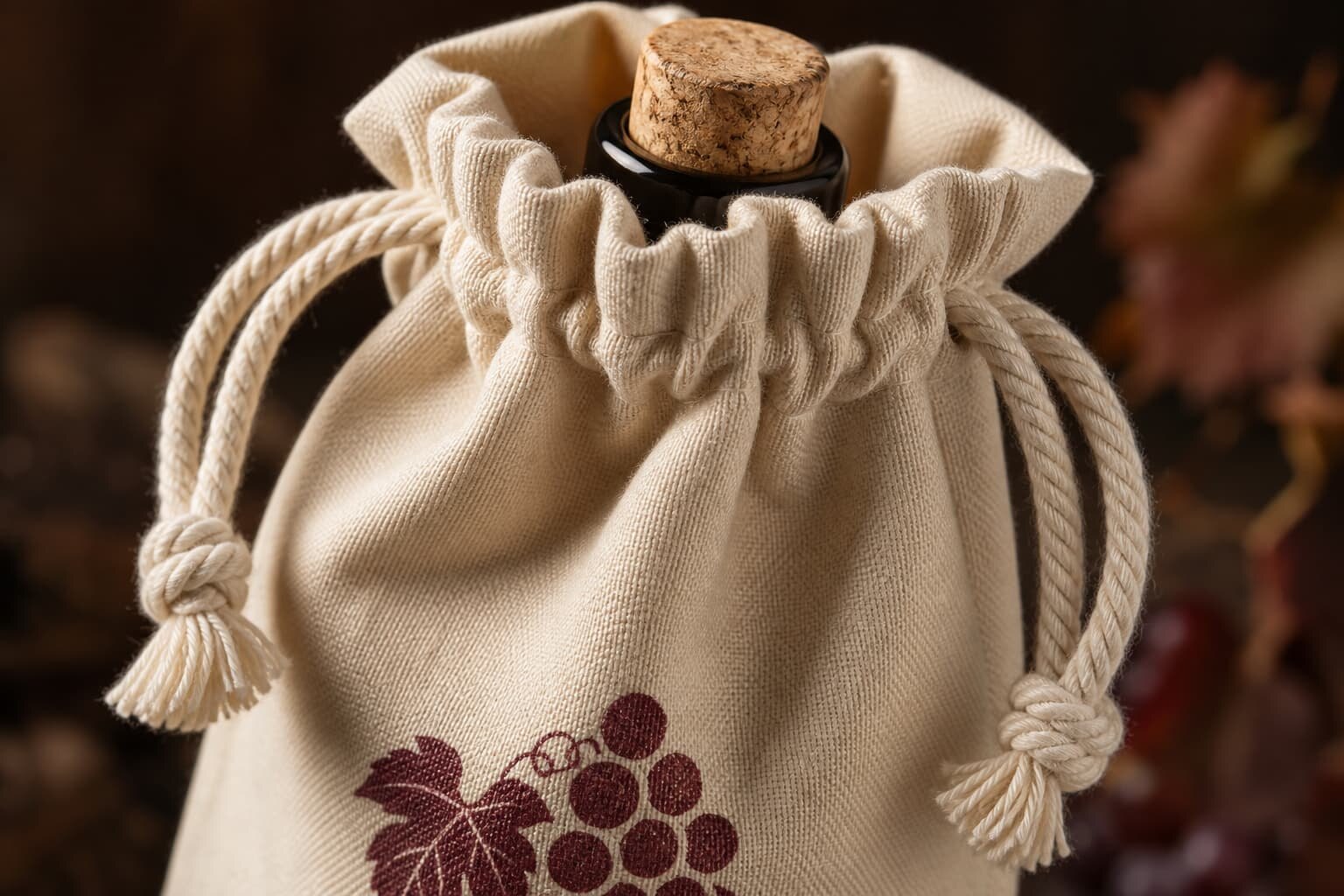
Why the spec sheet decides the real quote
A wine bottle bag looks simple until the RFQ reaches production. The bag must fit a glass bottle safely, carry weight without seam failure, present the brand correctly, and pack without damaging the print or label. If the private label spec sheet only says cotton wine bag with logo, each factory will make different assumptions. One may quote 8 oz cotton, another 12 oz canvas. One may include a woven side label, another may quote only a front print. The cheapest quote may simply be missing the cost items you actually need.
A useful wine bottle bag private label spec sheet should remove interpretation. It tells the supplier what bottle shape the bag must fit, what fabric weight should be used, how the brand mark is applied, how the bag is closed, how it is packed, and what sample must be approved before bulk cutting. This is not paperwork for its own sake. It is the tool that helps procurement compare quotes on the same base and prevents production teams from discovering late that the drawstring cannot close around a Champagne neck or that the label MOQ was not included.
- Use one master spec sheet per bag style, not one email thread with scattered instructions.
- Separate required details from optional upgrades so factories can quote base and premium versions.
- Ask suppliers to confirm assumptions in writing instead of only returning a unit price.
- Keep approved sample photos, artwork files, and packing instructions attached to the same RFQ package.
Start with the bottle, not the bag
The first production mistake is specifying the bag before specifying the bottle. Wine bottle sizes are not universal. A standard 750 ml Bordeaux bottle is usually slimmer with higher shoulders. A Burgundy bottle is wider and rounder. Champagne and sparkling bottles are often heavier, wider, and taller at the neck. If the bag is intended for spirits, olive oil, or gift-boxed bottles, the dimensions change again. A supplier cannot guarantee fit from the phrase standard wine bottle unless the market and bottle type are clear.
For RFQ purposes, give the factory the actual bottle height, maximum body diameter, shoulder width if relevant, and expected filled weight. If the bag must fit several bottles, specify the largest and heaviest one as the control sample. For drawstring bags, also state where the cord should close: above the shoulder, around the neck, or simply near the top opening. A bag that looks neat on an empty sample may become tight after the bottle is inserted, especially when the fabric has thick side seams or a boxed base.
- Bordeaux bottle programs usually need slimmer width control and neat front print positioning.
- Burgundy bottle programs need extra width or gusset allowance because of the wider body.
- Champagne bottle programs need stronger base seams and larger neck allowance.
- Retail gift sets may need hangtag and barcode placement that remains visible after the bottle is inserted.
- If the buyer cannot share a bottle, provide a dimensioned drawing and request a factory fit video.
Define fabric weight and structure clearly
Fabric weight is one of the biggest cost drivers and one of the easiest places for quotes to become uneven. Cotton may be quoted in ounces per square yard or GSM, while jute and non-woven PP are normally quoted in GSM. For cotton wine bags, 6-8 oz can work for light promotional use, but it may feel thin and collapse easily. 10-12 oz cotton canvas is a more common choice for reusable branded gift bags. For a premium retail feel, 14-16 oz can be used, but sewing bulk, freight volume, and minimum order cost increase.
Jute wine bags are often specified around 280-320 gsm for single-bottle styles, with heavier weights used for structured gift packaging. Non-woven bottle bags may sit around 80-100 gsm for promotional distribution, but the handle, seam, and lamination details matter more than the GSM alone. If the fabric is laminated, dyed, bleached, or lined, state it directly. A natural cotton bag and a bleached white cotton bag may require different print preparation, shrinkage control, and stain inspection.
- For cotton, specify fabric as 8 oz, 10 oz, 12 oz, or GSM equivalent and confirm tolerance.
- For jute, specify GSM, weave appearance, lamination requirement, and acceptable odor level.
- For non-woven PP, specify GSM, lamination, handle material, and whether the bag is sewn or heat sealed.
- For lined bags, specify lining fabric, lining color, and whether the lining is fixed at the opening.
- For dyed fabric, ask whether the MOQ is driven by fabric dye lot and whether colorfastness testing is available.
Choose the private label method by fabric reality
Private label branding can be printed, embroidered, woven, patched, sewn into a side seam, or added as packaging. The right method depends on fabric texture, brand detail, order quantity, and budget. Screen printing works well for bold one-color or two-color logos on cotton canvas and some jute surfaces, but fine text can break on coarse weave. Heat transfer can handle gradients and small details better on smoother materials, yet buyers should check hand feel, cracking risk, and wash or rub performance. Embroidery gives a premium look but can distort thin fabric and is usually unsuitable for very small typography.
Woven labels are useful when a brand wants a consistent retail identity across multiple bag materials. They also help when the main front panel changes seasonally but the brand label stays constant. However, woven label MOQ may be separate from bag MOQ. The spec sheet should include label size, fold type, background color, thread colors, sewing location, and whether the label is sewn into the side seam or top edge. If the quote does not list this separately, ask whether the label is included or assumed to be supplied by the buyer.
- Use screen print for simple solid artwork on cotton canvas or smoother jute panels.
- Use heat transfer when the artwork has gradients, photographs, or small multicolor details.
- Use embroidery for small premium marks on heavier cotton, not for large dense logos on thin fabric.
- Use woven labels when brand consistency matters across different bag styles.
- Use hangtags or belly bands for seasonal information that may change between production runs.
Write print placement like a production instruction
Artwork approval is not only about the logo file. The factory needs a print map that shows size, position, color, and orientation on the finished bag. For wine bottle bags, small changes in placement are visible because the front panel is narrow. A logo that is centered on the flat fabric may shift visually after a round bottle fills the bag. If the bag has a gusset or side seam, the printable area may be smaller than the total front width.
A good spec sheet should state print size in millimeters, distance from top opening, distance from side seam or center line, and the approved Pantone color. For jute and natural cotton, buyers should expect the fabric base color to affect the final printed color. White underbase may be needed for bright logos on dark fabric, and it must be included in the quote. If the bag folds through the print area during packing, ask the factory to test whether cracking, sticking, or creasing occurs.
- Attach vector artwork in AI, EPS, or PDF format with fonts outlined.
- State Pantone references and whether CMYK approximation is acceptable.
- Mark print size and position on a dimensioned bag drawing.
- Confirm whether a white underbase is included for dark or textured fabric.
- Approve a strike-off before bulk printing, especially for jute and dyed cotton.
- Keep print tolerance realistic, usually a few millimeters depending on sewing and fabric movement.
Build MOQ logic into the RFQ
MOQ is not one number. A factory may have different minimums for fabric, dyeing, printing, woven labels, hangtags, cartons, and cutting setup. For private label wine bottle bags, a low bag MOQ may still carry extra cost if the label supplier requires a larger woven label run. A custom dyed cotton bag may require a higher MOQ than a natural cotton bag because the fabric mill has a dye lot minimum. If the buyer asks only for the lowest MOQ, the quote may hide tooling or setup charges in the unit price.
Procurement teams should ask for quantity breaks that match real buying decisions. For example, request prices at 500, 1,000, 3,000, 5,000, and 10,000 pcs if those are realistic order levels. Ask the factory to explain what changes between tiers. Sometimes the 3,000 pc price is better because printing setup is spread over more units. Sometimes the 5,000 pc price improves because fabric can be ordered directly from the mill. This helps buyers compare supplier quotes beyond the headline unit cost.
- Ask which MOQ is controlled by fabric, print, label, or packing material.
- Request separate setup charges instead of allowing all setup cost to be buried in unit price.
- Ask whether excess woven labels can be stored for repeat orders.
- Confirm whether mixed colors or mixed artworks are allowed within one MOQ.
- For distributor programs, ask if carton quantity can be adjusted for warehouse handling.
Sample approval should match bulk production
A sample can prevent mistakes only if it is made close to the final production method. Many early samples are made from available fabric, substitute cord, or digital print because the buyer needs a fast visual check. That may be acceptable for shape discussion, but it should not release bulk production. For a private label order, the buyer should identify the sample stage clearly: reference sample, material swatch, logo strike-off, fit sample, pre-production sample, and packing sample.
The pre-production sample should use the bulk fabric weight, final color, final print method, final label, correct stitching, correct closure, and proposed packing. It should be checked with the actual bottle or a bottle that matches the dimensions and weight. Take photos of the approved sample from front, back, side, opening, base seam, label area, and packed condition. If any change is approved after the sample, update the spec sheet and sample record. Otherwise, the factory may follow the physical sample while the buyer expects the latest email instruction.
- Check bag size flat and with bottle inserted.
- Check whether the drawstring closes neatly without tearing the channel.
- Check print color, edge sharpness, ink coverage, and hand feel.
- Check label orientation and whether sewing stitches are straight.
- Check handle length and comfort with a filled bottle.
- Check packed appearance after 24 hours in the proposed carton arrangement.
Specify seams, handles, and load acceptance
Wine bottle bags carry concentrated weight. A filled 750 ml bottle can weigh around 1.2-1.6 kg depending on glass weight, and sparkling bottles can be heavier. The base seam, side seam, drawstring channel, and handle attachment are not decoration. They are the parts that decide whether the bag survives retail handling. If the RFQ does not state the expected load, the factory may use a standard seam suitable for light gift packaging but not repeated carrying.
Acceptance criteria should be practical. Buyers can request a simple load test using the approved bottle weight plus a safety margin, with repeated lifting cycles. For cotton and jute bags, stitch density, back tack quality, and seam allowance should be checked. For non-woven bags, heat seal width or stitch reinforcement should be reviewed. If the bag has rope handles, confirm whether the rope passes through metal eyelets, stitched tabs, or folded fabric channels. Each method has different cost and failure points.
- State filled bottle weight and whether the bag must carry one or two bottles.
- Request reinforced stitching at handles or top stress points where needed.
- Check base seam with the bottle standing upright for several hours.
- Reject loose back tacks, skipped stitches, and narrow seam allowance at load points.
- For drawstring styles, pull test cord knots and stopper security if stoppers are used.
- For non-woven styles, check whether the heat seal or stitching is consistent across the full seam length.
Packing details affect cost and damage rate
Packing is often treated as an afterthought, but for wine bottle bags it affects print condition, carton size, warehouse handling, and final landed cost. A flat cotton drawstring bag may pack efficiently, while a jute bag with padded handles or a structured base takes more space. If bags are over-compressed, front prints can crease, laminated jute can deform, and hangtags can bend. If they are packed too loosely, carton volume and freight cost increase.
The spec sheet should define whether bags are packed individually, in bundles, or in inner polybags. It should state pieces per inner bag, pieces per export carton, carton mark requirements, and whether desiccant is needed for long ocean shipment or humid seasons. For retail programs, buyers may need barcode stickers, hangtags, size labels, or country of origin labels applied before shipment. These are labor steps and should be included in the quote data, not added after purchase order approval.
- Use individual polybags only when retail handling or cleanliness requires them.
- Use bundle packing when cost and reduced plastic are priorities.
- Protect large front prints from direct friction against rough jute or carton surfaces.
- Confirm carton weight limits for warehouse lifting rules.
- Ask for a packed carton photo before bulk shipment.
- Include carton marks and barcode placement in the purchase order file.
Quote data that procurement should compare
A complete quote for private label wine bottle bags should show more than unit price. It should list fabric material and weight, bag size, print method, number of print colors, private label items, packing method, sample cost, setup cost, carton quantity, estimated carton size, lead time, and trade term. Without these details, a buyer may choose a lower quote that excludes woven labels, uses lighter fabric, or assumes bulk packing instead of retail packing.
When comparing suppliers, normalize the quote before making a decision. Convert fabric weights to the same unit if needed. Confirm whether all quotes include the same artwork size and color count. Check if sample cost is refundable or separate. Ask whether the stated lead time starts after deposit, after artwork approval, after sample approval, or after label approval. Small wording differences can create large schedule differences, especially when woven labels or dyed fabric are part of the program.
- Compare material weight and fabric finish line by line.
- Compare print method, print size, color count, and underbase assumptions.
- Compare private label cost: woven label, care label, hangtag, barcode sticker, and insert card.
- Compare packing method and carton quantity because freight volume may change the landed cost.
- Compare sample and setup charges separately from the unit price.
- Compare lead time triggers, not just the number of production days.
Specification comparison for buyers
| Spec decision | Recommended option | When it fits | Buyer risk to check |
|---|---|---|---|
| Bag material for standard wine | 10-12 oz cotton canvas or 280-320 gsm jute | Gift sets, winery retail, corporate wine promotions, reusable packaging | Too-light fabric may collapse around a 750 ml bottle and make printing look wavy |
| Budget promotional bag | 80-100 gsm non-woven PP with heat transfer or screen print | Large event quantities, short-term giveaways, low freight weight targets | Handle and side seam strength must be tested with a filled bottle, not judged empty |
| Premium private label finish | 12-16 oz cotton canvas with woven label or leather-look patch | Retail shelf programs, brand merchandise, higher perceived value | Thicker fabric increases sewing bulk at base seams and may affect carton quantity |
| Closure type | Cotton cord drawstring, ribbon tie, or open-top tote handle | Drawstring for dust protection, ribbon for gift feel, open-top for fast retail packing | Cord length, knot security, and stopper position need sample approval |
| Print method | Screen print for solid logos, heat transfer for gradients, embroidery for small premium marks | Depends on logo color count, fabric texture, and order quantity | Fine lines disappear on jute; large plastisol prints can crack if folded tightly |
| Private label placement | Main front print plus side seam woven label or inner care label | Brand owners needing visible retail identity and traceability | Label material, fold style, and sewing location must be included in the spec sheet |
| Bottle fit | Internal width and height based on actual bottle diameter plus tolerance | Bordeaux, Burgundy, Champagne, spirits, or mixed gift packs | A bag approved on one bottle shape may fail on wider shoulders or taller sparkling bottles |
| Packing method | Flat packed 25-100 pcs per inner polybag, export carton sized by fabric bulk | Most wholesale and distributor orders | Over-compression can crease prints, deform rope handles, and damage hangtags |
| Sample approval | Pre-production sample using bulk fabric, final print, label, and packing | Any private label order where brand color and fit matter | A salesman sample on substitute fabric is not enough for final production release |
Buyer checklist before sampling
- Confirm target bottle type: 750 ml Bordeaux, Burgundy, Champagne, spirits, magnum, or mixed use.
- State finished bag size as width x height x gusset, plus acceptable tolerance in millimeters.
- Specify material type, fabric weight or GSM, color, weave, lamination, lining, and shrinkage expectation.
- Attach print artwork in vector format and list Pantone colors, print size, print position, and print method preference.
- Define private label elements: woven label, printed care label, hangtag, barcode sticker, belly band, gift card, or insert card.
- Request sample stages clearly: material swatch, logo strike-off, fit sample, pre-production sample, and packing sample if needed.
- Ask for seam construction details at the base, side seams, handle area, drawstring channel, and label attachment point.
- Set load test expectation using a filled bottle weight, not an empty-bag visual inspection.
- Define packing: pcs per polybag, inner carton use, master carton size limit, carton marks, pallet preference, and anti-moisture requirements.
- Ask the factory to quote by order quantity tiers, including setup cost, sample cost, print plate cost, label cost, and packing cost separately.
Factory quote questions to send
- Which fabric weight do you recommend for this bottle size, and what GSM or ounce tolerance will you control in bulk?
- Is the quoted fabric greige, dyed, bleached, natural, laminated, or coated, and will the bulk color match the submitted sample?
- What print method is included in the quote, and what logo size, number of colors, and placement are assumed?
- Does the quoted MOQ come from fabric dyeing, printing setup, label weaving, cutting efficiency, or packing material MOQ?
- Can you produce a bottle fit sample using our actual bottle dimensions or a matching factory test bottle?
- What seam type and stitch density will be used at the base and handle areas?
- Are woven labels, hangtags, barcode stickers, care labels, and individual polybags included or quoted separately?
- What are the sample lead time, bulk production lead time, and extra days needed after artwork or label approval?
- How many pieces fit per export carton at the proposed fabric weight, and what is the estimated carton weight?
- What inspection points will your QC team check before shipment, and can the AQL or internal standard be shared?
Quality-control points to confirm
- Measure finished size on empty bags and again with the approved bottle inserted to confirm usable fit.
- Check fabric weight by random cutting sample or supplier mill report, especially when price changes between quotes look unusual.
- Compare print color against approved strike-off under consistent light, not against a phone photo.
- Rub test the print on jute and canvas surfaces because coarse weave can reduce ink adhesion.
- Pull test handles, drawstrings, and base seams with a filled bottle weight and short repeated lift cycles.
- Check woven label orientation, fold direction, sewing position, and whether stitches cover any logo details.
- Confirm drawstring channel width, cord length, knot finish, and whether the bottle neck can close as intended.
- Review packing after carton drop or compression simulation if the order includes hangtags, ribbon, or large front prints.
- Inspect carton marks, item number, PO number, country of origin wording, quantity, and barcode labels before container loading.
- Keep one approved pre-production sample sealed for comparison during final random inspection.