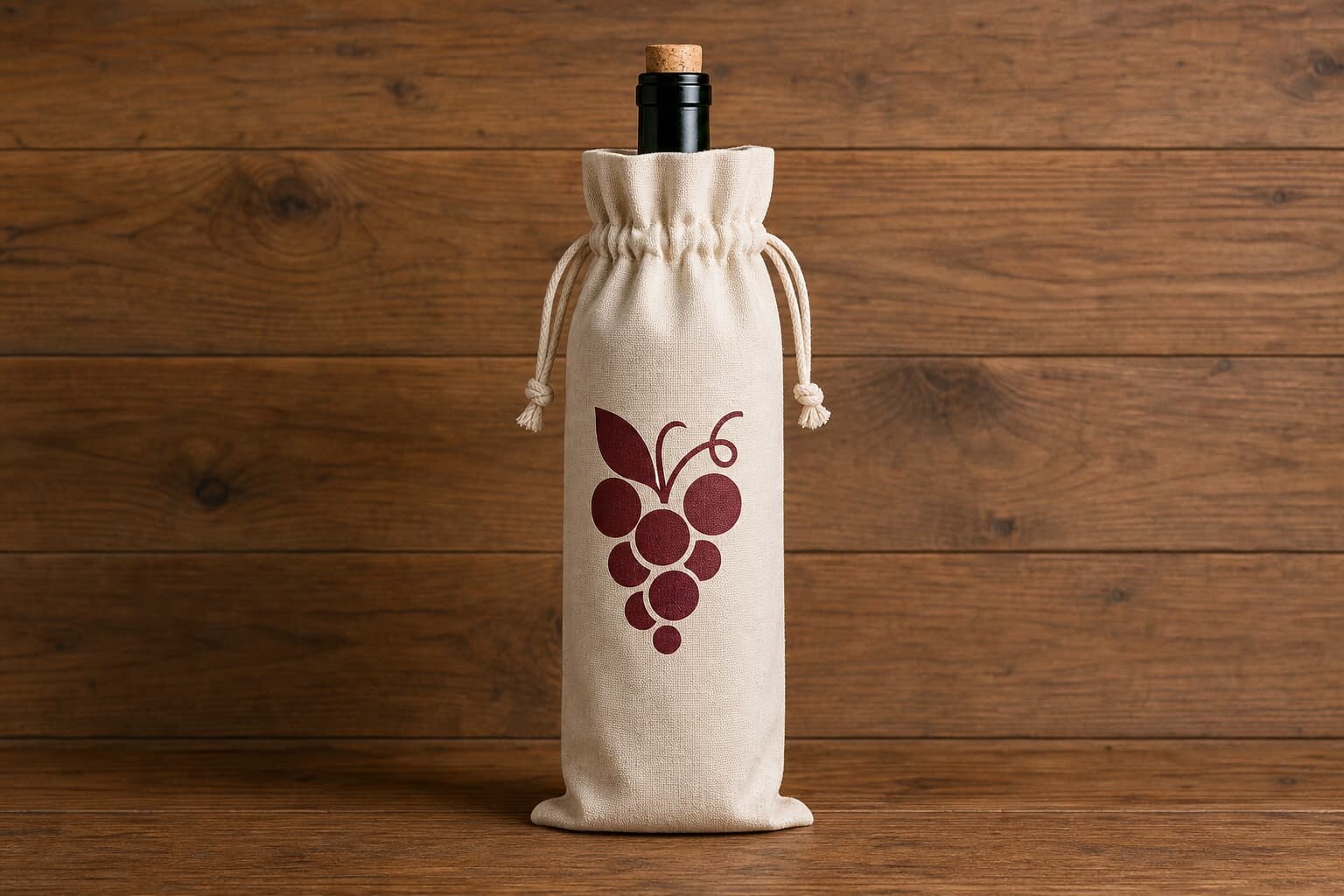
Why the neck tie deserves its own inspection step
On a wine bottle bag, the neck tie is not a minor accessory. It controls how the bag sits on the bottle, how quickly retail staff can dress the bottle, and whether the pack looks neat on shelf or in a gift box. A bag can pass a visual check when flat, then fail once tied around a real bottle because the closure pulls the fabric off center, twists the print, or leaves the bottle exposed at the shoulder. That is why buyers should inspect the tie as a functional part of the product, not as a sewing detail buried in the quote.
The neck tie also affects factory cost and consistency. If the tie is too thin, too short, or poorly attached, the line may run faster but the risk moves to the buyer in the form of rework, complaints, or retail presentation problems. For procurement teams, the right question is not only whether the bag looks good in a sample photo. It is whether the closure can be repeated across the full order without changing the hand feel, the knot position, or the bottle fit.
- Check closure function on a full bottle, not just a flat pattern.
- Treat tie length, attachment, and finish as separate spec points.
- Compare the packed look, not only the unfilled sample.
Lock the bottle and neck spec before you price anything
Do not let suppliers quote against a generic 750 ml bottle unless that is truly your only reference. Measure the bottle you will ship: body diameter, shoulder height, neck circumference, cap diameter, and overall height. A Bordeaux-style bottle, a wider Burgundy bottle, and a decorative gift bottle all create different stress points for the tie. If your bag must fit more than one market bottle, define the maximum dimension instead of giving the factory a guess. One extra few millimeters can change whether the tie closes cleanly or creates a distorted top edge.
Once the bottle data is fixed, translate it into a bag spec the factory can sew without interpretation. State the body width, gusset depth if any, tie placement above the shoulder, and the amount of overlap needed for closure. If the bottle has a thick neck label or a shaped cap, mention it in the RFQ. Buyers often lose quote comparability because one supplier assumes a narrow bottle and another assumes a larger one. The result is different tie lengths, different stitch loads, and a price spread that is not actually apples to apples.
- Measure the bottle with the real cap and any decorative collar in place.
- State whether the bag must sit above the shoulder or wrap lower on the body.
- If the pack includes inserts or cards, include them in the fit spec.
Compare tie materials and attachment methods before you choose the low quote
Tie material changes both the look and the way the closure behaves. Self-fabric ties made from the same cotton as the bag body give a premium natural look and are easy to source when the body fabric is already approved. Cotton twill tape is often the best middle ground for buyers because it is stable, easy to sew, and less likely to twist than a loose cord. Polyester ribbon can improve color matching and give a more giftable appearance, but it may slip more and can look too glossy for a natural wine program. Jute cord or braid fits rustic or eco-positioned packs, but it can shed fibers, feel rough in hand, and create a bulkier knot.
Attachment method matters just as much as material. A tie sewn into the side seam with a bartack or box stitch is usually stronger and cleaner than a simple inserted tail. A loop-through channel can create a tidy look, but it adds sewing steps and can slow production if the channel is too tight. If the tie is decorative and not load-bearing, that should be stated clearly. If it is the only closure keeping the bottle secure, ask the supplier to show the reinforcement detail on the sample and on the production sewing sheet.
- Ask for the finished tie width, not only the raw tape width.
- Ask whether the tie ends are raw-cut, hemmed, serged, or heat-sealed.
- Request a sample with a filled bottle so you can see how the knot behaves.
Set acceptance criteria that a factory can actually hit
A good inspection guide turns vague feedback into measurable acceptance criteria. The tie should close the bag without pulling the neck off center, and the bag should remain balanced after the knot is set. If the tie is meant to be decorative, the bow or knot should sit in the same relative position on each unit. If the bag is meant for repeated use, the closure should open and close several times without seam failure, distortion, or excessive fraying. These are simple checks, but they catch the majority of buyer complaints before bulk approval.
Appearance matters too, especially for retail and gifting. The left and right tie lengths should look even to the eye, the edge finish should be consistent, and the tie should not twist so much that the product looks cheap when photographed. If the tie is dyed or printed, set a reference shade and use the same lighting during approval that the factory will use on inspection day. A lot of disputes start because the buyer approved a flat sample under office light and received a tied product that looked different under store lighting.
- Require the bag to stay centered after the tie is secured.
- Check that the tie length looks even on both sides when tied.
- Reject samples where the print, seam, or label distorts once tied.
Match branding and print method to the closure design
The print method should fit both the fabric and the way the neck tie folds the bag. Screen print is often the most efficient choice for bold one- or two-color logos on cotton canvas or cotton twill, especially when the artwork is large and the texture is not too rough. Heat transfer can help when the artwork has more detail or several colors, but it should be tested carefully if it sits near a seam or under a fold because cracking and edge lift can appear after packing. Woven labels or embroidery can work well on premium programs where the bag itself is part of the gift presentation, though those options add cost and can affect lead time.
The closure line can change where branding should sit. If the tie crosses over the print zone, the logo may be partially hidden or compressed once the bottle is packed. Buyers should ask the supplier to show the bag both untied and tied during sample approval, not only laid flat on a table. That small step prevents one of the most common mistakes: signing off on artwork that looks clean in a flat photo but becomes unreadable when the customer actually uses the bag.
- Place key artwork below the tie fold if the closure overlaps the upper body.
- Ask for a tied and untied sample view before final approval.
- If using heat transfer, confirm that the print survives the fold and rub points.
Read the quote for real cost and lead-time drivers
When quotes vary, the difference is usually in the hidden details. Fabric weight, tie material, stitch complexity, print method, and packing labor all affect the final number. A 140 GSM cotton body with a simple twill tape tie is not the same product as a 220 GSM canvas body with a self-fabric tie, reinforced seam, woven label, and retail fold. If suppliers do not quote those items separately, the buyer cannot tell whether a lower price means a leaner process or a weaker product. That is why the RFQ should force suppliers to break the work into the actual production steps.
Lead time should be read the same way. The factory may need fabric booking, tie cutting, sample approval, printing, sewing, finishing, and carton packing. If the tie is custom dyed, color approval can add time before production starts. If the line must change folders or needles for a special tie channel, that also affects timing. Ask suppliers where the bottleneck sits. A quote that looks fast on paper may only be fast because it skips the approval steps that protect your order.
- Ask for a line-item view of fabric, tie, print, sewing, and packing.
- Separate sample timing from bulk timing in the quote.
- Check whether the quote includes folding labor and carton mark setup.
Approve the sample like a production test, not a showroom piece
The first sample should answer three practical questions: does the bag fit the bottle, does the neck tie work, and does the branding still look right once the bag is closed. Test it with the actual bottle or a close weighted dummy, because empty samples can hide the real tension at the neck. If the final pack includes a gift card, insert, sleeve, or tag, include that in the sample test too. The extra thickness can change how the tie sits and whether the bag closes cleanly without the top edge buckling.
Sample approval should include the people who will later sign off on the purchase order and carton spec. Procurement can catch cost and quote gaps, while merchandising or brand teams often catch visual issues that affect retail appeal. One common mistake is accepting a sample because the knot can be tied, while nobody checks that the knot lands in the same place each time. Another is approving a nice looking bag without recording the tie length, finished width, and attachment method in writing. Those details become the only defense when bulk units start arriving slightly different from the sample.
- Test the sample with a filled bottle and any insert or card.
- Repeat the tie several times to check handling and knot memory.
- Record the approved sample in photos and written measurements.
Check in-line, final, and packing details before shipment
In-line inspection should focus on the tie because that is where variation shows up fast. Check cut length, stitch placement, bartack strength, and left-right symmetry while the line is still active. By the time you reach final inspection, you should be checking lot consistency rather than fixing the process. If one carton shows a shorter tie, mixed color tape, or a seam that pulls under tension, the problem is probably in cutting or sewing discipline, not just in packing. Catch it early and you save rework, delays, and complaints from the distribution side.
Packing needs its own attention because the tie is easy to crease, snag, or crush. If the bags are flat-packed, define exactly where the tie sits in the fold so it does not leave a permanent kink or pull on the print. If the bags are folded around a bottle silhouette for retail display, confirm that the tie does not create uneven carton heights. Ask for inner bag protection if the tie finish is delicate. For store-ready programs, the fold direction, carton count, and outer label format should all be written into the packing instruction sheet before mass production starts.
- Inspect tie symmetry and stitch strength during in-line checks.
- Verify packing fold direction so the tie does not crush the print.
- Confirm carton count, inner packs, and shipping marks before release.
Build an RFQ that forces comparable quotes
The cleanest RFQ removes guesswork. State the bottle type, bag dimensions, fabric GSM, tie type, tie width and length, print method, packaging method, target carton count, and whether you need samples, spare units, or shipment marks included. If you want options, ask for one base spec and one alternate tie construction so you can see the real cost effect of a stronger or more decorative closure. That is much more useful than asking suppliers to quote a vague wine bottle bag with neck tie and then trying to compare different assumptions after the fact.
A strong RFQ also asks suppliers to list what they are excluding. Does the price include strike-off, dye approval, cutting waste, tie reinforcement, folding labor, or retail packing? If you are comparing factories across regions, this matters even more because one quote may cover only the sewn bag while another includes packed units ready for shipment. The goal is not to pick the lowest number on the page. The goal is to compare the same product, packed the same way, with the same tie performance and the same commercial risk.
- Ask for a base spec and one alternate tie option in the same quote.
- Require a list of exclusions so hidden costs do not distort comparison.
- Keep the RFQ specific enough that two factories cannot interpret it differently.
Specification comparison for buyers
| Spec decision | Recommended option | When it fits | Buyer risk to check |
|---|---|---|---|
| Tie material | Self-fabric cotton tie or cotton twill tape | Premium natural look, repeated retail use, and simple artwork | Cut width variation, fraying ends, and weak knot hold if the tape is too light |
| Tie attachment | Side seam insert with bartack reinforcement | Most reliable for bottle support and high-volume production | Stitch pullout, needle damage on thick seams, and visible bulk at the neck |
| Tie width and length | 10-15 mm width with enough length to wrap once and leave usable tails | Standard 750 ml bottles and most gift packs | Too short to close cleanly or too long to look messy at retail display |
| Branding approach | Screen print on body plus sewn side label on tie area | Natural cotton programs, distributor packs, and controlled artwork | Print distortion near the neck fold and unclear logo placement after tying |
Buyer checklist before sampling
- Measure the actual bottle, including body diameter, shoulder height, neck circumference, and cap size.
- Approve the tie on a filled bottle, not only on a flat sample.
- Confirm tie material, finished width, and total length in the signed-off spec.
- Check how the tie is attached: side seam, bartack, channel, or folded facing.
- Ask for fabric GSM, not just fabric name, for the bag body.
- State the print method and print location relative to the closure line.
- Define whether tie ends may be raw-cut, hemmed, serged, or heat-sealed.
- Confirm the packing method, fold direction, and carton count before bulk.
- Request line-item pricing for sample, bulk, and any tie upgrade options.
- Record acceptable tolerances for shade, stitch quality, and tie length.
Factory quote questions to send
- What bottle size and maximum diameter did you use to calculate the tie length and bag opening?
- Is the tie self-fabric, cotton twill tape, ribbon, or cord, and what is the finished width?
- How is the tie attached to the bag, and what reinforcement is used at the stress point?
- What is the quoted GSM of the bag body fabric, and is the weave or finish specified?
- Which print method is included, and does the quote include strike-off or color approval?
- What is the MOQ for the base style, and what changes the MOQ for a custom tie color or label?
- Is the quote based on flat packing, folded packing, or retail-ready inner packing?
- What lead time is included for sample approval, bulk production, and carton packing?
- What exactly is excluded from the quote, such as spare pieces, carton marks, or special folding?
- Can you quote one base spec and one alternate tie construction so we can compare cost impact directly?
Quality-control points to confirm
- Tie length matches the approved sample and keeps the knot or bow in the expected position.
- Tie attachment has no skipped stitches, loose threads, or weak bartacks at the stress point.
- Body fabric GSM and weave match the approved pre-production sample.
- The bag closes smoothly around a full bottle without twisting or leaning.
- Print near the neck area stays readable after tying and does not distort over the fold line.
- Tie ends are finished consistently, with no excessive fray, curling, or sharp edge damage.
- All cartons show the same fold direction and the tie is protected from crushing.
- Carton count, inner packing, and outer marks match the purchase order.