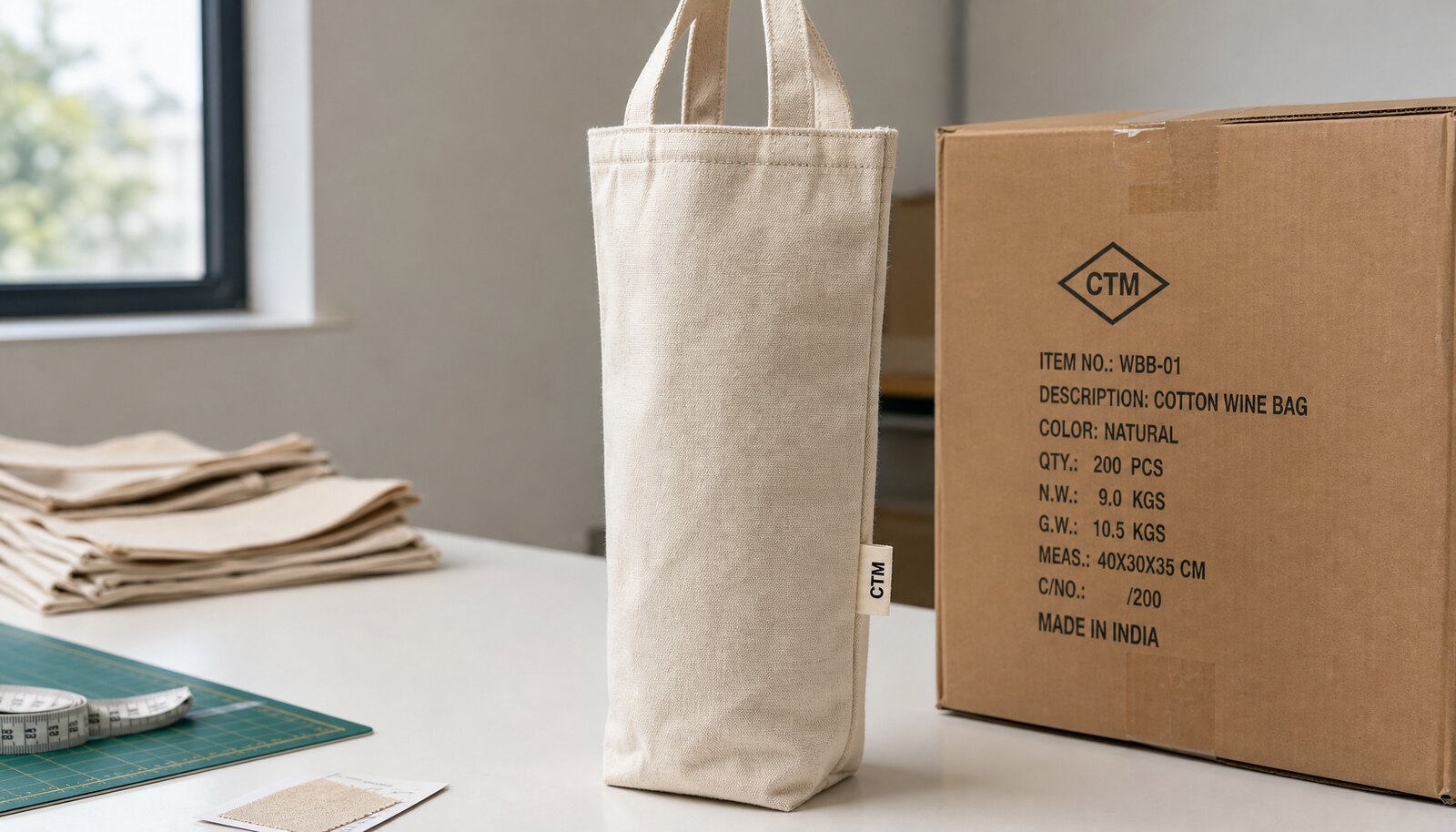
Why the export carton mark matters
For wine bottle bags, the carton mark is not decoration. It is the receiving instruction that tells your warehouse, forwarder, and customer exactly what is inside the carton, how many units are packed, and which program the carton belongs to. If the mark is wrong or incomplete, the problem rarely shows up at the factory. It shows up when cartons are sorted, palletized, or scanned at destination.
Buyers often focus on the bag body, print, handle, or closure and treat the carton mark as a last-minute detail. That is a mistake. A clean mark controls SKU separation, color splits, carton counts, and route handling. For promotional wine bottle bags, gift sets, or retail packs, the mark must align with the packing list and the warehouse system, or your shipment can be delayed even if the bags themselves are perfect.
- Use the carton mark as a receiving tool, not a branding element.
- Tie the mark to SKU, color, quantity, and destination before sample approval.
- Treat carton text as part of the production spec, not a post-quote add-on.
Lock the carton data before you request quotes
The easiest way to compare factory quotes is to give every supplier the same carton data sheet. That sheet should define the bag construction, folding method, quantity per carton, and the exact mark copy. If one factory quotes 1000 bags per carton and another quotes 800 because the bag is 200 GSM instead of 140 GSM cotton, the carton mark must reflect that difference. Otherwise you will compare the wrong unit cost.
For wine bottle bags, the bag spec often changes the packing density. A 140 to 180 GSM cotton single-bottle bag usually folds flatter than a 220 to 280 GSM canvas or brushed cotton version. Jute and laminated styles usually need more headroom in the carton. The carton mark should therefore include not only the product name, but also the pack count, carton number, and any split by size or color.
- Define material, GSM, size, closure, and print method before carton text is drafted.
- Send one master data sheet to every supplier so the quote is comparable.
- Include carton quantity by color or size, not only the total order quantity.
What the carton mark should contain
A practical export carton mark for wine bottle bags is short, readable, and consistent. At minimum, it should tell the receiver the product name, SKU or style code, color, quantity per carton, carton number, purchase order number, and destination. If your buyer or distributor requires country of origin, carton dimensions, or gross weight, add those fields only if they are truly used in receiving or customs handling.
Do not turn the carton into a paragraph. Receiving teams need fast identification, not a catalog page. Large block text works better than small decorative copy. If the program involves multiple colors or mixed packs, add a clear pack ratio line, such as one color per carton or a defined assortment split. When carton marks and packing lists use different names for the same item, warehouse errors go up fast.
- Keep the core fields consistent across all cartons in the same program.
- Use the same SKU naming system on the mark, packing list, and PO.
- Add carton number and total carton count when the order is split across multiple pallets.
Match the mark to the bag structure and GSM
The carton mark has to match how the bag is actually made and packed. A single wine bottle bag in 140 GSM cotton, folded flat without an insert, will pack very differently from a 230 GSM canvas bag with a drawstring, a neck tie, or a board insert. The same is true for jute and burlap styles, which are bulkier and may change carton count once the sample is folded and compressed. If the carton mark says the wrong pack count, the whole shipment becomes hard to verify.
Ask the factory to base the carton spec on a real fold test, not a guess. This matters even more if your line includes premium retail versions with stitching, lining, lamination, or embossing. Heavier materials increase carton volume and can change gross weight, so the carton mark should stay in step with the packing detail. For mixed programs, write separate marks for each GSM, size, or closure type rather than relying on a generic wine bottle bag description.
- Use actual sample folding to confirm pack count before artwork is frozen.
- Separate carton marks by GSM when slim cotton and bulky canvas are both in the order.
- Do not reuse one carton mark for different constructions if the pack density changes.
Choose a print method that survives transit
Most export cartons for wine bottle bags use simple 1-color flexo printing because it is economical and readable on corrugated board. That works well when the text is large, the layout is clean, and the carton face is smooth enough for the ink to hold. If you need a barcode, QR code, or retailer-specific label, do not assume one printed pass will solve everything. Many buyers end up using a printed carton mark plus a separate adhesive label for scan-critical data.
Rough kraft board, recycled board, or humid transit lanes can soften thin lines and small text. On real production cartons, keep the font bold, use high contrast, and avoid tiny type that disappears after taping or stretch wrapping. If the supplier proposes thermal labels, check whether they are applied on the side panel, on the top, or under a clear outer wrap. A readable label is better than a complicated print that cannot be scanned at receiving.
- Prefer bold, high-contrast text over decorative graphics.
- Use a separate barcode label if scanning matters to the customer.
- Check legibility on the actual corrugated board, not only on artwork files.
MOQ, setup, and lead time logic for carton marks
Carton marks are often low-cost in theory and expensive in practice when the spec changes late. A new carton size, a new print plate, or a second color in the mark can create setup time and minimum quantity pressure. That is why MOQ logic should be tied to the carton spec, not just to the bag body. If the order has several colors or multiple destination labels, each variation may need its own print file or label run.
When you compare quotations, separate the unit bag cost from carton print setup, carton sourcing, label application, and any artwork revisions. Ask what happens if the buyer changes the carton count after approval. Some factories can adjust quickly if the carton structure stays the same; others need a new outer carton specification and a longer lead time. For standard marks on stocked cartons, the lead time is usually shorter than for a new carton size or special label program, so confirm which case applies before you commit.
- Ask whether setup charges are one-time or repeated across revisions.
- Confirm whether the carton is stocked or custom-made.
- Check if a change in pack count triggers a new carton size and new mark.
Approve sample cartons before bulk production
A PDF proof is useful, but it does not prove that the carton will work in production. Ask for a printed carton sample or a photo proof on the actual board that will be used for shipment. Then compare it against the packing list and the fold test for the bag. This is the best way to catch missing carton numbers, wrong SKU text, or marks that sit too close to a flap seam.
A proper sample check should include handling, not just visual review. Rub the print lightly, apply tape where the carton will be sealed, and confirm that the text remains readable. If the shipment will be palletized, check the carton after wrapping to make sure the key data is still visible. If the program uses barcodes, scan them from the expected receiving distance. One clean sample carton can save a full container of avoidable disputes.
- Require proof on actual carton board, not only a design file.
- Check the carton after tape, wrap, and stacking.
- Scan any barcode or label before you release bulk packing.
Packing formats that change the mark requirement
Wine bottle bags are shipped in more than one packing format. A simple bulk carton for promotional cotton bags is very different from a retail-ready set with insert cards, tissue, or a hanging display pack. If the program includes mixed colors, nested packs, or shelf-ready cartons, the carton mark must reflect that packing logic clearly. Otherwise the warehouse may open the wrong carton first or split the assortment incorrectly.
The biggest risk appears when buyers assume the carton mark can be generic because the bags themselves look similar. In reality, a 6-pack canvas set, a single-bottle gift sleeve, and a jute bottle bag with a reinforced base may all require different carton counts and labeling. If one retailer asks for side labels and another needs top marks plus pallet labels, treat those as separate requirements in the RFQ. The factory should quote them separately so the receiving system stays aligned.
- Write separate marks for bulk cartons, retail sets, and mixed assortments.
- State whether inner packs, tissue, or insert cards change the count per carton.
- Add pallet label rules early if the shipment will go through a distribution center.
Common mistakes that cause receiving delays
The most common error is a carton mark that looks correct to the factory but wrong to the buyer's warehouse. That usually happens when SKU names are shortened, the color description changes, or the carton count is copied from an old program. Another frequent issue is printing the mark across a flap fold or under a sealing tape line, which makes the text hard to read when the carton is stacked or wrapped.
Another mistake is mixing carton data and retail data without a clear rule. Retail buyers may want one naming system, while the distributor wants another. If the carton mark uses the wrong name, receiving teams can treat the shipment as a mismatch even when the bags are fine. Set a simple acceptance rule: the mark must match the approved packing list, the carton count must match the actual fold test, and the key data must remain readable after packing and palletizing.
- Do not copy old carton marks without checking the current packing list.
- Avoid printing on flap folds, tape seams, or low-contrast board.
- Keep retail naming, carton naming, and PO naming aligned or clearly mapped.
How to compare supplier quotes line by line
A clean RFQ for wine bottle bag cartons should let you compare factories on the same basis. Ask each supplier to split the quote into bag body cost, print cost, carton cost, carton mark cost, label cost, palletizing cost, and any artwork or plate charge. If one factory bundles everything and another separates it, you cannot see where the real cost or risk sits. The carton mark itself may look cheap until you add revision fees, label application, or a new carton size.
Also compare the data behind the quote. One supplier may quote a higher carton count because the bag is slimmer at 160 GSM cotton, while another may reduce the count because the product is a thicker 240 GSM canvas version. If the carton mark hides that difference, the landed cost will be misleading. Ask for carton dimensions, gross weight, net weight, and packing method in writing. Those details matter as much as the per-unit quote.
- Separate artwork, plate, label, and carton setup costs from the base bag price.
- Compare carton count, gross weight, and carton dimensions, not just the unit price.
- Watch for hidden charges when the mark is revised after approval.
Specification comparison for buyers
| Spec decision | Recommended option | When it fits | Buyer risk to check |
|---|---|---|---|
| Mark placement | Two adjacent sides plus top label | Palletized exports, mixed warehouse handling, and long transit routes | One-side-only marks can disappear under stretch wrap or stacking |
| Print method | 1-color flexo on corrugated or adhesive label for barcodes | Standard export cartons with simple shipment data | Thin lines blur on rough board and barcodes should not rely on ink alone |
| Carton content | SKU, color, qty/ctn, gross weight, carton no., PO, and origin | Most retail, distributor, and importer programs | Missing carton number or pack ratio creates receiving disputes |
| Carton grade | 5-ply or board spec matched to load and route | Heavier canvas, jute, or humid long-haul lanes | Under-specced board crushes and makes the mark hard to read |
| Artwork style | Large block text, all caps, high contrast | Fast manual picking in warehouses and DCs | Decorative fonts and low contrast slow receiving and raise mis-pick risk |
Buyer checklist before sampling
- Confirm the exact carton text for each SKU, color, and pack ratio before the RFQ is sent.
- State whether the mark goes on one side, two sides, or top plus sides.
- Match carton data to the packing list language, not just the retail naming convention.
- Lock the bag construction first: fabric type, GSM, size, closure, and any insert card or tissue.
- Ask the factory to quote carton size, board grade, and printed mark as separate line items.
- Request a printed carton sample or photo proof on the actual board, not only a PDF.
- Check that font size, contrast, and placement stay readable after tape, wrap, and stacking.
- Verify carton number sequence, overage allowance, and destination labeling rules.
- Confirm whether barcode or retailer label requirements are part of the carton mark scope.
- Approve the final carton mark against the packing list and sample carton before bulk release.
Factory quote questions to send
- What exact carton size, flute type, and board grade are included in the quote?
- What carton mark text are you pricing, and how many print colors or passes does it require?
- Is carton printing included in the bag unit price or listed as a separate setup charge?
- How many bags per carton are you quoting for each GSM, size, and fold method?
- Do you quote the same carton mark for all colors, or do color splits need separate art and labels?
- Can you provide a printed carton proof on the actual board before production starts?
- What is the lead time after artwork approval, and what changes add extra days?
- What is your carton overage allowance for print, packing, and replacement cartons?
- If barcode or SSCC labels are required, are they printed, applied, or buyer-supplied?
- Can you show carton photos and the first packed carton before shipment release?
Quality-control points to confirm
- Carton text matches the approved packing list exactly.
- SKU, color, quantity per carton, and carton number are all visible and consistent.
- Mark placement avoids flap folds, tape seams, and pallet wrap coverage.
- Font size and contrast remain readable from normal warehouse viewing distance.
- Barcode or label scans correctly if the program requires machine reading.
- Printed carton proof matches the actual board color and print method.
- Carton quantity matches the bag fold test, especially for heavier GSM canvas or jute.
- Gross weight, net weight, and carton dimensions match the shipping plan.
- Sequential carton numbers do not skip or duplicate.
- Side labels and top marks do not conflict with retailer or destination labels.