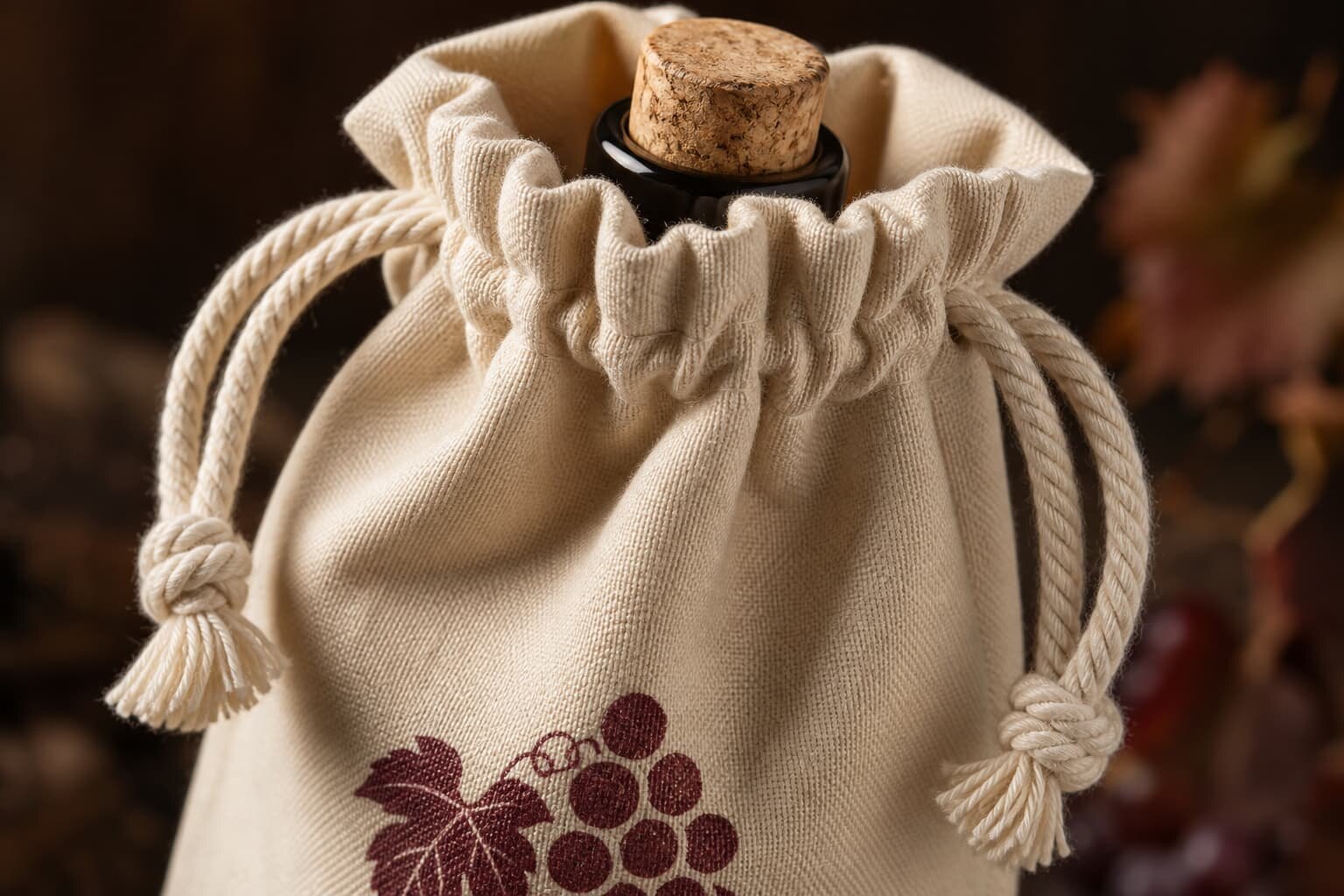
Why Wine Bottle Bag Quotes Vary So Much
Wine bottle bag bulk pricing is not only a matter of quantity. Two quotes can both say “cotton wine bag” and still describe very different products. One may be a thin 140gsm cotton sleeve with a basic drawstring and one-color print. Another may be a 280gsm canvas gift bag with full gusset, reinforced seams, and a larger logo area. If the RFQ is too general, the cheapest supplier often wins by assuming the lightest material and simplest construction.
Procurement teams should treat wine bottle bags as protective branded packaging, not only as decoration. The filled bottle creates real load on the bottom seam, handle, divider, and drawstring channel. A weak bag may look acceptable when empty but fail when used in a tasting room, gift shop, or retail checkout. A good pricing guide helps buyers compare the same specification across factories and understand which cost drivers are worth paying for.
- Fabric weight changes both unit cost and perceived value.
- Bag structure affects sewing time more than many buyers expect.
- Print size and color count can change setup cost and rejection risk.
- Packing method affects carton volume, sea freight, and warehouse handling.
- MOQ depends on fabric availability, dyeing, printing setup, and sewing efficiency.
Start Pricing From Bottle Fit, Not From Bag Size
The first mistake in many RFQs is asking for a standard wine bag without confirming the bottle. A Bordeaux bottle, Burgundy bottle, Champagne bottle, tall dessert wine bottle, and spirits bottle can require different widths, gussets, and neck clearance. If the bag is too narrow, the bottle pushes against the side seams and the printed logo may distort. If the bag is too tall, the top collapses and looks unfinished. If the bag is too short, the neck or cork area remains exposed when the buyer expected full coverage.
For single bottle drawstring bags, buyers commonly discuss sizes around 15 x 35 cm, 16 x 37 cm, or similar ranges depending on bottle diameter and whether the top must tie above the shoulder or neck. Handled gift bags and multi-bottle carriers require more exact calculation because gusset depth, bottom strength, and handle drop affect usability. Always give the factory bottle dimensions and filled weight, not only the bottle volume.
- Provide bottle height from base to top of cork or cap.
- Provide maximum bottle diameter at the widest point.
- Provide filled bottle weight, especially for Champagne or heavy glass bottles.
- State whether the bag should close fully, expose the neck, or show the label.
- For two-bottle bags, confirm whether bottles sit side by side with a divider or in separate sleeves.
Fabric Weight Choices That Drive Bulk Price
Fabric is usually the largest visible cost driver. Cotton wine bags are often quoted in GSM, while canvas may be quoted in ounces. A 140gsm cotton bag can work for a low-cost event giveaway, but it may feel thin and wrinkle easily. A 180-220gsm cotton bag gives better opacity and print stability. A 10oz or 12oz canvas bag feels more substantial and suits retail gifting, but it increases material cost, sewing time, carton weight, and freight volume.
Jute wine bags have a different cost profile. Natural jute in the 260-320gsm range gives a rustic look and good stiffness, but it may have fiber variation, odor, and rough edges if not controlled. Laminated jute can improve structure and reduce fraying, but lamination changes hand feel and may affect recyclability claims. If sustainability language is important to the brand, confirm what material claim is accurate before printing it on the bag or retail tag.
- 140-160gsm cotton: economical sleeve, suitable for simple promotions.
- 180-220gsm cotton: better balance for branded wine clubs and gift packaging.
- 8-10oz canvas: stronger hand feel for reusable retail or corporate gift bags.
- 10-12oz canvas: premium structure, higher cost, larger carton volume.
- 260-320gsm jute: rustic stiffness, but requires odor and shedding checks.
- Laminated jute: cleaner shape and print surface, but different material claim.
Construction Details Buyers Should Price Separately
Construction can change the quote even when fabric is the same. A flat drawstring sleeve is faster to sew than a bag with side gusset, bottom gusset, boxed corners, lining, divider, or reinforced handle patches. For single bottle bags, the cost difference may look small at sample stage, but at 10,000 pieces the sewing minutes matter. Factories price based on material consumption, sewing operations, trimming, inspection, and packing labor.
For handled wine bags, ask how the handle is attached. Cotton webbing handles sewn into the top seam are common, but stress points should be reinforced. Rope handles may need eyelets or reinforced holes, which add material and labor. Multi-bottle carriers need dividers that are high enough to stop glass contact and strong enough to hold shape. A low-cost divider that collapses during use can create bottle knocking and a poor retail experience.
- Drawstring channel width must match cord thickness so closing feels smooth.
- Bottom seam should be straight, tight, and reinforced for heavy bottles.
- Handle stitching should be checked with filled bottle weight, not empty bag weight.
- Dividers should be measured for height, attachment method, and bottle separation.
- Boxed corners improve standing shape but add sewing complexity.
- Lining improves finish but increases cost, thickness, and production time.
Print Method and Artwork Cost Control
Logo printing is where many wine bottle bag quotes become difficult to compare. A simple one-color screen print on cotton or canvas is usually cost-efficient for bulk orders. Multi-color screen printing can still work, but registration tolerance matters on soft fabric. Heat transfer or digital printing may be better for gradients, small details, or shorter runs, although the printed area may feel different from the fabric. Embroidery can look premium but is rarely the cheapest option and may pucker on lighter fabrics.
Before asking for price, prepare print data that a factory can actually use: vector artwork, Pantone references, logo size, print position, and whether both sides are printed. A large logo across a gusset or seam is more difficult than a centered front logo. For jute, fine text can lose sharpness because the weave is coarse. If a retail barcode, care label, or legal copy is required, do not assume the same print method can handle it clearly.
- Screen print: efficient for one to three solid colors and medium to large bulk orders.
- Heat transfer: useful for detailed artwork, but check hand feel and edge durability.
- Digital print: useful for complex graphics or lower quantities, depending on fabric surface.
- Embroidery: premium appearance, but needs suitable fabric weight and backing.
- Woven or sewn label: good for small branding when front print should stay minimal.
- Embossed leather or PU patch: premium option, but requires separate patch material and stitching.
MOQ Logic Behind Factory Bulk Pricing
MOQ is not only a sales rule. It comes from production efficiency and material sourcing. If the buyer selects standard natural cotton, natural jute, or stock canvas, the factory may support lower quantities because material is already available. If the buyer requests custom dyed fabric, unusual GSM, custom drawcord color, special hardware, or full-surface printing, the MOQ rises because dyeing, cutting, and setup need minimum production volume.
When comparing wine bottle bag bulk pricing, ask for several quantity breaks under the same specification. A quote at 500 pieces may carry high setup and sample cost per unit. A quote at 5,000 pieces may show better sewing efficiency and material purchase price. However, bigger is not always better if the buyer has uncertain demand, seasonal artwork, or warehouse limits. Use the price break table to find the practical order quantity, not only the lowest unit price.
- Stock natural fabric usually supports lower MOQ than custom dyed fabric.
- One-color print usually has lower setup risk than complex multi-color artwork.
- Custom hardware, rope, labels, or dividers can set their own MOQ.
- Factories may quote better prices when cutting layouts reduce fabric waste.
- Repeating orders can sometimes use existing screens or approved materials, if still available.
- Small quantity orders should expect higher unit cost because setup is spread over fewer pieces.
What a Clean Quote Should Include
A useful factory quote should let a procurement team compare cost, risk, and logistics without guessing. The quote should not only say unit price and MOQ. It should include material specification, finished size, print method, color count, accessories, packing, carton data, sample terms, lead time, payment terms, and trade term. If any of those are missing, the low quote may not be a real saving.
Ask factories to itemize special charges. Screen charges, digital setup, sample fee, mold fee for special labels, courier fee, and testing fee can be small individually but meaningful when comparing suppliers. Also confirm whether the quoted price is EXW, FOB, CIF, DDP, or another term. A low EXW unit price can become expensive once inland handling, export documents, freight, duties, and delivery are included.
- Material: composition, GSM or ounce weight, color, coating, and lining if any.
- Size: finished width, height, gusset, handle length, and size tolerance.
- Branding: print method, logo size, color count, position, and setup fees.
- Accessories: drawcord, handle, eyelet, divider, stopper, label, hangtag, or insert card.
- Packing: pieces per polybag or inner pack, carton quantity, carton size, gross weight, and CBM.
- Commercial terms: MOQ, quantity breaks, sample fee, lead time, payment term, and Incoterm.
Sample Approval Criteria Before Bulk Production
The approved sample is the bridge between quote and mass production. It should be made from the actual or clearly declared substitute fabric, with the actual print method and correct construction. If the sample uses available fabric only for shape checking, mark it as a fitting sample, not an approved production sample. For wine bags, appearance alone is not enough; the buyer should insert the actual bottle and check closure, balance, handle comfort, and bottom stability.
A good sample review should produce written comments, not only a yes or no. Measure the sample flat. Photograph the logo position with a ruler. Pull the drawstring several times. Carry a filled bottle for a short handling test. Check whether the fabric wrinkles, sheds, smells, or shows dark bottle color through the material. Any revision must be confirmed before the factory starts cutting bulk fabric.
- Measure width, height, gusset, handle drop, and drawstring channel.
- Check bottle fit with actual bottle type or a matching dummy bottle.
- Confirm logo size, color, position, clarity, and curing.
- Check seam straightness, stitch density, loose threads, and bottom reinforcement.
- Evaluate fabric opacity, hand feel, odor, creasing, and color consistency.
- Approve packing style if retail presentation or carton efficiency is important.
Packing, Carton Data, and Landed Cost
Wine bottle bags are lightweight individually, but packing still affects landed cost. A thick canvas carrier with handles and dividers can occupy much more carton volume than a flat cotton drawstring sleeve. If the quote does not include carton size, gross weight, and pieces per carton, the buyer cannot estimate freight accurately. This is especially important for air shipment, where volumetric weight may be more important than actual weight.
Packing should match the sales channel. Bulk packed drawstring bags may be fine for distributor use or kitting operations. Retail-ready bags may need individual polybags, paper belly bands, hangtags, barcode labels, or inner cartons. Each step adds labor and material cost. Over-packing can waste budget, while under-packing can create wrinkled bags, carton crushing, or dirty fabric when the goods arrive.
- Flat packing reduces volume for simple drawstring sleeves.
- Stuffed or shaped packing may protect premium structure but increases carton size.
- Individual polybags protect fabric but may conflict with plastic reduction policies.
- Hangtags and barcodes should be quoted with material, printing, and attachment method.
- Carton weight should be manageable for warehouse staff and within local handling rules.
- Moisture protection is important for cotton and jute during long sea freight routes.
Lead Time Planning and Production Mistakes to Avoid
Lead time should be discussed as a sequence, not one vague number. Material booking, sample making, sample courier time, buyer approval, bulk cutting, printing, sewing, trimming, inspection, packing, and export handover all take time. If artwork changes after sample approval, the schedule may reset. If custom dyed fabric is required, color approval and dye lot control can add more time than buyers expect.
The most common production mistakes are caused by incomplete RFQs and late changes. A buyer may approve a sample without testing the bottle, then discover the opening is tight. A brand may request a larger logo after screens are made. A distributor may choose a low GSM fabric without checking transparency. A retail buyer may forget carton marks or barcode labels until packing has started. These are preventable if the RFQ and approval checklist are specific from the beginning.
- Do not approve bulk production from artwork only; approve a physical or clearly documented sample.
- Do not change logo size, Pantone color, or bag size after screens and cutting are confirmed unless cost and schedule are updated.
- Do not compare quotes unless fabric weight, size, construction, print, and packing are the same.
- Do not ignore carton CBM when choosing heavy canvas or multi-bottle structures.
- Do not rely on verbal tolerance agreements; write them into the purchase order.
- Do not assume natural materials will be perfectly uniform in shade, texture, or fiber appearance.
Specification comparison for buyers
| Spec decision | Recommended option | When it fits | Buyer risk to check |
|---|---|---|---|
| Single bottle promotional giveaway | 140-180gsm cotton drawstring bag with 1-color screen print | Wine club gifts, tasting events, low to mid weight bottles | Check final bottle diameter and neck height; thin cotton can look transparent with dark bottles |
| Retail shelf wine gift bag | 220-280gsm cotton canvas or laminated jute with reinforced handles | Paid retail packaging, holiday gift sets, higher perceived value | Handle stitching and bottom seam must support filled bottle weight during carrying |
| Premium winery or corporate gift | 10-12oz canvas with full gusset, rope or cotton webbing handle, refined logo print | Branded gifting where bag is kept and reused | Higher fabric weight increases carton size, freight cost, and sewing tolerance requirements |
| Rustic natural positioning | Natural jute 260-320gsm with cotton drawstring or webbing handle | Organic wine, craft spirits, farm shop, wedding favors | Jute odor, fiber shedding, and color variation need approval before bulk production |
| Multi-bottle carrier | Two-bottle or six-bottle canvas/jute carrier with stitched divider | Retail bundles, distributor packs, tasting room upsells | Divider height, bottom reinforcement, and carton compression must be tested with real bottles |
| Detailed artwork or gradient logo | Heat transfer or digital print on cotton/canvas panel | Small batch launches or multi-color brand graphics | Confirm wash/rub resistance and whether transfer film changes hand feel |
| Lowest landed cost target | Standard size, existing fabric stock, 1-color print, master carton packing | Large volume distributor orders with simple branding | Very low unit price may hide thinner fabric, weak drawcord, or loose carton packing |
Buyer checklist before sampling
- Confirm bottle type, filled bottle weight, diameter, height, and whether the bag must cover the neck fully.
- State bag style clearly: drawstring sleeve, handled gift bag, tote-style carrier, two-bottle divider bag, or multi-bottle carrier.
- Specify fabric material and target weight: cotton 140-280gsm, canvas 8-12oz, jute 260-320gsm, or nonwoven if applicable.
- Provide finished bag size with width, height, gusset, seam allowance expectation, and acceptable tolerance.
- Define logo size, position, print colors, print method preference, and whether Pantone matching is required.
- Ask for itemized pricing by order quantity, including setup, sample, mold or screen charges, packing, and export carton details.
- Require a pre-production sample using actual fabric, actual print, actual drawcord or handle, and final packing method if possible.
- Check carton dimensions, gross weight, pieces per carton, and pallet loading before approving the final quote.
- Confirm lead time by stage: material booking, sample approval, bulk production, inspection, packing, and shipment handover.
- Set written acceptance criteria for stitching, fabric defects, logo position tolerance, drawstring function, odor, and carton condition.
Factory quote questions to send
- What fabric weight, yarn type, coating, or lamination is included in your quoted price?
- Is the quoted size measured flat before filling, or as the finished usable size after sewing and gusset formation?
- What is the MOQ for this exact fabric color, bag size, print method, and handle or drawcord combination?
- Are screen charges, digital setup fees, sample charges, and courier charges included or listed separately?
- What print method do you recommend for this artwork, and what logo size limit should we use to avoid distortion on seams or folds?
- Can you quote 1,000, 3,000, 5,000, and 10,000 pieces using the same specification so we can see the price break structure?
- What is the estimated carton size, gross weight, and CBM for the quoted order quantity?
- Can the bag be tested with our actual filled bottle, or can we provide bottle dimensions and filled weight for your load check?
- What is your standard size tolerance, logo position tolerance, and acceptable fabric color tolerance for bulk production?
- What documents and photos will you provide before shipment: sample photos, inline inspection, final inspection, carton marks, and packing list?
Quality-control points to confirm
- Finished size measured flat, including width, height, gusset, and drawstring channel position.
- Fabric GSM or ounce weight checked against approved sample and purchase order specification.
- Stitch density, seam allowance, reinforcement stitching, and loose thread control checked at handles, bottom, and divider points.
- Logo print color, sharpness, position, curing, rub resistance, and registration checked against approved artwork.
- Drawstring length, cord thickness, knot security, stopper quality if used, and smooth opening or closing function checked.
- Bottle fit tested with actual or equivalent bottle dimensions, including neck clearance and bottom stability.
- Odor, mildew risk, fiber shedding, and color transfer checked especially for jute, dyed cotton, and laminated materials.
- Carton packing checked for pieces per inner pack, carton strength, moisture protection, carton marks, gross weight, and compression risk.