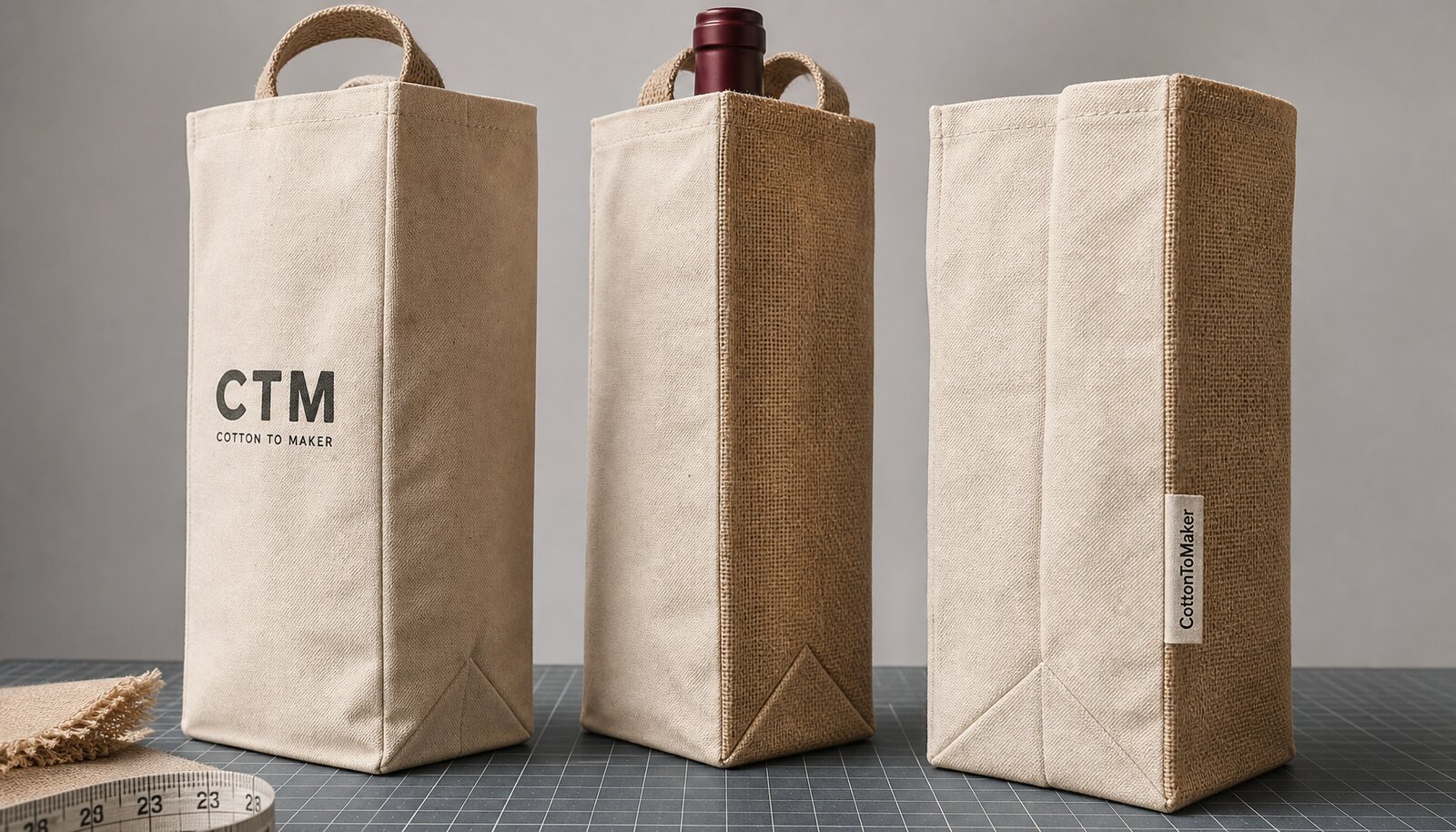
Why the Bottom Gusset Corner Deserves Its Own Checklist
The bottom gusset corner is a small construction detail, but it decides whether a wine bottle bag looks premium, stands correctly, and survives handling. Many RFQs describe only material, size, logo, and handle. That is not enough. A 750 ml filled bottle puts concentrated weight on the base, and the bottle bottom presses directly into the gusset corners. If the corner is weak, narrow, twisted, or poorly stitched, the bag may lean, split, or look misshapen before the consumer even carries it.
For procurement teams, the problem usually appears after quotes are collected. One supplier quotes a low price using thin fabric and simple corner stitching. Another quotes a stronger bag with a wider seam allowance and reinforced corner. On paper both may be called a cotton wine bottle bag with bottom gusset. Without a buyer checklist, the cheaper quote may win even though it cannot pass the real packing and carrying requirement.
- Use the checklist when comparing quotes from different factories.
- Treat the gusset as a load-bearing part, not a cosmetic fold.
- Ask for construction photos before you approve any price for bulk production.
- Do not release artwork until the finished bottom shape is confirmed.
Start with the Bottle, Not the Bag Drawing
A good wine bottle bag specification starts with the bottle data. Factories need bottle height, base diameter, shoulder shape, and filled weight. A standard 750 ml bottle is common, but Bordeaux, Burgundy, Champagne, sparkling wine, olive oil, spirits, and gift bottles can vary sharply. A few millimeters at the bottle base changes the required gusset width and the stress on each corner.
If you only send a flat bag size, the factory may quote a generic pattern that technically fits one bottle but does not stand well. For retail gift bags, upright presentation matters. For distributor giveaways, carrying strength may matter more. For wine club or e-commerce packing, the bag may need to keep shape after being folded in cartons for weeks.
- Confirm bottle diameter at the widest base point, not only label panel width.
- Confirm bottle height including cork, cap, or foil if the bag has a drawstring or higher neck.
- State whether the bag holds one bottle, two bottles, or one bottle plus insert card.
- Send a physical bottle to the sample room when the bottle shape is non-standard.
Choose a Gusset Construction That Matches the Use
For most single wine bottle bags, a boxed bottom gusset is the practical choice. The side and bottom seams are sewn so the bag opens into a rectangular or square base. This gives the bottle a stable platform and allows the bag to stand better than a simple flat pouch. The corner should be secured by backstitching, bartack, or consistent lockstitching depending on fabric and price level.
Some low-cost bags use a folded gusset with minimal corner forming. That can be acceptable for light promotional packaging where the bottle is inserted only at the point of sale. It is less suitable for heavier glass bottles, export gift sets, or bags expected to be reused. Inserted base panels can give a cleaner shape, but they add cutting, sewing, and alignment cost. The right construction depends on the target retail channel and failure tolerance.
- Boxed bottom: best balance for most cotton, canvas, jute, and non-woven wine bags.
- Folded gusset: lower cost, but check corner shape and strength carefully.
- Inserted base panel: cleaner base, useful for premium programs, but higher labor cost.
- Reinforced corner: recommended when bottle weight, reuse, or premium presentation matters.
Fabric Weight and Corner Performance
Fabric weight affects how the gusset corner behaves after sewing. For cotton wine bottle bags, 6 oz cotton can work for very light promotional use, but it may wrinkle around the bottle base and feel weak. Many retail-ready cotton or canvas wine bags sit in the 8 oz to 10 oz range, roughly 220-280 GSM depending on weave. Heavier canvas gives structure, but it also needs better needle choice and seam control to avoid bulky corners.
Jute has a different risk profile. A 250-320 GSM jute fabric can look strong, but loose weave and fraying at the corner can create production defects if seam allowance is too narrow. Laminated jute improves body and print sharpness but changes the handfeel and may crack if the corner is forced too tightly. For non-woven wine bags, GSM should be matched with handle strength and corner reinforcement because the material can tear along stitch holes.
- Cotton 140-180 GSM: only for low-cost, light-duty wine packaging with clear buyer acceptance.
- Cotton canvas 220-280 GSM: common range for reusable single-bottle bags.
- Jute 250-320 GSM: suitable for rustic gift bags if fraying is controlled.
- Non-woven 80-120 GSM: check stitch tear resistance at the gusset corner.
- Heavier fabric is not automatically better if the corner becomes too bulky to sew cleanly.
Print Placement Around the Bottom Fold
The most common artwork mistake is placing the logo too close to the bottom gusset fold. On a flat dieline the front panel looks large, but once the bottle expands the base, the lower area folds under or curves around the bottle bottom. A logo printed too low can disappear into the fold, distort at the corner, or look uneven from left to right.
For screen print on cotton or canvas, keep key artwork at least 25-35 mm above the bottom fold line unless the factory provides a physical sample proving otherwise. Heat transfer can give sharper detail but may crack or lift if it crosses a hard fold. Digital print can work for complex artwork, but the buyer should still approve real placement on the finished bag, not only a digital layout.
- Mark the safe print area on the sample approval file.
- Do not place legal text or barcode data near the bottom gusset.
- For jute, allow extra distance because weave and seam bulk can shift artwork visually.
- Ask whether print is done before or after sewing; this affects alignment tolerance.
- Approve print position with a bottle inserted, not only on a flat bag.
MOQ and Cost Logic Behind a Stronger Corner
A bottom gusset corner looks like a small detail, but it affects labor time, sewing setup, rejection rate, and packing. Reinforced corners may require extra stitching, slower operators, or a more experienced line. If two quotes differ by a few cents, ask whether both include the same seam allowance, stitch density, reinforcement, and inspection standard. The cheapest quote may be based on faster sewing and a narrower corner seam.
MOQ should be discussed by fabric, size, color, and artwork. A factory may accept 1,000 pieces total, but if that is split into five artworks and three fabric colors, the real production efficiency changes. Screen printing has setup cost per color and artwork. Dyed cotton has fabric MOQ. Jute and natural cotton may have shade variation by lot. A buyer who understands MOQ logic can negotiate better without forcing the factory into risky shortcuts.
- Ask for separate pricing for standard corner and reinforced corner.
- Confirm whether sample charge is refundable or separate from bulk cost.
- Clarify if MOQ applies per artwork, per fabric color, or total purchase order.
- Request setup cost details for screen print, heat transfer, woven label, or hangtag.
- Avoid mixing many small variants if the bottom construction must be tightly controlled.
Sample Approval: What to Check Before Signing Off
A wine bottle bag sample should be checked with the actual bottle. Insert the bottle, stand it on a flat surface, lift it by the handles, and inspect the bottom corners after handling. The corner should not twist, open, or pull into a sharp stress point. If the bag leans, measure whether the issue comes from uneven gusset width, crooked side seams, or fabric distortion.
Do not approve only the best-looking sample photo from the supplier. Ask for front, side, bottom, inside seam, and packed view. For higher-volume orders, request a pre-production sample made with bulk fabric, bulk thread, bulk print method, and actual packing. A prototype made with substitute fabric may hide corner problems that appear later in mass production.
- Measure finished height, flat width, and bottom gusset width.
- Check left and right corner symmetry with bottle inserted.
- Inspect inside seam allowance and thread trimming.
- Rub the print near the lower panel if the logo sits close to the fold.
- Keep one signed physical sample and one photo record for QC comparison.
Packing Decisions That Protect the Gusset Shape
Even a well-sewn bottom gusset can arrive deformed if packing is wrong. Wine bottle bags are often flat packed to save carton volume, but over-compression can crush the boxed corners and create permanent diagonal folds. This is especially visible on laminated jute, heavy canvas, or bags with a structured base. If the buyer expects the bag to stand cleanly at retail, packing must be part of the RFQ.
The practical packing choice depends on the sales channel. Bulk distributor giveaways may accept flat compressed packing. Retail gift bags may need fewer pieces per inner bundle, tissue separation, or a pre-creased gusset. E-commerce kits may need individual polybags, paper belly bands, or carton dividers. Ask the factory to quote packing separately if presentation matters, because better packing uses more carton volume and can affect freight cost.
- Specify pieces per inner bundle and pieces per export carton.
- Ask for carton dimensions and estimated gross weight in the quote.
- Confirm whether bags are packed flat, half-open, or with gusset pre-formed.
- Use moisture protection for cotton and jute if shipping in humid seasons.
- Approve carton packing photos before bulk shipment release.
Lead Time and Production Control Points
Lead time is not only sewing time. A realistic schedule includes fabric sourcing, cutting, printing, drying or curing, sewing, trimming, inspection, packing, and export booking. If the bottom gusset corner is important, do not skip pre-production approval. The first line output should be checked before the factory runs thousands of pieces. This is where corner size, stitch tension, print position, and handle placement can still be corrected.
For repeat orders, the buyer should still confirm whether fabric lot, machine setup, and operators are the same as the previous run. Small changes can affect the bottom shape. For seasonal wine promotions, build in time for one sample revision. Rushing directly from artwork approval to bulk sewing increases the risk that the first real problem is found during final inspection, when correction is expensive.
- Sample lead time should state material availability and print method assumptions.
- Bulk lead time should start after sample, artwork, deposit, and material approval.
- Request first-piece photos from the sewing line before full production.
- Set an inspection point after sewing but before final packing if volume is high.
- Ask the factory to flag any material substitution before cutting.
Quote Data Buyers Should Compare Side by Side
A useful supplier quote for wine bottle bags should not be a one-line unit price. At minimum, it should list fabric type, GSM or ounce weight, finished dimensions, gusset width, handle material, print method, print size, number of print colors, packing method, carton quantity, sample time, bulk lead time, MOQ, and quote validity. Without this data, procurement teams cannot compare suppliers fairly.
When the buying problem is the bottom gusset corner, add construction details to the quote sheet. Ask the factory to state seam allowance, stitch type, stitch density, corner reinforcement method, and finished tolerance. If the supplier cannot answer these points, they may be quoting from a generic sales template rather than a controlled production spec. That does not automatically mean they are a bad supplier, but it means you need a sample before relying on the quote.
- Compare fabric GSM and weave, not only material name.
- Compare finished gusset width and tolerance.
- Compare reinforcement details and whether they are included in unit price.
- Compare print setup charges and artwork split charges.
- Compare packing volume because it affects landed cost.
- Compare lead time assumptions, especially before holiday or wine season orders.
Specification comparison for buyers
| Spec decision | Recommended option | When it fits | Buyer risk to check |
|---|---|---|---|
| Bottom gusset construction | Boxed bottom with reinforced corner bartack or double backstitch | Single bottle cotton, canvas, jute, or non-woven wine bags that must stand upright | Corner collapse, uneven base width, and bottle leaning after packing |
| Fabric weight for cotton bag | 8 oz to 10 oz cotton canvas or 220-280 GSM cotton | Retail gift packaging, winery merchandise, reusable promotional bottle bags | Thin fabric may wrinkle at gusset corners and show bottle outline too strongly |
| Fabric weight for jute bag | 250-320 GSM laminated or unlaminated jute depending on finish | Rustic wine gifting, supermarket seasonal packs, distributor gift sets | Loose weave may fray at gusset corner unless seam allowance is controlled |
| Corner seam allowance | Minimum 8-10 mm finished seam allowance after trimming | Most stitched bottom gusset wine bags | Too narrow allowance can burst at the bottom corner under bottle weight |
| Print placement near gusset | Keep artwork 25-35 mm above bottom fold line unless approved by sample | Screen print, heat transfer, and digital print on front panel | Logo distortion when the bag expands around the bottle base |
| Handle attachment | Cotton webbing or self-fabric handles stitched above bottle shoulder area | Premium gift bags and reusable wine carrier programs | Handle stress transfers to bottom corners if bag height or handle position is wrong |
| MOQ logic | One fabric, one size, one print method per MOQ; color changes counted separately | Importers consolidating several wine labels or seasonal artworks | Supplier quote may hide higher setup cost when many small artwork splits are requested |
| Packing method | Flat pack with gusset pre-creased and corner protected from crushing | Retail buyers needing neat shelf-ready or e-commerce packaging | Over-compressed cartons can deform boxed bottoms before arrival |
Buyer checklist before sampling
- Confirm the bottle diameter, bottle height, and filled bottle weight before asking factories to quote the bottom gusset.
- Specify whether the bag must stand upright empty, stand upright with bottle inserted, or only function as a carry bag.
- Request the finished bottom gusset width, not only the flat bag width, because these are often confused in quotes.
- Ask for the corner construction photo from inside and outside the sample, including seam allowance and stitch density.
- Set an acceptable finished size tolerance, usually plus or minus 3-5 mm for gusset width on sewn fabric bags.
- Keep logos and mandatory text away from the lower fold line unless the factory proves print alignment on a physical sample.
- Check whether corner reinforcement is included in the quoted unit price or treated as an optional workmanship upgrade.
- Approve one packed sample, not only one loose sample, because carton compression can change the bottom corner shape.
- Test with the real bottle or a bottle of the same diameter and weight for at least 24 hours before production release.
- Record the final approved sample with front, side, bottom, inside seam, and packed carton photos.
Factory quote questions to send
- What is the finished flat width, finished height, and finished bottom gusset width you are quoting?
- Is the bottom corner made by boxed stitching, folded side gusset, inserted base panel, or another construction?
- What fabric GSM or ounce weight is included in the price, and is shrinkage allowed before cutting?
- What seam allowance and stitches per inch will be used at the bottom gusset corner?
- Will you add bartack, backstitch, or reinforcement at the corner stress point, and is it included in the quote?
- How far from the bottom fold line will you position the printed logo on the front panel?
- Which print method do you recommend for this fabric and order quantity, and what is the setup charge logic?
- What is the MOQ for one size, one fabric, one print color, and one artwork?
- How will the bags be packed so the bottom gusset is not crushed or permanently folded out of shape?
- What sample lead time, bulk lead time, and pre-production approval steps are assumed in your quote?
Quality-control points to confirm
- Measure bottom gusset width on at least 10 samples per inspection lot and compare against the approved tolerance.
- Check that left and right bottom corners are symmetrical when a bottle is inserted.
- Inspect inside seams for skipped stitches, exposed raw edges, loose jute fibers, and narrow seam allowance.
- Perform a bottle load test using the target filled bottle weight plus reasonable handling movement.
- Confirm the print does not crack, distort, or disappear into the bottom fold when the bottle sits in the bag.
- Check that the bag stands as approved after being removed from export carton packing.
- Verify carton quantity, inner packing, moisture protection, and carton marks match the purchase order.
- Compare bulk goods against the signed sample, not only against the supplier's written spec sheet.