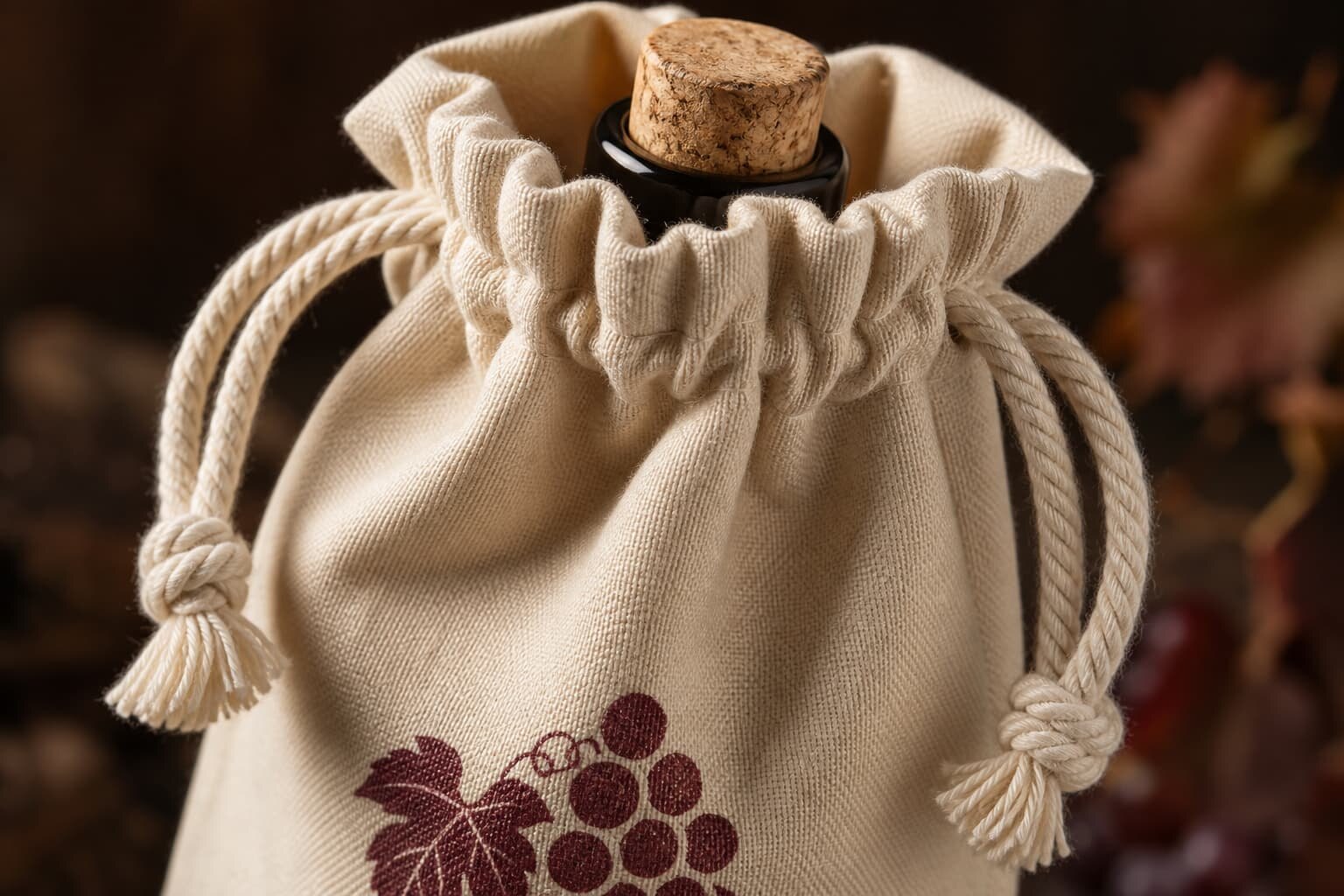
Start With the Buying Risk, Not the Design
A wine bag can look simple on a sales sheet and still fail in production because the quote does not lock the real variables: fabric weight, bottle fit, handle stress, print area, lining, and packing. When a supplier only confirms custom wine bag or sends a generic catalog price, you are not auditing a factory. You are guessing at output.
A proper audit is less about finding the cheapest number and more about proving that the quote matches the same product across all factories. If one supplier is quoting a 10 oz canvas sleeve and another is quoting a 12 oz fully lined bag with bar-tacked handles, the lower price is not a fair comparison. Your first job is to normalize the spec so the quote can be trusted.
- Freeze the bottle type before you compare any quote.
- Ask for the actual sample type, not a catalog image.
- Keep the first order focused on one structure and one decoration method.
- Make the supplier confirm every assumption in writing.
Lock the Product Spec the Supplier Must Quote Against
For a single-bottle wine bag, the most common mistake is starting with artwork before the body spec is fixed. A standard 750 ml bottle may fit a bag around 33 x 10 x 10 cm, but that does not mean a thicker Burgundy bottle, a champagne bottle, or a double-wall insulated style will use the same cut. The supplier should quote against a finished size, not a vague description of fit.
You also need to define the parts that change sewing cost. Handle length is not enough; ask for handle drop. A drawstring closure is not the same as a sewn top fold, and a lined bag is not the same as an unlined one. If the buyer team wants retail presentation, stacking strength, or a gift-ready finish, those details need to be fixed before the factory starts calculating labor and wastage.
- Material: cotton canvas, jute, nonwoven PP, neoprene, or another agreed body fabric.
- Weight: call out oz or gsm, because a light canvas and a heavy canvas are not interchangeable.
- Dimensions: finished width, height, gusset, and any top fold allowance.
- Structure: open top, drawstring, flap, zipper, divider, or insulated lining.
Compare Materials and Constructions Like a Merchandiser
The best material is the one that matches your channel, not the one that looks most premium in a photo. 12 oz cotton canvas, usually around 400 to 450 gsm depending on weave, is a strong middle ground for retail and gifting because it prints cleanly, sews well, and feels substantial without becoming too stiff. 14 oz and above gives a firmer body, but it also raises sewing load and can create bulk at folded seams.
Jute, nonwoven PP, and neoprene each solve a different buyer problem. Jute gives a natural, rustic look, but it can shed fibers and make fine-line logos harder to hold. Nonwoven PP is useful for promotional programs where unit cost and fast production matter more than a premium hand feel. Neoprene is suited to insulation or a more technical presentation, but it adds thickness, changes seam behavior, and can affect the MOQ and lead time.
- Use cotton canvas when print clarity and brand presentation matter.
- Use jute when the natural look is part of the product story.
- Use nonwoven when the budget and shipment speed matter most.
- Use neoprene or lined structures only when the function justifies the extra cost and process steps.
Read the Quote for Hidden Cost Drivers
A reliable quote should separate fabric, accessories, cut-and-sew, print, packing, and carton costs. If the supplier only gives one lump sum, you cannot tell whether a future revision is a real cost increase or a margin tactic. Ask for the quote to show the spec assumptions: fabric weight, color, print size, number of screens, and packaging method.
For wine bags, small changes can ripple through the whole quote. A switch from natural canvas to dyed black canvas can add a dye lot step. Adding a woven side label can mean a separate loom setup. Changing a drawstring to a zipper usually adds hardware and a different stitching sequence. The point is not to avoid upgrades, but to know which ones change MOQ, lead time, and scrap risk.
- Ask for fabric cost, printing cost, sewing labor, and packing cost as separate lines.
- Request separate pricing for natural color and custom dyed color.
- Confirm whether screens, plates, woven labels, and hangtags are included.
- Check if the unit price changes when you increase print colors or change the closure.
Audit Print, Branding, and Decoration Methods
Screen print is still the default for simple logos on cotton and jute because it is clear, repeatable, and easier to control in bulk. It works best when the logo has one to three solid colors and enough open space. If the artwork is tiny, gradient-heavy, or expects photographic detail, ask whether the factory will use heat transfer, woven label, embroidery, or a sewn-on PU patch instead.
The supplier audit here is about durability, not artwork preference. On textured jute, fine lines can break; on dark fabric, a white underbase may be needed; on soft cotton, heavy ink can crack if the bag is folded hard. Ask the factory to show you a print strike-off on the same fabric, in the exact placement, before you approve bulk.
- Check logo placement against the approved die line, not against the sales photo.
- Ask for print strike-off on the same fabric color and weight.
- Confirm whether the ink is hand-feel soft enough for retail use.
- Set acceptance criteria for registration, opacity, and rub resistance.
Check Sample Quality Before You Discuss Volume
Do not treat the first sample as a display piece. Treat it as a production proof. Measure the finished width, height, gusset, handle drop, and opening allowance. Test whether the bottle slides in without fighting the seam, whether the base sits flat, and whether the neck area leaves enough room for a tag or closure.
A wine bag should also survive handling, not just photos. Check that side seams stay straight, stitch density stays even, reinforcement is added at stress points, and the bag does not twist when a full bottle is lifted. If the supplier is offering a lined or insulated style, inspect the lining attachment, edge turn-in, and any exposed raw cuts inside the top fold.
- Measure the sample with a tape, not by eye.
- Insert a filled bottle and check fit, balance, and bottle neck clearance.
- Lift the loaded bag several times to see whether handles or seams deform.
- Review raw edges, stitching finish, and print alignment under normal light.
Set MOQ Logic Before the Supplier Sets It for You
MOQ is usually set by the most expensive production constraint, not by the quote line item you care about most. A stocked natural canvas body with a single screen color and standard carton can often run lower MOQ than a dyed fabric body with multi-color print, woven label, and custom insert card. If you ask for too many variables at once, the supplier has to protect against waste in fabric, printing screens, and sewing changeovers.
For buyer control, separate must-haves from optional upgrades. Decide whether the first order is a market test, a seasonal gift pack, or a full retail program. That decision changes how much you should spend on custom accessories. A smart supplier will tell you which features drive MOQ up the fastest and which can be postponed to the second order.
- Typical factory pattern: one stocked fabric and one-color print can often start lower than a custom-dyed, fully lined style.
- Custom woven labels, special closures, and packaging inserts usually raise MOQ faster than the bag body itself.
- Multiple print colors usually affect setup more than buyers expect.
- Ask the supplier to name the top two MOQ drivers before you revise the artwork.
Plan Lead Time Around Samples, Materials, and Packing
Lead time is not one number; it is a chain of small approvals. Sample approval, material booking, print plate preparation, sewing, inspection, and packing all consume time. If the supplier cannot explain where the calendar sits, they are probably estimating from a best-case slot instead of an actual production plan.
Packing matters more than many buyers expect. Wine bags are often sold in gift sets, so the inner pack may need a barcode sticker, folded insert, tissue wrap, or master carton divider. The wrong packing format can crush printed surfaces, set wrinkles into canvas, or create carton damage in freight. Ask for the unit pack, inner count, master carton dimensions, and whether the goods are packed flat or pre-shaped.
- Ask for sample lead time and bulk lead time as separate dates.
- Confirm whether the factory has already sourced the same fabric, cord, zipper, or label.
- Check whether print plate approval or woven label approval sits on the critical path.
- Make sure the packing method matches the retail channel and the freight plan.
Verify Factory Controls Before You Trust the Quote
When two quotes look close, score the supplier on clarity, not just unit cost. A good factory responds with the same measurement system every time, offers a correct sample type, and can explain why the quote moves when you change the fabric weight or print method. A weak supplier hides behind generic terms like premium, eco, or custom without the production detail to back it up.
The fastest way to avoid a bad PO is to force the quote into a checklist format and compare only like-for-like offers. If the factory will not confirm raw material, construction, packing, and QC standard in writing, treat the quote as incomplete. You can still keep them in the running, but do not use their price as a benchmark for approval.
- Red flag: unit price without fabric weight, size, or decoration method.
- Red flag: sample photos that do not match the written quote.
- Red flag: no answer on packing, carton count, or inspection standard.
- Red flag: the supplier changes the spec after you ask for a sample.
- Red flag: they cannot explain why MOQ changes when you adjust one part of the design.
Turn the Audit Into a PO-Ready Decision
By the time you issue a PO, the supplier should already know the exact product and the exact control points. Your final decision should be based on a simple comparison: which factory understood the spec, quoted it in the clearest way, and could show the cleanest sample-to-quote match. That is usually a better predictor of production stability than the lowest headline number.
If you are choosing between two similar suppliers, use a scoring sheet with four categories: spec accuracy, sample quality, quote transparency, and production confidence. The goal is not to reward the prettiest presentation. The goal is to reduce revision rounds, packing errors, and surprise costs after the order starts moving.
- Award the order to the supplier that matches the approved sample without spec drift.
- Prefer the quote that breaks out the cost drivers instead of hiding them.
- Use the factory that can explain lead time with real process steps, not vague promises.
- Keep a second supplier warm if they can support a later re-order or alternate material.
Specification comparison for buyers
| Spec decision | Recommended option | When it fits | Buyer risk to check |
|---|---|---|---|
| Body material | 12 oz cotton canvas or about 400 to 450 GSM | Private label retail, gift sets, and repeat orders that need cleaner print detail | Check shrinkage after wash, seam puckering, and whether the supplier states fabric weight before cutting |
| Body material | 14 to 16 oz jute | Rustic corporate gifting and premium natural look | Check fiber shedding, odor, edge binding quality, and whether the logo can print cleanly on the rough surface |
| Body material | 90 to 120 gsm nonwoven PP | Promo campaigns with lower unit cost and faster turn | Check strap pull strength, print rub resistance, and whether carton compression causes deformation |
| Closure and carry style | Drawstring with cord lock or cotton rope handles | Simple gift presentation and lighter bottles | Check cord slip, neck opening size, and whether the top closes securely during transit |
| Premium construction | 3 mm neoprene sleeve or lined cotton with divider | Temperature-sensitive gifting or higher-end retail sets | Check seam alignment, glue residue, and whether the extra layer changes MOQ and lead time |
Buyer checklist before sampling
- Confirm the bottle type first: standard 750 ml Bordeaux, Burgundy, Champagne, or magnum, because one size does not fit all.
- Freeze the fabric spec in writing, including material, weave, and weight such as 12 oz canvas, 14 oz jute, or 100 gsm nonwoven.
- State the print method, print size, number of colors, and exact placement on the bag body or side label.
- Ask for a proto sample, then a pre-production sample made from the same fabric and accessories as bulk.
- Request a line-item quote that separates fabric, printing, sewing, lining, closures, labels, and packing.
- Confirm MOQ by fabric color, print version, and accessory set, not just by product name.
- Check the unit pack, master carton quantity, carton size, and whether the bags ship flat or pre-shaped.
- Set measurable tolerances for finished size, handle drop, print placement, and stitch quality.
- Ask who approves the pre-production sample and who signs off the final packing method.
- Verify the production lead time from sample approval, not from the date the PO is issued.
Factory quote questions to send
- What exact fabric weight, weave, and finish are you quoting for this wine bag?
- Is your quotation for a standard 750 ml bottle, a larger Burgundy bottle, or a champagne-style bottle?
- Which print method do you recommend for the artwork, and what is the risk if we change to another method?
- Does the MOQ change if we switch from natural fabric to dyed fabric, or from one print color to two?
- Are the handles, reinforcement, lining, and closure included in the quoted structure?
- What sample stages do you provide, and which sample is the one I should approve for bulk production?
- What is your unit pack, inner pack, and master carton specification?
- What tolerances do you hold on finished size, stitch placement, and print position?
- What inspection standard do you use before shipment, and can you share the key defect categories?
- What is the production calendar after artwork approval and pre-production sample sign-off?
Quality-control points to confirm
- Fabric weight matches the approved spec and the hand feel is consistent across the whole lot.
- Color shade stays within the approved swatch and there is no visible dye streaking or blotching.
- Stitch density is even, seams are straight, and bar-tacks or reinforcements are present at load points.
- Handles or drawcords hold a full bottle without stretching, slipping, or twisting the bag body.
- Print is centered, opaque enough, and resistant to rubbing where the bag folds during packing.
- Finished size, gusset, and bottle clearance all match the approved sample and tolerance sheet.
- Closure function is smooth, whether it is a drawstring, zipper, flap, or open-top design.
- No loose threads, raw edges, odor issues, glue marks, or fabric distortion remain on the finished bag.
- Carton count, pack method, and shipping marks match the approved packing instructions.
- Bulk cartons survive stacking and compression without crushing the bag shape or damaging the print.