Wine Bag Sourcing Customization Options for Australia
By Vincent Xi, Editorial Author
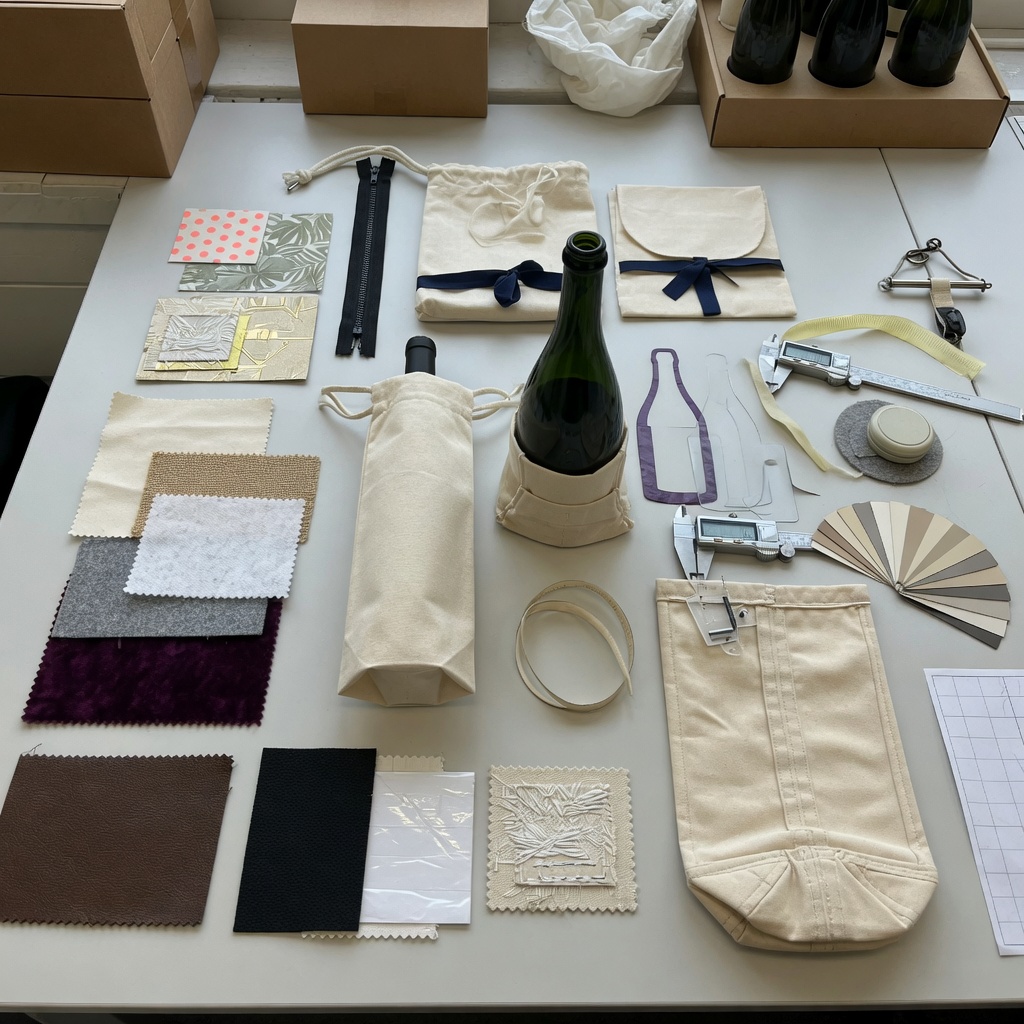
For Australian procurement teams, wine bag sourcing customization options should be resolved in a practical sequence: bottle fit, structural configuration, material, carrying and closure details, decoration, packing and commercial terms. A polished artwork mock-up cannot compensate for an undefined cavity, divider, handle attachment or variant minimum.
Send each shortlisted supplier the same bottle schedule and RFQ. Identify every bottle and accessory combination, then require the quotation to distinguish finished internal dimensions, finished external dimensions and pre-assembly panel dimensions. Material names, order totals and descriptions such as standard wine bottle bag are not enough to compare bids.
Published dimensions and supplier option menus can help screen possible configurations. Production approval should still depend on a current quotation, a dimensioned specification, a sample made for the intended bottle and written acceptance criteria linked to the purchase order.
Wine Bag Customization Options for Australian Procurement
Use the option matrix to keep visible customization from obscuring fit and construction decisions.
| Customization decision | Buyer defines in the RFQ | Supplier returns with the quote | Release evidence |
|---|---|---|---|
| Bottle format | Bottle drawing or physical sample, maximum bottle envelope, closure profile, accessories and loaded mass | Finished usable dimensions, dimension order, measurement datums, tolerances and proposed clearance | Production-material sample checked with every intended bottle profile |
| Bag configuration | Required bottle count, orientation, gusset, base and separation | Construction drawing showing cavity geometry, divider type and attachment points | Loaded sample demonstrating access, separation and stability under the agreed handling method |
| Material construction | Composition, construction method, weight or thickness, finish, colour and reinforcement requirements | Complete material and component specification, including proposed alternatives | Approved swatch and structural sample tied to the quoted specification |
| Carry and closure | Handle position, handle drop, opening access, closure type and loaded handling conditions | Handle, reinforcement and closure details with measurable dimensions and tolerances | Loaded carry and closure check using the buyer-defined method |
| Decoration | Controlled vector artwork, colour reference, print area and placement | Decoration process, printable area, edge exclusions, setup basis and placement tolerance | Decorated pre-production sample matched to the approved artwork version |
| Variant structure | Required quantity by size, material, body colour, artwork and delivery release | Minimum quantity, price break and setup allocation for each variant | Quote schedule mapping every charge and minimum to a defined variant |
| Packing and delivery | Fold method, protective packing, destination and requested delivery date | Inner-pack and carton configuration, carton dimensions and mass, freight scope and staged schedule | Approved packing sample or packing specification linked to the purchase order |
A quotation is not comparable when usable dimensions are undefined, material is identified only by a category name, or the minimum order is not allocated to the relevant variant. Resolve those omissions before comparing unit prices.
Practical RFQ Checklist for Wine Bag Customization Options
Attach this checklist to the RFQ and require a written response against every item. Use a separate response line for each size, material, body colour, artwork or delivery variant. Mark responses as complies, deviation proposed or not offered, and require the supplier to explain every deviation.
- [ ] Australian delivery scope: State the destination postcode, destination type, requested delivery date, named delivery point, delivery basis and freight responsibilities included in the quote.
- [ ] Variant schedule: List the required quantity for each combination of bottle format, bag size, material, colour, decoration and delivery release.
- [ ] Bottle and accessory schedule: Attach drawings or physical samples showing the maximum bottle envelope, closure profile, accessories and measured loaded mass for every intended pack.
- [ ] Finished fit: Require finished usable cavity dimensions, opening clearance, dimension order, measurement condition, datums and manufacturing tolerances.
- [ ] Construction drawing: Require the gusset, base, seams, divider, lining, padding, handles, reinforcement and closure to be shown with attachment points and measurable dimensions.
- [ ] Material specification: Require composition, construction method, weight or thickness, finish, colour reference and allowable variation for every material and component.
- [ ] Decoration specification: Supply controlled artwork and require the process, printable area, edge exclusions, colour method, placement datums and placement tolerances.
- [ ] Minimum allocation: Require the supplier to state whether each minimum applies to the total order, material, size, body colour, artwork, decoration process or delivery release.
- [ ] Commercial breakdown: Request separate quote lines for unit price, setup, tooling, samples, inspection, protective packing, cartons and freight.
- [ ] Sample sequence: Identify the required swatch, structural sample, decorated sample, pre-production sample and retained approval sample, as applicable to the quoted design.
- [ ] Acceptance checks: Define bottle insertion and removal, loaded carrying, divider separation, closure operation, decoration placement, workmanship and packing checks.
- [ ] Packing data: Require the fold method, protective materials, inner-pack quantity, carton configuration, carton dimensions, carton mass and carton marking proposal.
- [ ] Schedule: Require separate timing for material confirmation, sampling, buyer approval, production, inspection, packing, freight handover and delivery, with the start event and day type defined for each period.
- [ ] Claims and documents: Require current, scope-specific evidence for any material-origin, recycled-content, performance, compliance or certification claim that affects award.
- [ ] Substitutions and changes: Require written buyer approval before changing a material, component, process, production location, packing method or approved artwork.
- [ ] Quote exceptions: Require a consolidated list of assumptions, exclusions, proposed alternatives and unresolved fields rather than accepting exceptions scattered through correspondence.
Do not release production while a required field remains blank or is answered only with a general marketing description. The final purchase order should identify the approved specification, artwork version, pre-production sample, packing requirements and written change-control process.
Source Data for Fit and Quote Screening
The figures below are source-reported screening references. The cited pages show no publication date, so the figures have an undated as-of context and must be reconfirmed in a current supplier quotation. They are not universal specifications, buyer tolerances, independent standards or confirmed CottonToMaker capabilities.
| Source-supported scope and date context | Reported data | Procurement use |
|---|---|---|
| Bottle-sizing reference, page undated, nominal 750 mL bottle scope | About 5 x 13 inches, also presented as approximately 13 x 33 centimetres; another listed format is 4.5 x 13.5 inches | Use for initial sample screening only. The source does not establish dimension order or whether the measurements are internal, external or pre-assembly. |
| Bottle-sizing reference, page undated, bottle-profile examples within its nominal 750 mL discussion | A Bordeaux bottle is reported at about 3 inches in diameter and 11.5-12 inches tall; a Champagne bottle is reported at about 3.5 inches wide | Record each actual bottle envelope rather than approving fit from nominal capacity alone. |
| Bottle-sizing reference, page undated, filled nominal 750 mL bottle scope | Approximate loaded mass of 1.2-1.5 kilograms | Treat this as a screening reference. Approval should use the measured mass of the intended bottle, contents and accessories. |
| Supplier configuration page, page undated, supplier-specific single-bottle option | Approximately 4 x 4 x 14 inches | Ask the bidder to state dimension order, usable cavity size and internal-versus-external status. |
| Supplier configuration page, page undated, supplier-specific double-bottle option with divider | Approximately 7 x 3.5 x 14 inches | Request a comparable drawing that shows divider geometry and attachment points; do not treat the dimensions as a universal format. |
| Supplier configuration page, page undated, supplier-specific multi-bottle option | Approximately 10 x 7 x 11 inches | Require bottle count, orientation and usable cavity dimensions in the current quotation. |
| Commercial sourcing article, page undated, non-woven bag with the source's 1-4-colour screen-printing configuration | Reported starting quantity of 200 units | Reconfirm the minimum for each size, body colour, artwork and decoration configuration. |
| Commercial sourcing article, page undated, cotton bag within the source's stated category | Reported starting quantity of 100 units | Confirm material construction, decoration method and variant allocation in the quote. |
| Commercial sourcing article, page undated, laminated full-colour CMYK configuration | Reported starting quantity of 2,500 units and lead time of 60-90 days; the source does not identify the type of day | Obtain a current staged schedule and define whether each period uses calendar, business, production or transit days. |
These references are useful for identifying questions, not for setting purchase-order specifications. The approved sample and supplier drawing must govern the order.
Bottle Fit, Divider and Carry Customization Options
Build the fit specification from the actual products to be packed. For each bottle and accessory combination, record:
- Maximum body width or diameter, overall height, shoulder shape, base shape and closure projection.
- Any neck tag, label, sleeve or accessory that must remain undamaged during insertion and removal.
- Actual loaded mass and the handling condition the bag must support.
- Required opening clearance, closure clearance and ease of insertion and removal.
- The measurement condition for the bag, such as empty, loaded, closed, flattened or opened naturally.
Require a supplier drawing that labels cavity width, opening width, height, gusset depth, base depth, divider position and handle drop. Each measurement should have a datum, nominal value and manufacturing tolerance. Seams, folds, lining, padding and closure placement can reduce usable space, so flat panel width should not be treated as cavity width without confirmation.
For a multi-bottle configuration, specify whether the divider is fixed, removable, padded or suspended, and whether it attaches to the sidewalls, base or both. The supplier should show those attachment points in a drawing or open construction sample. Approval should use the intended bottles and a buyer-defined sequence for lifting, carrying, turning, opening and unloading.
A presentation or carry bag should not be approved as shipment-protective packaging unless that function is explicitly included in the RFQ and tested by an agreed method. None of the cited sources establishes transit-protection performance for the reported configurations.
Material and Construction Customization Options
The undated supplier options page lists paper, cotton, jute, non-woven material, RPET, felt, velvet, leather and neoprene as material categories. This is a supplier-specific menu, not an industry-wide range or confirmation that any particular supplier currently offers every option.
A category name does not define the construction. Build the material portion of the RFQ around measurable fields.
| Customization area | Specification fields | Approval evidence |
|---|---|---|
| Body material | Composition, construction method, weight or thickness, finish, colour reference and allowable variation | Supplier specification, swatch and sample made from the quoted material |
| Gusset and base | Finished geometry, material layers, reinforcement, seam arrangement and measurement datums | Dimensioned drawing and structural sample |
| Divider and lining | Material, thickness, coverage, anchoring, edge finish and permitted movement | Open construction view or approved sample showing attachment points |
| Handles | Material, width, length, position, attachment method and reinforcement | Quoted drawing and loaded sample checked by the agreed method |
| Seams and edges | Seam type, thread specification, stitch condition, edge treatment and visible-thread criteria | Workmanship sample and defined visual acceptance criteria |
| Padded or insulated request | Complete layer build, closure coverage, intended conditions and proposed performance method | Evidence for the quoted construction; a material name alone is not a performance result |
| Recycled-content request | Claimed percentage, calculation basis, supply-chain scope and current supporting document | Document review tied to the document owner, material, supplier and quoted product scope |
The term RPET alone does not establish a recycled-content percentage, calculation method or certification. When a material-origin or environmental claim affects supplier selection, require the exact proposed wording, applicable product scope, calculation basis, document owner and current supporting evidence.
The bill of materials should identify the body, gusset, base, divider, lining, padding, handles, reinforcement, thread, closure, decoration layers and protective packing. Require written approval before any quoted material, component, process or production location is changed.
Printing, Closure and Finish Customization Options
The undated supplier options page lists offset, flexographic, screen and digital printing, together with foil, embroidery and patches. It also lists drawstring, flap, zipper, open-top, strap and ribbon configurations. These are source-specific options and are not confirmed as suitable for every material or construction.
For each decorated variant, ask the supplier to state:
- The decoration process and exact body material to which it will be applied.
- The maximum printable area, seam and edge exclusions, artwork orientation and any required underbase.
- The controlled artwork version, colour reference and colour process.
- Placement and registration tolerances measured from identified datums.
- How folds, seams, texture, lining and backing affect the decoration area.
- Setup, tooling and sampling charges allocated to the applicable artwork and variant.
- The decorated sample stage used for production approval.
A digital artwork mock-up can confirm layout intent, but it does not demonstrate output on the quoted material. Use a decorated pre-production sample to approve placement, colour reference, surface interaction and finish.
For foil, embroidery and patches, define attachment, backing and edge-finish criteria. For closures, define opening clearance, alignment, operating direction, component material and acceptable operation on the intended loaded sample.
Sampling, Variant and Change Control
Match the sample sequence to the customization risk. Relevant stages may include a material swatch, plain structural sample, decorated sample, pre-production sample and retained approval sample. A stock sample can show general workmanship but should not approve custom dimensions, materials, reinforcement, decoration or packing unless those attributes match the quoted order.
The production-release record should identify:
- The approved bottle and accessory combinations.
- Finished dimensions, measurement datums and tolerances.
- Material and component specifications.
- Gusset, base, divider, lining, padding and reinforcement construction.
- Handle attachment and loaded-check method.
- Closure alignment and operation.
- Artwork version, print area, placement and colour reference.
- Workmanship and defect criteria.
- Fold method, protective packing and carton arrangement.
Ask whether each minimum applies to the total order, material, size, body colour, artwork, decoration process or delivery release. A combined order quantity should not be assumed to satisfy a variant minimum unless the quotation says so explicitly.
The purchase order should identify the approved pre-production sample, current bill of materials and written change-control process. Unit price, setup, tooling, samples, inspection, packing and freight should appear as separate quote lines so competing bids can be normalized to the same scope.
Australian Wine Bag Procurement, Packing and Delivery Controls
For delivery into Australia, provide the destination postcode, destination type, requested delivery date, delivery basis and named destination. Require the bidder to identify manufacturing origin, proposed freight mode, packing configuration, carton dimensions, carton mass and the responsibilities included in the quoted price.
The schedule should separate material confirmation, sampling, buyer approval, production, inspection, packing, freight handover and delivery. Each period needs a defined start event and a clear statement of whether it is measured in calendar, business, production or transit days.
The cited evidence does not establish an Australia-specific statutory test, labelling rule, import condition or climate-performance threshold for a customized wine bag. This article therefore does not prescribe one. The buyer should determine which requirements apply to the selected material, claim, intended use and shipment, then request current, scope-specific evidence before award.
Do not accept a broad claim of Australian compliant without the applicable requirement, product scope, responsible document holder and current evidence. If the buyer's own transport or storage assessment identifies heat, moisture or prolonged-storage exposure, put the actual condition and verification method in the RFQ rather than inferring performance from a material name.
A bid is ready for commercial comparison only when the supplier has returned a bottle-fit matrix, dimensioned construction, complete material description, variant-specific minimums, sample plan, packing scope, delivery scope and written substitution process. Production release should follow approval of the corresponding sample and specification, not the quotation alone.
Evidence Method, Limitations and Author Basis
Methodology: Dimensional and loaded-mass figures were extracted from the cited bottle-sizing page. Material, decoration, closure and bag-configuration examples were extracted from the cited supplier options page. Starting quantities and lead-time information were extracted from the cited commercial sourcing article. The reported data were treated as screening references and translated into RFQ questions, quote-comparison fields and sample controls. No source-reported figure was treated as a universal specification, independent standard, current quotation or CottonToMaker capability.
Limitations and verification: The cited commercial pages show no publication dates. The dimensional evidence does not consistently identify dimension order or whether measurements are internal, external or pre-assembly. Supplier menus, starting quantities and schedules may change with material, construction, artwork, variant allocation, production loading and delivery terms. Before award, obtain a current written quotation, dimensioned specification, production-material sample, packing schedule and supporting documents for every claim that affects procurement approval.
No standard or certification is asserted because the cited evidence does not establish one for the proposed product. A standard's requirements, a buyer's specification and a supplier's internal practices are separate. If a supplier names a standard, program or certification, verify its relevance, certificate holder, product scope, issuing body and current validity rather than inferring certification from a material or marketing term.
Author basis: CottonToMaker's approved profile identifies Vincent Xi as an Editorial Author. The profile does not provide a basis for first-person manufacturing, factory-visit, product-testing, client-outcome or certification claims, so none are made here.
Discuss Your Requirements
Review our manufacturing capabilities, then share your specifications for a supplier-fit review.