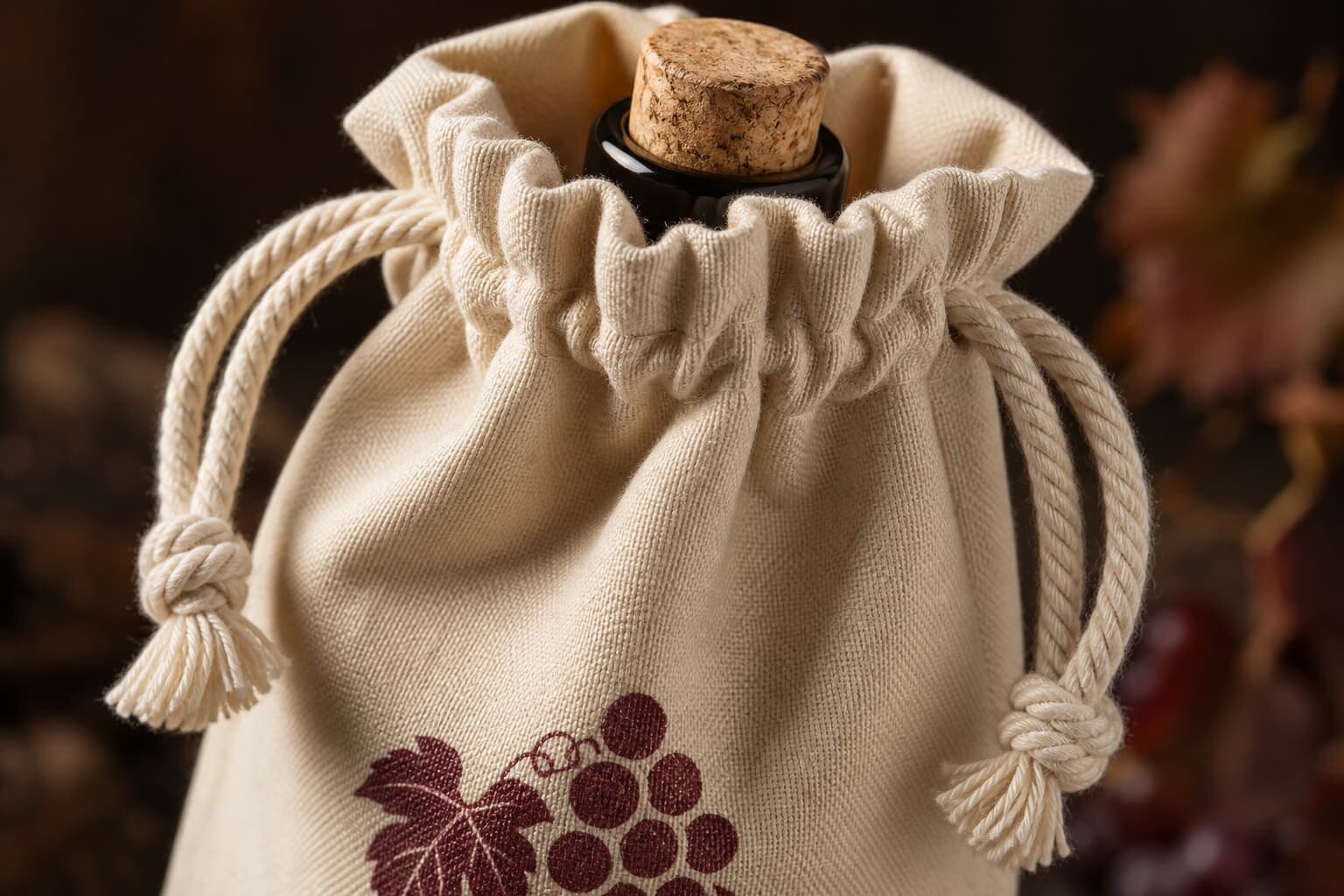
Start MOQ Planning From the Bottle and Sales Channel
A useful wine bag MOQ plan starts with the bottle you need to pack and the channel where the bag will be used. A 750ml Bordeaux bottle, a wider Burgundy bottle, and a Champagne bottle do not need the same bag width or gusset. If the RFQ only says custom wine bag, suppliers will quote their easiest standard size, and the buyer may discover the fit problem only after sampling or, worse, after bulk production.
The sales channel also changes the MOQ logic. A low-cost tasting event bag can use thinner material and simple one-color print. A retail gift bag for a bottle shop needs better fabric handfeel, cleaner stitching, and more stable packing. A winery club or corporate gift bag may justify embroidery, woven labels, or heavier canvas, but those choices often increase MOQ because they add separate material, print, or label production steps.
- For standard 750ml wine bottles, many buyers start around 15 x 35 cm flat size, then adjust for gusset and closure style.
- For Champagne or sparkling wine bottles, confirm bottle diameter and shoulder shape before fixing the width.
- For two-bottle bags, check center divider strength, bottom reinforcement, and carton packing direction.
- For retail display, ask whether bags will stand, hang, or be packed flat behind the counter.
- For online gift sets, plan outer carton or mailer protection separately; the wine bag is not a shipping box.
Understand How Factories Count MOQ
Wine bag MOQ is not only one number. A factory may quote 1,000 pieces, but that may mean 1,000 pieces per fabric color, per bag size, or per logo design. Another factory may accept 500 pieces if the fabric is stock natural cotton and the logo is one-color screen print, but require 2,000 pieces for dyed canvas or laminated jute. Buyers should force the MOQ definition into the quote table instead of accepting a headline number.
The most common MOQ drivers are material purchase, cutting efficiency, printing setup, sewing line changeover, label production, and packing version. If you split one order into four winery logos, two fabric colors, and three bag sizes, the factory may need twelve production lines from one PO. That is why a low total order quantity can still be expensive or rejected.
- Total MOQ: the minimum pieces for one purchase order when all specs are the same.
- Color MOQ: the minimum pieces required for each fabric color or dye lot.
- Artwork MOQ: the minimum pieces for each printed, embroidered, woven, or labeled logo version.
- Size MOQ: the minimum pieces for each cutting pattern or bottle format.
- Packing MOQ: the minimum pieces for each retail header card, barcode, polybag, or carton mark version.
Choose Fabric Weight Before Asking for Price
Fabric weight is one of the fastest ways to make wine bag quotes look different. If one supplier quotes 140gsm cotton and another quotes 10oz canvas, the cheaper quote is not necessarily better; it may simply use much lighter material. For cotton wine bags, buyers commonly compare 120-140gsm cotton for promotional use, 180-220gsm cotton for better handfeel, and 8-12oz canvas for durable retail or gift use.
Jute wine bags are usually judged by GSM, weave density, lamination, smell, and stiffness. A 220gsm jute may be acceptable for a rustic bottle gift bag, while 280-320gsm jute gives a stronger structure for retail packs. If the bag needs a printed logo, remember that open jute weave is not as smooth as cotton. Fine artwork, small serif letters, and thin lines may not print cleanly unless a cotton patch, laminated surface, transfer label, or woven label is used.
- 80-100gsm non-woven PP: economical, light, good for short-term promotions, not premium.
- 120-140gsm cotton: good for simple single-bottle pouches and event giveaways.
- 180-220gsm cotton: better for repeated use and cleaner screen print results.
- 8-10oz canvas: stronger handfeel for retail gift bags and brand merchandise.
- 220-280gsm jute: rustic appearance with better structure, but print detail must be managed.
- Laminated jute: more rigid and moisture resistant, but confirm odor, crease marks, and MOQ.
Match Print Method to MOQ and Artwork Risk
The logo method affects both MOQ and reject risk. Screen print is usually the practical choice for wine bag MOQs when artwork is simple and colors are limited. It works well on cotton and canvas, but the factory must confirm ink coverage, curing, and print position tolerance. On jute, screen print can work for bold logos but may look uneven because of the coarse weave.
Digital print, heat transfer, embroidery, woven labels, and patches solve different problems. Digital print can handle gradients or multi-color artwork but may have higher unit cost and lower compatibility with rough materials. Embroidery gives a premium look but can pucker lightweight cotton and requires a minimum stitch area. Woven labels and patches are useful when many logo versions share the same base bag because the bag can be produced in bulk and labels can be applied by version, but label MOQ and sewing time still need to be included.
- Use screen print for one or two solid-color logos with practical MOQ and stable cost.
- Use heat transfer when the design has many colors but the buyer accepts a label-like finish.
- Use embroidery for premium bags, but test on the selected fabric weight before bulk approval.
- Use woven side labels when branding should be subtle and durable.
- Use a front cotton patch on jute when artwork needs sharper detail than direct jute print can provide.
- Ask for print position tolerance, such as plus or minus 5 mm, in the approved sample record.
Build MOQ Tiers That Match Real Ordering Behavior
Import buyers often ask for the lowest MOQ first, then compare unit prices without thinking about reorder behavior. A better approach is to ask for practical MOQ tiers, such as 500, 1,000, 2,500, and 5,000 pieces, using the same exact spec. This lets procurement see whether the cost drop comes from material purchasing, print setup absorption, sewing efficiency, or carton loading.
For distributors managing several wine brands, it may be better to keep one base bag size and fabric color, then vary the logo by print or label. For a retailer, it may be better to reduce logo versions and increase quantity per SKU, because inventory handling and carton labeling can cost more than the small savings from splitting designs. MOQ planning should support sell-through, not just factory convenience.
- Ask each supplier for the same quantity breaks and the same Incoterm.
- Keep fabric, size, and packing identical when comparing MOQ tiers.
- Separate one-time setup fees from recurring unit cost.
- Check whether the factory allows mixed logo versions inside one production batch.
- Avoid too many low-volume SKU versions unless your warehouse and sales team can manage them.
- Use reorder forecast to negotiate lower setup cost or held screens, but confirm storage time.
Sample Approval Should Prove Fit, Strength, and Branding
A wine bag sample is not approved only because the logo looks correct in a photo. The sample should prove that the bottle fits, the closure works, the seams hold, and the bag looks acceptable after packing. Ask the factory to test with the same bottle type or send exact bottle dimensions. If the bag is for several bottles in your assortment, check the largest diameter and tallest bottle first.
Sample approval should also record measurable details. Buyers should keep the approved sample, sample photos, fabric swatch, print color reference, and measurement sheet in one file. During bulk inspection, this becomes the reference for disputes. If the PO says natural cotton wine bag but the approved sample is actually 10oz canvas, the sample record prevents later confusion.
- Place a real filled or weighted bottle inside the sample and lift by the handle or drawstring.
- Check whether the bottom seam twists, puckers, or stretches under bottle weight.
- Measure finished width, height, gusset, handle drop, and drawstring length.
- Rub the printed logo lightly with dry and slightly damp white cloth to check obvious ink transfer.
- Fold the bag as it will be packed and check whether the logo cracks or leaves transfer marks.
- Photograph the sample next to a ruler and bottle for later factory and inspector reference.
Packing Specs Can Change Carton Cost and Product Appearance
Wine bags are often flat packed, but the packing method still matters. Heavy compression can create permanent creases in cotton and canvas, especially across the logo area. Jute can develop fold marks, loose fibers, or odor if packed too tightly or with poor moisture control. For bags with handles, the handle direction inside the carton should be controlled so handles do not bend unevenly.
Packing also affects landed cost. A slightly thicker canvas bag may not change the unit price much, but it can reduce pieces per carton and increase freight volume. Procurement teams should ask for carton dimensions, gross weight, net weight, and pieces per carton before purchase approval. If the product will go to retail stores, include barcode stickers, carton marks, and inner pack quantity in the RFQ instead of adding them after production starts.
- For simple cotton pouches, 50-100 pieces per inner polybag is common, depending on fabric and logo finish.
- For structured jute or two-bottle bags, lower carton quantity may prevent deformation.
- For printed bags, avoid direct logo-to-logo contact if ink transfer is a risk.
- For retail SKUs, define barcode label size, label position, and carton assortment before mass packing.
- For humid routes or long storage, ask about carton strength, desiccant use, and moisture protection.
- For inspection, require cartons to be easy to open and reseal without damaging the product.
Lead Time Planning: Where Delays Usually Happen
Wine bag lead time is often delayed before sewing starts. Artwork conversion, sample revision, fabric availability, custom dyeing, label production, and print color approval can take more time than the sewing itself. If the buyer approves artwork late or changes bag size after sample review, the original delivery date may no longer be realistic.
A practical RFQ should separate sample lead time, pre-production sample approval time, material preparation time, bulk production time, inspection window, and shipping handover. This is especially important for seasonal wine promotions, harvest events, Christmas gift packaging, and corporate year-end campaigns. The factory should not only provide a delivery date; it should explain which approval dates are required to keep that date.
- Stock natural cotton with one-color print is usually faster than custom dyed canvas or laminated jute.
- Embroidery and woven labels require artwork digitizing or label proof approval before bulk application.
- Custom fabric color may require lab dip approval, bulk dyeing, and color tolerance agreement.
- Large orders with several logo versions need a production schedule by version, not only one final date.
- Inspection should be booked after packing is complete but before goods are sealed for export.
- If the shipment is urgent, reduce custom variables instead of asking the factory to compress every process.
Quote Data Needed for a Fair Supplier Comparison
Many wine bag quote comparisons fail because each supplier quotes a different product. One quote may include 220gsm cotton, another 140gsm cotton. One may include screen setup, another may add it later. One may quote EXW, another FOB. Procurement should build a quote table that locks product spec, quantity tier, packing method, and trade term before comparing price.
The quote should also show what is excluded. If the buyer needs a hangtag, barcode label, individual polybag, color-matched drawstring, reinforced bottom, divider, or retail carton, each item should be listed. This makes negotiation easier because the buyer can see which cost belongs to fabric, printing, sewing, packing, and logistics preparation.
- Unit price by quantity tier and currency.
- Incoterm and named port or delivery point.
- Fabric type, GSM or ounce weight, color, and whether it is stock or custom.
- Finished size, tolerance, gusset, handle, drawstring, and construction details.
- Print method, number of colors, print area, setup charge, and artwork requirements.
- Packing details including inner pack, export carton, carton size, gross weight, and marks.
- Sample cost, sample time, bulk lead time, payment terms, and quantity tolerance.
- Validity period of quote, because cotton, jute, and freight-related costs can change.
Common MOQ Planning Mistakes to Avoid
The most expensive MOQ mistake is splitting the order too early. Buyers often request many fabric colors, several logo sizes, multiple drawstring colors, and different pack quantities before testing sales. This creates small production runs with higher setup cost and more inspection complexity. For a first order, it is usually safer to standardize the bag body and test a few branding versions.
Another mistake is treating MOQ as only a factory rule. MOQ is also connected to warehouse receiving, retail allocation, carton labels, and reorder timing. A low MOQ can be useful for testing, but if the bag becomes a recurring packaging item, the buyer should plan carton quantity, reorder point, and safety stock. A rushed reorder with custom fabric or special labels can cost more than ordering a sensible quantity the first time.
- Do not approve a quote without confirming whether MOQ is per design or total order.
- Do not compare prices unless fabric weight and print method are the same.
- Do not use fine artwork on jute without a real print sample.
- Do not assume a 750ml bag fits all bottle shapes.
- Do not add retail labels after production if packing labor was not quoted.
- Do not let the factory start bulk printing before written sample and artwork approval.
Specification comparison for buyers
| Spec decision | Recommended option | When it fits | Buyer risk to check |
|---|---|---|---|
| Base fabric for entry promotion | 80-100gsm non-woven PP or 120-140gsm cotton | Large wine tastings, festival giveaways, low unit cost campaigns | Very low GSM can sag around a 750ml bottle and may not support premium retail positioning |
| Base fabric for retail gift packaging | 8-10oz cotton canvas or 220-280gsm jute | Bottle shop gift sets, winery merchandise, seasonal retail displays | MOQ rises when fabric color, lamination, or custom dyeing is required |
| Logo method for small MOQ | One-color screen print on natural fabric | Simple winery logo, importer brand mark, event name, or distributor promotion | Fine lines may fill in on jute; request artwork minimum line thickness before sampling |
| Logo method for premium finish | Embroidery, woven label, leather patch, or heat transfer label | Higher perceived value, club gift bags, corporate wine gifting | Setup cost and sampling time increase; placement tolerance must be defined |
| Bag construction | Single-bottle drawstring pouch or stitched handle bag | Standard 750ml wine bottle, low packing volume, easy retail handling | Confirm finished size with bottle diameter and height, not only nominal capacity |
| Packing plan | Flat packed 50-100 pcs per export carton with inner polybag if required | Most importers balancing carton strength and warehouse handling | Overpacked cartons can crease fabric, deform handles, and create inspection disputes |
| MOQ planning approach | Combine colors or print versions only if factory confirms same fabric and same cutting size | Multi-brand distributors or campaigns with regional artwork | Factories may count each color, fabric, or logo version as a separate MOQ line |
Buyer checklist before sampling
- Define bottle type before RFQ: standard 750ml Bordeaux, Burgundy, Champagne, spirit bottle, or mixed bottle range.
- State finished bag size with tolerance, not only bottle capacity; include height, width, gusset, and drawstring or handle length.
- Choose fabric GSM or ounce weight based on sales channel: giveaway, retail gift, winery club, or premium corporate pack.
- Decide whether MOQ is needed per total order, per fabric color, per logo version, or per bag size.
- Send logo artwork in vector format and specify print size, color reference, and position from seam or bottom edge.
- Request sample photos showing bottle fit, seam strength, drawstring closure, logo sharpness, and packing fold marks.
- Ask for carton dimensions, gross weight, net weight, units per carton, and pallet loading suggestion before confirming PO.
- Separate one-time mold, screen, embroidery, or label setup charges from recurring unit price in your quote comparison.
- Confirm pre-production sample approval timing and whether bulk fabric or printed panels start only after written approval.
- Include acceptable quantity tolerance, color tolerance, and AQL inspection level in the purchase order.
Factory quote questions to send
- What is your MOQ for this wine bag by total order, by fabric color, by print design, and by bag size?
- Is the quoted fabric regular stock material or custom dyed material, and what is the minimum dye lot if we need a custom color?
- What GSM or ounce weight is included in the quote, and can you provide actual fabric weight tolerance?
- Which print method is quoted, how many colors are included, and what is the maximum printable area on this bag construction?
- What setup charges apply for screen, digital print, embroidery, woven label, patch, or special cutting die?
- Can different logo versions share one MOQ if the bag fabric, size, and construction stay the same?
- What is the sample cost, sample lead time, and bulk lead time after sample approval and deposit?
- How will the bags be packed: pieces per inner bag, pieces per carton, carton size, carton weight, and export carton material?
- What are the expected quantity tolerance and overrun or underrun policy for bulk production?
- Which quality defects will be checked before shipment, and can you support third-party inspection using the buyer's AQL plan?
Quality-control points to confirm
- Check finished size against approved sample using a bottle inside the bag, not only flat measurement.
- Measure fabric weight or compare handfeel and opacity against approved pre-production sample.
- Inspect seam strength at side seam, bottom seam, handle attachment, drawstring channel, and gusset corners.
- Check logo color, position, edge sharpness, registration, and print rubbing resistance after light handling.
- Verify drawstring length, knot security, stopper function if used, and closure height around the bottle neck.
- Review fabric defects such as slubs, stains, heavy creases, odor, color shading, loose yarns, and lamination bubbles.
- Confirm packing method prevents heavy compression, handle deformation, logo transfer, and moisture exposure.
- Match carton marks, SKU labels, barcode labels, and quantity per carton to the buyer's warehouse receiving requirements.