Wine Bag OEM Cost Breakdown for United States Buyers
By Vincent Xi — Editorial Author
For United States procurement teams, a wine bag OEM cost breakdown is decision-ready only when every supplier prices the same frozen specification, order quantity, branding scope, packing method, quality acceptance process, trade term, and delivery endpoint. Use landed cost per accepted unit as the comparison basis, not a headline ex-factory or FOB figure.
This page is limited to manufacturing RFQ controls for wine bags. It does not present a market average, a current supplier quotation, or a CottonToMaker selling claim. The linked commercial seller pages provide scoped price and MOQ contexts. Because the available excerpts do not state publication dates, every figure requires confirmation in a dated quotation for the actual United States order.
Require each supplier to identify recurring bag cost, branding adders, nonrecurring setup, samples, MOQ and variant rules, inspection or testing costs, packout, origin charges, transport, import-review inputs, domestic delivery, remedies, and exclusions. Treat a blank field as pending rather than included.
United States Wine Bag OEM Cost Breakdown Worksheet
Use a shared worksheet and the same specification revision for every supplier under consideration.
> Normalized landed cost per accepted unit = (recurring goods cost + branding and options + allocated nonrecurring charges + order-assigned sample and quality costs + packing + origin charges + main transport + insurance + verified import and brokerage charges + United States domestic delivery + documented remediation) ÷ accepted units
For this RFQ model, accepted units are units that meet the signed specification and agreed acceptance process after any documented rework or replacement. Before production, any assumed accepted-unit quantity must be labeled as a buyer assumption to verify rather than a supplier commitment.
| Cost block | Required supplier return | Evidence and status | Comparison rule |
|---|---|---|---|
| Base wine bag | Quoted currency, price per unit, product code, specification revision, material, construction, quantity basis, and standard packing | Itemized quotation, bill of materials, finished-product drawing, and signed deviation schedule | Compare only identical specification and quantity scopes |
| Branding and options | Recurring price for each print scope, handle, divider, lining, insulation, closure, reinforcement, insert, or other option | Artwork reference, print specification, option-level description, and bill-of-material change | Keep the unprinted base bag separate from each configurable adder |
| Nonrecurring charges | Charge by event or order for screens, plates, tooling, setup, artwork preparation, or development | Charge trigger, ownership or retention terms, and repeat-order treatment | Allocate only applicable charges across accepted units |
| Samples and quality | Cost by sample stage, inspection scope, test scope, reinspection event, or report | Sample quotation, quality plan, method, location, responsibility, and bulk-equivalence statement | Do not bury sample or quality charges in an unexplained unit price |
| MOQ and variants | Minimum by total order and by material, color, size, artwork, or construction | MOQ matrix, same-spec quantity tiers, and permitted production variance | Compare total spend and inventory exposure as well as unit cost |
| Packing | Fold method, inner pack, units per carton, carton dimensions, gross weight, net weight, protection, and pallet scope | Quotation-stage estimate followed by final production packout | Refresh transport cost if final packout changes |
| Origin and transport | Cargo-ready location, local handling, export scope, main transport, insurance scope, and exclusions | Dated logistics quotation plus the selected trade term and named location | Align all offers to the same transport endpoint and responsibility scope |
| United States import and delivery | Proposed product description, classification input, brokerage scope, and delivery to the named receiving point | Supplier proposal plus buyer-side importer, broker, or compliance review | Keep unverified import values pending and normalize delivery to the same endpoint |
| Remedies | Treatment of shortages, rejected units, rework, replacement, repeat inspection, incomplete documents, and delays | Written responsibility and cost allocation | Do not treat a buyer allowance as a supplier commitment |
Mark every cost field as included, excluded, quoted separately, buyer supplied, allowance, or pending. The supplier return should be signed together with the specification and deviation schedule.
Cost Breakdown Evidence From Commercial Seller Contexts
The figures below retain the scope stated in each available seller-page excerpt. They are not interchangeable price benchmarks or complete landed-cost quotations.
- ReuseThisBag context: In the seller-page excerpt available for this article, no publication date is stated. ReuseThisBag lists US$0.59–US$3.00 per bag for its described non-woven scope with a single-color print and US$3.01–US$7.00 per bag for its described insulated cotton-and-jute scope. The same undated excerpt lists quantity breaks of 250 units, 500 units, 1,000 units, 2,500 units, and 5,000 units. Source: ReuseThisBag. Verify finished dimensions, material construction, print coverage, packing, trade basis, exclusions, and quotation validity.
- K-Packings context: In the seller-page excerpt available for this article, no publication date is stated. K-Packings lists US$0.08–US$0.30 per bag on an FOB basis for its described PP non-woven wine bag scope, with an MOQ of 500–1,000 pieces. The same undated context associates 80–120 GSM PP non-woven material with a 750 mL bottle format. Source: K-Packings. The excerpt does not establish universal finished dimensions, print scope, packout, named FOB port, or landed cost; verify each field in the current quotation.
- Lovrix context: In the seller-page excerpt available for this article, no publication date is stated. Lovrix lists US$0.40–US$0.80 per bag for its described basic non-woven individual-bottle carrier and US$3.50–US$8.00 per bag for its described insulated double carrier. The same undated excerpt gives an MOQ context of 200–1,000 pieces. Source: Lovrix. These figures cover different constructions and should not be compared without normalizing specification, quantity, packing, quality, and trade-term scope.
The supported conclusion is limited: the cited sellers associate different price ranges with different materials, constructions, branding scopes, and quantities. The excerpts do not support averaging the figures, declaring a current market price, or assuming the lowest amount includes the required United States delivery scope.
Freeze the Manufacturing Specification Before Requesting the Cost Breakdown
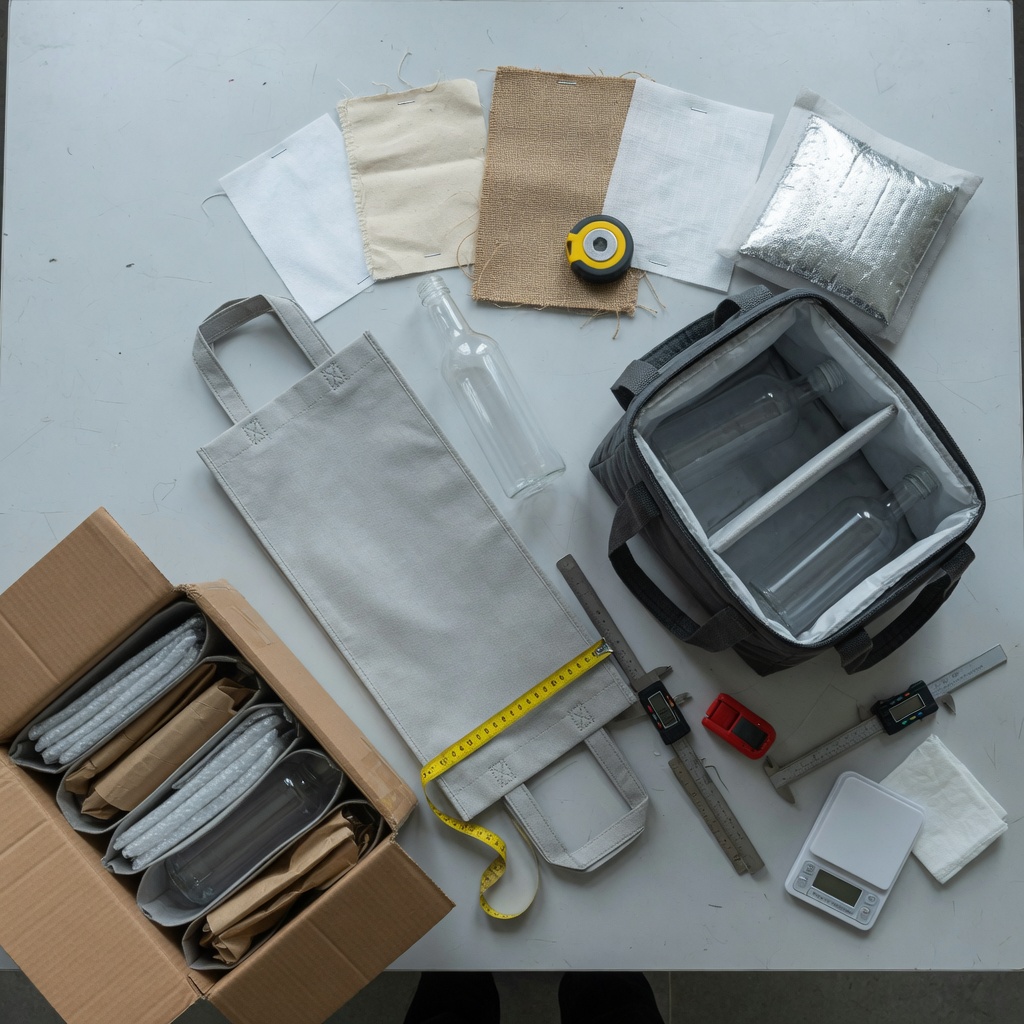
A supplier cannot return a comparable cost breakdown if the RFQ describes only a generic non-woven wine bag or insulated carrier. Freeze the following fields before comparing quotations.
| RFQ field | Buyer-controlled specification | Required supplier evidence | Cost control |
|---|---|---|---|
| Product identity | Product code, revision, revision date, intended use, and carrier layout | Signed specification and deviation schedule | Exclude quotations tied to obsolete or different revisions |
| Bottle format and fit | Physical bottle, accurate dummy, or dimensioned drawing; capacity in mL; maximum body diameter and overall height in mm; required clearance and neck exposure | Fit-check record, sample photographs, and signed finished-product drawing | Approve fit only against the buyer-selected bottle format |
| Finished dimensions | Finished width, height, gusset, handle drop, divider position, measurement points, sample condition, and buyer-selected tolerances | Measured sample results and proposed production tolerances | Do not substitute cut-panel dimensions for finished dimensions |
| Materials | Composition by layer, nominal basis weight in GSM where relevant, tolerance, color, coating, lamination, lining, insulation, insert, reinforcement, and handle material | Itemized bill of materials and requested material declarations | Price every proposed material change as a separate option |
| Construction | Seam or seal method, seam location, stitch or seal parameters, reinforcement pattern, handle attachment, bottom support, divider, closure, and edge finish | Construction sheet and representative physical sample | Tie bulk production to the approved construction revision |
| Branding | Print process, artwork dimensions, locations, orientation, color references, coverage, registration tolerance, and permitted visual variation | Recurring print price, setup charges, proof method, and branded-sample plan | Separate recurring print cost from setup and development charges |
| Samples | Development and preproduction stages, approval authority, freight responsibility, and required bulk equivalence | Cost, production method, dispatch trigger, and deviations from intended bulk production | Link the approved sample to the purchase-order revision |
| Quantity and MOQ | Target quantity, same-spec comparison tiers, variant mix, and permitted production variance | MOQ by total order and by applicable variant, plus tier pricing | Do not accept a lower tier price that changes product or packing scope |
| Packing | Fold method, inner packing, carton quantity, dimensions, weights, shipment volume, protection, pallet scope, and carton-mark inputs | Quotation-stage estimate and final production packout | Reprice logistics against final production data before booking |
| Change control | Prohibited substitutions and written-approval procedure | Signed no-substitution commitment and deviation log | No material, construction, branding, or packing change without approval |
Request every value-engineering proposal as a separate quote line. The supplier return should identify the exact material or construction change, recurring cost effect, nonrecurring charge, sample requirement, MOQ effect, packing effect, quality effect, and delivery effect. Hold all unrelated variables constant so the price change can be traced to the proposed option.
Allocate MOQ, Setup, and Quality Costs
Use the following allocation rule rather than hiding nonrecurring charges in the base price:
> Allocated nonrecurring cost per accepted unit = applicable nonrecurring charges for the order ÷ accepted units
Show initial-order and repeat-order results separately when a supplier states that a setup charge will not recur. The initial-order comparison should still include every charge applicable to that order.
For MOQ and variant control, require the supplier to state:
- Whether the minimum applies to the complete order or separately to each material, color, size, artwork, or construction.
- Whether mixed variants create separate minimums or surcharges.
- The permitted production overrun or underrun, with the percentage completed by the supplier in the quotation.
- Whether rejected units count toward the ordered quantity or pricing tier.
- Treatment and ownership of unused custom material.
- Whether repeat pricing depends on retained setup items or stocked material.
- Whether a quantity tier changes the product, inspection, packing, payment, or trade-term scope.
Quality costs also require a defined acceptance process. The RFQ should state lot identification, measurable requirements, defect descriptions, inspection timing, sampling method, report format, release authority, functional-test method where applicable, and responsibility for rework, replacement, reinspection, shortage, and replacement freight.
If the buyer selects an inspection or test standard, identify the method and edition in the RFQ. That reference establishes a requested contractual method only; it does not demonstrate that a supplier or CottonToMaker is certified or routinely follows it. Verify any certification claim with a current document that matches the product, facility, and claimed scope.
United States Landed Cost, Labeling, and Delivery Inputs
Import and labeling return package
Require the supplier to return the following as review inputs rather than final legal or customs determinations:
- Country of manufacture and material composition by layer.
- Proposed tariff description and classification.
- Draft commercial-invoice and packing-list descriptions.
- Proposed country-of-origin marking artwork and placement.
- Proposed product, inner-pack, and carton labels.
- Buyer-specific SKU, barcode, routing, lot, and carton-mark inputs where applicable.
- Final carton quantity, dimensions, gross weight, net weight, and shipment volume.
- Current, scope-matched evidence for any requested material, recycled-content, environmental, chemical, performance, or certification claim.
The United States importer of record, retained customs professional, or responsible compliance reviewer should verify the current classification, applicable import charges, marking treatment, and any product- or channel-specific labeling obligations before purchase-order release. Applicability should be assessed against the exact material, construction, claims, packaging, manufacturing origin, and distribution plan.
Keep import or legal marking inputs separate from buyer-specific warehouse, routing, barcode, and carton-label requirements. A supplier proposal should remain pending until the responsible reviewer accepts it for the actual order.
Landed-cost evidence controls
Record the source, currency, quote date, validity period, charge basis, inclusion status, and responsible reviewer for every external cost input. The comparison file should contain:
- A dated goods quotation tied to the signed specification revision.
- A dated inspection or testing quotation when those services are included.
- A quotation-stage packout estimate for preliminary transport pricing.
- Final production packout before transport booking.
- A dated freight offer showing origin, destination, mode, chargeable basis, and exclusions.
- Import and brokerage inputs reviewed for the exact product and manufacturing origin.
- Domestic-delivery scope tied to the named United States receiving point and its receiving conditions.
If final carton quantity, dimensions, weight, or shipment volume differs from the quotation-stage estimate, obtain updated freight and domestic-delivery costs before shipment approval. Record the variance instead of silently replacing the earlier cost input.
Where the parties choose an ICC Incoterms rule, the RFQ should record the rule, edition, and named place or port. This is a buyer-requested contract control, not a claim that CottonToMaker or any cited seller uses a particular rule, and it is not evidence of certification. The selected trade term does not replace product specifications, acceptance criteria, remedies, payment terms, insurance review, or import review.
Delivery return
Require a milestone schedule in which each stage has a trigger, endpoint, stated duration unit, responsible party, planned date, and completion evidence.
| Delivery stage | Required trigger | Completion evidence | Cost or schedule control |
|---|---|---|---|
| Development sample | Approved sample instruction and agreed commercial trigger | Dispatch record and received sample | Prevent undefined sample scope from delaying approval |
| Preproduction approval | Frozen specification, approved artwork, and agreed sample method | Signed approval linked to the active revision | Prevent bulk work against an obsolete revision |
| Material readiness | Approved specification and production trigger | Supplier readiness confirmation tied to the order | Route substitutions through written change control |
| Production completion | Agreed production trigger | Lot and quantity record | Distinguish produced, shipped, and accepted units |
| Inspection and corrective action | Agreed inspection stage | Inspection report and documented closure | Assign time and cost for rework or reinspection |
| Cargo release and transport | Passed acceptance process, final packout, and complete shipping documents | Cargo-ready notice and carrier milestones | Avoid booking against unsupported carton estimates |
| United States domestic delivery | Import release and final-delivery instruction | Delivery record for the named receiving point | Include appointments, handling, and receiving conditions where applicable |
The purchase order should state the agreed treatment of delays, substitutions, shortages, rejected goods, incomplete documents, and failed delivery. A schedule is not comparable unless its triggers, endpoints, and responsibility boundaries are defined.
Practical RFQ Checklist for United States Wine Bag Manufacturing
Copy this checklist into the RFQ and require a completed, signed return. Treat every unchecked line or blank response as pending rather than included.
Buyer completes before issuing the RFQ
- [ ] Attach the active product code, specification revision and date, finished-product drawing, bottle-fit reference, artwork, packing requirements, and requested quantity tiers.
- [ ] Define measurable materials, finished dimensions, construction, branding scope, sample stages, acceptance process, and prohibited substitutions.
- [ ] State the target quantity, variant mix, permitted production variance, required delivery date, and acceptance treatment for rejected or replacement units.
- [ ] Name the United States receiving point, receiving conditions, requested trade term with edition and named place, and the responsible import and labeling reviewer.
Supplier returns with the quotation
- [ ] Identify the quote currency, quote date, validity period, manufacturing location, product code, and specification revision.
- [ ] Return the base unit price by same-spec quantity tier, recurring option adders, nonrecurring charges, sample costs, quality costs, and initial-order versus repeat-order treatment.
- [ ] Return MOQ rules by total order and applicable variant, mixed-variant restrictions, surcharges, production variance, and treatment of unused custom material.
- [ ] Sign the bill of materials, finished-product drawing, no-substitution commitment, packing estimate, and deviation schedule.
- [ ] State the print process, artwork scope, setup treatment, sample method, bulk-equivalence status, quality plan, and responsibility for rework, replacement, reinspection, shortage, and replacement freight.
- [ ] Return carton quantity, dimensions, weights, shipment volume, origin charges, transport and insurance scope, import and brokerage inputs, domestic-delivery scope, and every exclusion.
- [ ] Return country of manufacture, proposed classification input, origin-marking proposal, product and carton-label proposals, and current evidence for each requested product or certification claim.
- [ ] Return a milestone schedule with triggers, endpoints, duration units, responsible parties, planned dates, and completion evidence.
Buyer verifies before award
- [ ] Normalize every offer to landed cost per accepted unit at the same United States receiving point.
- [ ] Confirm that every cost field is marked
included,excluded,quoted separately,buyer supplied,allowance, orpending. - [ ] Confirm that the approved physical sample is linked to the active bulk-production revision.
- [ ] Verify the selected trade term, import inputs, origin marking, and labeling proposals with the named responsible reviewer.
- [ ] Verify each requested certification or product claim using a current document that matches the product, facility, and claimed scope.
- [ ] Confirm that final production packout will trigger updated freight and domestic-delivery pricing when it differs from the quotation-stage estimate.
- [ ] Confirm that substitutions, rejection, rework, replacement, shortage, document, and delay remedies are written and signed.
Pause the award if the return contains a from price without a frozen specification, an MOQ with no total-order or variant basis, printing with no artwork scope, FOB pricing with no named port, freight based on packout that will not be reconfirmed, or import and labeling assumptions with no responsible United States reviewer.
Methodology, Limitations, and What to Verify
Methodology: The evidence review extracted only the price ranges, quantity or MOQ contexts, material and construction descriptions, print scope, basis-weight reference, and bottle-capacity reference stated in the available seller-page excerpts. Each retained data point is presented with its seller-specific scope and linked source. No average, midpoint, market-price estimate, or landed-cost projection was calculated because the cited product and commercial scopes differ.
The specification, cost-return, quality, import-review, delivery, checklist, and award controls are buyer-side RFQ methods. They are not claims that the cited sellers or CottonToMaker use those procedures.
Limitations: The cited product sources are commercial seller pages rather than a harmonized pricing dataset, and the available excerpts do not state publication dates. No current supplier quotation, signed product specification, physical sample, laboratory report, production inspection, freight booking, customs determination, duty calculation, or United States labeling assessment was available. The sources do not establish universal dimensions, common performance levels, standard packouts, complete trade-term scope, or current landed costs.
Author basis: The approved Vincent Xi author profile identifies Vincent Xi as an Editorial Author. It does not document first-hand factory visits, product tests, sourcing transactions, certification audits, client engagements, or buyer outcomes; this article makes no such claims.
Before purchase-order release, verify the signed specification revision, approved sample, bill of materials, finished dimensions and tolerances, bottle fit, branding scope, quantity and MOQ basis, recurring and nonrecurring charges, final packout, acceptance process, selected trade term and named location, country of manufacture, current import treatment, applicable labeling, delivery schedule, and remedies for nonconforming or delayed goods.
Discuss Your Requirements
Review our manufacturing capabilities, then share your specifications for a supplier-fit review.