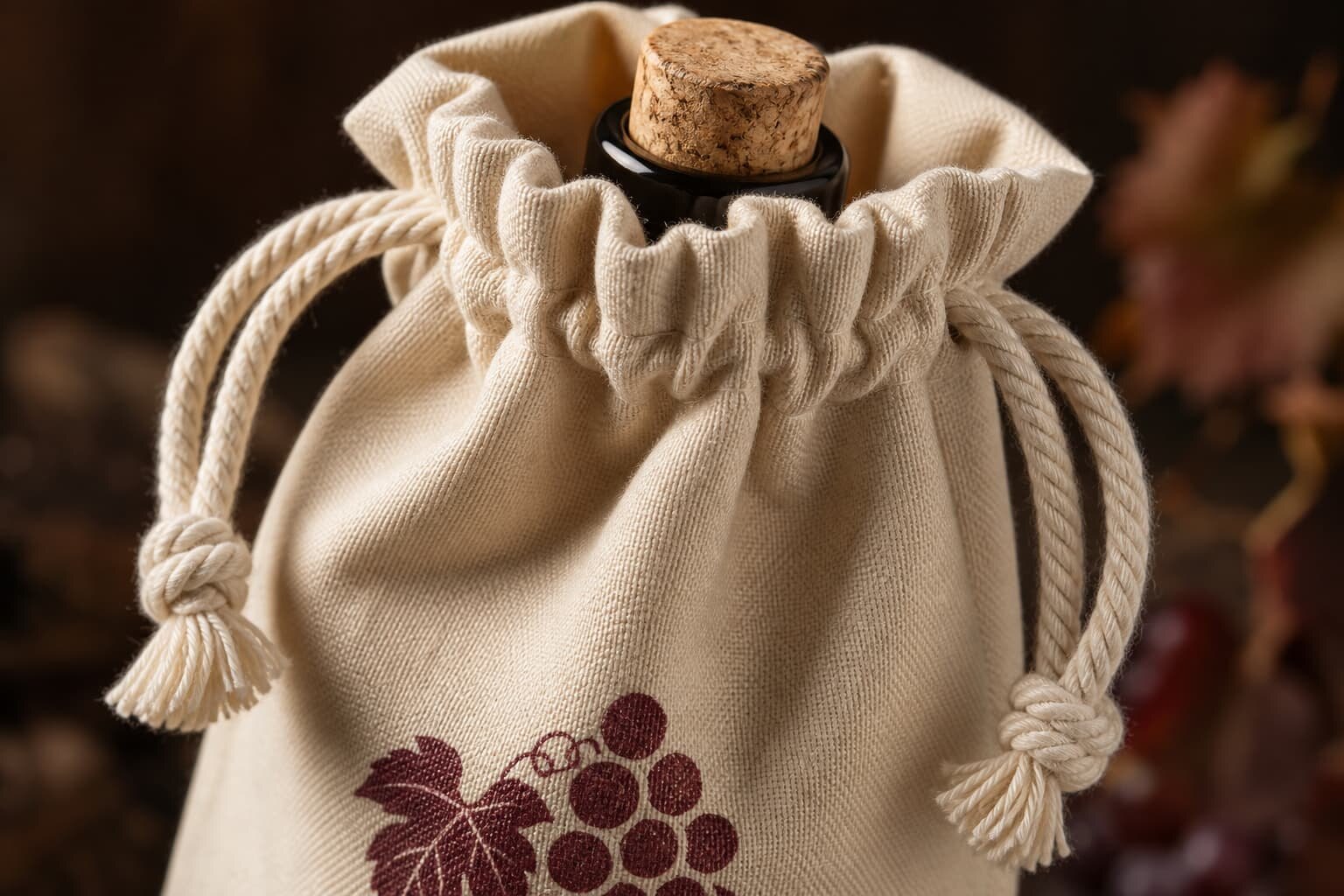
Why Logo Placement Fails on Wine Bags
Wine bag logo placement looks simple on a flat artwork file, but the finished product is not a flat poster. A bottle bag becomes narrow around the neck, round at the body, compressed near the bottom fold, and often gathered by a drawstring. If the logo is approved only on a flat rectangle, the production result can sit too high, disappear into the gathered top, or curve around the side where retail buyers cannot see it.
For bulk buyers, the common problem is not only bad printing. It is unclear position control. One supplier may center the logo on the cut fabric panel. Another may center it on the visible area after sewing. A third may print on finished bags and avoid the seams by eye. All three can quote the same bag size and logo size, but the shelf appearance will be different. Your RFQ should define the placement reference, logo method, fabric, and inspection tolerance before price comparison.
- Do not approve logo position from a loose flat bag only; review it with a real bottle inserted.
- Avoid using vague instructions such as center front or same as picture without millimeter measurements.
- Remember that drawcord bags lose visible height when tied, especially on soft cotton and jute.
- Check whether the supplier prints before sewing or after sewing because it changes registration accuracy.
- Treat logo placement as a production specification, not a design preference left for the factory to interpret.
Choose the Bag Construction Before Placing the Logo
The correct logo position depends first on the wine bag construction. A single-bottle drawstring pouch has a different safe print area than a two-bottle carrier with a stitched divider. A tote-style wine bag with handles may have a large front panel but also handle stitch boxes that limit the clean print zone. A jute wine bag often has a coarse weave and a thicker bottom fold, so small logos or low placement can look uneven.
For RFQs, include a simple product drawing or supplier template showing finished dimensions. Typical single-bottle wine bags are made around 150 x 350 mm, 160 x 360 mm, or similar sizes depending on bottle height and whether the neck is covered. Two-bottle carriers may need gussets from 80 to 100 mm and a central divider. Once these construction details are fixed, the factory can tell you the safe decoration window instead of guessing from the front view.
- Single-bottle drawstring cotton bag: keep front logos below the drawcord channel and above the curved bottle shoulder.
- Jute wine bag: use bolder artwork and leave more clearance from seams because weave and sewing thickness vary.
- Two-bottle carrier: check divider stitch location before confirming logo width.
- Tote-style wine carrier: avoid handle reinforcement stitch boxes and upper panel stress points.
- Insulated bottle bag: confirm whether decoration is possible before lamination or only on an outer fabric panel.
Set Logo Size and Position in Millimeters
A reliable wine bag logo placement guide should use fixed measurements. Give logo width and height in millimeters, then define the distance from a stable point. For a drawstring wine bag, the most useful reference is usually the top edge, the bottom of the drawcord channel, or the bottom fold. For a tote-style carrier, use the top edge of the front panel, handle opening, side seam, or bottom seam. Avoid references that change during use, such as the tied knot location.
A practical front logo for a single-bottle bag is often 70 to 90 mm wide. Larger logos can work on canvas or non-woven bags, but on narrow cotton or jute bags they can wrap toward the side seam and lose visibility. If the logo includes small text such as vintage, website, importer name, or legal copy, check the minimum readable letter height. On rough jute, small characters that print well on paper may break up badly.
- Use a placement note such as logo centerline 80 mm below bottom of drawcord channel.
- Set side clearance of at least 20 mm on narrow cotton bags and 25 to 30 mm on jute bags.
- Keep bottom clearance of at least 25 mm to avoid folding, carton pressure, and uneven sewing bulk.
- For two-color logos, ask whether both colors can hold registration within the required tolerance.
- For small text, request a printed strike-off before approving bulk production.
Match Print Method to Fabric and Brand Use
Logo method affects both appearance and placement tolerance. Screen print is common for cotton, canvas, jute, and non-woven wine bags when the artwork has solid colors and the order quantity supports screen setup. Heat transfer can handle gradients or detailed artwork, but buyers must check hand feel, edge durability, and heat marks on dark or textured fabric. Digital print can be useful for short runs or colorful designs, but color consistency and fabric pretreatment should be confirmed.
Embroidery gives a premium look on thicker canvas, but it is not always suitable for narrow drawstring wine bags. Dense stitches can pucker light 5 oz cotton and distort the panel. Woven labels or sewn patches are good when the same bag carries changing seasonal inserts or when the brand wants a smaller, quieter logo. For leather or PU patches, clarify whether the logo is debossed, printed, or laser marked and whether the patch is sewn before or after bag assembly.
- Screen print: best for simple one to three color logos on cotton, canvas, jute, and non-woven bags.
- Heat transfer: useful for fine detail, but inspect edge lift, shine, and wash or rub performance.
- Digital print: flexible for color artwork, but confirm MOQ, pretreatment, and repeat color control.
- Embroidery: stronger on 10 to 12 oz canvas than on light cotton pouches.
- Woven label: practical for small brand marks and better MOQ control across multiple bag colors.
Fabric Weight Changes the Decoration Decision
Fabric weight is not only a cost item. It changes how the logo prints, how the bag hangs with a bottle inside, and how much distortion appears around the artwork. A light 5 oz cotton wine bag may be economical for promotions, but it can wrinkle through the logo and show more transparency. A 6 to 8 oz cotton bag gives better print stability for many wine club, retail, and gifting programs. Canvas around 10 to 12 oz supports embroidery and larger prints, but the higher fabric cost and sewing thickness should be reflected in the quote.
Jute is usually discussed by GSM rather than ounces, and buyers should ask whether the quoted jute is laminated or unlaminated. Coarser jute can create a broken edge on small letters. Laminated jute gives a smoother printing surface, but it changes the hand feel and recyclability discussion. Non-woven PP wine bags may be quoted around 80 to 120 GSM depending on target price and stiffness; logo placement is usually easier, but heat and print adhesion need checking.
- 5 oz cotton: budget-friendly, suitable for simple logos, but check wrinkles and show-through.
- 6 to 8 oz cotton: safer for standard screen print and reusable gifting bags.
- 10 to 12 oz canvas: better for embroidery, premium carriers, and heavier two-bottle formats.
- Natural jute: attractive texture, but requires bolder artwork and wider placement tolerance.
- 80 to 120 GSM non-woven PP: cost-efficient for promotions, but confirm heat transfer and ink adhesion.
MOQ Logic for Logo Placement and Artwork Versions
MOQ is often driven by material purchase, dyeing, cutting efficiency, print setup, and carton packing, not only by sewing capacity. A simple one-color screen print on natural cotton may support a lower MOQ than a full-color all-over print or embroidery on multiple bag colors. If your order has several wine brands, flavors, or seasonal artwork versions, ask whether the MOQ applies per bag style, per fabric color, per logo design, or per print color.
Logo placement also affects MOQ when the factory needs fixtures, screens, or jigs. Printing on finished bags may allow smaller quantities, but placement can vary more because seams and drawcords interfere with flat printing. Printing on cut panels before sewing usually improves print quality and speed, but it requires tighter production planning and may create more wastage if artwork changes late. For importers comparing quotes, a lower MOQ is not automatically better if it increases placement variation or sample risk.
- Ask for MOQ by decoration method, not only by bag style.
- Confirm whether multiple logo versions can share the same fabric lot and sewing line.
- Check screen charge per color and per artwork size.
- For all-over or panel printing, ask about cutting loss and extra fabric percentage.
- If the order is split by destinations, confirm whether each carton mark and packing method affects MOQ.
Sample Approval: What Buyers Should Actually Check
A wine bag sample should be evaluated in the same condition as use. Insert the target bottle or a bottle with the same diameter and shoulder height. Tie the drawstring if that is how consumers will receive it. Stand the bag on a table and look at it from normal retail viewing distance. Many placement problems appear only after the bottle pushes the fabric outward or the top gathers around the neck.
Do not approve only the print color and forget the position. Measure the logo from the agreed reference points and record the sample result in the approval file. If the sample is made from substitute fabric, mark the approval as construction and placement only, not final color or print texture. For repeat orders, keep a sealed reference sample or detailed photos with a ruler so the next production batch does not drift.
- Check the logo with an actual bottle inserted, not just an empty flat bag.
- Photograph front, side, back, bottom, and tied-top views for the approval record.
- Measure logo width, height, top distance, side distance, and bottom clearance.
- Rub the print lightly by hand to check curing, transfer, or surface tackiness.
- Fold one sample as packed to see whether the fold crosses the logo.
Packing Details That Protect the Logo
Packing can damage a good logo after production is finished. Fresh screen print needs enough curing time before stacking. Heat transfer logos can mark if bags are packed face to face under pressure. Jute and canvas textures can rub printed surfaces during inland transport if the carton is overfilled. If the logo is dark on natural fabric, scuffing or lint marks may be visible when retail buyers unpack the goods.
Specify whether bags are bulk packed, bundled, individually polybagged, or packed with tissue between printed faces. For sustainable programs, buyers may avoid individual polybags, but then carton arrangement becomes more important. If wine bags are folded, ask where the fold line sits. A fold through the logo can create creasing, especially on heat transfer or heavy ink layers. Carton size, quantity per carton, gross weight, moisture protection, and shipping marks should be part of the quotation.
- Avoid folding directly across large printed logos when possible.
- Use face-to-back stacking or protective paper for sensitive print surfaces.
- Confirm ink curing time before bulk packing and carton closing.
- Keep carton weight practical so bottom layers are not crushed during transport.
- For jute bags, discuss moisture control because odor and mildew complaints can override logo quality.
Quote Data Needed for Fair Supplier Comparison
Two wine bag quotes can look similar while covering different products. One may include 6 oz cotton, one-color screen print, bulk packing, and a loose placement tolerance. Another may include 8 oz cotton, a pre-production sample, individual packing, and controlled logo measurement. Procurement teams should request quote data in a format that separates bag cost, decoration cost, setup cost, sample cost, packing cost, and lead time. This makes negotiations more practical and reduces later change charges.
Ask suppliers to confirm the decoration process in writing. The quote should state whether the logo is printed before sewing or after sewing, what Pantone or color reference is used, what artwork file is required, what tolerance is offered, and what defects are not acceptable. If the supplier cannot define the safe print area or placement tolerance, the buyer should treat the quotation as incomplete, even if the unit price is attractive.
- Bag specification: material, GSM or ounce weight, finished size, gusset, drawcord, handle, and stitching.
- Logo specification: method, size, color count, position, artwork file, and Pantone reference.
- Commercial terms: MOQ, sample charge, screen charge, unit price, packing cost, and validity period.
- Timeline: artwork proof, sample making, sample transit, material booking, production, inspection, and shipment.
- Inspection basis: approved sample, tolerance sheet, AQL level if used, and photo reporting requirements.
Acceptance Criteria for Bulk Inspection
Inspection should not rely on subjective comments such as logo looks centered. Define measurable acceptance criteria before production starts. For many wine bag orders, a placement tolerance of plus or minus 5 mm from the approved sample may be realistic for screen print on cut panels. Finished-bag printing, jute fabric, side labels, and hand-positioned patches may need a wider tolerance. The important point is to agree before shipment, not after defects are found.
Separate critical, major, and minor logo issues. A missing logo, wrong artwork, upside-down print, or logo hidden by sewing is normally a serious defect. Slight position variation within the agreed tolerance may be acceptable. Small ink pinholes on rough jute may be acceptable if they do not affect brand recognition, while the same pinholes on a clean white cotton bag for retail shelves may not be acceptable. Tie the standard to the order purpose and sales channel.
- Critical defects: wrong logo, wrong position side, missing print, inverted artwork, or unsafe contamination.
- Major defects: logo outside tolerance, heavy smearing, color clearly off approval, or print crossing seam.
- Minor defects: small texture-related ink gaps within agreed limit and not visible at normal viewing distance.
- Measurement method: use the same reference points shown on the approved placement sheet.
- Sampling: inspect both early cartons and later cartons because placement can drift during long production runs.
Specification comparison for buyers
| Spec decision | Recommended option | When it fits | Buyer risk to check |
|---|---|---|---|
| Front center logo on single-bottle cotton wine bag | Logo width 70-90 mm, placed 70-90 mm below drawcord channel on 6-8 oz cotton | Best for retail gifting, wine clubs, hotel welcome packs, and simple brand recall | Logo may sit too high and be partly hidden when the neck gathers; confirm filled-bottle photo sample |
| Lower front logo on jute wine bag | Logo width 80-110 mm, placed above bottom fold with at least 25 mm seam clearance | Useful when the wine label must remain visible above the bag opening or when logo needs a rustic look | Coarse jute weave can break fine letters; avoid small text and request print strike-off on actual jute |
| Vertical side logo or side woven label | Side label 25-45 mm wide or vertical print under 120 mm tall, kept away from gusset fold | Works for premium minimalist branding, distributor private label, or when front artwork changes by SKU | Side seam tolerance can shift label position; set acceptable left-right variation in inspection criteria |
| Two-bottle carrier front panel logo | Logo centered on the outer panel, 90-130 mm wide, below handle cutout or drawstring line | Suitable for winery gift sets, liquor store promotions, and corporate hamper programs | Divider stitching and handle reinforcement reduce print area; request flat artwork template before approval |
| All-over print background with small logo | Use rotary, digital, or cut-panel print before sewing; keep logo away from seams and bottom folds | Good for seasonal retail packaging where pattern sells more than a single large logo | Panel matching and MOQ are higher; check whether quote includes print setup, wastage, and cutting loss |
| Embroidery on canvas wine carrier | Simple logo under 80 mm wide on 10-12 oz canvas, placed before final assembly where possible | Fits premium reusable carriers, clubs, and corporate gift bags with longer service life | Dense embroidery can pucker fabric and slow production; approve thread count, backing, and wash appearance |
Buyer checklist before sampling
- Define bag type first: single-bottle drawstring, tote-style wine carrier, two-bottle carrier, jute wine bag, non-woven wine bag, or insulated bottle bag.
- Provide finished bag size, gusset depth, bottle diameter, and whether the bottle neck should be exposed or covered.
- Mark logo placement from fixed reference points such as top edge, drawcord channel, side seam, bottom fold, or handle opening.
- State logo size in millimeters, not only as a percentage of the bag front.
- Confirm fabric weight and color before judging print method, especially natural cotton, jute, dyed canvas, and laminated jute.
- Specify print method preference and acceptable alternatives: screen print, heat transfer, digital print, embroidery, woven label, leather patch, or debossed patch.
- Keep artwork at least 20-30 mm from seams, bottom folds, drawcord exits, handle stitch boxes, and divider stitching.
- Request a pre-production sample with an actual bottle inserted and photographed from front, side, and packed-carton condition.
- Set logo placement tolerance, color tolerance, and print defect acceptance criteria before mass production.
- Ask the supplier to quote setup charge, sample charge, MOQ by logo method, lead time, carton packing, and extra cost for individual polybags or hangtags.
Factory quote questions to send
- What is the maximum safe logo area for this exact wine bag pattern after sewing, including seam and drawcord clearance?
- Will the logo be printed on cut panels before sewing or on finished bags after sewing, and how does that affect placement tolerance?
- What fabric GSM or ounce weight are you quoting, and has this print method been tested on that fabric color and texture?
- For my artwork, do you recommend screen print, heat transfer, digital print, embroidery, woven label, or patch, and why?
- What is the MOQ for this logo method and how does MOQ change if I have multiple artwork versions or bottle bag colors?
- What artwork file format, Pantone references, line thickness, and minimum letter height do you need for production?
- Can you provide a printed strike-off or full sample before bulk approval, and will it use actual bulk fabric?
- What placement tolerance will you guarantee in mass production, for example plus or minus 5 mm from approved sample?
- How will bags be packed to prevent logo rubbing, transfer marks, folding across the print, or carton compression?
- What are the quoted lead times for artwork proof, sample, material booking, mass production, inspection, and export packing?
Quality-control points to confirm
- Measure logo placement from the same reference point used on the approved artwork sheet, not by visual centering only.
- Check filled-bottle appearance because drawstrings, gussets, and fabric tension can move the logo after the bag is loaded.
- Compare print color against approved strike-off under consistent light, allowing for fabric base color influence.
- Inspect for ink bleeding, pinholes, uneven pressure, heat press shine, embroidery puckering, loose label stitching, and adhesive edge lift.
- Confirm the logo is not cut into the seam allowance, hidden under handle stitching, distorted by bottom folding, or blocked by the bottle neck.
- Open cartons after packing trial to check logo rubbing, print offset, fabric creasing through the logo, moisture risk, and individual bag orientation.
- Record defects by bag type and logo method so acceptance decisions are based on commercial risk, not only defect count.