1. The buying problem: similar zipper business bags can hide very different specs
A zipper business bag looks simple in a catalog photo: flat shape, front logo, handle, zipper, maybe a laptop pocket. In wholesale production, the cost difference is usually hidden in details that are not visible from the first image. A supplier quoting 280 GSM polyester with a No. 3 zipper and no padding is not comparable with a supplier quoting 12 oz cotton canvas, No. 5 zipper, lining, foam, reinforced handles, and individual packing.
This wholesale zipper business bags supplier checklist 02 is designed for buyers who need quote accuracy before placing an order. The aim is not to over-specify every small point, but to define the details that change price, production risk, and customer complaints. If your RFQ only says 'zipper business bag with logo, size A4, 5,000 pcs,' you will receive fast prices, but they will not be equal prices.
- The fabric choice controls hand feel, strength, print result, and freight weight.
- The zipper grade controls daily usability and complaint rate more than many buyers expect.
- The lining and padding change both cost and the true internal size.
- The packing method affects presentation, carton size, and sea or air freight cost.
- The supplier quote must show what is included, otherwise the lowest unit price may become the most expensive landed cost.
2. Start the RFQ by naming the exact bag function
Many quote problems begin because the buyer uses one name for several different products. A zipper document bag, a laptop sleeve with handles, a conference portfolio bag, and a multi-pocket business bag are not the same factory build. They may share a zipper, but the pattern, material consumption, sewing time, and inspection points differ.
Before discussing price, define the intended use in plain language. Will the end user carry paper documents only, or a laptop and charger? Will the bag be used once at an event, or sold as a retail accessory? Will it be packed inside a welcome kit, shipped through ecommerce, or displayed in a store? This information helps the supplier avoid quoting a bag that is too light or too expensive for the channel.
- For document use: specify A4, legal size, catalog thickness, and whether the zipper opening must allow easy insertion.
- For laptop use: specify laptop screen size plus actual device dimensions, because a 14 inch laptop can vary by brand.
- For conference kits: specify expected content weight, such as notebooks, pens, brochures, charging cable, or samples.
- For retail: specify hangtag, barcode, dust protection, carton presentation, and whether creasing is acceptable.
- For distributor stock: specify whether one neutral bag will carry multiple logos or if each SKU needs separate packing.
3. Fabric GSM and construction: do not compare only material names
The words cotton, canvas, polyester, RPET, and nylon are not enough for a reliable quotation. A cotton canvas zipper business bag can be made from 8 oz, 10 oz, 12 oz, or heavier fabric. Polyester canvas may be 280 GSM, 320 GSM, 380 GSM, or coated. Non-woven or lighter promotional fabrics may be cheaper, but they change the appearance and durability completely.
For business bags, fabric stiffness matters because flat bags show wrinkles and seam waves easily. A very light fabric can look weak after packing. A very heavy canvas improves structure but raises sewing difficulty, zipper stress, carton weight, and freight cost. Ask your supplier to quote a recommended standard option and one upgrade option so your team can compare value instead of only chasing the lowest line.
- Common economical option: 280-320 GSM polyester canvas for promotional document zipper bags.
- Common mid-range option: 10-12 oz cotton canvas for a natural, retail-friendly business bag.
- More structured option: 380 GSM polyester canvas or 14 oz cotton canvas, used when the bag must stand better or carry more weight.
- Lining option: 190T polyester for basic lining, 210D polyester for stronger lining, or cotton lining for a premium natural build.
- Color control: give Pantone reference for dyed fabric, or request available stock colors to reduce MOQ and lead time.
4. Zipper specification: the small component that creates big complaints
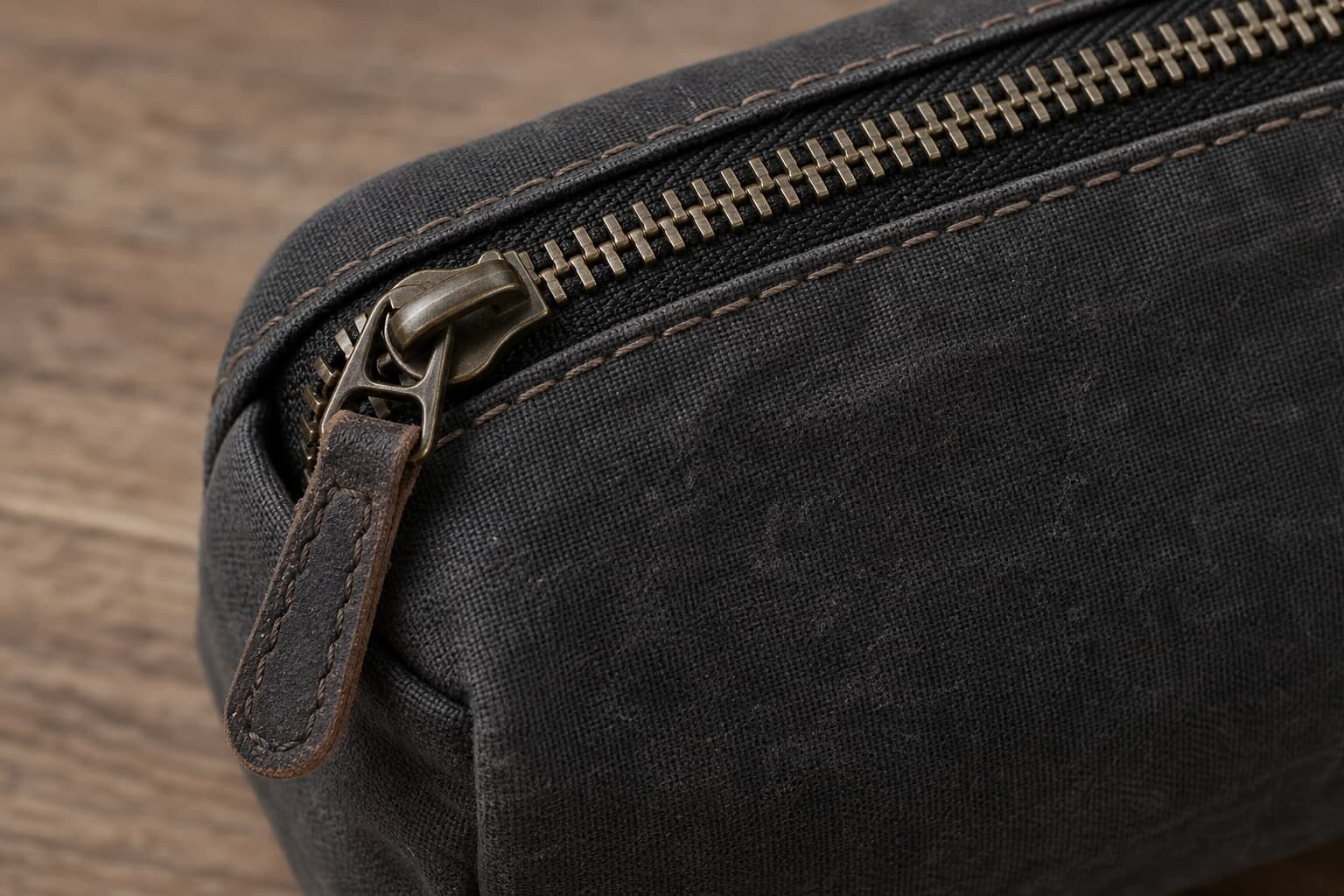
A zipper business bag is judged every time the user opens it. If the zipper catches, waves, separates, or feels too weak, the whole bag feels cheap. For most document and office bags, a No. 5 nylon coil zipper is a practical standard. No. 3 can be acceptable for very light pouches, but it is often too small for business bags with handles or padding. No. 8 may be used for larger laptop brief bags, but it increases cost and can look bulky on a slim product.
Do not leave the zipper as 'good quality zipper' in the RFQ. Define zipper type, tape color, teeth color, puller style, zipper length, and opening direction. Also check whether the quote includes a standard puller, metal puller, rubber puller, or custom logo puller. A branded puller may need a mold charge and a higher MOQ, while a standard metal puller can still look clean and professional.
- Ask whether the zipper is nylon coil, plastic tooth, or metal; nylon coil is usually smoother for flat business bags.
- Confirm zipper tape color because off-color tape is very visible on black, navy, natural, and grey bags.
- Check zipper end reinforcement, especially where the user pulls hard at the corner.
- Ask for zipper opening length, not only total bag width, because a short opening can make document insertion difficult.
- For laptop bags, test zipper movement with the laptop inside, not only on an empty sample.
5. Size, padding, lining, and internal capacity must be checked together
Finished external size does not equal usable internal size. Seam allowance, padding, lining, zipper tape, and corner radius all reduce the space inside the bag. A buyer may request 390 x 290 mm for a laptop sleeve and later find that the laptop fits tightly or scratches against the zipper. The supplier should confirm both finished size and internal usable size after the sample is sewn.
Padding is another common quote gap. A factory may interpret 'padded' as a thin interlining, 2 mm foam, 3 mm foam, or 5 mm foam. Each option changes cost, sewing tension, bulk thickness, and carton volume. If the bag is only for documents, padding may be unnecessary. If the bag is sold as a laptop bag, padding becomes part of the promise to the end user and should be defined clearly.
- For document bags, allow enough zipper opening so papers slide in without bending corners.
- For laptop sleeves, provide real device dimensions and charger/accessory requirement if applicable.
- For 3 mm foam padding, check whether the bag remains flat after sewing and packing.
- For 5 mm foam padding, check zipper tension and carton volume before approving bulk production.
- For lining, confirm whether internal seams are bound, overlocked, or hidden between layers.
6. Printing and branding: quote by artwork, not by the word logo
Branding cost on zipper business bags depends on the artwork size, color count, print method, material surface, and placement. A one-color screen print on a flat front panel is usually straightforward. A large multi-color logo near a zipper seam is not. A heat transfer can handle gradients and small details, but the hand feel and durability may differ from screen print. Embroidery can look premium but may pull light fabric and add cost.
Send vector artwork and state the exact print area in millimeters. Also define the distance from zipper, seam, bottom edge, and handle. If the bag has a front pocket, confirm whether the logo is printed before pocket sewing or after assembly. Printing after sewing may be limited by seams and zipper height; printing before sewing needs accurate cutting and alignment control.
- Screen print: good for solid logos, cost-effective at volume, needs color and curing control.
- Heat transfer: useful for gradients, small text, or multi-color art, but check edge adhesion and wash/rub requirement.
- Embroidery: suitable for premium fabric bags, but not ideal for very thin panels or large dense logos.
- Woven label: stable for repeated programs and small brand marks, but needs label MOQ and lead time.
- Debossed or embossed patch: possible on PU or leatherette patches, not directly on normal cotton canvas.
7. MOQ logic: separate fabric MOQ from logo MOQ and packing MOQ
A supplier's MOQ is rarely one simple number. It may be driven by fabric dyeing, stock fabric availability, zipper color, lining color, print setup, woven label production, or packing material. If you ask for 1,000 pcs in five colors, the real production difficulty may be higher than 5,000 pcs in one color. This is why two suppliers can give very different MOQ answers while both are technically correct.
For better purchasing control, ask the factory to explain MOQ by component. Stock fabric colors can reduce MOQ and lead time, while custom dyed fabric may require a larger minimum. Standard zipper colors are easier than custom zipper tape. A single print design is simpler than multiple brand logos. Retail packing with printed insert cards or barcodes may create separate material minimums.
- Ask for MOQ per fabric color and whether stock fabric is available.
- Ask for MOQ per zipper tape color if it must match the bag.
- Ask for MOQ per logo design, especially if distributors need different brand prints.
- Ask for MOQ per woven label or custom puller if those components are branded.
- Ask whether mixed colors can share the same print setup or require separate setup charges.
8. Sample approval: check the sample like a production document, not a souvenir
A pre-production sample should lock the specification before bulk cutting. Many buyers approve a sample by general appearance and later discover that size, zipper opening, handle drop, fabric weight, or logo position was never recorded. Treat the sample as a physical contract. Mark every approved detail in a sample comment sheet and keep supplier photos, measurements, and material notes together.
For zipper business bags, sample inspection should include practical use. Put the intended document stack or laptop inside. Open and close the zipper several times. Carry the bag with weight. Check the logo under normal light. Look inside for loose threads and seam ends. Then review packing, because a good bag can arrive looking poor if it is folded badly or packed too tightly.
- Measure finished width, height, gusset if any, handle drop, pocket size, zipper opening, and logo placement.
- Check fabric GSM or compare with the approved material swatch attached to the sample record.
- Run the zipper at least 20 times during sample review to feel catching, waviness, or weak puller connection.
- Load the bag with a realistic weight and inspect handle stitches afterward.
- Confirm that print color and position match artwork, not only that the logo is generally visible.
- Approve packing style with one packed sample if retail or ecommerce presentation matters.
9. Packing, carton data, and freight: flat bags still need packing control
Zipper business bags are often packed flat, but that does not mean packing is automatic. Cotton canvas may crease, coated polyester may mark, and padded laptop sleeves can deform if over-compressed. If the product is for retail, a poor fold line through the logo can create a rejection even when sewing quality is acceptable. Define whether each bag is flat packed, folded once, inserted in a polybag, tied with a paper band, or packed with a hangtag.
Carton data should be requested before purchase order confirmation, not after production. Carton quantity, carton size, gross weight, and net weight affect freight quotations and warehouse planning. Air freight may penalize bulky padded bags by volume weight. Sea freight buyers still need carton strength and moisture control, especially for cotton canvas or jute blend accessories shipped in humid seasons.
- For promotional distribution, bulk packing may be acceptable if bags do not rub or wrinkle heavily.
- For retail, individual polybag, paper band, barcode sticker, or hangtag may be needed.
- For cotton canvas, consider moisture protection and avoid packing before print is fully cured.
- For dark bags, check rubbing marks caused by zipper pullers or metal accessories during transit.
- Ask the supplier to confirm carton markings, SKU labels, country of origin marking, and any retailer-specific label format.
10. Quote comparison: build a landed-cost view, not a unit-price contest
A useful supplier quote should be broken into parts. Unit bag cost is only one line. Buyers should also see branding cost, sample cost, setup cost, packing cost, inspection readiness, carton data, and lead time assumptions. If one supplier includes individual packing and another quotes bulk packing, the unit prices are not comparable. If one supplier quotes 12 oz canvas and another quotes 10 oz canvas, the difference may be reasonable rather than expensive.
When comparing quotes, create a column for each production decision that affects cost or risk. Mark unknown items as not quoted instead of assuming they are included. This method protects your team from approving a low price that later receives add-on charges after artwork, packing, or sample review. A clear quote also helps distributors and retail buyers explain pricing internally without going back to the factory for every detail.
- Compare fabric by GSM or oz, not only by material name.
- Compare zipper number, type, puller, and tape color.
- Compare lining and padding thickness as separate lines.
- Compare branding by method, size, color count, and setup charges.
- Compare MOQ by SKU, color, and logo version.
- Compare packing by unit presentation and carton data.
- Compare lead time from approved sample and material readiness, not only from deposit date.
Specification comparison for buyers
| Spec decision | Recommended option | When it fits | Buyer risk to check |
|---|---|---|---|
| Outer fabric weight | 12 oz cotton canvas or 320-380 GSM polyester canvas | Standard document bags, conference bags, light laptop folders, corporate giveaways that need structure without high freight weight | Suppliers may quote lower GSM to win price; request GSM tolerance and a cutting swatch from bulk fabric |
| Zipper type | No. 5 nylon coil zipper with metal or molded puller | Most business bags, flat document bags, A4 file bags, and simple laptop sleeves | Cheap zipper tape can wave after sewing; test opening force and check whether zipper length includes end stops |
| Laptop protection | 3-5 mm foam padding plus 190T or 210D lining | When the bag is sold as a laptop or tablet business bag, not only a document pouch | Padding thickness affects sewing tension, carton size, and unit weight; confirm finished internal laptop size |
| Handle construction | Self-fabric handles with reinforced cross stitch or 2.5-3.8 cm webbing handles | Trade show bags, document carriers, staff kits, and reseller stock that must carry catalogs or electronics | Handle drop and stitch area are often missed in quotes; define load test and reinforcement patch |
| Branding method | Screen print for simple logos, heat transfer for gradients, woven label for premium small branding | Corporate branding, distributor inventory, retail-ready stock, or promotional programs | Print cost depends on artwork size, color count, and placement; ask for print plate, setup, and bulk tolerance |
| MOQ logic | Base MOQ by fabric color and zipper color, then by print design | Importers managing multiple SKUs or mixed brand orders | A low MOQ quote may hide fabric surcharge, zipper dye surcharge, or separate setup charges |
| Packing method | Individual polybag or paper band, then export carton with moisture control if needed | Retail buyers, distributors, and ecommerce replenishment orders | Flat bags can crease; carton dimensions and packing direction affect presentation and freight cost |
Buyer checklist before sampling
- Define the business bag type: A4 document zipper bag, laptop sleeve, conference portfolio, or multi-pocket zipper brief bag.
- Confirm finished external size and usable internal size after seam allowance, lining, padding, and zipper opening.
- Specify outer fabric by material, GSM or oz, yarn/texture if relevant, color standard, and shrinkage or colorfastness expectation.
- State zipper number, zipper material, tape color, puller style, opening direction, and whether a branded puller is required.
- Confirm handle type, handle drop, webbing width, reinforcement stitching, and expected carrying load.
- List lining fabric, padding thickness, interlining, binding, and internal pocket requirements instead of writing only 'with lining'.
- Send artwork with print size, color count, Pantone references, placement distance from seams, and whether the logo crosses a pocket or zipper.
- Ask suppliers to separate unit bag cost, print cost, sample cost, mold or plate cost, packing cost, and inland freight to port if applicable.
- Request sample approval criteria: finished size tolerance, zipper function, print position tolerance, seam strength, packing presentation, and smell/moisture check.
- Confirm MOQ by fabric color, zipper color, print design, and packing version before comparing quotes.
Factory quote questions to send
- What exact outer fabric are you quoting: material, GSM or oz, construction, color standard, and tolerance?
- Is the zipper No. 3, No. 5, or No. 8, and is it nylon coil, plastic tooth, or metal? What zipper brand or grade is included?
- What is the finished external size and the usable internal size after lining, padding, and zipper opening?
- What lining and padding are included in the price, and can you quote an option with thicker foam or no padding?
- How is the handle reinforced: box stitch, cross stitch, bar tack, backing patch, or binding reinforcement?
- Which branding method are you quoting, and what logo size, color count, and placement are included?
- Are print setup, screen charge, heat transfer film, woven label setup, or zipper puller mold charges included or separate?
- What is the MOQ by fabric color, zipper color, logo design, and packing method?
- Can you provide pre-production sample photos and a physical sample before bulk cutting?
- What are the carton dimensions, pieces per carton, gross weight, and recommended loading method for sea or air freight?
Quality-control points to confirm
- Finished size tolerance checked on at least length, height, gusset if any, handle drop, and zipper opening length.
- Fabric GSM verified against approved sample and purchase specification, not only judged by hand feel.
- Zipper runs smoothly across the full opening without wave, broken teeth, skipped stitching, or loose end stops.
- Print color, size, registration, curing, and position checked against approved artwork and production sample.
- Handle strength checked with realistic static load and seam inspection after load, especially near zipper ends.
- Padding and lining kept flat without trapped threads, puckering, twisting, or sharp internal seam edges.
- Corners and zipper ends reinforced where stress occurs during daily office use.
- Each bag checked for stains, oil marks, fabric slubs beyond approved standard, loose threads, odor, and moisture.
- Packing checked for correct SKU label, barcode if required, bag orientation, carton mark, quantity, and carton strength.
- Final inspection photos include front, back, inside, zipper close-up, logo close-up, handle stitching, packed unit, and master carton.