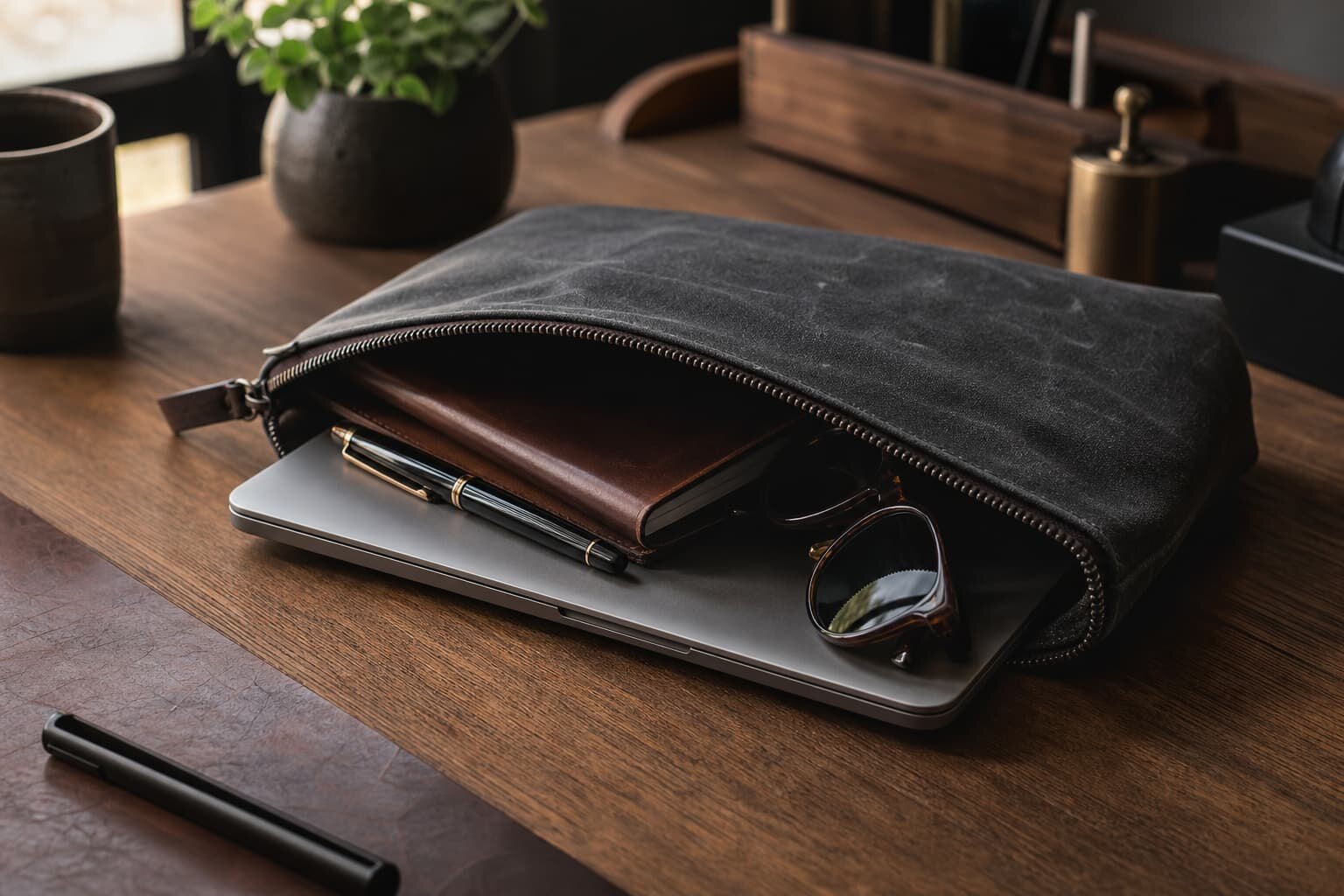
1. The buying problem: samples look fine until bulk production changes the details
A zipper business bag is usually judged by buyers as a simple promotional or office product. In production, it is not simple. The bag combines fabric stiffness, zipper sewing, handle strength, logo placement, lining, and packing shape. A small change in fabric weight, zipper tape, or folding method can make the bulk order look cheaper than the approved sample. This is why a sample review should not be limited to checking whether the logo is correct.
For wholesale zipper business bags, the main sourcing risk is not one dramatic defect. It is a chain of small downgrades: 420D fabric quoted instead of 600D, No.3 zipper used where No.5 was expected, thin webbing handles, weak stitching, oversized polybags, or cartons packed so tightly that the front panels crease. Procurement teams should use the sample stage to lock these points before price comparison. A lower quote is only useful if it includes the same construction.
- Review the sample as a production contract, not only as a presentation piece.
- Compare supplier quotes line by line against the approved sample specifications.
- Ask the factory to state what is included and what is excluded from the quoted price.
- Do not approve bulk production until zipper, fabric, logo, handle, and packing details are written.
2. Start with the real use case before choosing fabric weight
Fabric selection should come from the weight and shape of the contents. A bag for conference papers can use lighter construction than a bag intended for catalogs, a tablet, and sales samples. If the bag must stand neatly in retail photos or on a trade show table, stiffness matters. If the bag is mainly a low-cost document carrier, the buyer may accept lighter fabric but should still control zipper quality and handle strength.
Common options for zipper business bags include 600D polyester, 300D or 420D polyester for budget orders, 12 oz cotton canvas, 14 oz canvas, and sometimes non-woven laminated material for very low-cost campaigns. For business-style zipper bags, 600D polyester is often a practical balance: it has structure, accepts printing, and is easier to clean. Canvas gives a more natural retail feel but may have shade variation, shrinkage, and higher freight weight.
- 300D to 420D polyester: cost-sensitive document bags, lower structure, lighter handfeel.
- 600D polyester: stronger general-purpose option for distributor, corporate, and event orders.
- 12 oz canvas: natural fabric appearance, suitable for premium promotional and retail programs.
- 14 oz canvas: heavier and more structured, but increases unit cost, sewing difficulty, and shipping weight.
- Ask for GSM, denier, coating, and color standard instead of writing only polyester or canvas in the RFQ.
3. Zipper specification is where many cheap quotes hide the difference
The zipper is the functional part buyers notice first. A business bag with a rough zipper feels low grade even if the fabric is acceptable. For most document-size zipper business bags, a No.5 nylon zipper is a sensible baseline. Larger bags with heavier contents may need No.8. Metal zippers can look premium but add cost, weight, and sometimes scratch risk. Plastic molded zippers are strong, but less flexible around corners.
During sample review, do not only pull the zipper once. Open and close it repeatedly while the bag is empty and while loaded. Check whether the slider catches at corners, whether the zipper tape waves after sewing, and whether both ends are properly secured. If the factory changes zipper supplier after sample approval, bulk consistency can change. The zipper size, tape color, slider finish, puller shape, and end stop method should be written into the order.
- Use No.5 nylon zipper as a typical baseline for standard zipper business bags.
- Use No.8 zipper when the bag is larger, thicker, or expected to carry more weight.
- Check zipper tape sewing alignment on both front and back sides.
- Reject samples with sharp puller edges, loose sliders, missing end stops, or wavy zipper tape.
- If brand color matching is required, confirm zipper tape color early because custom tape may affect MOQ and lead time.
4. Handle and seam construction must match the expected load
Many zipper business bags fail not because the fabric tears, but because the handle stitching is underbuilt. A bag carrying paper catalogs can become surprisingly heavy. Self-fabric handles look clean, especially on canvas bags, but they need enough internal reinforcement and firm stitching. Webbing handles are practical for heavier use, but the buyer must specify width, thickness, color, and attachment method.
A good sample review includes a simple loaded carry test. Put the intended contents in the bag, lift it repeatedly, and inspect handle stress points. X-box stitching, bartacks, reinforcement patches, and seam allowance should be checked visually. If the handle area puckers or stitches stretch on the sample, bulk production will not improve unless the construction is changed before approval.
- For light document bags, self-fabric handles may be acceptable if stitching is neat and reinforced.
- For heavier loads, webbing handles with bartacks often give better strength and consistency.
- Specify handle drop so the bag works by hand or over the shoulder, depending on the use case.
- Check that left and right handles are symmetrical and do not twist after sewing.
- Ask the factory to confirm any load test method used for the approved sample.
5. Logo method: choose for fabric surface, order quantity, and durability
Logo decoration affects both appearance and production risk. Screen printing is usually efficient for simple solid-color logos on polyester or canvas. Heat transfer can handle gradients and detailed artwork, but buyers should test adhesion and cracking, especially on coated polyester. Embroidery gives a premium feel on canvas or thicker fabric, but it can pucker lighter panels. Woven labels or sewn side labels are useful for repeat programs because they keep the bag clean and reduce large print defects.
The sample should be checked under normal light and at the distance end users will see it. Measure logo position from the top edge, zipper, side seam, and bottom seam. If the logo is close to a zipper curve or seam, the factory may struggle to keep it straight in bulk. For multi-color logos, require a Pantone or approved color standard, but understand that ink on black polyester, natural canvas, and white transfer film will not look identical.
- Screen print: good for simple logos, cost-effective, but needs curing and rub testing.
- Heat transfer: good for detail and gradients, but check edge lifting and cracking.
- Embroidery: premium look, but may distort lighter fabric or affect inside lining.
- Woven label: consistent for repeat orders and useful when the bag design should stay minimal.
- Include logo size, placement tolerance, color reference, and print method in the purchase order.
6. MOQ logic: why the lowest quantity may not be the best production plan
MOQ for zipper business bags is usually driven by fabric purchase, dye lot, zipper color, printing setup, label production, and cutting efficiency. A supplier may accept a small quantity using available stock fabric and standard zipper colors. However, custom fabric color, custom zipper tape, special pullers, or woven labels may raise MOQ. Buyers comparing quotes should ask what MOQ assumption is behind each price.
For importers and distributors, the better question is not only whether the factory can make a low MOQ. The question is whether the production method at that MOQ matches the final program. A 300-piece sample order using stock black fabric may not prove the cost or lead time for a 5,000-piece order in two custom colors. If future reorders are expected, discuss repeat MOQ, material reservation, and whether the same fabric shade can be maintained.
- Stock fabric and standard zipper colors allow lower MOQ and faster sampling.
- Custom dyed fabric usually requires higher MOQ and longer material lead time.
- Multiple logo versions may create separate setup charges even when bag fabric is the same.
- Retail packaging, hangtags, and barcode labels can also affect MOQ and handling cost.
- Ask whether the quoted MOQ is per style, per color, per logo, or per shipment.
7. Sample review workflow: approve construction before approving color details
A practical sample review should move in sequence. First approve bag size, fabric, zipper, handle, lining, and general construction. Then approve logo artwork, color, label, and packing. If the buyer changes the bag size after print approval, the logo may need to move. If the buyer changes the fabric after zipper approval, the sewing tension and zipper wave may change. Keeping the workflow disciplined reduces repeated sample rounds.
For a zipper business bag, the pre-production sample should be as close as possible to bulk production. If the first sample uses substitute fabric or an available zipper, mark it as a construction sample only. Do not use a substitute sample as final approval unless the order documents clearly state what will change. Photos are helpful, but they do not replace physical review for zipper smoothness, fabric handfeel, handle strength, and packing shape.
- Step 1: approve dimensions, gusset, zipper opening, handle drop, and pocket layout.
- Step 2: approve fabric weight, color, coating, and lining material.
- Step 3: approve logo method, color, size, and placement tolerance.
- Step 4: approve packing, folding, carton quantity, carton marks, and label placement.
- Step 5: issue written pre-production approval before bulk cutting starts.
8. Packing choices can protect or damage the final bag appearance
Packing is often discussed too late. Zipper business bags can crease at corners, flatten unevenly, or develop zipper impressions if they are folded aggressively. Individual polybags protect against dust and warehouse handling, but tight polybags can deform the bag. For retail or distributor orders, barcode labels, SKU stickers, carton marks, and carton assortment must be agreed before production packing begins.
Carton data also affects quote comparison. One supplier may quote a lower unit price but use heavy folding and high carton density, which can reduce freight volume but harm presentation. Another supplier may use larger cartons with better shape protection, increasing shipping volume. Buyers should decide what matters more: lowest freight cost or cleaner arrival condition. For premium retail programs, packing shape may be part of the product quality.
- Confirm whether bags are packed flat, lightly folded, or folded into a compact shape.
- Keep carton gross weight practical for manual warehouse handling.
- Use moisture protection if shipping during humid seasons or by long ocean transit.
- Specify carton marks with item number, color, quantity, PO number, and destination data.
- Check one fully packed carton sample or packing photo before mass shipment when presentation matters.
9. Quote data buyers should request to compare suppliers fairly
A zipper business bag quote should be more than a unit price. It should list size, fabric, zipper, handle, lining, logo method, accessories, packing, MOQ, sample timing, production lead time, and trade term. Without these details, two quotes may look comparable but represent different products. Procurement teams should require suppliers to fill the same data points so the internal buying decision is based on specification, not assumption.
Lead time should also be broken down. Sample making may take a few days for stock materials, but custom color fabric, custom zipper tape, woven labels, or special packaging can add time. Bulk production timing should be counted after sample approval, deposit, and material confirmation, not from the first inquiry date. If the delivery date is fixed for an event or retail launch, communicate the required ex-factory date and shipping method early.
- Request unit price by quantity breaks, such as 500, 1,000, 3,000, and 5,000 pieces, if relevant.
- Ask the supplier to state the exact Incoterm, currency, validity period, and payment assumption.
- Separate sample fee, mold or setup fee, print setup, label cost, and courier charge.
- Ask for carton dimensions, pieces per carton, gross weight, and estimated CBM.
- Require the factory to identify any materials that are not stock and may affect lead time.
10. Acceptance criteria before bulk production and before shipment
Acceptance criteria should be simple enough for the factory floor and clear enough for third-party inspection. For zipper business bags, focus on dimensions, zipper function, handle strength, logo appearance, sewing quality, cleanliness, and packing. If the buyer only says good quality, the factory has no measurable standard. If the buyer provides tolerances and check points, defects are easier to prevent during production.
Before shipment, inspect both loose samples and packed cartons. Loose samples show sewing and logo quality. Packed cartons show whether the goods will arrive in acceptable condition. If possible, check early production units before the full order is completed. This gives the factory time to correct zipper tension, print placement, or handle stitching before thousands of pieces are finished.
- Finished size tolerance: define acceptable variation, commonly around plus or minus 0.5 cm to 1 cm depending on style.
- Zipper function: smooth opening and closing, no missing teeth, no stuck slider, no loose end stops.
- Logo tolerance: define placement allowance from approved artwork and reject obvious tilt, smearing, cracking, or color mismatch.
- Sewing: no skipped stitches, open seams, loose thread nests, broken needle damage, or uneven handle attachment.
- Packing: correct quantity per carton, dry cartons, readable marks, correct SKU separation, and no severe deformation.
Specification comparison for buyers
| Spec decision | Recommended option | When it fits | Buyer risk to check |
|---|---|---|---|
| Outer fabric | 600D polyester, 12 oz canvas, or 14 oz canvas | Corporate document bags, conference kits, retail work bags, and distributor stock programs | Too light fabric may collapse after packing; too heavy fabric increases freight cost and makes zipper corners stiff |
| Zipper type | No.5 nylon zipper for standard bags; No.8 nylon zipper for larger laptop-style bags | Daily-use business bags where smooth opening is more important than luxury appearance | Cheap zipper tape may wave after sewing; weak pullers may break during carton drop handling |
| Logo method | Screen print for simple solid logos; heat transfer for gradients; woven label for repeat orders | Brand campaigns, employee kits, dealer packs, school and office promotions | Ink cracking on coated polyester, color shift on dark fabric, and logo misplacement near seams |
| Handle construction | Self-fabric handles with X-box stitching or webbing handles with reinforced bartacks | Bags carrying catalogs, folders, samples, tablets, or event documents | Handle length mismatch, weak bartacks, and seam tearing under loaded testing |
| Inner structure | Light lining plus one document sleeve for higher perceived value | Retail buyers and brand owners needing a more finished product | Added lining can hide seam defects; sleeve size must fit actual document or device |
| Packing method | Individual polybag plus export carton; carton weight kept practical for manual handling | Mixed SKU distributor orders and retail-ready deliveries | Over-tight packing can deform corners and zipper teeth; no carton mark control causes warehouse sorting errors |
Buyer checklist before sampling
- Confirm final bag size with tolerance, measured flat and loaded, not only from a drawing.
- Check outer fabric GSM or denier against the approved sample and require a swatch approval before bulk cutting.
- Open and close the zipper at least 20 times on the sample and inspect the puller, slider, end stops, and zipper tape alignment.
- Load the sample with the intended contents, such as catalogs, folders, or a tablet, and inspect handle stitching after carrying.
- Review print sharpness, logo size, position from seams, color standard, and rub resistance before signing the pre-production sample.
- Check inside lining, binding tape, loose threads, seam allowance, corner shape, and whether the zipper turns smoothly around corners.
- Approve the packing method, folded shape, polybag size, carton quantity, carton marks, and any barcode or retail label location.
- Request quote data by material, size, logo method, packing, MOQ, sample time, production lead time, and inspection standard.
Factory quote questions to send
- What exact outer fabric will be used, including denier or GSM, coating, colorfastness level, and available stock colors?
- Which zipper specification is included in the quote: size, material, tape color, slider type, puller style, and brand or grade?
- Is the quoted handle construction self-fabric, webbing, padded, or reinforced, and what stitching method is used at the stress points?
- Which print method is quoted, what is the maximum print area, and are setup charges or extra color charges included?
- Does the price include lining, inside pocket, binding tape, bottom gusset, label, hangtag, barcode sticker, and individual polybag?
- What is the MOQ by fabric color and logo version, and can different logos or colors be combined under one production run?
- What are the sample fee, sample lead time, revision cost, and courier method for pre-production approval samples?
- What is the estimated production lead time after sample approval and deposit, and what materials could extend that timeline?
- What carton size, pieces per carton, gross weight, net weight, and packing method are assumed in the quote?
- Which inspection points will be controlled in-line and before shipment, and what AQL or acceptance criteria can be applied?
Quality-control points to confirm
- Fabric weight, color, coating, handfeel, and shrinkage compared with the approved pre-production sample.
- Finished size tolerance, especially zipper opening width, handle drop, gusset depth, and document compartment fit.
- Zipper smoothness, slider strength, tape alignment, end stop security, and corner operation after repeated opening.
- Handle pull strength, X-box stitching, bartack density, seam allowance, and reinforcement patch placement.
- Logo position, print color, ink coverage, curing, rub resistance, and registration on multi-color artwork.
- Inner lining sewing, pocket dimensions, binding tape coverage, thread trimming, and absence of needle holes or skipped stitches.
- Packing shape, carton strength, moisture protection, carton marks, SKU separation, and barcode readability.