1. Start with the buying decision, not the bag photo
Wholesale zipper business bags are easy to underestimate because most versions look similar online: rectangular body, zipper opening, two handles, front pocket, and a printed logo. For procurement, the risk is that similar photos can represent very different constructions. A lightweight event giveaway, a reusable corporate document bag, and a retail-ready business organizer may share the same outline but require different fabric, zipper, reinforcement, packing, and inspection standards.
The first decision is the job the bag must perform. If the end user will carry a few papers from a conference desk to a hotel room, an economy construction may be acceptable. If the bag will carry catalogues, sample folders, chargers, or onboarding materials, the handle anchoring and zipper grade matter more. If the bag is resold or used in a distributor program, finishing, branding durability, and packing consistency become part of the product value.
A strong RFQ should therefore define the use case before requesting price. This does not mean over-engineering the product. It means preventing suppliers from filling gaps with the cheapest available component. The goal is to compare factories on the same construction and then decide where cost can be reduced safely.
- Classify the order as economy event use, reusable corporate use, distributor use, or retail/resale use.
- List the actual contents the bag must carry, including catalogues, samples, accessories, or documents.
- Separate must-have requirements from optional upgrades so suppliers can propose controlled savings.
- Ask every supplier to quote the same written specification and list any deviations clearly.
2. Build a specification that controls the real cost drivers
The unit price of a zipper business bag is driven by more than size and order quantity. Fabric weight, coating, zipper size, handle reinforcement, lining, pocket structure, logo method, packing, and inspection terms all affect cost. A quote that excludes lining, uses a smaller zipper, or packs in bulk may look attractive until receiving teams discover dirt marks, deformation, or weak construction.
A procurement-ready specification should state dimensions, tolerances, materials, accessories, workmanship, branding, packing, and delivery terms. The most useful version is not a long legal document; it is a clear technical sheet that a merchandiser, sample room, production supervisor, and inspector can all understand. Include drawings or annotated photos where possible, but do not rely on images alone. Photos rarely show fabric GSM, zipper grade, seam finishing, or carton packing.
The best suppliers will use the specification to confirm what is practical and where tradeoffs exist. If a supplier cannot confirm basic construction details, the buyer should treat the quote as provisional rather than comparable.
- Include finished size, gusset, pocket dimensions, handle drop, and logo position with measurement tolerances.
- Specify main fabric, lining if any, zipper, webbing, thread color, label, and print process.
- State whether the bag needs to stand with some structure or can fold flat for economy shipping.
- Require suppliers to confirm inclusions and exclusions instead of accepting a single unit-price line.
3. Fabric selection: match durability, appearance, and MOQ reality
Fabric is usually the largest visible material decision. Common options include 300D polyester, 600D polyester, heavier polyester Oxford, laminated non-woven material, cotton canvas, and blended promotional fabrics. For many reusable document and business bags, 600D polyester is a practical baseline because it offers better body than very light fabrics while remaining efficient to cut and sew. However, the term 600D does not guarantee the same performance across suppliers. Yarn density, coating thickness, weave stability, and finishing can all change the result.
Procurement teams should ask for material, denier or weave, GSM range, backing or coating, and color availability. GSM should be treated as one indicator, not the entire specification. A coated fabric can weigh more because of backing but still have poor tear performance if the base weave is weak. Conversely, a slightly lighter but tighter fabric may perform better in a specific use. This is why a physical swatch and pre-production sample are essential for first orders.
MOQ is often controlled by fabric. Stock black, navy, and gray fabrics are usually easier for factories to source in smaller quantities. Custom-dyed fabric may require mill minimums and more time. If the order quantity is modest, using a stock fabric and investing in better branding may be more practical than insisting on a custom body color.
- Ask whether the fabric is stock or custom dyed, and whether all colorways come from the same fabric quality.
- Confirm whether GSM is measured before or after coating, and request the acceptable range.
- For lightweight fabric, add reinforcement at handle roots and avoid unrealistic load expectations.
- For premium or retail bags, approve fabric handfeel, structure, and color with a physical swatch before sampling.
4. Zippers and openings: define the component that gets daily use
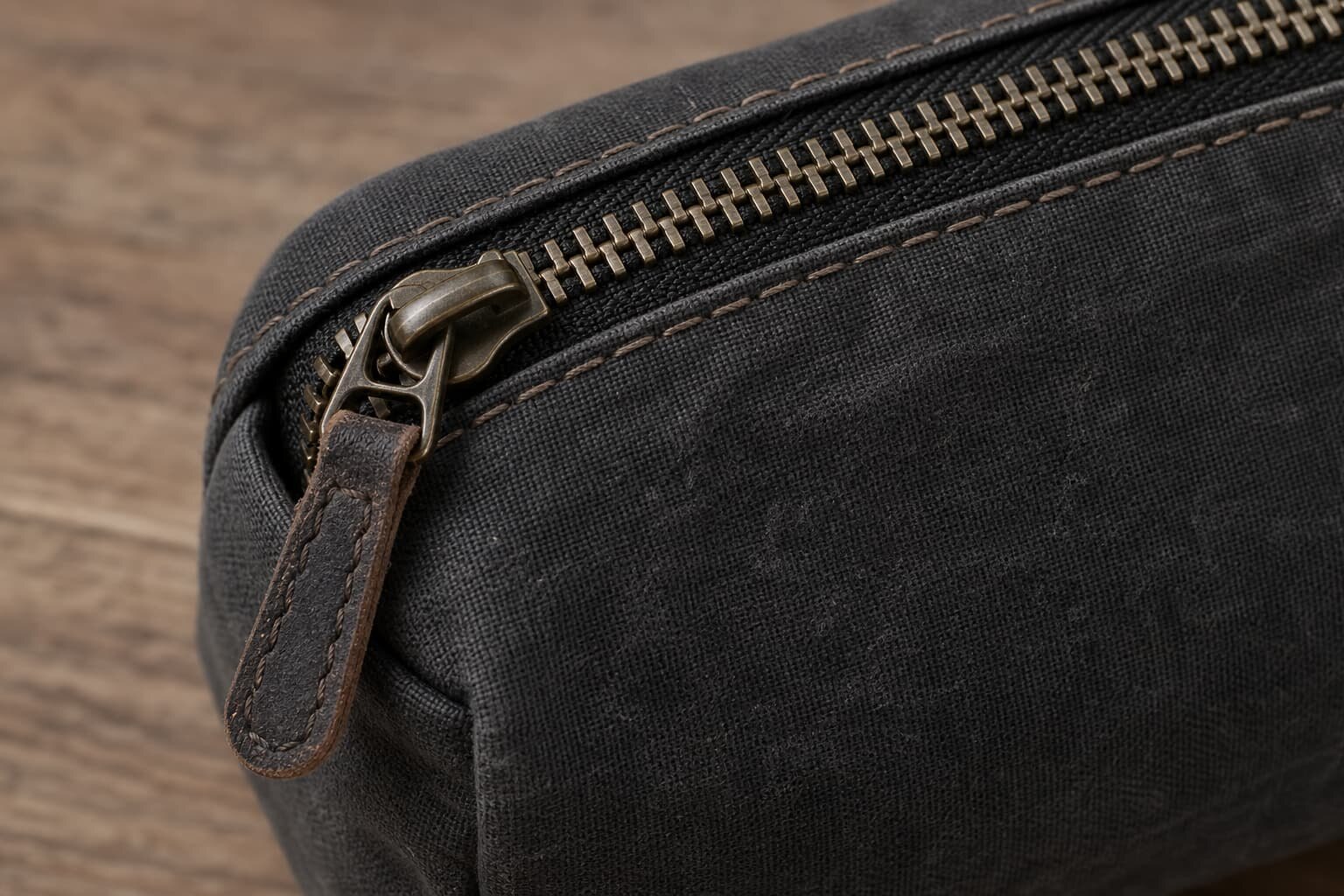
The zipper is the moving part users interact with most. A weak or rough zipper can make an otherwise acceptable bag feel poor. For most A4 document bags and conference business bags, a No. 5 nylon coil zipper is a practical standard because it is flexible, widely available, and suitable for long openings. Smaller zippers may be acceptable for thin pouches or very light bags, but they should not be substituted without buyer approval.
A good zipper specification includes size, type, tape color, slider finish, puller style, opening direction, and zipper-end treatment. The end treatment matters because many zipper failures begin where the slider meets a bulky seam or an unsecured zipper stop. If the bag has a gusset, curved top, or tight corner, sample review should include opening and closing the finished bag while it is filled with realistic contents.
Buyers should also consider brand perception. A standard metal puller may be sufficient for a corporate giveaway. A molded puller, cord puller, or branded puller may fit a retail program, but it can add tooling cost and MOQ. Custom pullers should only be added when they support the product value or repeat-order plan.
- Specify No. 5 nylon coil zipper for standard document and business bags unless there is a reason to use another type.
- Confirm zipper tape color, slider color, and puller material in the quote and sample approval.
- Inspect zipper smoothness after sewing, because loose zipper samples do not reveal seam interference.
- Reject bulk bags where zipper tape is wavy, end stops are loose, or fabric catches during normal use.
5. Handles, seams, and internal finish: where cheap construction shows first
Handle and seam failures are common because the approved sample is often reviewed empty. End users load bags with paper, manuals, brochures, cables, or samples. The handle may look strong on a table but fail if the webbing is only caught in a seam or stitched with a single weak line. Procurement should define handle width, material, drop length, reinforcement method, and the intended loading condition.
For many business bags, 25-30 mm polyester webbing is a practical starting point, but attachment method is more important than width alone. Box-X stitching, bartacks, or reinforced patches can improve stress distribution. If the main fabric is lightweight, the reinforcement must protect the fabric from tearing, not only keep the webbing from breaking. Bottom corners and side seams also need attention when the bag has a gusset or will carry thick contents.
Internal finish affects both durability and perceived quality. Unlined bags can work for cost-sensitive orders if seams are neatly bound or overlocked. Lined bags feel more finished and can protect documents from rough seam edges, but they add sewing operations and inspection points. The buyer should choose deliberately rather than letting each supplier decide.
- Define handle drop for hand carry or shoulder carry instead of leaving it to the factory pattern.
- Require close-up sample photos of handle roots inside and outside the bag.
- Use seam binding or lining when loose internal edges would catch documents or reduce perceived value.
- Include handle roots, side seams, bottom corners, and pocket corners in the inspection checklist.
6. Branding and artwork: choose the decoration method before comparing price
Logo decoration is a frequent source of quote variation. A supplier may include a small one-color screen print, while another assumes a large heat transfer, woven label, or patch. These are not equivalent. Screen printing is usually suitable for simple solid-color logos and controlled budgets. Heat transfer can handle gradients and fine detail, but adhesion must be checked on the selected fabric and coating. Woven labels, rubber patches, or leather-look patches can raise perceived value but may create separate accessory minimums.
Artwork control matters for bulk consistency. The RFQ should state artwork file format, logo size, placement, color reference, and acceptable tolerance. Placement should be measured from fixed edges, seams, or pocket lines, not described only as centered. If the bag includes a front pocket, zipper, or panel seam, the print position should be checked on the physical sample to avoid awkward alignment.
For repeat programs, a branded label or patch may be a good investment because it can be reused across orders. For one-time event orders, simple screen print may be more efficient. The procurement decision should balance visual value, durability, setup cost, lead time, and the likelihood of reorders.
- Use screen print for simple logos with limited colors and clear edges.
- Use heat transfer for detailed or multi-color artwork, but test adhesion and cracking on the actual fabric.
- Use woven labels or patches when durability and brand presentation justify separate accessory production.
- Approve a physical logo sample or pre-production sample before bulk printing begins.
7. MOQ and supplier pricing: compare the constraint, not only the number
MOQ is not always controlled by the sewing line. It may be controlled by fabric rolls, zipper tape color, custom puller tooling, woven label production, print setup, carton printing, or warehouse sorting requirements. A factory may be able to sew a small order, but the material suppliers may not support every custom component at that quantity. This is why two suppliers can give different minimums for what appears to be the same bag.
For procurement, the useful question is: which component controls the MOQ? If the answer is custom fabric dyeing, the buyer can consider stock fabric with custom printing. If the answer is woven labels, the buyer can use a standard side label for the first order and add a custom label after demand is proven. If the answer is split colors, the buyer can reduce colorways or combine them under one fabric purchase where possible.
Supplier comparison should include pricing structure, not only final unit price. Ask what changes at different quantities, what is included, what is optional, and what setup fees are amortized into the unit price. A slightly higher unit price from a supplier with clearer material control, inspection access, and realistic lead time may be lower risk than a vague low quote.
- Ask whether MOQ is per style, per color, per logo, per fabric, or per shipment.
- Request price breaks with the same specification, not downgraded materials at lower quantities.
- Identify setup costs separately so repeat-order pricing can be evaluated properly.
- For pilot orders, simplify custom components before forcing a premium build into an uneconomic MOQ.
8. Sampling and approval: make the sample a production control tool
A sample is not just a sales confirmation. For zipper business bags, it should become the control reference for bulk production and inspection. A showroom sample can show general capability, but it is not enough for approval unless it uses the same fabric, zipper, webbing, lining, branding method, and packing fold planned for bulk. The final pre-production sample should represent the actual quoted construction.
During sample review, inspect the parts that photos hide. Open the bag fully, check seam finishing, pull the zipper through the full path, examine the handle roots from inside and outside, and load the bag with the intended contents. A bag may look square when empty but twist, sag, or catch at the zipper when filled. If the print is large, fold the sample as it will be packed and check whether creases cross the logo.
Document approval clearly. Keep one signed sample if possible, or at least maintain dated photos, measurements, component swatches, and written comments. If changes are required, confirm whether they affect price or lead time before bulk production begins.
- Measure all critical dimensions and record any approved tolerance changes.
- Check filled-bag performance, not only empty appearance.
- Confirm print adhesion, zipper smoothness, handle reinforcement, internal finish, and packing fold.
- Do not allow bulk cutting or printing until the buyer approves the final sample or written deviation list.
9. QC plan and escalation: decide what happens when defects appear
Quality control should be planned before production, not negotiated after defects appear. For zipper business bags, inspection should compare bulk goods against the approved sample, component swatches, specification sheet, and packing requirements. The buyer should define critical, major, and minor defects in practical terms. A missing logo, wrong fabric, broken zipper, unsafe sharp edge, or unusable handle is critical. Poor stitching, visible stains, wrong label, or zipper catching may be major. Small thread ends or minor wrinkles may be minor if they do not affect use or presentation.
The inspection plan should include measurement checks, fabric review, zipper operation, handle load review, print inspection, internal workmanship, and packing verification. The sampling method can follow the buyer’s internal standard or an agreed AQL plan, but the acceptance rule must be clear. If the buyer requires third-party inspection, the supplier needs notice so finished goods are packed but accessible.
Escalation paths matter. If defects are found, the buyer and supplier should know whether goods will be reworked, replaced, discounted, reinspected, or held. Without an escalation plan, shipment pressure often leads to rushed decisions. A practical QC plan protects both sides because it turns quality discussions into evidence-based decisions.
- Define critical defects that automatically block shipment until corrected.
- Require defect photos, quantities affected, root cause, and rework method for any failed inspection.
- Inspect reworked goods again before release, especially for zipper, handle, and print issues.
- Keep final inspection time in the lead-time plan so quality review does not become a shipping delay.
10. Packing, shipping, and final quote comparison
Packing is part of the product specification for business bags. Individual polybags protect against dust, moisture, and handling marks and make counting easier for distributors, retailers, and corporate receiving teams. Bulk packing can reduce cost for one-time event distribution, but it increases the risk of dirt, deformation, sorting labor, and mixed-SKU confusion. The correct choice depends on destination requirements, product value, and warehouse process.
The packing plan should include fold method, pieces per polybag, pieces per carton, carton dimensions, net and gross weight, carton marks, barcode labels, and pallet requirements if any. Avoid folding across a large print or stiff zipper area unless the sample has already confirmed that the fold will not damage the appearance. Ask for a packed-carton photo before all goods are sealed, especially for first orders or mixed-color shipments.
Final quote comparison should convert each supplier’s offer into a common cost sheet. Compare fabric, zipper, handle reinforcement, logo method, lining, packing, inspection access, lead-time milestones, and trade terms. An EXW unit price cannot be compared directly with an FOB or delivered price unless local handling, export costs, and freight assumptions are added. The best procurement decision is not always the lowest initial quote; it is the quote with the clearest specification, acceptable risk, and reliable delivery path.
- Confirm carton marks match PO number, item number, color, quantity, and destination requirements.
- Request carton dimensions and gross weight before booking freight or warehouse slots.
- Include labels, inserts, barcodes, and mixed-SKU sorting in the RFQ, not after production.
- Compare landed cost and risk controls before issuing the purchase order.
Specification comparison for buyers
| Supplier comparison point | Lower-cost quote may use | Stronger procurement spec | Pricing and MOQ impact | QC method and pass threshold |
|---|---|---|---|---|
| Main fabric | 300D polyester, light coating, stock color | 600D polyester with declared GSM range, backing type, and approved color standard | Heavier or custom fabric raises material cost, carton weight, and sometimes MOQ if fabric must be dyed | Measure GSM from random cuttings; compare handfeel, color, coating, and creasing to approved sample; reject clear mismatch or unstable coating |
| Fabric color | Available black, navy, gray, or other stock shade | Stock shade approved by physical swatch, or custom Pantone with tolerance agreed before dyeing | Custom dyeing can trigger fabric mill minimums and longer lead time | Check bulk panels against approved swatch under consistent light; hold shipment for obvious shade variation between panels or lots |
| Zipper | No. 3 or unbranded nylon zipper with basic slider | No. 5 nylon coil zipper for most document bags, specified tape color, slider, puller, and end finish | Better zipper and custom puller add cost; custom tape color may raise MOQ | Open and close sampled bags repeatedly; pass if slider moves smoothly, end stops hold, and tape is not wavy or caught in seams |
| Handle attachment | Webbing caught in top seam or single-line stitch | 25-30 mm webbing with defined handle drop and box-X stitch, bartack, or reinforced patch where needed | More stitch operations increase labor time but reduce failure risk on loaded bags | Apply agreed load based on intended contents; pass if no stitch popping, fabric tearing, or webbing slippage after holding and lifting |
| Side and bottom seams | Plain seams with loose internal edges | Bound seams, lining, or neat overlock depending on price level and use | Seam binding and lining add material and labor, but improve durability and presentation | Inspect inside workmanship; pass if no raw fraying, loose threads, sharp zipper ends, or skipped stitches in stress areas |
| Branding | One-color print included only, unspecified ink or position | Confirmed print method, artwork file, size, color reference, placement tolerance, and approval sample | More colors, larger print areas, transfers, patches, or labels can create setup charges and accessory MOQ | Rub, bend, and visually inspect print; pass if adhesion, registration, edge quality, and position match approved sample within tolerance |
| Internal features | Unlined single compartment | Lining, divider, document pocket, pen loop, or label only when needed by use case | Extra compartments increase sewing time, inspection points, and sample revision risk | Check pocket size, stitching, accessibility, and alignment; reject features that obstruct zipper operation or deform the bag |
| Packing | Bulk packed in export carton | Individual polybag, defined folding method, carton quantity, carton marks, labels, and warehouse requirements | Individual packing and special labels add cost but reduce dirt, sorting labor, and receiving errors | Open packed cartons; pass if counts, labels, carton marks, folding, cleanliness, and moisture condition meet PO requirements |
| Inspection access | Factory internal check only | Pre-shipment inspection against approved sample, spec sheet, and AQL or agreed sampling plan | Third-party or buyer inspection adds cost and schedule time, but reduces receiving risk | Hold shipment until critical defects are cleared; rework or replace if major defects exceed agreed acceptance level |
Buyer checklist before sampling
- Define the intended use: conference documents, catalogues, sales samples, laptop accessories, employee onboarding kits, retail resale, or distributor giveaway.
- State finished size, gusset depth, handle drop, pocket size, and measurement tolerances instead of using only terms such as A4 or laptop bag.
- Specify fabric by material, denier or weave, GSM range, backing or coating, color standard, and whether stock fabric is acceptable.
- Name the zipper size, zipper type, tape color, slider finish, puller style, opening direction, and zipper-end construction.
- Define handle webbing width, material, attachment method, reinforcement stitch, and the load test that reflects real contents.
- Select branding by artwork and use case: screen print, heat transfer, woven label, patch, embroidery, or a combination.
- Ask suppliers to separate unit price, sample fee, screen or tooling fee, label fee, packing cost, and any custom material surcharge.
- Confirm MOQ by style, color, logo, and shipment; identify which component creates the MOQ constraint.
- Approve a pre-production sample made with bulk-intended fabric, zipper, webbing, logo method, and packing fold.
- Require packing details: pieces per polybag, pieces per carton, carton size, gross weight, carton marks, barcode labels, and mixed-SKU sorting if needed.
Factory quote questions to send
- What exact fabric are you quoting for the main body: material, denier or weave, GSM range, backing or coating, and stock availability?
- Is the quoted color from stock fabric, or does it require dyeing? If custom dyeing is required, what is the fabric mill MOQ, color tolerance, and added lead time?
- Which zipper size, zipper type, tape color, slider finish, puller material, and zipper-end finish are included in the unit price?
- What handle webbing width, handle drop, stitch pattern, bartack or box-X reinforcement, and internal reinforcement are included?
- What intended loading condition do you recommend for this construction, and what load or pull test can you perform on samples or during QC?
- Which seams are bound, overlocked, lined, or left raw? Please confirm internal finish with sample photos.
- Which branding method is included, how many colors, what maximum logo size, what placement tolerance, and what artwork format do you require?
- Does the unit price include lining, front pocket, divider, label, hangtag, barcode sticker, instruction insert, or retail polybag?
- What sample charges, print screen charges, transfer setup charges, label tooling charges, or custom puller charges are separate from the unit price?
- What is the MOQ for the exact quoted construction, and what changes if we split colors, split logos, or reduce the order quantity?
Quality-control points to confirm
- Measure finished width, height, gusset, handle drop, pocket position, zipper length, and logo position against the approved spec sheet with defined tolerances.
- Verify fabric handfeel, color, GSM range, backing quality, odor, coating evenness, and visible defects such as stains, creases, scratches, or delamination.
- Check zipper operation on random finished bags, not loose zipper samples: slider movement, end stops, seam clearance, tape waviness, and fabric catching.
- Apply the agreed load test based on intended contents; inspect handle roots, webbing, side seams, and bottom corners after lifting, holding, and light movement.
- Inspect stitching density, skipped stitches, broken thread, seam allowance, bartack placement, box-X shape, and thread trimming at all stress points.
- Review inside workmanship: lining attachment, seam binding, loose threads, raw edges, sharp zipper tape ends, trapped fabric, and pocket accessibility.
- Check print or branding for adhesion, edge sharpness, color consistency, registration, position, cracking after bending, and abrasion from normal handling.
- Compare bulk production to the signed pre-production sample and approved component swatches, not to a catalogue photo or digital mockup.
- Inspect packing condition: correct quantity per polybag and carton, clean bags, dry cartons, no over-compression, correct marks, readable barcodes, and SKU separation.
- Document defects by severity and location; require rework or replacement before shipment if critical defects are found or major defects exceed the agreed sampling plan.