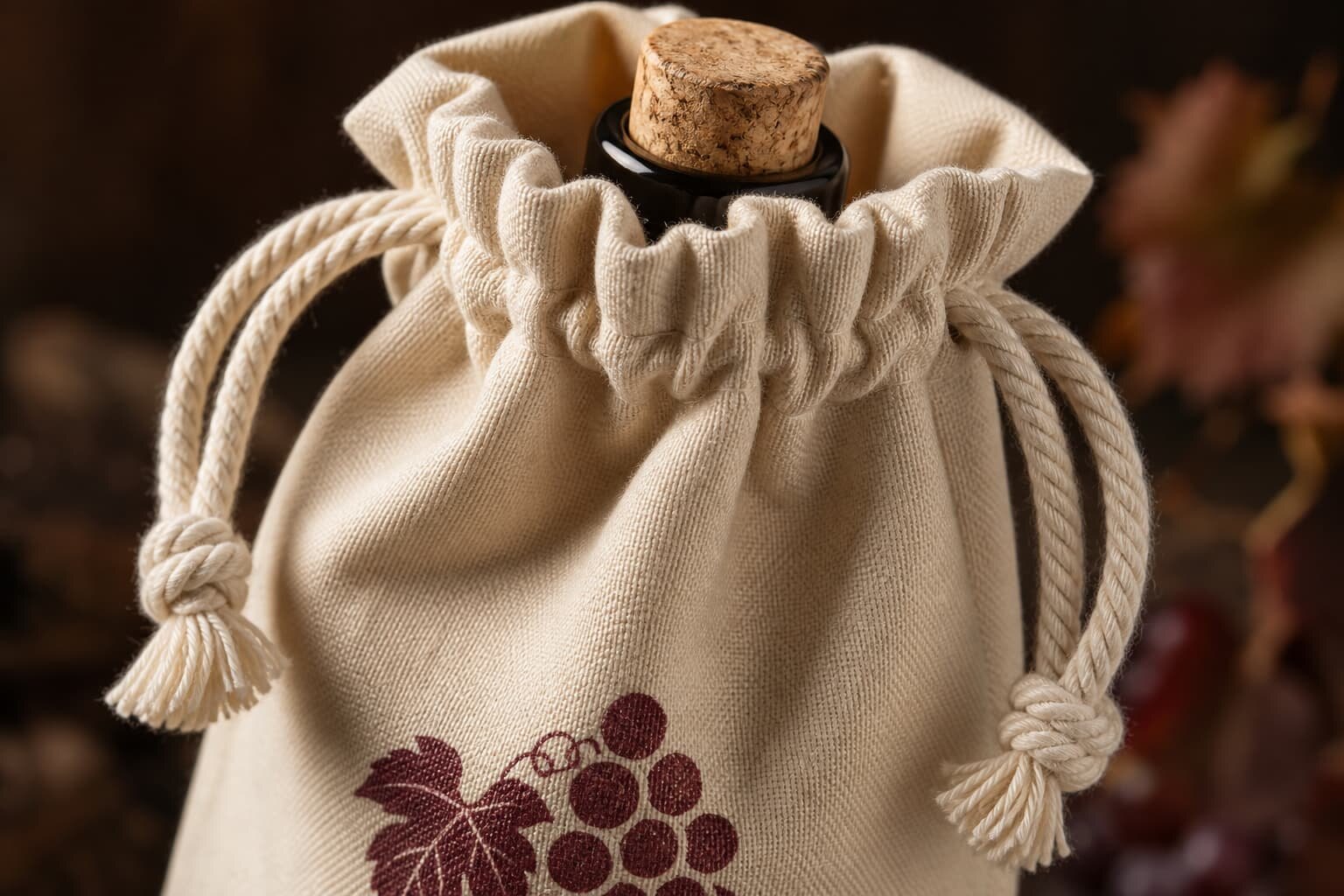
The buying problem: wine bags look simple but quote badly
Wine and bottle bags are often treated as small promotional accessories, but they create many quotation errors because the product is built around another product: the bottle. A 750 ml Bordeaux bottle, a Champagne bottle, a Burgundy bottle, a spirits bottle, and an olive oil bottle can all be called a bottle by a buyer, but they do not use the same bag dimensions, base structure, or handle strength. If the RFQ says only “cotton wine bag with logo,” suppliers will fill in the missing details differently, and the lowest quote may be based on a thin pouch that does not fit your actual bottle.
The goal of a wholesale wine and bottle bags supplier checklist is not to make the RFQ longer for no reason. It is to remove hidden assumptions before you compare prices. For procurement teams, the main risk is not only unit cost. It is receiving a bag that has the wrong clearance, weak drawcord, poor print registration, cartons that exceed warehouse weight limits, or a lead time based on plain stock fabric when your order needs custom dyed canvas. This guide focuses on controlling those variables before you issue a purchase order.
- Do not compare quotes until bottle size, fabric weight, print method, and packing are defined.
- Ask suppliers to state assumptions in writing if they recommend dimensions or construction changes.
- Treat a wine bag as a load-bearing package, especially for two-bottle and Champagne formats.
Start with the bottle, not the bag size
The most common production mistake is starting with a standard bag size copied from a catalog. A catalog size may fit one common bottle, but it may fail with wider shoulders, taller cork finishes, foil capsules, wax seals, gift sleeves, or imported spirits bottles. A correct RFQ starts with the bottle specification: total height, maximum body diameter, shoulder profile, base shape, filled weight, and whether the neck should be exposed or fully covered.
Finished bag dimensions should include practical clearance. For a basic drawstring cotton bottle pouch, the inner width must allow the bottle to slide in without forcing the seams. For a boxed-base carrier, the base must sit flat when the filled bottle is inserted. For a two-bottle bag, the divider must be high and strong enough to prevent glass contact during handling. If your product range includes mixed bottles, state the largest and heaviest bottle, then ask the factory whether one universal size is safe or whether separate SKUs are more sensible.
- Provide bottle height including cap, cork, pump, wax top, or decorative closure.
- Provide maximum diameter at the widest body point, not only label panel width.
- Specify desired neck visibility: fully covered, neck exposed, or drawstring closing below shoulder.
- Confirm whether the bag is for direct retail sale, gift box insertion, ecommerce shipment, or store counter use.
Choose fabric weight by function, not by habit
Fabric weight is one of the biggest quote variables for wholesale wine and bottle bags. Cotton can be quoted in ounces or GSM. As a rough buying reference, 5 oz cotton is around 140 GSM, 7 oz is around 200 GSM, 10 oz is around 280 GSM, and 12 oz is around 340 GSM, depending on weave and finishing. A light cotton pouch may be acceptable for a one-time event giveaway, but it may feel under-specified for premium wine retail or a reusable gift program.
Jute and burlap bags are usually quoted by GSM and by lamination status. Laminated jute gives more body and can reduce fraying, but it changes the natural hand feel and may limit folding. Unlaminated jute looks more natural but can shed fibers and may absorb moisture. Canvas is usually more stable for detailed printing and premium reuse. Nonwoven polypropylene may be cheaper for some bottle promotions, but it should not be confused with cotton or jute when comparing quotes.
- Use 5 oz to 7 oz cotton for light promotional pouches where low cost matters more than structure.
- Use 10 oz to 12 oz canvas for better standing shape, stronger seams, and premium gift positioning.
- Use laminated jute when the bag needs more body and a rustic retail look.
- Ask the supplier whether fabric is greige, bleached, dyed, washed, laminated, or coated because each affects price and lead time.
Match bag construction to bottle weight and selling channel
Construction changes cost more than many buyers expect. A flat drawstring pouch is usually the simplest style: two panels, side seams, bottom seam, and a drawcord channel. A boxed-bottom wine bag requires more sewing operations and better dimensional control. A two-bottle carrier needs a divider, stronger handle attachment, and usually a more stable base. Retail buyers may also need a hangtag, barcode label, or display-friendly folded packing, which changes labor time.
If the wine bag will be handed over at a tasting event, a lighter drawstring pouch may work. If it will be sold as a gift carrier in a wine shop, it needs better standing shape and cleaner finishing. If it will be shipped in an ecommerce order, the bag may be folded tightly and must recover well after packing. If it will carry two filled glass bottles, the handle and divider seams must be tested under realistic weight, not judged only by appearance.
- For single-bottle drawstring bags, check drawcord channel width and cord thickness so the closure moves smoothly.
- For handled wine bags, require bartack or reinforced stitching at handle stress points.
- For two-bottle bags, require a divider that reaches high enough to stop bottle-to-bottle impact.
- For boxed-bottom styles, confirm the bag stands upright with the filled bottle inserted.
Print method decisions that change cost and failure risk
Logo application is where many supplier quotes stop being comparable. Screen printing is usually reliable for solid logos and limited colors on cotton canvas. It can produce good opacity, but setup cost and unit cost increase with each print color and each position. Heat transfer can handle gradients or photographic art, but the film feel, edge visibility, and cracking risk must be tested on textured fabric. Digital printing can be useful for small runs or complex graphics, but color control and fabric compatibility need confirmation.
Jute has a coarse surface, so tiny text, fine lines, and gradient logos do not reproduce the same way as on smooth cotton. Embroidery can look premium on canvas, but it may pucker lighter fabric and is not ideal for very small lettering. Woven labels or sewn side labels are often a clean option for premium bottle bags, especially when the fabric texture makes direct printing difficult. Your RFQ should state print method if you know it, or ask the factory to recommend one and explain the limits.
- Provide vector artwork, Pantone colors, print size, and exact placement from seams or edges.
- Ask whether the price includes one-side print, two-side print, or multiple positions.
- Set print placement tolerance, for example within a practical millimeter range agreed with the supplier.
- Check print adhesion after rubbing, folding, and inserting the bottle repeatedly.
- Avoid tiny QR codes or legal text on coarse jute unless the supplier proves readability on a sample.
MOQ logic: why one number is not enough
A supplier may advertise a low MOQ, but that number may apply only to standard size, standard fabric color, no custom label, and one-color print. In real orders, MOQ is driven by fabric purchase minimums, dyeing lots, printing setup, accessory minimums, and packing requirements. A custom dyed cotton wine bag can have a very different MOQ from a natural cotton bag with black screen print. A woven label or custom rope color can also create its own minimum even if the bag body MOQ is lower.
Procurement teams should request MOQ by component. This makes quote comparison more honest and helps you plan SKU consolidation. If you need five artwork versions for different wine varieties, ask whether the MOQ is per design, per fabric color, per size, or per total order. Sometimes it is cheaper and safer to keep the bag body common and change only the label or hangtag. Other times, different bottle sizes require separate bag sizes, and forcing one universal SKU causes fit complaints.
- Ask MOQ per bag size, per fabric color, per print design, and per packing style.
- Confirm whether setup charges apply below a certain quantity.
- Check if spare quantity or overrun/underrun tolerance is included in the order terms.
- For distributors, ask whether the factory can hold a standard fabric and repeat print in batches, but do not assume stock availability.
Sampling: what to approve before bulk production
A wine bag sample should not be approved on appearance alone. It must be checked with the real bottle or an accurate substitute. Insert the filled bottle, close the drawstring, lift the bag, place it on a flat table, and check whether the seams twist, the base pulls, or the handle feels overloaded. If your bottle has a wide shoulder or heavy punt, check the bottom and side seam pressure points. A sample that looks neat when empty may fail when loaded.
For branded bags, sampling must also confirm print scale and position. A logo may look centered on a flat empty pouch but appear too low once a bottle is inserted and the fabric curves. If the bag is for retail sale, review folded presentation and creasing. If the order will be packed by SKU for distribution, ask for a packing sample or at least a carton packing plan. The approved pre-production sample should become the reference for bulk production and inspection.
- Measure finished sample size after sewing and compare with the approved spec sheet.
- Check the sample with the exact bottle or a dummy matching height, diameter, and filled weight.
- Review drawstring function, handle comfort, seam strength, and standing stability.
- Confirm fabric hand feel, shade, odor, and texture against approved swatches.
- Approve print color under consistent lighting and keep a signed or sealed reference sample when possible.
Packing and carton details that affect landed cost
Packing is often left until the end, but it affects freight, warehouse receiving, and retail presentation. Wine bags can be flat packed, folded, bundled, individually polybagged, paper banded, or packed with hangtags. Flat packing is usually efficient, but stiff jute or boxed-bottom bags may crease if compressed too tightly. Individual polybags protect against dust and moisture, but some buyers prefer reduced plastic. Carton quantity must balance freight efficiency with safe handling weight.
Ask for carton dimensions and gross weight before approving the final quote. Heavy canvas or jute bottle bags can make cartons surprisingly dense, especially if packed in large master cartons. If your warehouse has a maximum carton weight or requires barcodes, carton marks, or mixed SKU separation, tell the supplier before they quote. Repacking after production wastes time and can create sorting errors.
- Specify units per inner pack and units per export carton.
- Confirm whether bags are packed flat, folded once, rolled, or shaped around inserts.
- Ask for carton size, gross weight, net weight, and estimated CBM.
- Define carton marks, SKU labels, barcode stickers, and country-of-origin labeling if required.
- For sea freight, confirm moisture protection, especially for jute, cotton, and long transit lanes.
Lead time control: separate artwork, sampling, material, and production
Lead time problems often come from using one simple number. A supplier may say production takes a certain number of days, but that may exclude artwork clarification, fabric sourcing, sample making, sample shipping, buyer approval, deposit confirmation, carton printing, inspection scheduling, and freight booking. For custom wine and bottle bags, the lead time depends heavily on fabric availability and print complexity. Natural cotton with one-color print is usually faster to arrange than custom dyed canvas with woven labels and retail packaging.
Build your sourcing calendar backwards from the in-warehouse date, not the factory finish date. If your retail program is seasonal, add buffer for sample revisions and inspection. If the order includes multiple SKUs, ask whether all styles will be produced together or staggered. For importers, the safest RFQ asks the supplier to break down the timeline into sample time, material preparation, bulk production, packing, inspection readiness, and shipment handover.
- Ask for sample lead time separately from bulk production lead time.
- Confirm whether the quoted lead time starts after deposit, artwork approval, sample approval, or material arrival.
- Identify long-lead items such as custom dyed fabric, custom rope, woven labels, special cartons, or retail tags.
- Request a production schedule for larger or multi-SKU orders.
- Do not approve bulk production until the fit, print, and packing method are settled.
How to compare supplier quotes without being misled
When quotes arrive, line them up by specification, not by price first. Check whether each supplier quoted the same fabric weight, same finished size, same print size, same number of print colors, same handle construction, same packing, and same incoterm. A lower quote may simply exclude setup charges, use thinner fabric, quote a smaller bag, or pack more units per carton than your warehouse can handle. A serious supplier should be able to explain the construction and cost drivers clearly.
Ask each factory to show the assumptions behind the quote. If one supplier recommends changing the bag width or fabric weight, that may be useful, but it must be documented. For a fair comparison, create a quote summary with unit price, tooling or setup charges, sample cost, MOQ, lead time basis, packing data, overrun tolerance, and payment terms. This gives procurement and merchandising teams a cleaner decision than a spreadsheet of unit prices only.
- Compare finished bag dimensions, not only the style name.
- Compare fabric GSM or ounce weight and whether fabric is stock or custom.
- Compare logo method, print colors, print size, setup charges, and placement.
- Compare carton quantity, carton size, CBM, gross weight, and inner packing.
- Compare lead time trigger and what approval step starts the production clock.
- Compare inspection readiness standards and what happens if defects exceed acceptance criteria.
Specification comparison for buyers
| Spec decision | Recommended option | When it fits | Buyer risk to check |
|---|---|---|---|
| Single bottle cotton wine bag | 10 oz to 12 oz cotton canvas, approx. 280-340 GSM, reinforced side seam | Premium gifting, winery retail, subscription boxes, reusable brand packaging | Bag must fit the real bottle diameter and shoulder height, not only a standard 750 ml sample |
| Light cotton drawstring bottle pouch | 5 oz to 7 oz cotton, approx. 140-220 GSM, cotton rope or matching cord | Lower-cost event packs, hotel amenities, short-term promotional use | Thin fabric may show bottle color and can distort with heavy glass bottles |
| Jute or burlap wine bag | Laminated or unlaminated jute, approx. 260-360 GSM, cotton webbing or jute handle | Natural look, wine shops, holiday hampers, rustic gift packaging | Print detail is limited on coarse jute; confirm odor, fiber shedding, and lamination feel |
| Two-bottle carrier | 10 oz canvas or laminated jute with center divider and boxed base | Retail gifting where two bottles must not knock together | Divider height and stitch strength must be checked with filled bottles during sampling |
| Logo printing | Screen print for solid logos; heat transfer for gradients; woven label for small premium branding | Most brand programs where repeat color control matters | Supplier must quote print size, number of colors, placement tolerance, and setup charge |
| Packing method | Flat packed in export carton with inner polybag or paper band as required | Importer stock, retail replenishment, ecommerce bundling | Creasing, moisture protection, carton weight, and scannable carton marks affect receiving cost |
Buyer checklist before sampling
- Confirm bottle type: Bordeaux, Burgundy, Champagne, spirits, olive oil, water bottle, or mixed assortment.
- Provide bottle height, body diameter, shoulder shape, filled weight, and whether the cap or neck must remain visible.
- Specify finished bag size after sewing, not fabric cutting size.
- State fabric type and target weight: cotton 5 oz, 7 oz, 10 oz, 12 oz; jute GSM; nonwoven GSM if applicable.
- Clarify handle style: drawstring closure, side handles, top carry handle, rope handle, cotton webbing, or no handle.
- Define base style: flat pouch, boxed bottom, round bottom, gusseted side, or reinforced base insert.
- Provide logo artwork in vector format and confirm print size, number of colors, Pantone references, and print position.
- Ask whether the quoted print method is screen print, heat transfer, digital print, embroidery, woven label, or leather patch.
- Set acceptable size tolerance, print position tolerance, color tolerance, and stitching tolerance before bulk approval.
- Request a physical pre-production sample using the correct fabric, drawcord, handle, and print method.
Factory quote questions to send
- What finished bag size do you recommend for our exact bottle height and diameter, and what clearance do you allow around the bottle?
- Is your quotation based on finished dimensions or cutting dimensions?
- Which fabric weight/GSM is included in this price, and can you provide a swatch or previous production reference?
- What is the fabric shrinkage risk after dyeing, washing, or heat pressing?
- Which print method are you quoting, and what is the maximum printable area on this bag shape?
- How many logo colors are included, and are screen charges, plate charges, or artwork handling fees separate?
- What MOQ applies to the fabric color, bag construction, printing, labels, and custom packing?
- Can you test the sample with a filled bottle of our same weight or with dimensions provided by us?
- What are your size tolerance, print placement tolerance, stitch density standard, and seam strength check method?
- How many pieces per carton, what carton size and gross weight, and can you adjust packing for our warehouse limit?
Quality-control points to confirm
- Measure finished width, height, gusset, and base after sewing with an empty bag and again with the target bottle inserted.
- Check whether the bottle slides in smoothly without tearing side seams or forcing the drawstring closure.
- Load test handles, drawstrings, and divider seams with filled bottles, not empty display bottles.
- Verify fabric weight by GSM or ounce reference and compare hand feel against the approved sample.
- Check print adhesion, rubbing resistance, cracking risk on folded areas, and edge sharpness on textured fabric.
- Confirm logo placement from top edge, side seam, and bottom seam; do not judge by eye only.
- Inspect stitch density, skipped stitches, loose threads, seam allowance, reinforcement at stress points, and divider alignment.
- Check odor, mildew, moisture marks, jute fiber shedding, and lamination bubbles before final packing.
- Confirm each carton label, inner pack quantity, barcode or SKU sticker, and mixed SKU segregation.
- Open random cartons after packing to check creasing, deformation, wrong assortment, and carton crushing risk.