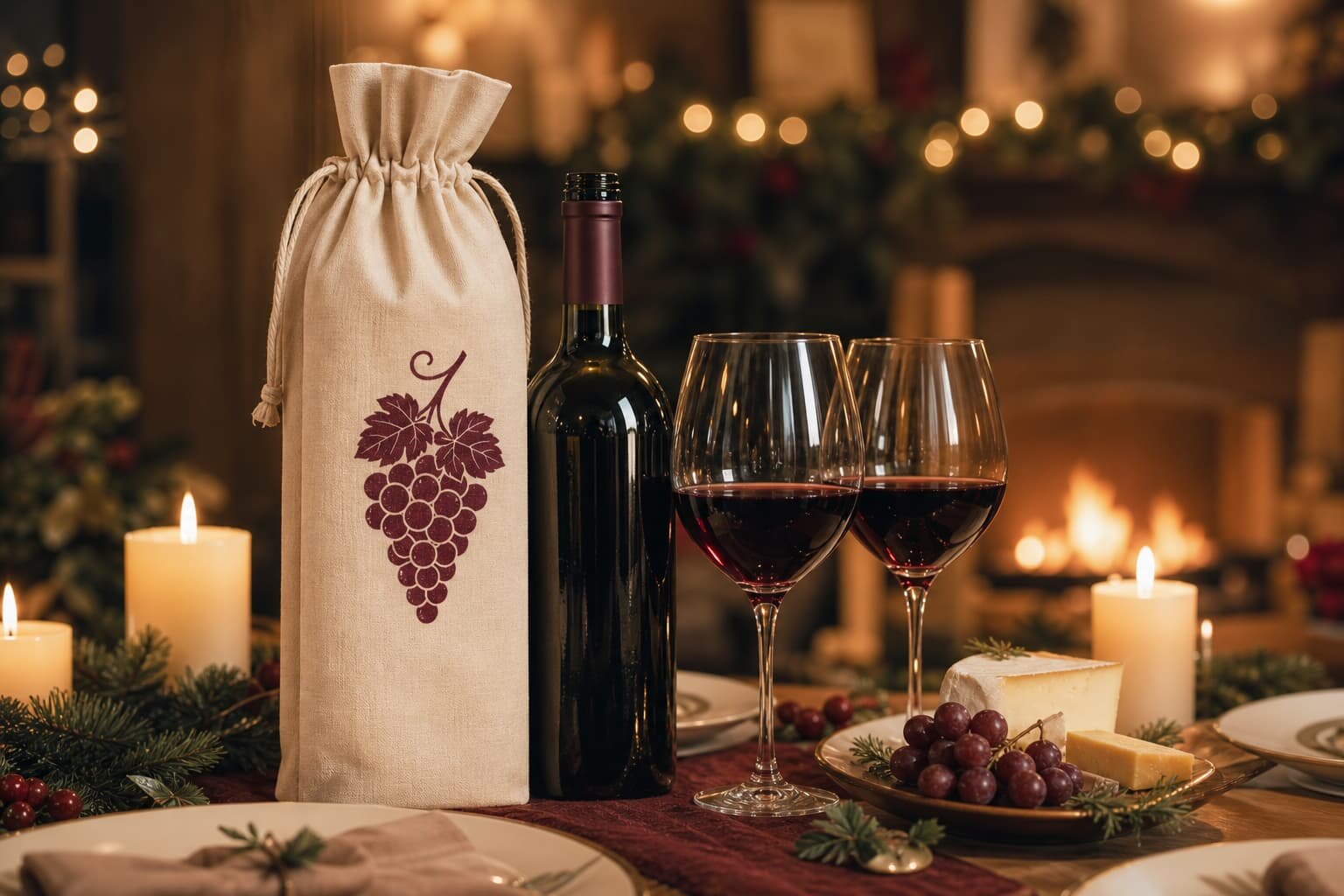
1. Why this wholesale wine & bottle bags supplier checklist 03 starts with risk, not style
Wine and bottle bags look simple in a catalog, but they create several procurement risks at once: product fit, load safety, brand presentation, carton efficiency, and delivery timing. A supplier can quote a standard-looking cotton wine bag very quickly, yet the quote may be unsafe if the buyer intends to pack a wide Burgundy bottle, a heavy sparkling bottle, a spirits bottle, or a two-bottle gift set. For B2B buyers, a low unit price has limited value if the finished bag cannot hold the real bottle or does not pass retail handling.
The purpose of this wholesale wine & bottle bags supplier checklist 03 is to help procurement teams turn a vague inquiry into a controlled RFQ. A strong supplier should ask about bottle dimensions, filled weight, bag use, artwork, packing, and deadline before locking the price. If a factory only replies with a photo and a unit cost, the buyer still does not know whether the quote includes the correct fabric weight, reinforcement, printing, sample approval, or carton data.
The first supplier-screening rule is simple: the bottle defines the bag. Standard bag dimensions are useful as a starting point, not as final approval. The RFQ should connect bottle type, material choice, construction details, decoration method, load-test criteria, and packing plan. When those items are visible, buyers can compare factories on equal terms instead of discovering hidden differences after sampling.
- Treat bottle fit and load strength as commercial acceptance criteria, not minor technical details.
- Require every supplier quote to identify material, GSM or ounce weight, finished size, decoration, construction, packing, MOQ, and lead time.
- Do not compare unit prices until all suppliers quote the same bottle size, same fabric weight, same reinforcement, and same packing method.
- Use the supplier’s questions as a qualification signal; good factories usually ask about the bottle and usage before final costing.
2. Define bottle data before approving bag dimensions
Bag size should be calculated from bottle data, not guessed from a generic wine bag size table. A common single 750 ml Bordeaux-style wine bag may start around 15 cm wide by 35 cm high when measured flat, but that does not mean it will fit every 750 ml bottle. Bottle height, base diameter, shoulder shape, neck length, and filled weight can vary enough to affect the pattern, gusset, closure position, and handle balance.
For open-top handled bags, the buyer should decide whether the bottle neck is meant to show. Some gift bags intentionally expose the neck and label; others should hide most of the bottle body. For drawstring pouches, the cord channel must sit in the right position. If it is too low, the bag may not close cleanly around the bottle shoulder. If it is too high, the top may look loose or oversized.
Two-bottle carriers need more control than single-bottle pouches. Width alone is not enough. The divider must create practical bottle separation, the bottom must resist sagging, and the handles must remain balanced when two full bottles are inside. A divider that looks acceptable in a flat sample may fail once the bottles shift during carrying.
- Collect bottle height, base diameter, widest diameter, shoulder diameter, neck diameter, and filled weight.
- Confirm whether one bag must fit several bottle types; if yes, size around the largest realistic bottle, then check whether smaller bottles still look acceptable.
- For drawstring styles, specify the expected closed position: above shoulder, around neck, or covering the full bottle.
- For handled bags, specify handle drop and whether the bag should stand upright with a full bottle inserted.
- For non-wine bottles such as olive oil, sauce, spirits, or cosmetics, request a fresh pattern instead of reusing a wine bag template.
3. Select fabric by use case, load, print quality, and freight impact
Fabric weight affects more than durability. It changes how the bag stands, how the logo prints, how premium the product feels, how many pieces fit in a carton, and how much the shipment weighs. A 120-140 gsm cotton bottle sleeve may be acceptable for a low-cost event giveaway, but it can look thin around a glass bottle and may not support a premium wine brand. A 220-280 gsm cotton canvas bag has better body, better reusability, and stronger perceived value, but it increases material cost and carton gross weight.
Jute and burlap are popular for wine, gourmet food, and natural gift positioning. They provide texture and shelf presence, but buyers should not ignore odor, moisture sensitivity, rough fibers, and print limitations. Direct screen printing on coarse jute rarely looks as sharp as printing on smooth cotton canvas. If the artwork includes small text or a strict logo standard, a cotton print panel, woven label, PU patch, or stitched label may be safer.
Non-woven material can be useful for large promotional campaigns where price matters most and the brand accepts a less premium hand feel. Procurement should confirm whether non-woven is acceptable for the channel and whether the finished product must meet any retail, sustainability, or internal brand guidelines. For many wine brands, the lowest-cost material may conflict with the intended gifting experience.
- 120-140 gsm cotton: cost-sensitive sleeves, event giveaways, simple one-color logos, short handling cycles.
- 180-220 gsm cotton: mid-range promotional wine bags, better opacity, moderate reusable value.
- 220-280 gsm canvas: retail gift bags, winery merchandise, wine club packaging, heavier bottles, stronger brand presentation.
- Laminated jute: structured natural look, useful for retail shelves, but check lamination cracks, odor, edge finishing, and print clarity.
- Non-woven fabric: economical for high-volume distribution, but check load capacity, brand fit, and local compliance expectations.
4. Control construction: seams, handles, base, dividers, and drawstrings
Most bottle bag failures happen in predictable areas: handle attachment, side seam, bottom seam, divider seam, or drawstring channel. A filled 750 ml glass bottle can weigh around 1.2 kg to 1.5 kg, depending on bottle and liquid. Two-bottle carriers can exceed 2.5 kg before adding tissue, cards, or accessories. The bag therefore needs to be designed for loaded handling, not only for a clean product photo.
Construction details can also explain major price differences between suppliers. One quote may include bartacks, wider handles, reinforced bottom panels, and stronger stitching. Another quote may use the same photo style but remove reinforcement to reduce cost. If the RFQ does not ask for those details, procurement may choose the lower price without realizing the specification is weaker.
For drawstring bags, the closure system deserves its own check. Cord thickness, channel seam allowance, knot quality, and grommet or eyelet construction all affect durability. Some bottle pouches are carried by the cord even when they are not designed for it. If the buyer expects customers to lift the bag by the drawstring, that must be stated and tested.
- Request handle width, handle material, handle drop, stitching pattern, and whether bartacks are included.
- For heavier canvas and two-bottle bags, specify reinforced handle ends and stronger bottom construction.
- For two-bottle carriers, require a divider that reduces bottle contact in the lower body, not only near the opening.
- For drawstring pouches, inspect the cord, channel seam, knots, eyelets, and whether the cord bleeds color onto light fabric.
- For premium retail products, check inside seam finishing because visible fraying can weaken the product and lower perceived quality.
5. Make load testing measurable before sampling
Many supplier conversations say the bag is strong enough, but that phrase is not a QC standard. Buyers need a measurable load test that reflects how the product will be used. For most single-bottle glass programs, a practical factory test is a loaded hang test using at least 1.8 kg for 4 hours, followed by 20 manual lift cycles. This provides margin above many filled 750 ml bottles and helps reveal weak handle stitching, bottom seam stress, or drawstring-channel failure.
For two-bottle carriers, the test load should be higher. A practical starting point is at least 3.5 kg for 4 hours, followed by 20 manual lift cycles using the intended handles. If the bag is intended for heavier sparkling bottles, spirits, or added accessories, the buyer should increase the test weight based on actual filled weight plus a safety margin. The factory should record the load, duration, sample size, and result with photos.
Failure conditions must be defined before inspection. Minor fabric creasing is normal after load testing, but seam opening, broken stitches, detached handles, divider tearing, bottom distortion that prevents safe carrying, or drawstring-channel ripping should trigger rejection or corrective action. The buyer should keep the approved sample and test photos as the reference for bulk shipment release.
- Single-bottle baseline: 1.8 kg load, 4-hour hang, 20 manual lift cycles, then inspect all seams and handle points.
- Two-bottle baseline: 3.5 kg load, 4-hour hang, 20 manual lift cycles, then inspect handles, divider, bottom, and side seams.
- Acceptance: no broken handle stitches, no seam opening over 3 mm, no bottom seam failure, no divider detachment, no drawstring-channel tearing.
- Record: test load, duration, sample quantity, photos before and after, and the name of the person or department performing the check.
- Adjust upward when the actual filled bottle, accessories, or customer use requires a heavier safety margin.
6. Match artwork and decoration method to fabric reality
Decoration risk is often underestimated because artwork looks perfect on a screen. Fabric texture, color, weave, and absorption all affect the finished print. Screen printing is usually practical for wholesale wine and bottle bags when the artwork uses solid colors, bold lines, and limited color count. It is less suitable for fine gradients, very small legal text, detailed illustrations, or tight registration across a rough fabric surface.
Cotton and canvas normally give more predictable printing than jute. Natural cotton can still shift color perception because the base color is off-white rather than pure white. Black or dyed fabric may require an underbase or different ink system. Jute creates a rustic appearance but can break fine print edges. When logo accuracy matters, buyers should approve a physical strike-off or pre-production sample on the actual fabric, not a digital mockup.
Alternative branding methods can reduce print risk. Woven labels work well for small text and repeat brand marks. Cotton patches can provide a smoother print surface on jute. PU or leather-look patches can support premium gifting, but buyers should check stitch durability and color consistency. Embroidery can look premium on canvas, but it may pucker thin cotton and is not ideal for tiny letters.
- Specify print size in centimeters, placement from top edge and side seam, number of sides, and number of colors.
- Provide Pantone references, but approve final color against actual fabric and lighting conditions.
- Keep critical artwork away from gusset folds, bottom curves, drawstring channels, handle stitching, and heavy seam areas.
- Ask the supplier to flag small text, gradients, thin lines, and fine registration risks before sampling.
- Confirm whether screen charges, heat-transfer setup, label MOQ, patch cost, or embroidery digitizing fees are included.
7. Understand MOQ logic so the quote does not change later
MOQ for wine and bottle bags is not only a total quantity number. It is shaped by fabric availability, dyeing requirements, cutting efficiency, print setup, label production, sewing-line changeover, packing format, and SKU separation. A supplier may accept a lower MOQ for natural stock cotton with one-color print, but require higher quantities for custom dyed canvas, special jute, woven labels, retail packaging, or several small artwork splits.
Procurement teams should be careful when a program includes several bottle sizes, brand logos, or seasonal designs. From the factory’s view, four fabric colors with three artwork versions may be twelve controlled SKUs, not one order. Each SKU may need separate printing screens, separate QC references, separate carton marks, and separate packing counts. If the buyer asks for one blended unit price without showing the SKU structure, the quote may be revised later.
A good supplier should explain what can be combined and what cannot. For example, the factory may be able to buy one lot of natural cotton fabric for several artwork versions, but printing setup and packing labels may remain separate. Custom dyed material may have its own minimum before sewing even begins. Buyers should ask for MOQ by fabric, size, print, label, and packing method to prevent surprises.
- Separate MOQ by fabric color: natural, black, custom dyed cotton, dyed canvas, laminated jute, or non-woven.
- Separate MOQ by bag size: single bottle, champagne, two-bottle, spirits, olive oil, or accessory gift set.
- Separate MOQ by artwork: each logo, event date, slogan, barcode, or private-label version may require separate control.
- Ask whether available stock fabric can support a pilot order before committing to custom dyeing.
- Request a cost ladder, such as 1,000, 3,000, 5,000, and 10,000 pieces, when budget planning depends on volume.
8. Sample approval should prove fit, strength, print, and packing
A wine bag pre-production sample should be approved as a working product, not a flat fabric item. The buyer should insert the real bottle or approved dummy bottle, close the bag if it has a drawstring, lift it by the intended carrying point, inspect the base, and photograph the front, side, bottom, inside seams, handle area, and print close-up. Only then can procurement know whether the pattern, construction, and branding work together.
Sample comments should be specific enough to become production instructions. Comments such as make it stronger or logo too high are not precise. Better comments would be add bartack reinforcement at each handle end, increase gusset by 1 cm, move logo 2 cm lower from the top edge, change from 140 gsm cotton to 220 gsm canvas, or increase drawstring length by 3 cm per side. Specific instructions reduce the chance of misunderstanding and protect the buyer when checking the revised sample.
The approved sample should also lock packing details when relevant. If bags will be folded, individually packed, tagged, or barcode labeled, the buyer should check whether the fold line damages the print or changes the retail look. If bulk packing is used, the sample approval should still show the folding method, inner quantity, carton label, and any moisture protection.
- Approve finished sewn dimensions, not only cutting dimensions or supplier drawings.
- Check fit with the bottle inserted: insertion ease, top clearance, closure position, standing stability, and side profile.
- Measure handle drop while loaded, because the bag shape changes when a bottle is inside.
- Run the agreed load test on the sample or require the factory to provide test photos and results.
- Keep one approved sample with procurement or QA and one sealed reference sample with the supplier for bulk comparison.
9. Packing and carton planning affect landed cost and retail execution
Packing choices change both cost and operation. Wine bags may be bulk packed, folded in bundles, individually polybagged, packed with belly bands, fitted with hangtags, or prepared for retail display. Each method affects labor, material cost, carton quantity, warehouse handling, and the risk of dust or moisture. A quote that includes individual polybags is not the same as a quote for bulk packing, even if the bag itself is identical.
Carton data is essential for landed-cost comparison. Buyers should request pieces per carton, carton size, gross weight, net weight, and estimated CBM before approving a supplier. Heavier canvas or jute may reduce the number of pieces per carton. Retail hangtags, belly bands, or insert cards may slow packing and change carton dimensions. If the buyer compares only unit price, freight and warehouse costs may be missed.
Moisture control matters for natural materials. Cotton and jute should be packed dry, stored away from damp floors, and protected during sea freight where required. Jute can carry natural odor, especially if packed too soon after production or stored poorly. Plastic-free packing may support sustainability goals, but buyers should then discuss carton liners, desiccant, warehouse routing, and dust exposure so the decision does not create a quality problem.
- Ask for carton quantity, carton dimensions, net weight, gross weight, and CBM for each packing option.
- Define whether bags are flat packed, half-folded, rolled, bundled, individually polybagged, or retail tagged.
- For retail programs, confirm barcode type, hangtag placement, belly band artwork, price label rules, and master carton marks.
- For multi-SKU orders, require carton labels that show SKU, artwork version, bag size, color, quantity, and PO number.
- For cotton and jute, confirm moisture-control steps before carton sealing and whether desiccant or carton liner is required.
10. Compare suppliers by lead time, quote completeness, and release readiness
Lead time should be counted from confirmed approvals, not from the first inquiry date. A supplier’s production clock usually starts after the purchase order, deposit if required, artwork approval, material confirmation, sample approval, and packing instruction approval. If bottle dimensions change after sampling or the buyer updates artwork late, the original schedule should be revised. This is especially important for holiday wine gifts, event launches, winery openings, and seasonal retail programs.
A complete lead-time view separates sample making, sample transit, buyer review, material preparation, printing, sewing, trimming, inspection, packing, and export handover. Stock natural cotton with one-color screen print may move quickly. Custom dyed canvas, woven labels, laminated jute, multi-color artwork, outsourced printing, or divided two-bottle construction can add time. The supplier should state what is in-house, what is outsourced, and which approvals are on the critical path.
For supplier comparison, procurement should score both price and readiness. A supplier that provides fit advice, measurable load testing, carton data, defect criteria, and a realistic schedule may be lower risk than a cheaper supplier with vague answers. Before releasing production, the buyer should have an approved sample, final artwork, locked packing method, written tolerance, load-test method, inspection plan, and confirmed shipment schedule.
- Ask each supplier for sample lead time, bulk material lead time, printing time, sewing time, inspection time, packing time, and export-ready date.
- Confirm whether fabric, printing, labels, patches, and packing materials are stock, custom made, in-house, or outsourced.
- Build time for inspection, possible rework, document correction, carton relabeling, and freight booking into the purchasing schedule.
- Do not approve bulk production while bottle fit, artwork placement, packing labels, or load-test criteria remain open.
- Final buyer action: send one controlled RFQ sheet, require fit photos and measurable QC, compare total landed impact, then approve only against a signed pre-production sample.
Specification comparison for buyers
| Spec decision | Recommended option | When it fits | Buyer risk to check |
|---|---|---|---|
| Standard 750 ml single wine bag | Start around 15 x 35 cm flat size, then adjust after bottle-fit test | Common Bordeaux-style bottles, winery gifts, distributor giveaways | Burgundy, champagne, spirits, olive oil, and unusually tall bottles may need more width, gusset, or height |
| Cost-sensitive promotion fabric | 120-140 gsm cotton or approved non-woven alternative | Short event use, low unit-cost campaigns, simple one-color print | Thin fabric can reveal bottle shape, feel less premium, and require stronger seam control for glass load |
| Reusable retail gift bag fabric | 220-280 gsm cotton canvas or structured laminated jute | Wine clubs, gift shops, corporate gifting, retail displays | Higher GSM improves body but increases unit cost, ink usage, carton gross weight, and freight CBM |
| Two-bottle carrier construction | Center divider reaching the lower body plus reinforced bottom and handle bartacks | Corporate gift sets, wine subscriptions, paired bottle promotions | A decorative divider that does not separate the bases allows glass-to-glass impact during handling |
| Load-test acceptance | Loaded hang test at 1.8 kg for single-bottle bags and 3.5 kg for two-bottle carriers for 4 hours, followed by 20 manual lift cycles | Most filled glass bottle programs where the bag may be carried by the handle or drawstring | Reject if handle stitches tear, seam opening exceeds 3 mm, bottom distorts severely, divider detaches, or drawstring channel rips |
| Logo printing method | Screen print for solid 1-3 color artwork on cotton or canvas | Most wholesale wine and bottle bags with bold logos and practical cost targets | Small text, gradients, and print over coarse jute may lose detail; require sample approval on actual fabric |
| Premium branding | Woven label, cotton patch, PU patch, embroidery, or printed cotton panel on jute | Retail gifting, wine clubs, premium brand presentation | Embroidery may pucker light fabric; patches need stitch durability and colorfastness checks |
| Closure choice | Open top with handles for gift bags; drawstring for bottle pouches; flap or tie only when specified | Open top supports quick retail insertion; drawstring covers the bottle and supports gifting presentation | Cord length, knot strength, grommet quality, channel seam, and color bleeding should be checked on the sample |
| MOQ planning | Quote MOQ separately by fabric color, bag size, artwork, label, and packing method | Multi-SKU programs, seasonal artwork, private label runs | Combining SKUs into one MOQ may not be possible when dyeing, cutting, printing screens, or barcode packing differ |
Buyer checklist before sampling
- Confirm the exact bottle type: 750 ml Bordeaux, Burgundy, Champagne, sparkling wine, spirits bottle, olive oil bottle, sauce bottle, or mixed-use program.
- Send bottle height, base diameter, shoulder diameter, filled weight, and photos; for critical programs, send a physical bottle or approved dummy bottle.
- Specify finished flat width, height, gusset, bottom shape, handle length, handle drop, drawstring length, divider requirement, and top-clearance expectation.
- Choose fabric by use case: light event giveaway, reusable retail gift bag, premium wine club packaging, two-bottle corporate gift, or export gift set.
- List material and weight clearly: for example, 140 gsm cotton, 220 gsm cotton canvas, 280 gsm canvas, laminated jute, or approved non-woven material.
- Confirm whether the bag must carry one full glass bottle, two bottles, bottle plus opener, bottle plus card, or bottle plus retail insert.
- Define print method, print size in centimeters, Pantone references, number of colors, number of sides, label or patch details, and artwork distance from seams.
- Ask for sample photos showing bottle inserted, top clearance, bottom stability, side profile, handle position, drawstring closure, and logo placement.
- Set QC load-test criteria: target weight, test duration, number of lift cycles, acceptable distortion, and failure conditions.
- Specify finished-size tolerance, print-position tolerance, color tolerance approach, stitch quality expectations, and allowed defect classification.
Factory quote questions to send
- What bag size, gusset, and top clearance do you recommend for our bottle dimensions, and can you show a fit photo with an equivalent bottle?
- Which fabric weights do you offer for this style, and can you quote at least two options, such as 140 gsm cotton and 220 gsm canvas, with carton weight impact?
- Does the quoted construction include bottom reinforcement, bartack stitching, handle reinforcement, inner seam finishing, drawstring channel reinforcement, or center divider?
- For a two-bottle bag, does the divider reach the bottom area and prevent bottle contact, or is it only a partial divider?
- What is the MOQ by fabric color, print design, bag size, label type, and packing method?
- Which print method is included in the quote, what is the maximum print area on this bag size, and what artwork details are risky on the selected fabric?
- Are screen setup charges, plate charges, woven label charges, patch mold charges, sample charges, courier charges, or testing charges included or listed separately?
- How many days are needed for material sourcing, sample making, sample transit, buyer review, bulk production, inspection, packing, and export readiness after final approval?
- What in-line and final inspection checks will you perform, and can you use our load-test method or propose a measurable equivalent?
- What carton quantity, carton size, net weight, gross weight, and CBM do you estimate for our order quantity and packing method?
Quality-control points to confirm
- Measure finished bag flat width, height, gusset, handle length, handle drop, drawstring length, divider height, and print position against approved tolerance before packing.
- Insert the buyer's bottle or approved bottle dummy to confirm fit, insertion ease, top clearance, drawstring closure, base stability, and logo visibility after filling.
- For single-bottle bags, test with at least 1.8 kg load for 4 hours and complete 20 manual lift cycles by the intended carrying point.
- For two-bottle carriers, test with at least 3.5 kg load for 4 hours and complete 20 manual lift cycles while checking divider and handle stress.
- Reject load-test samples if handle stitching tears, seam opening exceeds 3 mm, bottom seam fails, divider detaches, drawstring channel rips, or the bag can no longer stand or carry safely.
- Check handle attachment, bartacks, bottom seam, side seam, divider seam, drawstring channel, seam allowance, skipped stitches, loose threads, and sharp fabric edges.
- Verify fabric material, fabric weight, fabric color, shrinkage risk, lamination condition, jute odor, moisture condition, and any visible stains or weaving defects.
- Compare print color, print size, position, registration, edge sharpness, ink coverage, curing, cracking, bleeding, and hand feel against the approved sample.
- Confirm that labels, patches, embroidery, hangtags, barcodes, and retail inserts match the correct SKU and approved placement.
- Check packing count, inner pack method, carton marks, barcode placement, carton strength, moisture protection, desiccant use where specified, and carton sealing.