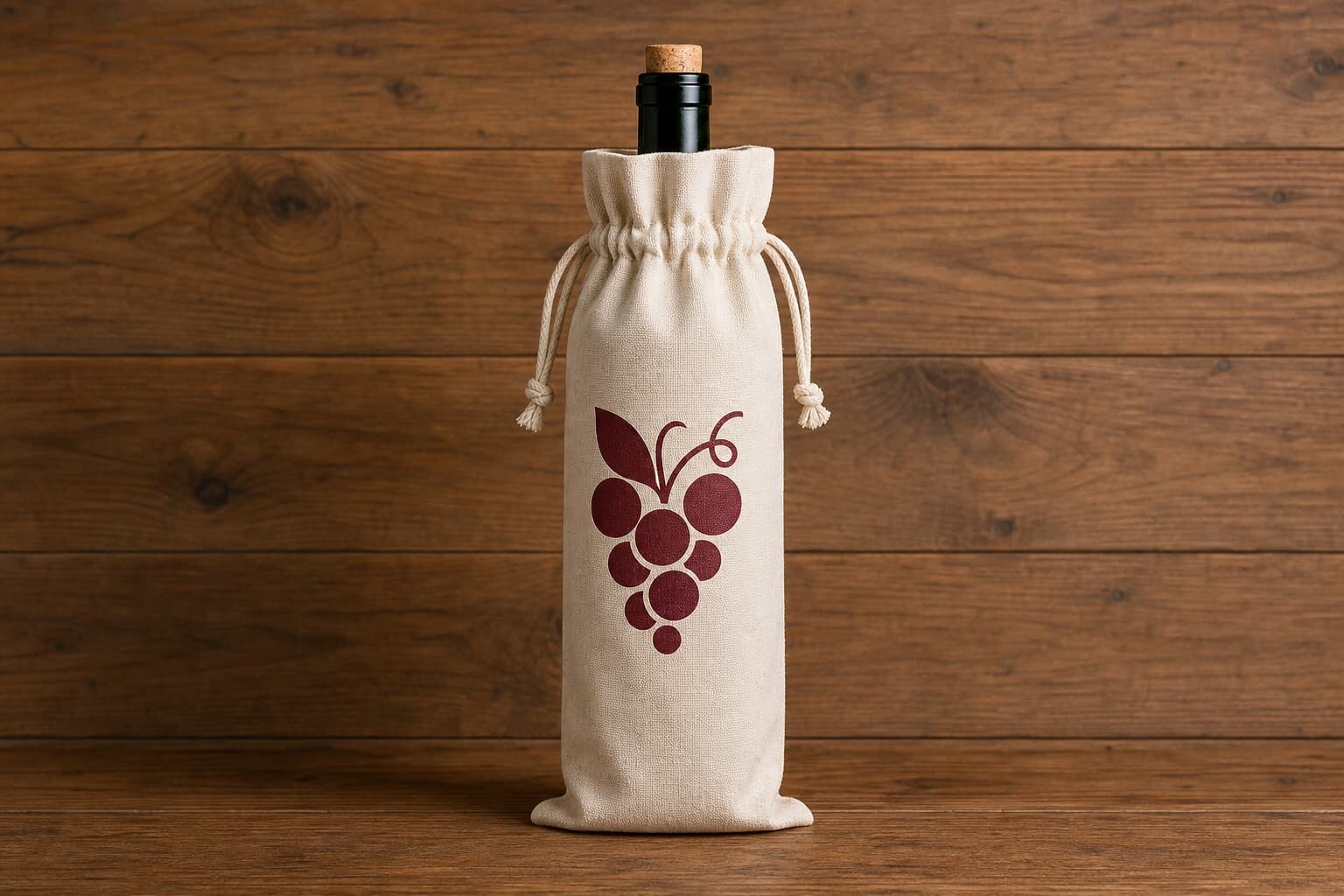
1. Start With the Bottle, Not the Bag
Most wine bag problems begin because the RFQ says “standard wine bag” without defining the actual bottle. A 750ml Bordeaux bottle, Burgundy bottle, champagne bottle, spirits bottle, and olive oil bottle can all require different width, height, gusset, and closure positions. If the bag is too narrow, the buyer gets seam stress and ugly distortion. If it is too tall, the bottle sinks and the branding sits too low.
Before asking for a wholesale wine and bottle bags quote, confirm what the bag must carry and how the end user will handle it. A retail gift bag only needs to present well at the counter. A two-bottle carrier used for distribution samples needs stronger handles, more stable bottom construction, and possibly a divider. A reusable wine tote for loyalty programs needs better fabric and stitching than a one-time promotional sleeve.
- For a single 750ml wine bottle, common finished sizes are around 14-16cm wide x 34-38cm high, with or without a 7-10cm gusset.
- For champagne bottles, allow extra width and neck height; do not copy a narrow wine bottle pattern.
- For two-bottle bags, specify bottle diameter, divider width, and whether both bottles must fit with labels facing forward.
- If the bag is for boxed retail display, confirm whether it must stand upright when empty or only when filled.
2. Choose Material and GSM Based on Use, Not Only Unit Price
Wine and bottle bags are small products, so buyers sometimes treat fabric as a minor detail. In production, fabric choice controls print quality, seam strength, appearance, folding thickness, carton volume, and buyer complaints. A 140gsm cotton wine bag may be fine for a tasting event giveaway, but it will not feel like premium gift packaging. A 12oz canvas two-bottle carrier looks substantial, but it costs more to cut, sew, and ship.
Ask suppliers to quote the exact fabric weight and construction, not only “cotton,” “canvas,” or “jute.” Cotton can mean 120gsm plain weave or 10oz canvas. Jute can be loose, hairy, laminated, dyed, blended with cotton, or backed with a lining. Non-woven can be 60gsm, 80gsm, 100gsm, or laminated. If competing quotes do not specify GSM, you are probably comparing different products.
- 120-140gsm cotton: budget single-bottle sleeve, light giveaway, less structure.
- 160-180gsm cotton: common promotional wine bag with better print surface.
- 6oz-8oz cotton canvas: better hand feel for reusable gift packaging.
- 10oz-12oz canvas: stronger carrier for two bottles or premium programs.
- 250-320gsm jute: rustic gift packaging, strong visual texture, print limitations.
- 80-100gsm non-woven: economical promotion, wide color choices, less premium perception.
3. Define Construction Details That Affect Strength
For wine bags, the sewing line is often more important than the visible fabric. The bottle is heavy, rigid, and narrow, so load concentrates at the bottom corners, side seams, drawstring channel, and handle attachments. A beautiful logo does not matter if the bottom seam opens when a customer carries two glass bottles to a car.
Your RFQ should describe the bag structure in practical language. State whether the bag has a bottom gusset, side gussets, boxed bottom, inserted base, drawstring channel, side handle, top handle, divider, lining, or lamination. For two-bottle carriers, ask how the divider is fixed and whether it reaches the bottom. Loose dividers can twist and make packing difficult.
- Use lockstitch or secure overlock plus lockstitch depending on fabric and seam type.
- Request reinforced stitching at handle ends, such as box stitch or bar tack where suitable.
- Confirm the drawstring channel height and seam allowance so the cord moves smoothly.
- For jute bags, check edge finishing because loose fibers can shed inside cartons.
- For laminated jute or non-woven, confirm the stitching needle does not create tearing along perforation lines.
- For multi-bottle bags, require a practical bottle load test before shipment.
4. Match Print Method to Fabric Texture and Artwork
Printing on wine bags is not the same as printing on smooth paper packaging. Natural cotton has shade variation. Canvas absorbs ink differently across yarns. Jute has a coarse surface that breaks fine lines. Non-woven can distort under heat if the process is wrong. A supplier can quote a low price by choosing the easiest print method, but that may not match the brand artwork.
For most cotton and canvas wine bags, screen printing is the safest option for solid logos, simple type, and one to three colors. Heat transfer or digital printing may work for gradients, detailed graphics, or short runs, but the buyer should approve hand feel and edge appearance. Embroidery is possible on heavier canvas, but it can distort light fabric and increases production time. Woven labels or sewn side labels are useful when the bag surface is too textured for sharp printing.
- Provide vector artwork with Pantone references, not only a JPG from a catalog.
- State print size in centimeters and position measured from top edge, side seam, or bottom.
- Ask whether ink is water-based, plastisol, pigment, or transfer film depending on fabric.
- For jute, avoid tiny text, thin outlines, and small QR codes unless tested.
- For natural cotton, approve a realistic color tolerance because the fabric base is not pure white.
- Request rub testing on dark prints and fold testing for prints crossing creases.
5. Understand MOQ Logic Before You Build the Assortment
MOQ for wholesale wine and bottle bags is rarely only one number. The practical MOQ depends on fabric procurement, dyeing, cutting setup, print setup, cord color, packing materials, and carton labeling. A supplier may say 1,000 pieces MOQ, but that can mean 1,000 pieces per color, per logo, or per size. If your program has six bottle bag designs, the real production plan may be very different from your first estimate.
When comparing quotes, separate base bag MOQ from customization MOQ. Stock fabric with one-color screen print can usually start lower than custom dyed canvas with printed lining and retail packaging. For seasonal promotions, the best way to control MOQ is to reduce the number of fabric colors, keep the same bag size across SKUs, and change only the printed logo or paper tag where possible.
- Ask MOQ per finished size, because changing gusset or height changes cutting patterns.
- Ask MOQ per fabric color, especially for dyed cotton, canvas, non-woven, or ribbon.
- Ask MOQ per print design and per print color because screens and setup time change.
- Ask MOQ per packing style if some units need retail polybags, barcodes, or gift tags.
- Confirm whether overproduction or underproduction tolerance applies to custom orders.
- If you need many SKUs, request a mixed-assortment quote with clear line-item minimums.
6. Require Samples That Prove the Bulk Order, Not Decoration Samples Only
A common mistake is approving a sample that only proves the shape, while the bulk order uses different fabric, different cord, different ink, or different packing. For a serious import order, the pre-production sample should represent the final product as closely as possible. If the supplier cannot use exact bulk fabric at sample stage, they should say so clearly and send swatches for confirmation.
Use the sample stage to test practical performance. Insert the actual bottle, pull the drawstring, lift the bag repeatedly, check whether the bottom stands, and place the printed area under normal store lighting. A wine bag can look acceptable flat on a table but fail when filled because the print curves around the bottle or the logo sits too low.
- Check finished size with bottle inserted, not only when the bag is flat.
- Check whether the neck closure works without bunching too much fabric.
- Check handle comfort when carrying one or two filled bottles.
- Check print alignment after the bag is filled, especially on narrow panels.
- Check if fold lines damage print or create visible creases in retail packing.
- Keep the approved sample sealed and referenced in the purchase order.
7. Build a Quote Sheet That Makes Suppliers Comparable
A useful wine bag quote is more than unit price. Procurement teams need to know what is included, what is excluded, and what changes the cost. Two suppliers can quote the same bag at different prices because one includes heavier fabric, better packing, screen charges, and export cartons, while the other assumes lighter material and bulk loose packing.
Ask for a line-item quote format. The base product price should identify fabric, GSM, size, construction, print method, number of print colors, packing, carton quantity, estimated carton size, and lead time. Setup charges and sample charges should be separate. This makes negotiation cleaner because you can decide whether to reduce fabric weight, simplify print, change packing, or combine SKUs.
- Base unit price with exact material, GSM, size, and construction.
- Print charge by method, color count, print size, and print position.
- Setup charges such as screens, plates, cutting mold, or artwork adjustment.
- Sample cost and sample courier cost, with sample lead time.
- Packing cost for individual polybag, paper band, hangtag, barcode, or master carton.
- Estimated carton quantity, carton dimensions, gross weight, and CBM.
- Bulk lead time after deposit, artwork approval, and sample approval.
- Trade term used in the quote, such as EXW, FOB, or other agreed basis.
8. Control Packing, Carton Volume, and Retail Handling Early
Packing is not just an afterthought for wine bags. A flat cotton sleeve can be packed in tight bundles, while a structured two-bottle jute carrier may take much more carton volume. If the bag has an inserted base, thick handles, or rigid lamination, the carton size can increase quickly. Freight cost may change the real landed cost more than a small unit price difference.
Retail buyers should define how the bag will arrive at store or warehouse. If each bag needs a barcode, hangtag, individual polybag, paper belly band, or shelf-ready carton, include that in the RFQ. If the product is going into a gift set packing line, the folding method and bundle count must match the packer’s workflow. A bag folded through the printed logo may arrive with permanent creases.
- State whether bags should ship flat, half-folded, rolled, or shaped.
- Set a maximum carton gross weight that warehouse teams can handle safely.
- Confirm pieces per inner bundle and pieces per master carton.
- Avoid folding across heavy ink areas, transfer prints, or embossed labels.
- Confirm carton marks, SKU labels, barcode stickers, and country-of-origin marking where required.
- Ask for packed carton photos before shipment for first orders.
9. Set Practical Lead Time Milestones
Lead time should be managed as a sequence, not a single number. Wine bag production may include fabric purchase, dyeing, cutting, printing, sewing, trimming, inspection, packing, and booking. If artwork is late or the sample is revised twice, the bulk shipment date moves. During seasonal gift periods, print and sewing capacity can also become tight.
A realistic purchase plan separates sample lead time from bulk lead time. It also states what triggers production: deposit received, artwork approved, fabric approved, or pre-production sample approved. For custom dyed fabric, printed lining, multi-color logos, or special retail packing, add buffer. For repeat orders using approved fabric and artwork, timelines are usually easier to control, but still confirm capacity before launching a promotion.
- Artwork review and technical confirmation: often the first hidden delay.
- Sample making: depends on fabric availability and print method.
- Sample approval: include buyer review and possible courier transit time.
- Bulk fabric preparation: longer if dyed or custom woven.
- Printing and curing: affected by color count, drying time, and weather for some processes.
- Sewing and finishing: affected by construction complexity and order mix.
- Inspection and packing: do not compress this stage if retail accuracy matters.
10. Use Acceptance Criteria to Prevent Disputes
The best time to define quality is before production starts. If the purchase order only says “good quality,” both sides are exposed. The buyer may reject goods based on expectations the factory never priced, and the factory may ship products that pass its internal standard but fail retail inspection. For wine and bottle bags, acceptance criteria should cover size, fabric, stitching, printing, appearance, load performance, packing, and labeling.
Do not create unrealistic zero-defect requirements for handmade textile products, but do define what is critical. A loose thread may be minor if trimmed easily. A weak handle, wrong barcode, incorrect logo color, mildew odor, or undersized bag is serious. If you use third-party inspection, share the checklist with the factory before production so they can prepare the same standard internally.
- Size tolerance: define acceptable variation for width, height, gusset, and handle length.
- Fabric tolerance: approve shade range, GSM range, texture, and acceptable natural slubs for cotton or jute.
- Stitching: reject broken seams, skipped stitches at stress points, open bottom corners, or insecure dividers.
- Printing: reject wrong artwork, major position shift, poor curing, heavy smudging, or unreadable text.
- Function: reject bags that cannot fit the approved bottle or fail agreed load testing.
- Packing: reject wrong SKU mix, wrong barcode, wet cartons, crushed cartons, or missing carton marks.
Specification comparison for buyers
| Spec decision | Recommended option | When it fits | Buyer risk to check |
|---|---|---|---|
| Single-bottle promotional wine bag | 140-180gsm cotton or 160-220gsm non-woven with drawstring | Retail promotions, winery tasting events, seasonal giveaways, lighter glass bottles | Thin fabric may show bottle outline, print may bleed on loose weave, cord channel must not tear under load |
| Premium single-bottle gift bag | 220-280gsm cotton canvas, 10-12oz canvas, or 250-320gsm jute | Gift sets, brand boutiques, corporate gifting, reusable packaging programs | Higher GSM changes folding thickness, freight volume, and may require longer stitching time |
| Two-bottle carrier | 10-12oz canvas or laminated jute with internal divider and reinforced handles | Retail carryout, wine clubs, distributor samples, holiday gift packs | Divider size must match bottle diameter; handle attachment needs reinforcement stitching |
| Printing for simple logos | Screen print with 1-3 solid colors | Most cotton, canvas, jute, and non-woven wine bags with flat print areas | Confirm Pantone tolerance, ink coverage on textured jute, and curing method |
| Printing for photographic or gradient artwork | Heat transfer or digital print on suitable cotton/canvas panels | Short runs, multi-color branding, seasonal artwork, online retail collections | Transfer hand feel, wash/rub resistance, and edge film visibility must be approved on sample |
| Closure method | Cotton cord drawstring, ribbon tie, hook-and-loop, or snap button depending on positioning | Drawstring for standard wine bags; ribbon for gift packaging; snap for reusable carriers | Cord length and end finishing affect safety, appearance, and packing speed |
| Packing for ecommerce-ready retail | Individual polybag or paper belly band with carton drop-tested to agreed export standard | Marketplace sellers, gift stores, subscription boxes, retail distribution | Extra packing increases unit cost and carton CBM; barcode placement must match retailer rules |
| MOQ planning | Separate MOQ for fabric color, bag size, print color, and packing style | Orders with multiple SKUs, mixed logo colors, or seasonal assortments | A quoted MOQ may apply per design, not total order quantity; confirm before approval |
Buyer checklist before sampling
- Confirm the bottle type: 750ml wine bottle, champagne bottle, spirits bottle, olive oil bottle, or mixed bottle sizes.
- Provide finished bag dimensions in width x height x gusset, not only bottle volume.
- Specify material composition and target fabric weight, such as 6oz cotton, 10oz canvas, 250gsm jute, or 80gsm non-woven.
- State whether the bag must stand upright when filled and whether a bottom gusset or inserted base is required.
- Define handle or drawstring material, cord diameter, length, color, and end finishing.
- Provide artwork files in vector format and list Pantone colors, print size, print position, and whether color matching is required on natural fabric.
- Ask the factory to quote tooling, screen, plate, sample, packing, and carton costs separately.
- Clarify MOQ per size, fabric color, logo design, print color, and packing method.
- Request a pre-production sample made with bulk fabric, bulk cord, bulk print method, and final packing style.
- Define inspection criteria for stitching strength, print adhesion, shade tolerance, size tolerance, odor, stains, carton marking, and barcode accuracy.
Factory quote questions to send
- What fabric construction and GSM are included in your quote, and can you provide a swatch photo or physical swatch before sampling?
- Is the MOQ calculated per total order, per bag size, per fabric color, per print design, or per packing style?
- What finished size tolerance can you hold for wine bags with gussets and drawstring channels?
- Which print method do you recommend for our artwork on this fabric, and what are the expected limitations on fine lines, gradients, and Pantone matching?
- Are screen setup, digital artwork handling, cutting mold, sample, and courier charges included or separate?
- Will the pre-production sample use actual bulk fabric and actual printing, or substitute material?
- What reinforcement is included at handles, side seams, bottom seams, and divider seams for multi-bottle carriers?
- How many pieces are packed per inner polybag or bundle, and what is the estimated carton size and gross weight?
- What quality checks are done before packing, and can you share an inspection report format or AQL plan?
- What is the production lead time after deposit and sample approval, and what may extend it during peak season?
Quality-control points to confirm
- Check finished bag size against approved sample and tolerance, especially height after drawstring channel sewing.
- Confirm fabric GSM by weighing a measured fabric piece or checking mill documentation against the approved swatch.
- Inspect handle attachment, drawstring channel, bottom seam, gusset corners, and divider seams for skipped stitches or weak reinforcement.
- Perform a practical load test using the intended bottle weight plus margin, especially for two-bottle and champagne carriers.
- Check print position, color, adhesion, ink coverage on textured fabric, curing, rubbing resistance, and cracking on folds.
- Review fabric shade consistency across cartons, especially for natural cotton, dyed canvas, jute, and colored non-woven.
- Check odor, mildew, oil marks, loose threads, stains, dust, and broken fibers before final packing.
- Confirm carton markings, SKU labels, barcodes, inner pack quantity, polybag warnings where required, and carton weight.
- Compare packed carton dimensions against the quote because small folding changes can increase freight volume.
- Keep one approved pre-production sample and one sealed bulk reference sample for dispute control.