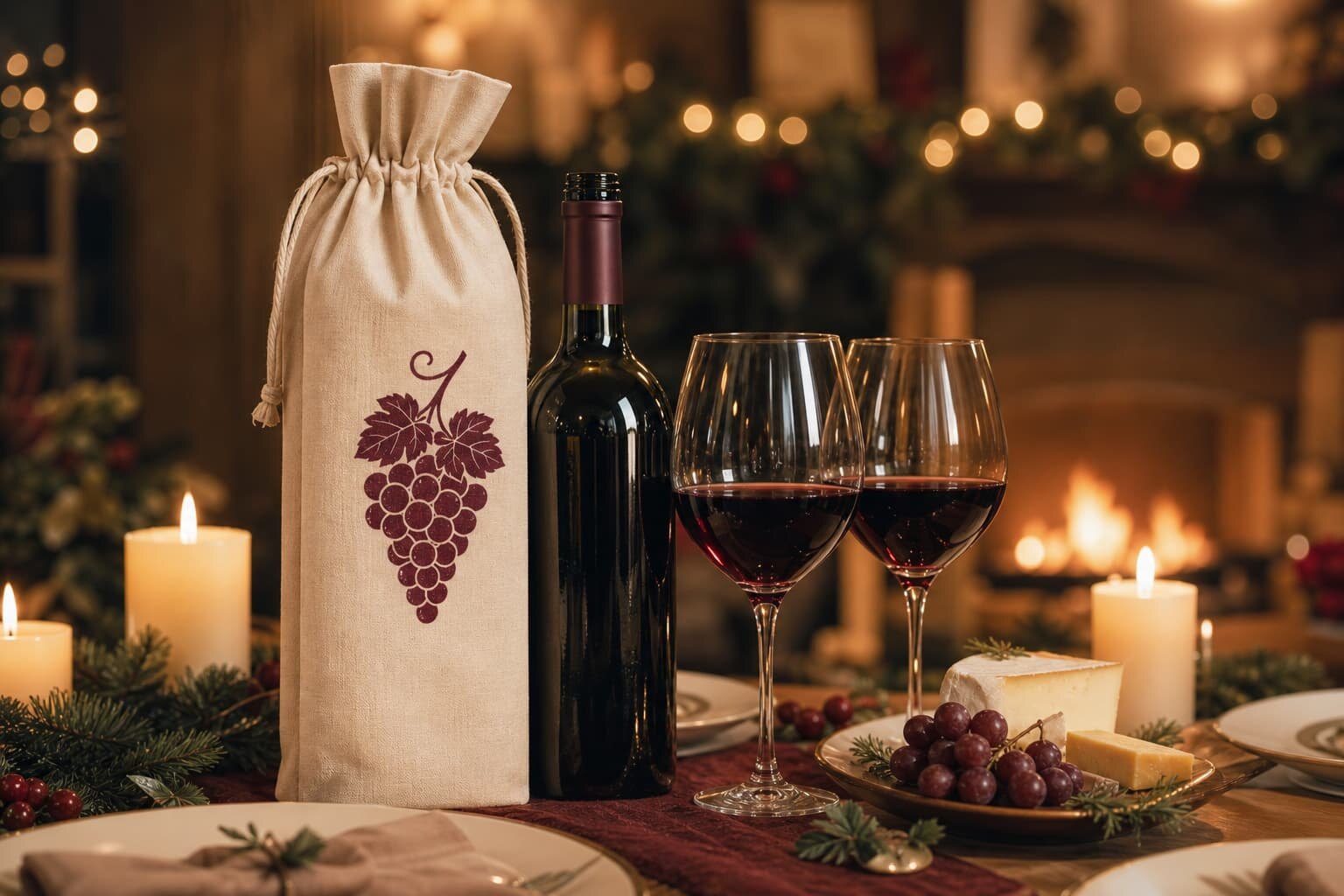
1. The sample review problem: a nice flat bag is not enough
Wine and bottle bags often look acceptable when they are empty and placed flat on a table. The real test starts when a bottle is inserted, the drawcord is pulled, and the bag is handled like it will be handled in a store, warehouse, gift counter, or delivery kit. Many sample approvals fail because the buyer reviewed the surface artwork but did not check bottle fit, seam stress, handle strength, packing shape, or bulk material availability.
For procurement teams, the purpose of a wholesale wine and bottle bags sample review is not to admire a prototype. It is to remove ambiguity before the factory cuts bulk fabric. The sample should confirm the commercial specification: material weight, finished size, closure, print method, packing method, and inspection standard. If any of these points are missing, two suppliers can quote the same-looking bag but deliver very different quality and landed cost.
- Review the sample with the actual bottle or a confirmed bottle drawing, not only by bag dimensions.
- Insert the bottle before checking logo position, because fabric curves around the shoulder and changes visual alignment.
- Ask whether the sample is made from bulk-available fabric or only from sample-room stock.
- Treat the sample as a production reference: approve, reject, or approve with written corrections.
2. Start with bottle profile and finished bag size
The biggest avoidable mistake is ordering one standard wine bag size for several bottle types without testing the largest and widest profile. A common 750ml Bordeaux bottle is usually easier to fit than a Burgundy bottle with a wider body. Champagne and sparkling wine bottles need more width and gusset space. Spirits, olive oil, vinegar, and premium water bottles may be taller, squarer, or heavier than a normal wine bottle.
When reviewing the sample, measure the empty bag first, then measure it again with the bottle inserted. If the width is too tight, the seams carry extra stress and the print can distort. If the bag is too tall, the product looks loose and low-value. If the bag is too short, the bottle neck may show when the buyer expected full coverage. Your RFQ should state the bottle type, bottle dimensions, and expected coverage.
- Common single-bottle drawstring bag reference: about 15 x 35 cm for many 750ml wine bottles, but confirm by bottle profile.
- For Champagne or wider Burgundy bottles, request extra width or a side gusset instead of forcing the same flat size.
- For bottle carriers with handles, check center of gravity when the bottle is inside.
- If one bag must fit several products, approve it using the largest bottle and visually check it on the smallest bottle.
3. Compare material options by weight, structure, and use case
Fabric choice drives appearance, strength, print result, MOQ, and freight. Cotton wine bags are common for reusable gift packaging and brand promotions. A 6 oz cotton bag can be suitable for light promotional use, while 8 oz to 10 oz cotton canvas gives better structure and a more premium hand feel. In GSM terms, this often sits roughly around 170-280 GSM depending on weave and finishing. Do not compare only by the word cotton; compare by fabric weight, weave, color, and finish.
Jute and burlap bottle bags give a natural look but require closer sample review. The weave can be uneven, fiber shedding is normal to a degree, and odor control matters. Laminated jute can improve structure and reduce fraying, but it changes the hand feel and may affect recyclability claims. Non-woven PP is cost-efficient for seasonal programs, but buyers should verify GSM and seam method because low-cost bottle bags can tear if the handles or side seams are underbuilt.
- Cotton 6 oz: economical, soft, suitable for simple drawstring gift bags.
- Cotton 8-10 oz: better opacity and structure for retail-quality branding.
- Jute 12-14 oz: stronger rustic look, but inspect odor, fiber shedding, and print sharpness.
- Non-woven 80-100 GSM: budget option for high-volume promotions; check seam strength carefully.
- Canvas or cotton-linen blends: useful for premium gift sets but require clear composition and shrinkage discussion.
4. Review print method before approving artwork
Wine and bottle bags are often printed on narrow panels, curved surfaces, textured jute, or drawstring areas. A print that looks centered on the flat sample may shift once the bottle stretches the fabric. For most wholesale orders with one to three solid colors, screen printing is practical and cost-effective. It gives good opacity on cotton and canvas, but heavy ink coverage can make the panel stiff. On jute, ink edges may not be as sharp because of the open weave.
Heat transfer can handle gradients, small details, or full-color artwork, but the buyer should check film edge, cracking, and flexibility around the bottle shoulder. Embroidery and woven labels can look premium, but they add cost and may have higher MOQ or longer lead time. For dark fabrics, ask whether the quote includes a white underbase or if the logo color will appear dull. For metallic, gold, or holiday artwork, confirm the exact method instead of assuming the factory can match a digital file.
- Check logo position with the bottle inserted and the drawstring closed.
- Request printed strike-off approval when artwork is color-sensitive.
- Use Pantone references for solid brand colors, but allow reasonable fabric-related variation.
- For jute, avoid very small reversed text and thin lines unless the factory has tested it.
- For transfer printing, fold and rub the printed area to check film durability.
5. Check seams, handles, drawcords, and closure function
A bottle bag carries a hard, heavy object. The failure points are usually not the middle of the fabric; they are side seams, bottom corners, handle attachments, drawstring channels, and cord ends. A single-bottle cotton drawstring bag may not need the same reinforcement as a six-bottle carrier, but it still needs clean stitching and a channel that does not tear after repeated closing. If the sample has skipped stitches or uneven seam allowance, expect more variation in bulk unless you correct it before approval.
For handled bottle carriers, pull each handle upward and outward, then check the stitch box, bar-tack, or reinforcement area. For drawstring styles, close the bag several times and look for cord friction, fabric puckering, loose knots, and cord length. If the bag is used at retail checkout, the handle drop must feel comfortable. If it is used in a gift box, extra handle height may create packing problems. Function should match the selling channel, not just the design sketch.
- Side seams should be straight, without skipped stitches, open seams, or loose thread nests.
- Drawcord length should be consistent on both sides after closing.
- Cord ends should be knotted, tipped, or finished according to the approved sample.
- Handle attachment should be reinforced for bottle weight, especially for jute and non-woven carriers.
- Bottom corners should not show stress holes after inserting and removing the bottle several times.
6. MOQ logic: why the same bag can have different minimums
Buyers often ask for the MOQ as if it is one fixed number. In factory production, MOQ depends on fabric procurement, dyeing, cutting efficiency, print setup, accessory sourcing, and packing requirements. A natural cotton wine bag in a standard size may have a lower MOQ than a custom dyed canvas bag with a special cord color. A jute bag with a common natural fabric may be easier than a laminated colored jute panel that must be ordered from a mill.
When comparing supplier quotes, ask MOQ by specification component. One supplier may accept a low total quantity but charge high setup fees, use stock fabric, or limit color choices. Another may quote a higher MOQ because they are pricing true custom material. Neither is automatically wrong, but the procurement team needs to know what is fixed and what can be adjusted. If your launch quantity is small, keep the fabric natural, the size standard, and the print simple.
- Lower MOQ is more realistic with natural cotton, natural jute, standard non-woven colors, and one-color screen print.
- Higher MOQ may apply to custom dyed fabric, special drawcords, woven labels, full-color transfer prints, or multi-size assortments.
- MOQ can apply per design, per color, per size, per print artwork, or per shipping carton configuration.
- Ask whether sample charges and setup charges are separate from unit price.
- For distributors, consider ordering one shared base bag with different printed labels or hangtags if SKU quantities are small.
7. Cost breakdown points to compare in supplier quotes
A useful quote should show more than unit price. For wholesale wine and bottle bags, cost is affected by fabric weight, wastage from bag size, number of print colors, print area, handle or cord material, sewing complexity, packing labor, carton volume, and inspection requirements. A heavier canvas bag may look better but increases fabric cost and carton weight. A large front-and-back print may require more ink, more drying time, and a higher defect risk.
Ask suppliers to separate cost drivers where possible. You do not need a full factory cost sheet, but you do need enough data to compare offers. If two quotes differ by 15 percent, the reason may be fabric GSM, lamination, printing method, packing, or carton quantity. Without those details, a cheaper quote can become expensive after failed inspection, repacking, or customer complaints.
- Fabric: composition, GSM or ounce weight, color, lamination, washing or finishing.
- Cut and sew: finished size, gusset, handle style, drawstring channel, reinforcement.
- Print: method, color count, print area, one side or two sides, setup charge.
- Accessories: cotton cord, polyester cord, jute rope, webbing handle, label, hangtag.
- Packing: individual polybag, paper band, inner carton, master carton, retail barcode label.
- Logistics: carton size, gross weight, CBM, loading quantity, and whether bags are compressed.
8. Packing review: protect the print and control warehouse handling
Packing is not a small detail for bottle bags. Cotton and canvas bags can crease through the logo if folded badly. Heat transfer prints can mark if packed under pressure before fully cured. Jute bags can shed fibers into cartons. Non-woven bags can deform if over-compressed. If the bags are going directly to retail stores or kitting lines, inconsistent packing creates extra labor and delays.
During sample review, ask for a packing mock-up or at least a written packing plan. Confirm whether each bag is flat packed, half-folded, bundled by 25 or 50 pieces, individually polybagged, or packed with a paper band. Sustainability teams may prefer no individual polybag, but humidity, jute odor, and warehouse dust still need consideration. The right packing method depends on destination, storage time, retail requirements, and whether the product will be handled again before final sale.
- Avoid folding directly across large printed logos when possible.
- Request carton marks by SKU, artwork, size, quantity, gross weight, and destination if needed.
- For mixed-SKU orders, require inner packs or dividers to prevent sorting errors.
- Confirm carton strength if the cartons will be stacked for long storage.
- Ask for estimated carton dimensions before booking freight because bottle bags can be bulky even when lightweight.
9. Lead time: sample approval must match production reality
Lead time should be counted from approved artwork, approved sample, confirmed packing, deposit or payment arrangement, and material availability. If any of those items remain open, the factory cannot accurately reserve production capacity. A common procurement mistake is approving the look of a sample but leaving print color, carton label, or bottle fit unresolved. The order then enters production with questions still active, causing rework or delay.
Ask the factory to separate sample lead time, material preparation time, bulk production time, and packing time. For a simple stock-fabric cotton drawstring wine bag, sampling and production can be more straightforward. For custom dyed fabric, laminated jute, multi-color printing, or retail packing, more steps are involved. Do not force a short lead time by skipping sample corrections; bottle bag defects are highly visible because they are used as gift packaging.
- Confirm whether the quoted lead time starts after sample approval or after deposit only.
- Ask if fabric is in stock or must be woven, dyed, laminated, or specially purchased.
- Allow extra time for printed strike-offs if brand color matching is important.
- Freeze artwork before bulk cutting and printing to avoid mixed versions.
- For seasonal wine programs, build in time for inspection, rework if needed, and freight buffer.
10. Approval criteria before moving from sample to bulk
The safest approval is not a short email saying the sample looks good. It should list what is approved and what must change. For example, the buyer may approve the fabric and size but require the logo to move up 10 mm, the drawcord to be 5 cm longer, and the carton packing to change from folded to flat. This written approval becomes the reference for the production team, merchandiser, and final inspection.
Keep one approved physical sample with the factory and one with the buyer if the order value justifies it. Mark the approved sample with date, version, fabric GSM, print method, and any accepted tolerance. If you only approve photos, color, hand feel, and stitching details can be misunderstood. For repeat orders, compare the new pre-production sample against the previous approved version because mills, dye lots, and accessories can change.
- Approve with version control: sample 1, revised sample 2, or pre-production sample.
- Record accepted fabric GSM, finished size, print colors, and packing method.
- State tolerances for size, color, print placement, and minor fabric variation.
- Reject samples with functional issues such as poor bottle fit, weak seams, or unstable handles.
- Do not authorize bulk production until the quote, sample, artwork, and packing plan match the same specification.
Specification comparison for buyers
| Spec decision | Recommended option | When it fits | Buyer risk to check |
|---|---|---|---|
| Cotton wine bag fabric | 6 oz to 10 oz cotton canvas, usually 170-280 GSM | Gift packaging, winery retail, supermarket promotion, brand reusable packaging | Thin cotton may show bottle outline too strongly; heavy canvas may increase freight and make drawstring closure stiff |
| Jute bottle carrier fabric | 12 oz to 14 oz laminated or unlaminated jute with cotton webbing handles | Rustic gift sets, natural product positioning, higher perceived value | Jute shedding, odor, uneven weave, and print edge bleeding need sample approval before bulk |
| Non-woven bottle bag | 80-100 GSM PP non-woven with heat-sealed or stitched seams | Low-cost seasonal retail, events, distributor giveaways | Weak seams and handle tear are common if the quoted GSM is not verified by cutting and weighing |
| Print method | Screen print for 1-3 solid colors; heat transfer for gradients; woven label for premium texture | Most wine bag programs with logos, holiday artwork, or distributor branding | Large ink coverage can stiffen fabric; transfer film may crack if folded sharply around the bottle shoulder |
| Closure style | Double cotton drawcord for soft bags; stitched handles for carrier bags | Drawstring for single-bottle gift bags; handles for retail carryout and multi-bottle packs | Short cords, loose knots, or handle bar-tacks without reinforcement can fail during store handling |
| Bottle fit | Allow room for 750ml Bordeaux, Burgundy, and Champagne shapes if mixed use is expected | Brands or distributors selling multiple bottle profiles through one packaging SKU | A sample that fits one slim bottle may not fit a sparkling wine bottle or tall spirits bottle |
| Packing method | Flat packed in export cartons with inner polybag or paper banding by SKU | Importer warehouse receiving, retail store distribution, or kitting projects | Over-compression can crease print areas and distort jute panels; loose packing increases carton volume |
Buyer checklist before sampling
- Confirm the sample bag fits the exact bottle types you will sell: 750ml Bordeaux, Burgundy, Champagne, spirits, olive oil, or custom bottle.
- Measure finished width, height, gusset, handle drop, drawcord length, and seam allowance against the approved spec sheet.
- Check fabric GSM by supplier declaration and, for high-volume orders, request a cut-weight verification from the factory.
- Review print position with a bottle inserted, not only when the bag is lying flat.
- Rub the print dry and lightly damp to check ink transfer, cracking, or poor curing.
- Pull handles, drawcords, and side seams by hand to identify weak stitching before laboratory testing or bulk approval.
- Check jute odor, cotton shrinkage risk, non-woven thickness, and any lamination stiffness.
- Confirm if sample materials are bulk-available or substituted from sample-room stock.
- Open and close the bag several times to check drawstring channel friction and closure quality.
- Inspect packing proposal: pieces per inner pack, carton quantity, carton size, gross weight, and whether bags are flat or folded.
Factory quote questions to send
- Which exact fabric composition and GSM are included in your quote, and what tolerance should we allow in bulk production?
- Is the sample made from the same fabric, drawcord, handle tape, and accessories that will be used for bulk?
- What bottle size was used to check the sample fit, and can you test our supplied bottle or technical drawing?
- Which print method is quoted, how many colors are included, and what is the maximum printable area on each panel?
- Do you charge separate screen, plate, mold, label, or sample fees, and are any refundable after order confirmation?
- What MOQ applies by bag style, fabric color, print color, and size, not only by total order quantity?
- What is the estimated production lead time after sample approval and deposit, excluding international transit?
- How will the wine bags be packed: flat, folded, individually polybagged, bundled, or master carton only?
- Can you provide carton dimensions, estimated gross weight, and loading quantity for freight comparison?
- What in-line and final inspection checks are performed, and what defects are considered major for bottle bags?
Quality-control points to confirm
- Finished size tolerance: normally keep width and height within an agreed tolerance such as plus or minus 5 mm for standard fabric bags, but define tighter tolerance if the bag must fit a rigid gift box.
- Bottle fit: test the approved sample with every bottle profile that will be packed, especially Champagne, Burgundy, spirits, and olive oil bottles.
- Fabric weight: verify GSM or ounce weight because a small downgrade can reduce structure, opacity, and perceived value.
- Stitching: check side seam consistency, skipped stitches, loose threads, reinforced handle positions, and drawstring channel strength.
- Print quality: confirm color, registration, ink hand feel, curing, edge sharpness, and alignment after the bottle is inserted.
- Closure function: drawcords should close smoothly without cutting into the fabric channel or leaving the bottle neck exposed if full coverage is required.
- Jute condition: inspect odor, shedding, oil marks, uneven lamination, and loose fibers around seams.
- Packing condition: ensure bags are not over-folded through the print area, compressed while ink is fresh, or packed with mixed SKUs without clear carton marks.