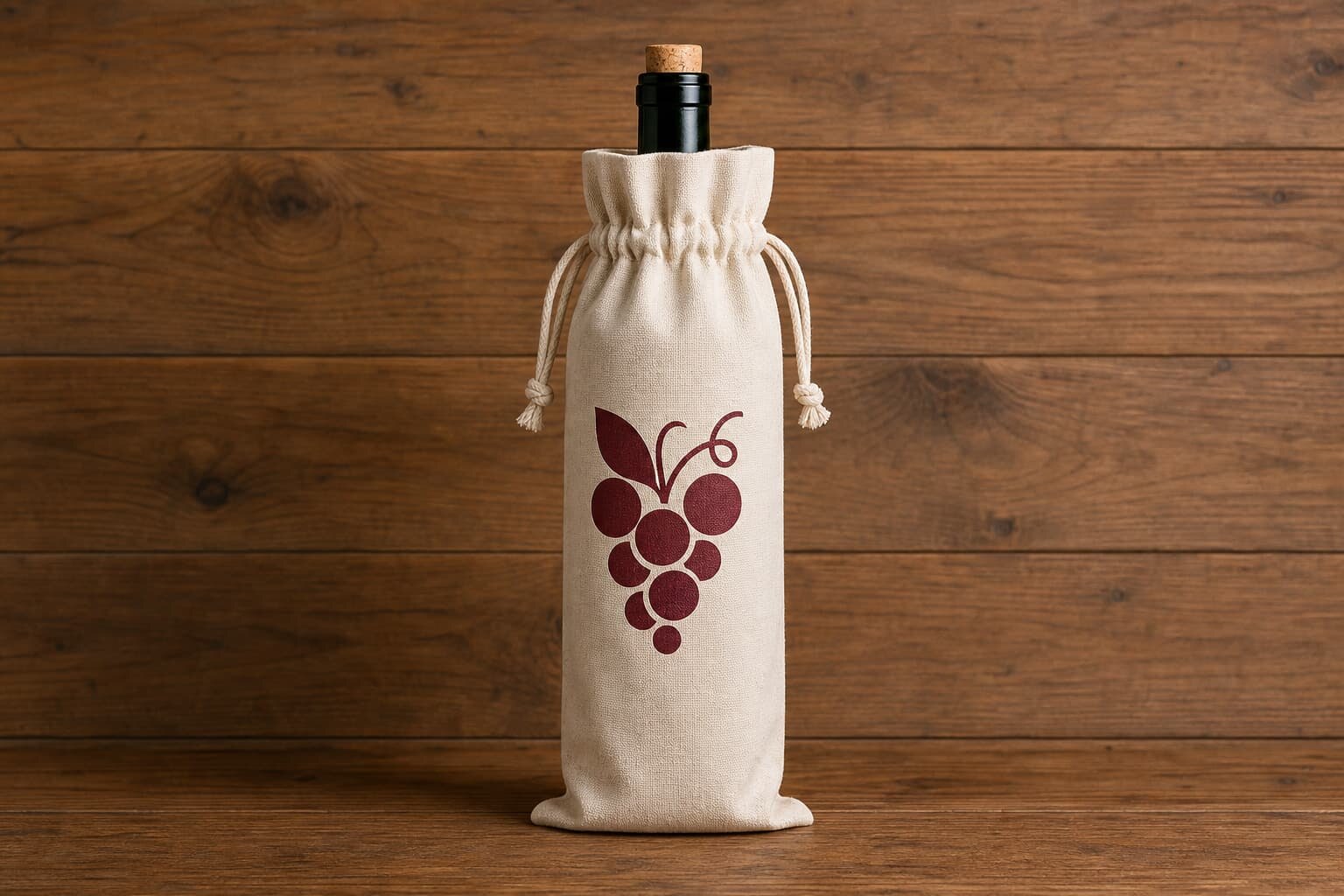
1. The buying problem: a nice sample can still fail in bulk
Wine and bottle bags look simple, but the sample review is where many procurement mistakes start. A buyer may approve a bag because the logo looks clean and the bottle fits once on the desk. Bulk production later exposes the real issues: the drawcord does not close over the bottle neck, the jute smells strong after sea freight, the cotton is thinner than quoted, or the handle stitching fails when a heavy sparkling wine bottle is inserted.
This wholesale wine & bottle bags sample review 05 guide focuses on one practical buying problem: how to approve a sample in a way that protects the bulk order. The goal is not to make a beautiful showroom sample. The goal is to define measurable specifications that a factory can repeat across cartons, colors, and purchase orders.
- Do not approve a bottle bag sample from photos only if bottle fit, standing shape, or handle strength matters.
- Do not compare quotes only by finished bag size and logo print. Material weight, trim, reinforcement, packing, and print process can change the real cost.
- Do not accept vague words such as 'canvas', 'jute', or 'eco material' without GSM, ounce, count, lamination, or composition.
2. Start sample review with the bottle, not the bag
The most common mistake is reviewing the bag before confirming the bottle range. A standard 750 ml wine bottle, Burgundy bottle, champagne bottle, spirit bottle, olive oil bottle, and tall sauce bottle can all require different height, diameter, shoulder clearance, and closure position. If the buyer only says 'wine bag', the factory may sample around a local standard bottle that is not the buyer's retail product.
For a single 750 ml bottle bag, procurement should define usable internal size, not only external finished size. Seam allowance, fabric thickness, gusset construction, and drawcord channel reduce usable space. For two-bottle and three-bottle carriers, divider width and bottom strength become more important than the printed panel.
- Send bottle height, maximum diameter, shoulder height, neck diameter, and filled weight.
- State whether the bag must fully cover the bottle, expose the neck, or close with a drawstring.
- Test the sample with the heaviest bottle in the range, not the easiest one.
- For champagne or spirits, check whether a wider gusset or reinforced bottom is needed.
- For retail shelves, test whether the filled bag stands upright without leaning.
3. Fabric weight and material choice: quote it in measurable terms
Wine bottle bags are made in cotton, canvas, jute, non-woven polypropylene, felt, kraft paper, polyester, and blended materials. For CottonToMaker's soft bag categories, the most frequent B2B choices are cotton, canvas, jute, and non-woven. Each option has a different cost structure and different failure mode. A cotton wine bag can look clean but feel too limp. Jute can look premium but may shed fibers or smell if not controlled. Non-woven can hit a low budget but may stretch at the handle.
When you compare supplier quotes, require material weight in a format that can be checked. Cotton and canvas are often quoted by ounce or GSM; common promotional wine bags may use 5 oz, 6 oz, 8 oz, or 10 oz cotton canvas depending on structure. Non-woven bottle bags are commonly specified around 80-100 GSM for better appearance than very light giveaway material. Jute should be described by weave quality, lamination, backing, and whether edges are bound or overlocked.
- Budget cotton drawstring wine bag: usually around 5-6 oz cotton, suitable for simple gifting but less structured.
- Mid-range cotton canvas wine bag: 6-8 oz, better print surface and more durable drawcord channel.
- Premium canvas or structured carrier: 10 oz or heavier, useful when shape, repeat use, or two-bottle weight matters.
- Jute wine bag: confirm natural jute count, lamination, odor control, edge finishing, and handle material.
- Non-woven bottle bag: confirm GSM, sewn versus heat-sealed seams, and handle reinforcement.
4. Construction details that separate a usable bag from a risky sample
A bottle is narrow, heavy, and hard. This makes seam construction more important than it looks. On a lightweight promotional pouch, a small seam weakness may not matter. On a wine bag, the full filled weight presses against the bottom seam and pulls against the handle or drawcord area. If the buyer only checks the logo, the construction risk remains hidden until warehouse handling or retail use.
For drawstring wine bags, check the drawcord channel, side seam crossing, bottom seam, cord thickness, cord length, and whether knots or cord ends are finished cleanly. For handled jute or canvas bags, check the handle insertion depth, bartack or cross-stitch, and whether the handle position allows a balanced carry. For multi-bottle bags, internal dividers must be fixed securely and should not collapse when bottles are inserted.
- Stitch density should look even and should not skip at thick fold points.
- Bottom seam should be straight, with enough seam allowance to avoid fraying.
- Handle attachment should be reinforced by bartack, box stitch, or other agreed construction.
- Drawcord should slide smoothly but not tear the channel when pulled tight.
- Inside loose threads should be trimmed, especially near glass bottles and gift presentation.
5. Print and branding: choose the method by material, not by habit
A wine bag is often used as branded gift packaging, so the print must look acceptable at close range. However, the best print method depends on material texture, logo detail, order quantity, and color count. Silkscreen printing is a reliable choice for simple logos on cotton, canvas, jute, and non-woven, but ink coverage on coarse jute will never look as sharp as on smooth cotton canvas. Heat transfer can handle gradients and small detail, but buyers should test cracking and edge lift after folding.
For premium bottle bags, buyers sometimes use woven labels, leather patches, cotton labels, embossing on PU trim, or small side labels. These can reduce printing risk on rough materials, but they add MOQ and sewing steps. When requesting a quote, specify print position by measurement from top edge or seam, not just 'front center'. A 5 mm shift may be acceptable for a casual promo item but not for retail packaging with strict brand guidelines.
- Silkscreen: good for solid logos, simple text, and economical bulk production.
- Heat transfer: useful for gradients, photographic effects, or multi-color artwork, but test fold resistance.
- Digital print: suitable for small runs or complex artwork on selected fabrics, but confirm hand-feel and colorfastness.
- Woven label: good for consistent small branding when fabric texture makes print less sharp.
- Embossed or patched branding: premium look, but quote separately for patch material, die, and stitching.
6. Sample approval workflow: do not treat one sample as final proof
A serious sample process usually has stages. First, the buyer may review available material swatches or blank reference samples. Then the factory makes a size-fit sample to confirm bottle compatibility. After artwork is approved, a printed sample or pre-production sample should confirm logo placement, color, material, construction, and packing method. Combining all decisions into one rushed sample increases the chance of hidden changes during bulk.
When the sample arrives, inspect it like an incoming quality inspector, not like a marketing reviewer. Measure it, weigh it, fill it, pull the handles, rub the print, fold it as packed, and photograph every approved detail. Then send the factory a written approval sheet that says exactly what is approved and what must be corrected. Verbal comments such as 'quality is okay, please improve stitching' are not enough for production control.
- Step 1: approve material swatch with GSM or ounce noted.
- Step 2: approve blank size-fit sample with actual bottle inserted.
- Step 3: approve printed or branded sample with logo size and position measured.
- Step 4: approve packing sample if creasing, display, barcode, or retail presentation matters.
- Step 5: approve pre-production sample before bulk cutting and printing.
7. MOQ logic: why the lowest MOQ may not be the cheapest order
Wholesale wine and bottle bag MOQ depends on fabric sourcing, dyeing, printing setup, trim, cutting efficiency, and packing. A factory may accept a small MOQ for natural cotton bags using stock fabric, but custom dyed canvas, special jute lamination, multiple print colors, custom woven labels, or mixed SKUs can change the minimum order. Buyers should ask for MOQ by specification line, not only a single total number.
For example, 3,000 pieces in one natural cotton fabric with one-color print is different from 3,000 pieces split across six artwork versions and three fabric colors. The second order creates more screen setup, color matching, cutting separation, packing control, and carton labeling work. If this is not declared in the RFQ, suppliers may quote aggressively first and revise after artwork review.
- Ask MOQ per material color, per size, per print design, and per logo color count.
- Ask whether stock fabric can reduce MOQ or lead time.
- Ask whether screen charges, label setup, and color matching fees are included.
- Ask whether mixed carton packing is allowed or if SKUs must be packed separately.
- Ask whether repeat orders can use the same screens, labels, or approved fabric reference.
8. Lead time and production planning: where delays usually happen
Lead time for wine bottle bags is affected by fabric availability, sample approval speed, artwork readiness, printing queue, sewing capacity, and packing requirements. Importers often ask for bulk lead time but forget sample iteration time. If the first sample needs resizing after bottle testing, the calendar changes. If print colors are rejected after the pre-production sample, production cannot start safely.
A practical timeline should separate sample lead time, buyer review time, material procurement, print preparation, bulk production, inspection, and shipment booking. Do not accept a lead time statement that starts from inquiry date. It should start from confirmed deposit, approved artwork, approved sample, and confirmed packing details, depending on the factory's process.
- Blank sample lead time may be shorter than printed sample lead time.
- Custom dyed fabric can add time compared with natural or stock fabric.
- Jute odor airing, lamination curing, or material inspection can affect schedule.
- Holiday seasons and gift campaigns need earlier packing and carton label approval.
- Inspection should be booked after goods are packed but before final shipment release.
9. Packing and carton data: small details that affect landed cost
Bottle bags are light, but they can become bulky depending on gusset, handle, lamination, and packing method. Flat cotton drawstring bags pack efficiently. Structured jute bags with handles may consume more carton volume and can be damaged if compressed too tightly. For importers, carton size and gross weight affect warehouse handling, courier cost, pallet loading, and sometimes retail distribution compliance.
Request packing details during quotation, not after production. If the supplier quotes only unit price without carton quantity and carton dimensions, you cannot compare landed cost properly. For retail buyers, packing may also include hangtags, barcodes, warning labels, recycled content claims, inner polybags, master cartons, and SKU separation. These must be included in the quotation or listed as optional charges.
- Confirm pieces per inner polybag and whether individual polybag is required.
- Confirm carton quantity, carton size, gross weight, and net weight.
- Check whether printed panels face each other or need tissue separation to prevent rubbing.
- For jute, avoid rough edges rubbing against printed cotton or light-colored panels.
- For retail programs, confirm barcode placement, hangtag material, carton marks, and SKU labels.
10. Quote comparison: build a spec sheet before choosing supplier
The best way to compare wine and bottle bag suppliers is to convert every quote into the same spec sheet. Unit price alone is not reliable unless material, size, print, construction, packing, sample policy, and inspection agreement match. A low quote may be using lighter fabric, narrower seam allowance, cheaper cord, fewer stitches, less reinforcement, or bulk packing that does not fit your retail channel.
A useful RFQ should include a drawing or photo reference, target bottle dimensions, material spec, finished size, print artwork, quantity breakdown, packing requirement, testing expectation, destination port or delivery term, and inspection standard. If a supplier cannot answer with complete quote data, procurement should not assume the missing items are included.
- Compare quoted material weight against approved sample weight.
- Compare logo method, number of colors, print size, and print position.
- Compare whether sample cost, screen charge, label charge, and carton marking are included.
- Compare production lead time from approved pre-production sample, not from inquiry.
- Compare defect handling terms: remake, sorting, discount, or replacement on next order.
Specification comparison for buyers
| Spec decision | Recommended option | When it fits | Buyer risk to check |
|---|---|---|---|
| Cotton fabric weight | 6 oz to 8 oz cotton canvas for single bottle bags | Promotional wine gifting, retail add-on packaging, winery merchandise | Below 5 oz may show bottle outline, wrinkle heavily, or tear near drawcord channel |
| Jute material | 13 x 14 count natural jute with laminated inner backing if shape retention is needed | Premium rustic gift packaging, supermarket wine sets, seasonal hampers | Loose weave, strong odor, uneven lamination, and shedding at cut edges |
| Non-woven option | 80-100 GSM non-woven polypropylene | Budget bottle carriers, short campaign runs, event giveaways | Very low GSM can stretch at handle points and look transparent under dark bottles |
| Bottle fit | Single 750 ml wine bottle size with 1.5-2 cm clearance around diameter | Standard wine, sparkling wine, olive oil, sauce, and gift bottles | Samples reviewed without actual bottle testing may fail on shoulder height or neck draw closure |
| Print method | Silkscreen for simple 1-3 color logos; heat transfer for gradients; woven label for small branding | Brand-controlled retail packaging where logo position and color matter | Ink migration, poor opacity on jute, cracking transfers on folded areas, and wrong Pantone matching |
| Handle or closure | Cotton drawcord for cotton bags; padded cotton webbing or jute handles for heavier bottle sets | Single bottle bags, two-bottle carriers, holiday gift bags | Weak bartack, handle pullout, short drawcord length, and rough cord ends |
| Packing method | Flat packed with carton size confirmed after real sample folding | Import shipments, warehouse storage, retail distribution | Over-compressed packing can crease laminated jute, deform handles, or rub print surfaces |
| MOQ logic | Separate MOQ by material, print color count, and size, not only total order quantity | Mixed SKUs, retailer assortments, brand gift programs | Supplier may quote low MOQ but add hidden setup charges or split-color surcharges later |
Buyer checklist before sampling
- Confirm the intended bottle type: 750 ml wine, champagne, spirits, olive oil, sauce, or mixed retail bottle range.
- Measure sample internal width, gusset, height, neck opening, and drawcord or handle length with the actual bottle inserted.
- Check fabric GSM or material count against the quote, not only against the supplier's product photo.
- Review whether the sample stands upright, collapses acceptably, or needs a gusset, bottom insert, or heavier material.
- Check seam allowance, stitch density, bartack position, and whether stress points are reinforced.
- Inspect print position, logo size, color tolerance, ink hand-feel, edge sharpness, and rub resistance after folding.
- For jute bags, check odor, fiber shedding, lamination bubbles, edge binding, and color variation between panels.
- For cotton bags, check shrinkage risk, fabric slubs, drawcord channel strength, and whether natural fabric marks are acceptable.
- For non-woven bags, check GSM, heat-sealed or sewn seams, handle strength, and transparency against dark bottles.
- Confirm bulk packing: units per inner polybag, carton quantity, carton dimensions, gross weight, and whether retail hangtags or barcodes are needed.
Factory quote questions to send
- What is the exact material specification: cotton ounce/GSM, jute count and lamination, non-woven GSM, or canvas weight?
- Is the quoted size external finished size or usable internal size after seams and gusset are made?
- Which bottle model did you use for fitting, and can you test with our supplied bottle dimensions?
- What is the MOQ per size, per fabric color, and per print design?
- Which print method is included in the quote, and how many colors, positions, and setup charges are included?
- What is the quoted seam construction: single stitch, double stitch, overlock, bound edge, bartack, or heat seal?
- Are handle reinforcement and drawcord quality included, or quoted as standard basic trim?
- What sample types are available: blank material sample, printed sample, size-fit sample, and pre-production sample?
- What is the expected sample lead time and bulk lead time after artwork approval, stated as factory working days?
- What are the packing details: pieces per polybag, pieces per carton, carton size, carton weight, and pallet option if needed?
Quality-control points to confirm
- Finished size tolerance should be agreed before production, commonly tighter for retail bottle bags than general tote bags.
- Bottle fit must be checked with the buyer's target bottle, including shoulder height, neck closure, and bottom stability.
- Fabric weight should be verified by GSM or ounce test from bulk material, not by touch only.
- Handle and drawcord stress points should be pull-tested according to the expected filled bottle weight plus safety margin.
- Print adhesion and rub resistance should be checked after folding, packing pressure, and light abrasion.
- Jute odor and shedding should be judged before packing because both can worsen in sealed cartons.
- Cotton bags should be checked for oil marks, dark slubs, weaving defects, and shade variation between panels.
- Non-woven bags should be checked for seam separation, handle tearing, and transparency.
- Carton packing should prevent printed faces from rubbing directly against rough jute or untrimmed cord ends.
- Final inspection should include carton count, SKU separation, barcode or label check, and export carton condition.