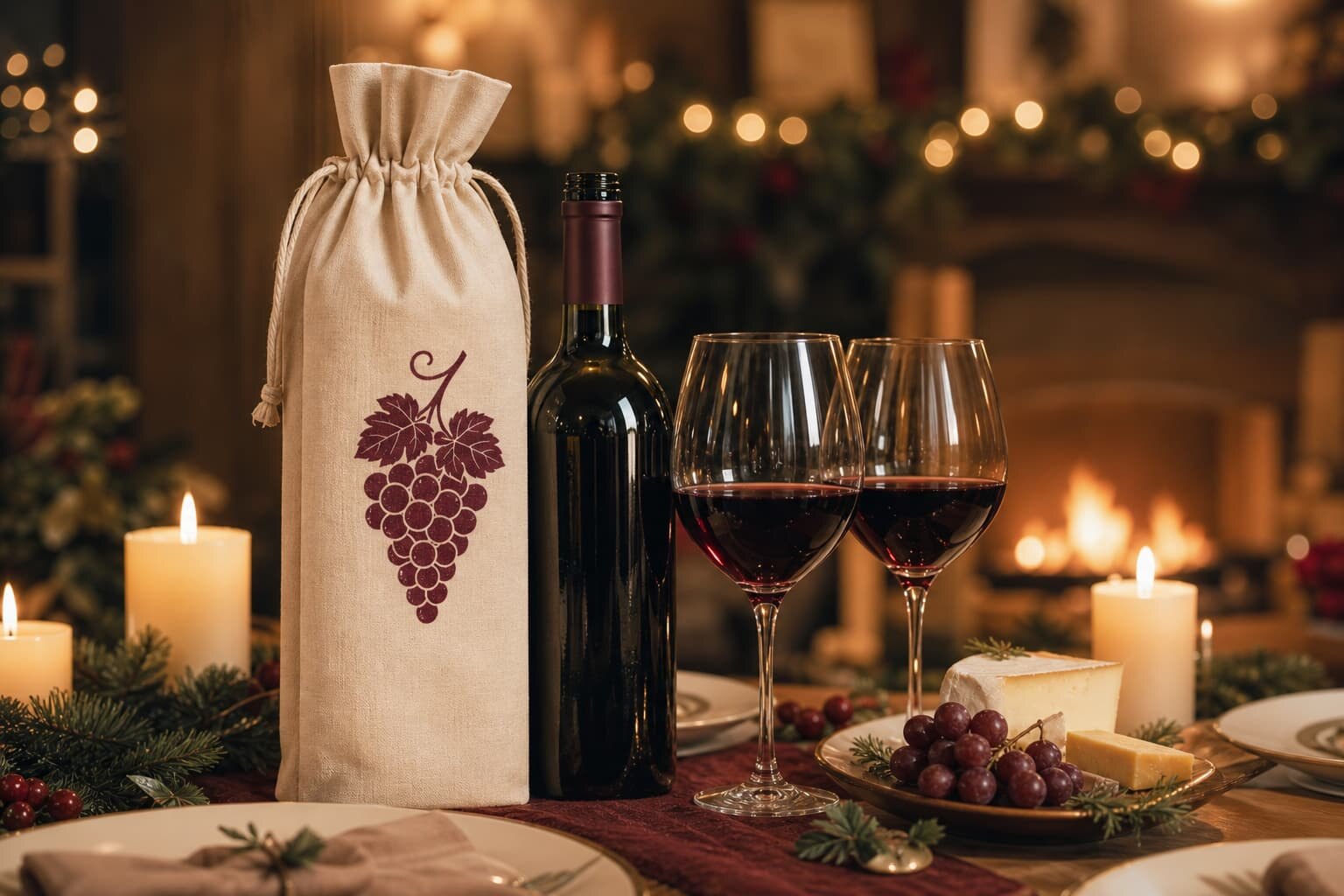
Why Unit Price Alone Misleads Wine Bag Buying
Wine and bottle bag quotes only compare cleanly when the buyer locks the use case first. A bag for a tasting room gift set, a distributor promotion, and an e-commerce mailer may all hold one bottle, but they are not the same product. The first decision is not price; it is bottle profile, carry method, decoration method, and target shelf position.
Send every supplier the same destination, incoterm, annual volume, and repeat-order expectation, then ask them to quote against one spec sheet. That is the only way to compare true manufacturing cost instead of a quote padded by assumptions. If one factory is pricing a loose sleeve and another is pricing a stitched tote with a woven label, the low quote is not a deal. It is a different product.
- State whether the bag is for retail resale, gifting, or simple transport.
- Define the bottle type and the target pack-out: single bottle, double bottle, or multi-bottle set.
- Tell suppliers up front whether the quote must include packaging and export cartons.
Lock The Bottle Profile And Fit Tolerance First
A wine bag quote is only usable when the supplier knows what bottle it must fit. A standard 750 ml bottle is not enough information. Bordeaux, Burgundy, Champagne, and magnum bottles have different shoulder shapes, base diameters, and heights, and those details change gusset depth, opening size, and seam placement. If you are buying a gift bag, the fit must be snug enough to look intentional but not so tight that the bottle catches on the seam during packing.
Write the bottle dimensions into the RFQ as measurable numbers, not as a sales description. Include height, body diameter, neck diameter if relevant, and the maximum acceptable variation. If the bag uses a drawstring or flap closure, confirm whether the top must close above the neck or simply cover the shoulder. A supplier who guesses the fit may still give you a fast quote, but the first bulk run will expose the error.
- Provide bottle height and diameter in millimeters.
- State whether the bag must fit a standard bottle, a tapered bottle, or a decorative bottle shape.
- Clarify if the closure must fully cover the bottle neck or only secure the opening.
Fabric Weight And Construction Choices That Move Cost
The fastest way to get misleading quotes is to compare bags without comparing fabric weight. For cotton, buyers often see 8 oz drill, 10 oz canvas, and 12 oz canvas quoted as if they were close substitutes. They are not. Heavier fabric gives better stand, less light bleed, and a more premium hand feel, but it also changes sewing speed, material cost, and carton weight. For jute, the difference between plain woven jute and laminated jute matters as much as the raw GSM. For nonwoven, the gauge and finish determine whether the bag feels promotional or disposable.
Ask the factory to state whether the quoted GSM is finished fabric or base fabric. That detail matters after printing, washing, or coating. A good quote also identifies seam structure: single needle, double needle, binding tape, bar-tacked stress points, and whether the bottom is flat or gusseted. If the bottle bag will be reused in retail, spend for reinforcement where the load transfers into the handle or cord channel, not on decorative details that do not improve function.
- 8-10 oz cotton drill is usually enough for promotional bottle bags with light to moderate reuse.
- 10-12 oz canvas fits premium retail sets where the bag should stand up and hold its shape.
- 250-300 gsm jute suits rustic gifting, but the quote should address fray control and odor management.
Compare Print And Branding Costs Separately
Decoration is where many quote comparisons break down. A screen print, heat transfer, woven label, embroidery, embossed PU patch, or sewn side label can all put a logo on the bag, but they do not carry the same cost, durability, or visual result. For natural fabrics like cotton and jute, a one-color screen print or woven label is often the cleanest commercial choice. For a premium program, a PU patch or embroidery can justify the extra cost if the bag is meant to sit on shelf or be reused.
Do not accept a quote that lumps decoration into one line item without breaking out setup, color count, and placement. Ask whether the quoted print price includes one side only, whether a second print location is extra, and whether the factory charges again for repeat orders because plates, screens, or digital files need to be remade. The right quote tells you exactly what changes when the logo changes from one color to two, or when the artwork coverage increases from a small chest mark to a full-panel print.
- Confirm print method, placement, number of colors, and artwork size in the same line.
- Ask if the quote includes screen charges, embroidery digitizing, or label sewing.
- Require Pantone references or a clear note if the factory is matching by visual approximation.
MOQ And Sampling Logic For Custom Bottle Bags
MOQ is not a random factory number. It usually follows fabric width, trim sourcing, dye lot size, print setup, and sewing complexity. A supplier can often keep MOQ lower when the bag uses stock fabric and standard cord or handle material. The number rises quickly when you ask for custom-dyed fabric, custom webbing, a special closure, or more than one decoration method. If you need multiple SKUs, it is usually cheaper to keep the core bag constant and change only the print or label than to change the base construction for every version.
Sampling should also be structured. A development sample confirms size and construction. A pre-production sample confirms the exact fabric, logo, and packing. In some programs, a production sample is pulled from the first bulk output for final signoff. Each step has a purpose. Ask whether the sample fee is deductible from bulk, whether the sample uses real production materials, and whether revision requests create a new charge. Without that clarity, the quote looks cheap until the approval cycle starts.
- Stock fabric and stock trims usually support lower MOQ than custom dyed or custom woven components.
- One-color prints are easier to scale at lower MOQ than multi-color artwork with tight registration.
- Ask for the MOQ by colorway, not only the MOQ for the entire style.
Packing Spec And Carton Math Change Landed Cost
Packing can change the landed cost more than buyers expect. A bottle bag packed flat in a master carton is not the same as a retail-ready item packed with an insert card, tissue, hangtag, or individual polybag. If the bag is made from cotton or jute, moisture protection matters during ocean freight and warehouse storage. If the finish is premium, you also need to protect the print and surface from rubbing inside the carton. The quote should show how the bags are folded, how many go into each inner pack, and how the master carton is built.
Do not approve a quote without carton dimensions, carton quantity, and gross weight. These numbers drive freight, pallet planning, and warehouse receiving time. For bottle bags that are sold in gift sets, the outer carton should be tested for compression and corner damage, especially if the product uses a structured handle or a thick insert. A quote that ignores packing is incomplete because the factory may be pricing only the bag, not the shipment you actually need.
- Ask whether the bags are folded flat, stuffed, or packed with an insert board.
- Confirm inner pack quantity, master carton quantity, and carton dimensions before order release.
- Request moisture protection details for sea freight, especially for jute and untreated cotton.
Lead Time Only Matters After Approval Gates Are Defined
Lead time is useful only when the approval gates are explicit. For bottle bags, the schedule usually moves through artwork approval, sample approval, bulk material booking, sewing, print application, inspection, packing, and shipment booking. If a supplier gives you one short lead time without stating what happens if the artwork changes or the sample is revised, the number is not operational. It is only a best-case estimate. Buyers should ask for a timeline that starts after deposit and final file approval, not before.
Seasonal wine programs need more discipline than generic accessory orders. Holiday gifting, harvest launches, and distributor campaigns often have a hard ship date, which means the critical path is not just sewing capacity. Trims, labels, carton materials, and print tools can all move the delivery window. Work backward from the ship window, then give the factory a realistic buffer for correction and rework. That protects both the booking and the shelf date.
- Separate sample lead time from bulk lead time.
- Ask what date the factory considers the schedule to start: order confirmation, deposit, or final sample approval.
- Build a buffer for print revision, label correction, and packaging changes.
Read Supplier Quotes Line By Line, Not As A Total
The cleanest quote comparison is a line-by-line worksheet. Compare the base bag first, then compare decoration, packaging, QC, and freight separately. The lowest quote often wins on headline price because it excludes one of those items. If one supplier includes export cartons and another does not, the comparison is already broken. The same problem appears when one factory quotes an 8 oz bag and another quotes 12 oz, or when one supplier uses a woven label and another uses a simple print. Treat every quote as a bill of materials until the hidden assumptions are visible.
Good quotes also show exclusions and change-control rules. You want to know what happens if artwork changes after sample approval, if the carton count changes, or if a second color is added late. Those are not rare events in bottle bag sourcing; they are normal procurement issues. A factory that can itemize costs and state its revision rules is usually safer than a cheaper supplier that only sends a single rounded number.
- Compare fabric spec, print method, packing method, and incoterm on separate lines.
- Check whether the quote includes tool charges, plate charges, or embroidery digitizing.
- Flag any supplier quote that omits carton data, sampling terms, or exclusion notes.
Acceptance Criteria Before You Issue The PO
The purchase order should not repeat the marketing description. It should lock the acceptance criteria. For wine and bottle bags, that means finished dimensions, fabric weight tolerance, seam style, print location, color target, packing count, and carton marks. If the bag is supposed to fit a specific bottle, include that bottle reference in the PO or in the approved sample record. A vague PO turns a sourcing issue into a dispute after production starts.
The strongest control is a sealed approved sample or gold sample tied to the order. The PO should reference that sample, not just the spec sheet, because the sample captures the real-world details that text often misses: how the gusset stands, how the cord sits, how opaque the fabric is, and how the logo reads at arm's length. If you expect repeat orders, define whether the factory may use a different dye lot or carton layout on reorders, and how much visual variation is acceptable.
- Attach the approved sample reference to the PO.
- Define the acceptable tolerance for size, color, and logo placement.
- State who pays for remake, rework, or replacement if the shipment fails the agreed standard.
Build A Quote Packet The Factory Can Price In One Pass
A good RFQ packet reduces quote noise. It should contain one page for dimensions and bottle type, one page for construction and fabric, one page for decoration and artwork, one page for packing, and one page for shipping assumptions. When the factory gets all of that at once, the quote is faster and more comparable because the salesperson is not filling in gaps with guesswork. That matters especially for wine and bottle bags, where a small change in closure, lining, or cord length can change labor time and material waste.
The same packet also protects your internal comparison process. Procurement, brand, and operations teams can look at the same document and understand what was priced. If the bag is being compared across multiple suppliers, the RFQ should list the same bottle sample, the same logo file, the same carton target, and the same incoterm. That is how you avoid re-bidding the order after the first round of quotes comes back inconsistent.
- Include product drawings or dimension photos with labeled measurements.
- Attach the logo file, color reference, and print placement sketch.
- State the target annual volume and the first order quantity separately so the supplier can judge reuse potential.
Specification comparison for buyers
| Spec decision | Recommended option | When it fits | Buyer risk to check |
|---|---|---|---|
| Single-bottle cotton drawstring bag | 8-10 oz cotton drill with reinforced cord channel | Corporate gifts, winery sets, and repeated reuse | Cord strength, shrinkage, and loose seam allowance after washing |
| Canvas bottle tote with handle | 10-12 oz canvas with bar-tacked handles | Retail sets, premium promotions, and carry-away packaging | Handle attachment, print cracking on folds, and weight carry rating |
| Jute bottle sleeve | 250-300 gsm jute with optional lining or lamination | Rustic gifting, hampers, and premium seasonal programs | Fray control, odor, dust shedding, and surface scuffing |
| Nonwoven bottle bag | 90-120 gsm PP nonwoven with stitched or heat-sealed finish | Low-cost giveaways and high-volume event runs | Tear resistance, heat sensitivity, and lower perceived value |
| PU-panel premium bottle bag | Cotton or canvas base with PU label or panel | Upscale branding and emboss or deboss decoration | Color match drift, surface scuffing, and panel adhesion quality |
Buyer checklist before sampling
- Confirm the bottle profile first: 750 ml, magnum, champagne, or another format, plus exact height and diameter.
- Set the fabric weight, finish, and construction standard before asking for price.
- State the decoration method, logo placement, and number of print colors in the RFQ.
- Ask for MOQ by fabric, color, and print combination, not just a single headline number.
- Require sample stages, revision rules, and who signs off on the approved sample.
- Include packing, carton count, and incoterm in the same quote request.
- Define the lead-time start point as the date after artwork and sample approval, not the date of inquiry.
Factory quote questions to send
- What exact fabric, GSM, and finish are you quoting, and is the weight based on finished fabric or raw fabric?
- What is included in the unit price: base bag, print, label, lining, cord, packaging, and export carton?
- What is the MOQ by color, decoration method, and any custom trim or handle component?
- What sample stages do you offer, what does each sample cost, and is the sample fee deductible from bulk?
- What lead time do you quote for sample approval, bulk production, and final carton readiness?
- How many print colors and placements are included, and what is the surcharge for extra colors or larger coverage?
- What carton quantity, carton size, gross weight, and packing method are you using for this quote?
- What are your accepted defect tolerances, rework rules, and replacement process for failed inspection?
Quality-control points to confirm
- Check finished fabric weight, hand feel, and shade against the approved sample or sealed reference.
- Measure body width, height, gusset, and opening tolerance after sewing, not only on cut panels.
- Inspect logo placement, print registration, ink coverage, and edge bleeding under normal light.
- Pull-test handles, drawcords, seams, and bar-tacks to confirm the bag survives normal use.
- Open random cartons to verify quantity, folding method, dust protection, and moisture condition.
- Confirm carton marks, pack count, and barcode placement before release to freight or warehouse.