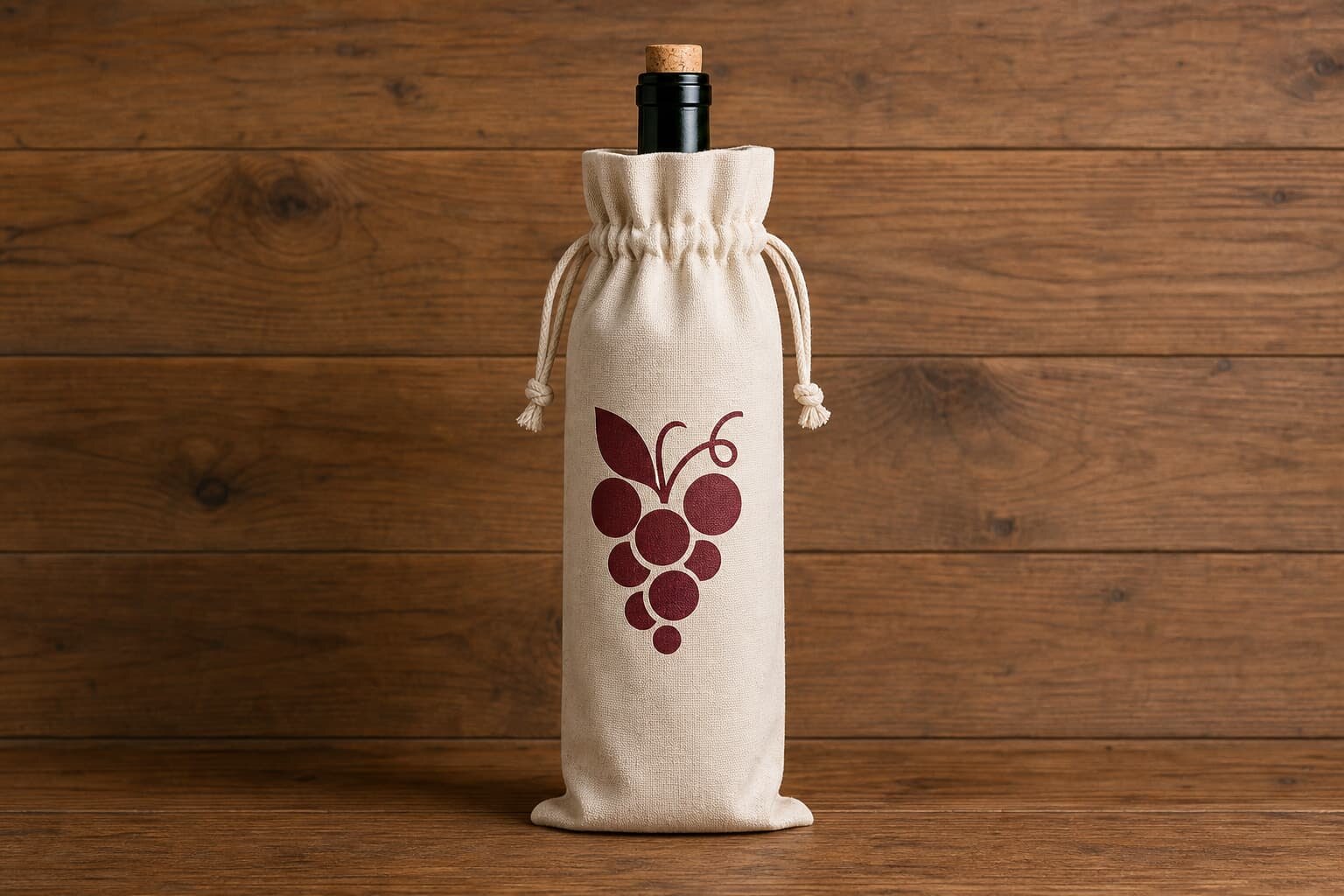
Start With Bottle Fit
The most common failure in wholesale wine and bottle bags is not poor sewing. It is a bag that looks correct flat on the table but does not fit the buyer's actual bottle. A 750 ml Bordeaux bottle, a Burgundy bottle, a Champagne bottle, and a square spirit bottle do not occupy the same volume, especially around shoulder width and base diameter. Your RFQ should identify the bottle type before asking for fabric, print, or price.
Factories often quote from a previous sample size unless the buyer gives a clear fit target. That can work for a standard slim wine bottle, but it becomes risky when the order is for mixed bottles, gift sets, olive oil, spirits, or bottles with thick glass bases. Ask the supplier to check the finished sample with a real bottle or a bottle-weight substitute, then show front, side, top closure, and bottom gusset photos.
- For a standard single 750 ml wine bag, confirm usable inner height after the drawcord channel or top hem is sewn.
- For a gusseted bottle bag, check whether the base opens enough for the bottle to stand upright without forcing the seams.
- For a two-bottle carrier, confirm the divider height and width so the bottles do not knock together.
- For retail gift bags, check whether the bottle label remains visible or hidden as intended.
Choose Fabric by Load
Fabric selection should follow the bottle weight, brand positioning, and packing method. A light cotton wine bag may be fine for a counter giveaway, while a reusable canvas bottle tote needs stronger fabric and better handle reinforcement. For cotton drawstring wine bags, many buyers use 140-220 GSM depending on budget and print requirements. For heavier canvas carriers, 10-16 oz canvas is more suitable when the buyer expects reuse.
Jute and burlap wine bags bring a natural retail look, but they behave differently from cotton. Jute can shed fiber, vary in shade, and feel rougher against printed labels or glass surfaces. Laminated jute improves structure and reduces fraying, but it changes the handfeel and may affect foldability. If the buyer cares about a cleaner premium finish, request a lining or inner cotton panel and ask the factory to quote it separately.
- 140-160 GSM cotton: light promotional single-bottle bag with low carrying expectation.
- 180-220 GSM cotton: stronger gift bag with better print coverage and less transparency.
- 10-12 oz canvas: reusable wine tote or two-bottle carrier with handle stitching.
- 250-350 GSM jute: natural presentation bag where texture is part of the product look.
- Lined jute or canvas: better for premium gifting, but increases sewing time and MOQ pressure.
Control the Finished Size
A good bottle bag RFQ should separate cut size, finished outside size, and usable internal size. These are not the same. Seam allowance, bottom gusset construction, drawcord tunnel, folded hem, and lining can reduce the actual space available for the bottle. If a supplier only repeats the flat size, the buyer still does not know whether the bottle will load smoothly.
Set a practical tolerance for finished measurement instead of demanding impossible precision. Fabric bags move during cutting, printing, sewing, and pressing. For many cotton and jute bottle bags, plus or minus 5 mm on width and height may be workable, while print placement may need a tighter visual tolerance depending on logo size. The important point is to define which measurements are critical to function.
- Measure height from bottom seam to top opening or drawcord channel, depending on how the bottle is enclosed.
- Measure width across the usable body, not including side seam bulk.
- Measure gusset when fully opened, because a flat gusset measurement can be misleading.
- For handles, measure both total length and handle drop.
- For two-bottle bags, measure each compartment separately.
Specify Print Method Early
Wine and bottle bags usually carry brand logos, winery marks, event artwork, or retailer names, so print quality is commercially visible. Screen print is often the best choice for solid logos on cotton, canvas, and some jute surfaces. It gives strong coverage and predictable color when the artwork is not too detailed. Heat transfer may fit artwork with gradients or small details, but buyers should check handfeel, edge lifting, and behavior when the bag is folded.
Jute creates special print questions because the surface is uneven. A fine logo may break or look fuzzy if printed directly on coarse jute. In that case, a cotton patch, woven label, leather-look patch, or sewn side label may be cleaner than forcing detailed artwork onto rough fabric. Ask the factory to recommend the method, but require sample evidence before bulk approval.
- For screen print, specify Pantone or approved color reference, number of colors, and print size.
- For heat transfer, check edge adhesion, cracking, and surface shine after folding.
- For woven labels, confirm label size, fold type, stitch position, and MOQ.
- For embroidery, check whether the fabric can hold the stitch density without puckering.
- For jute, request a close-up photo because distant photos hide broken print edges.
Build Sample Approval Around Risk
A pre-production sample is not only a visual approval. It is the buyer's chance to lock the fit, fabric handfeel, print position, handle strength, and packing fold before the factory cuts bulk material. For bottle bags, the sample should be loaded with the correct bottle weight and checked while standing upright. A bag that collapses, twists, or pulls at the seam during this check needs revision before production.
Do not approve a sample without knowing which parts are final. Many factories make an early sample from available fabric or substitute cord to save time. That is acceptable for shape checking, but it should not be treated as final approval for shade, GSM, print result, or trim quality. The buyer should record what is approved and what remains conditional.
- Fit sample: used to confirm shape, finished dimensions, gusset, divider, and closure.
- Print strike-off: used to approve logo size, color, edge sharpness, and ink coverage.
- Pre-production sample: should use production fabric, final trims, final print method, and packing fold.
- Carton packing sample: useful when the order is retail packed or has barcode labeling.
- Retention sample: one approved sample should stay with the factory QC team during production.
Check Handles, Cords, and Dividers
Bottle bags carry a concentrated load. One filled wine bottle can weigh around 1.2-1.5 kg depending on glass weight, and two-bottle carriers double that quickly. Handle stitching, drawcord knots, bottom seams, and divider seams deserve more inspection attention than decorative side seams. A nice-looking bag that fails at the handle is not a minor issue for a retailer or distributor.
For drawstring wine bags, check whether the cord closes smoothly around the bottle neck without trapping fabric unevenly. For handled carriers, check handle drop, hand comfort, and reinforcement style. For two-bottle carriers, the divider should prevent glass-to-glass contact and stay upright after loading. A weak divider can make the product feel cheap even when the outside fabric is strong.
- Request pull testing for handles and cords based on loaded bottle weight plus a safety margin.
- Use bar tack, box stitch, or reinforced seam construction where handles join the body.
- Check cord end treatment: knot, metal tip, plastic tip, heat seal, or stitched finish.
- Confirm divider material and whether it is sewn into the bottom seam or only side seams.
- Inspect bottom corner stress points after loading and lifting the bag several times.
Make Quotes Comparable
A low quote for wine and bottle bags can hide missing details. One factory may include 180 GSM cotton, one-color screen print, individual polybag, and export carton. Another may quote 140 GSM cotton, no inner packing, and a different size. Unless the buyer forces the quote into the same structure, the cheapest supplier may simply be quoting a thinner or less finished product.
Ask for quote data in a way that lets procurement compare cost drivers. Fabric weight, bag size, number of print colors, trim type, packing method, carton quantity, and sample assumptions all affect price. MOQ also changes by component. A small order using natural cotton may be easier than a small order requiring custom dyed fabric, custom woven labels, and four-color print.
- Separate base bag cost from print cost and packing cost.
- Ask whether screen setup, label tooling, sample fee, and courier charge are included or separate.
- Confirm MOQ by bag style, fabric color, print artwork, and packing version.
- Request estimated carton size, gross weight, and pieces per carton for freight planning.
- Ask what price changes if GSM, print size, or packing method changes.
Plan MOQ and Lead Time
MOQ is not only a number the factory uses to protect production efficiency. It is linked to material buying, fabric dyeing, printing setup, label production, cutting waste, and packing work. A natural cotton single-bottle bag with one-color print may support a lower MOQ than a custom-dyed canvas two-bottle carrier with woven label and retail barcode sticker. Buyers should ask which component creates the MOQ limit.
Lead time should also be broken into stages. Wine and bottle bag orders often appear simple, but delays can come from artwork approval, fabric arrival, print screen preparation, sample revision, or retail packing confirmation. If the order is for a seasonal campaign, launch box, or holiday gift set, sample approval speed matters as much as factory sewing capacity.
- Ask for sample lead time separately from bulk production lead time.
- Confirm whether bulk lead time starts after deposit, artwork approval, or sample approval.
- Check whether custom dyed fabric adds extra days compared with stock natural fabric.
- For multi-SKU orders, ask how the factory schedules cutting and printing to avoid mix-ups.
- Build inspection and shipping buffer into the schedule instead of using factory completion date as delivery date.
Set Packing Requirements
Packing is part of the quality plan, not an afterthought. Wine bags can be creased, contaminated, or deformed during packing if they are folded carelessly. Screen printed areas should not be rubbed directly against rough jute, metal cord tips, or carton walls. If the logo must look clean on arrival, tell the factory how to fold the bag and whether tissue paper, paper banding, individual polybag, or bulk packing is acceptable.
Export cartons should protect both appearance and count accuracy. Retail buyers may need barcode labels, SKU separation, and carton marks. Distributors may prefer bulk packs with simple carton IDs. If the order includes several logos, bottle sizes, or colors, packing control prevents expensive receiving problems. A carton with the wrong mixed assortment can create more work than a small sewing defect.
- Define pieces per inner pack and pieces per master carton.
- Specify whether bags are flat packed, half folded, rolled, or packed upright.
- Keep printed panels protected from abrasion and hard trim contact.
- Use carton marks with PO number, SKU, size, color, logo version, and quantity.
- For jute, consider moisture control and odor check before carton sealing.
Use Practical Acceptance Criteria
A quality control plan becomes useful when the factory and buyer agree what passes and what fails. For wholesale wine and bottle bags, critical defects include safety and function problems such as broken handles, open seams, sharp trim, wrong logo, or a bag that cannot fit the approved bottle. Major defects include visible print misplacement, heavy stains, wrong fabric weight, poor divider sewing, or carton quantity errors. Minor defects may include small loose threads or slight natural fabric shade variation within the approved tolerance.
The buyer should not inspect every feature with the same strictness. Bottle fit, load strength, logo accuracy, and packing count are higher-risk points because they affect usability and commercial acceptance. Natural fabric texture, small slubs, or slight cotton specks may be normal if agreed during sample approval. Good QC separates real defects from material character so the factory can control the right issues.
- Critical: wrong bottle fit, broken handle, open bottom seam, wrong logo, sharp or unsafe trim.
- Major: print color outside approved range, severe stains, wrong GSM, weak divider, incorrect carton label.
- Minor: small loose thread, slight natural shade variation, minor jute hairiness within approved range.
- Inspection should include loading test, measurement check, print check, workmanship review, and packing count.
- Keep approved sample, artwork file, packing instruction, and measurement sheet available at final inspection.
Specification comparison for buyers
| Spec decision | Recommended option | When it fits | Buyer risk to check |
|---|---|---|---|
| Single 750 ml wine bottle bag | 180-220 GSM cotton or 250-300 GSM jute with drawcord | Gift packaging, wine clubs, retail counter promotions, and event giveaways | Confirm usable inner width and height after sewing, not only flat fabric size |
| Two-bottle carrier | 10-12 oz canvas or laminated jute with reinforced divider and handle stitching | Corporate gifting, bottle sets, premium retail packs, and distributor samples | Divider must be stitched securely and wide enough to prevent bottle contact |
| Premium canvas bottle tote | 12-16 oz canvas with bottom gusset and cross-stitched handles | Reusable gift bag where the buyer wants a higher perceived value | Heavier fabric increases carton weight and may require adjusted packing quantity |
| Logo print | Screen print for solid logos; heat transfer only when artwork has fine color gradients | Brand logos, winery names, event marks, and simple retail graphics | Run rub test, tape test, and bottle contact check before approving bulk production |
| Natural cotton color | Unbleached cotton with tolerance agreed on shade and black specks | Eco-style presentation and lower-dye-risk orders | Natural fabric shade varies by batch, so approve a tolerance range, not one photo |
| Retail packing | Flat folded in polybag or paper band, then export carton with bag count by SKU | Distributors and retail buyers who need barcode or store-ready handling | Wrong fold direction can crease the printed logo or deform the bottle base area |
Buyer checklist before sampling
- Confirm target bottle type: 750 ml Bordeaux, Burgundy, Champagne, spirit bottle, olive oil bottle, or mixed bottle use.
- Request flat dimensions and usable internal dimensions after stitching, including seam allowance and drawcord closure space.
- Specify fabric type and weight: cotton GSM, canvas ounce weight, jute GSM, lining if required, and acceptable tolerance.
- Ask the factory to test the approved sample with a real filled bottle or bottle-weight substitute before bulk cutting.
- Define print method, artwork size, ink color code, print position tolerance, and print durability checks.
- Confirm handle or cord material, length, knot method, metal tip or plastic tip if used, and pull strength requirement.
- Require pre-production sample approval using bulk fabric or the closest available production material.
- Set acceptable measurement tolerance for bag height, width, gusset, handle length, and print location.
- Specify packing method, pieces per inner pack, pieces per export carton, carton marks, barcode labels, and moisture control if needed.
- Ask for a quote that separates bag cost, print cost, packing cost, sample cost, tooling or screen charge, and freight assumptions.
Factory quote questions to send
- Which bottle size did you use when checking the bag fit, and can you send photos with that bottle inserted?
- What is the fabric weight in GSM or ounces, and what tolerance do you apply during bulk production?
- Is the quoted size the flat cut size, finished outside size, or usable inner size after sewing?
- What print method is included in the quote, and how many colors, positions, and print area limits are assumed?
- Will the pre-production sample use bulk fabric, bulk drawcord, bulk handle material, and the final print process?
- What MOQ applies to the fabric color, print setup, bag style, and packing method separately?
- How many pieces are packed per carton, what is the estimated carton size and gross weight, and is the bag folded over the printed area?
- What are the main lead time stages: material preparation, sample approval, cutting, printing, sewing, inspection, and packing?
- Which inspection standard do you support for finished goods, and what defects are counted as critical, major, and minor?
- If the order includes mixed SKUs, how will you label cartons and prevent wrong logo, wrong color, or wrong bottle-size mixing?
Quality-control points to confirm
- Bottle fit must be checked with the real bottle profile or a buyer-approved measurement drawing.
- Finished bag measurements should be inspected after sewing and pressing, not before folding.
- Fabric GSM or ounce weight should be checked against the approved sample and purchase specification.
- Drawcords, handles, and dividers need pull checks because bottle bags carry concentrated weight.
- Prints should pass visual color check, position check, rub test, tape test, and folding crease review.
- Natural cotton and jute require shade, odor, hairiness, slub, and contamination checks before cutting.
- Seam strength around bottom corners, handle joints, and divider seams should be inspected more tightly than decorative seams.
- Packing must protect print surfaces from abrasion and prevent moisture, odor, and carton deformation during export transit.
- Carton labels should identify SKU, logo version, bottle count, color, size, PO number, and quantity.
- Final inspection should include functional bottle loading, appearance, measurement, print, workmanship, and packing checks.