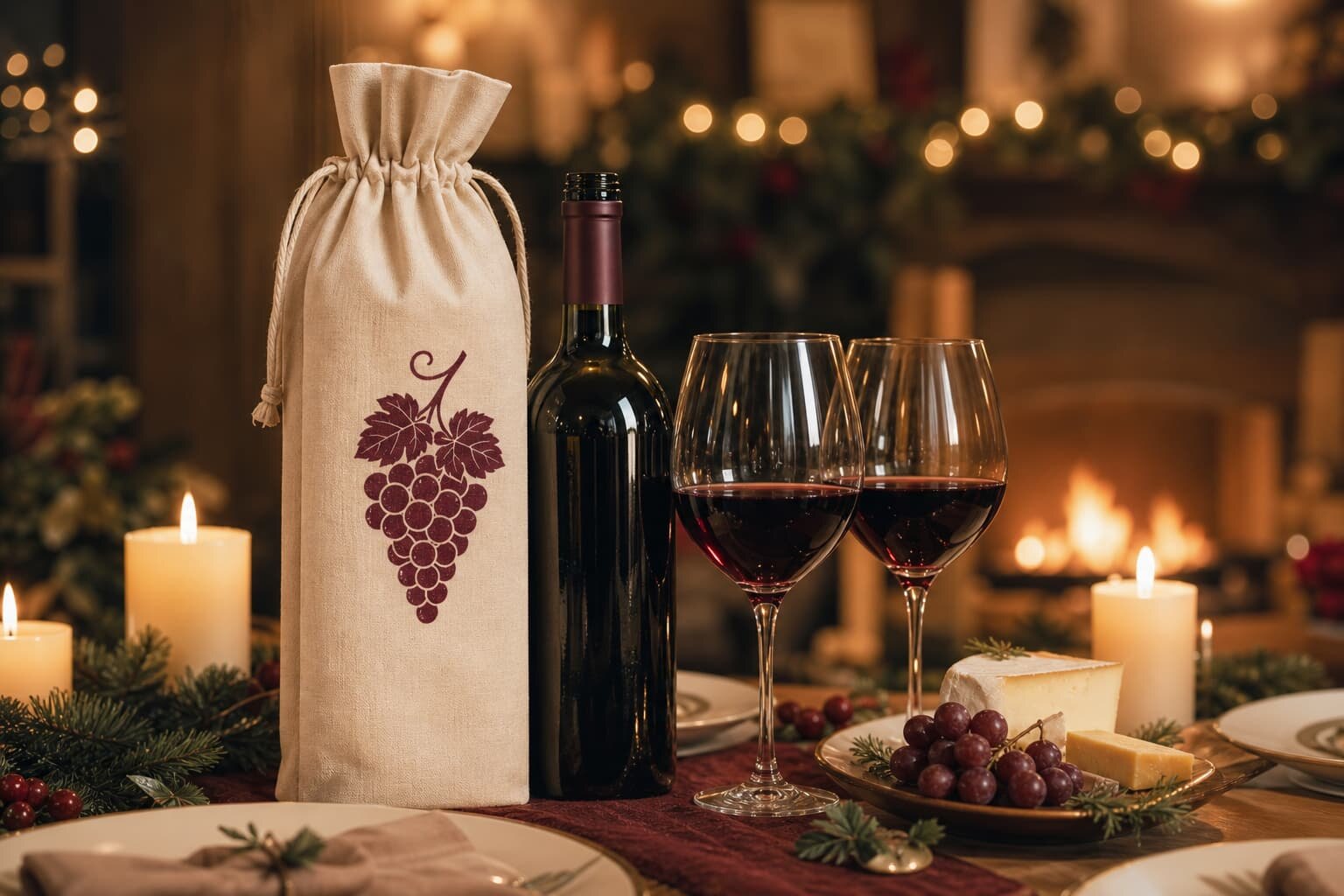
1. What “wholesale wine & bottle bags production timeline 08” means for buyers
The phrase “wholesale wine & bottle bags production timeline 08” is best understood as a buyer’s planning topic: how to map the full production route for wine bags and bottle bags before releasing a purchase order. The “08” can function as an internal content series number, SKU planning code, campaign marker, or procurement file reference. The important point is not the number itself. The important point is that buyers need a realistic timeline, not a vague promise such as “ready in two weeks.”
Wine and bottle bags look simple, but the schedule depends on many small decisions: fabric availability, bottle size, print method, drawstring or handle construction, lining, retail labeling, carton packing, and inspection timing. A plain cotton drawstring wine bag with one-color print is a different production job from a two-bottle canvas carrier with divider, barcode sticker, hangtag, and export cartons. If both are quoted with the same lead time, the buyer should slow down and ask for a process breakdown.
For B2B procurement, the goal is to protect launch dates, avoid rework, and compare suppliers on real capacity. A supplier that explains sample approval, material booking, print setup, sewing capacity, quality control, and packing is usually giving a more useful answer than a supplier that only gives the lowest unit price. Your RFQ should force clarity before the order becomes urgent.
- Use the keyword topic as a planning framework: quote, sample, approve, produce, inspect, pack, and ship.
- Do not treat wine bag production as only a sewing job; print, fabric, labels, and packing often control the schedule.
- Ask suppliers to split lead time by process step so you can compare risk, not just price.
2. Build the timeline from the bottle outward
A reliable production timeline starts with the bottle, not the bag drawing. A standard 750 ml Bordeaux bottle, Burgundy bottle, champagne bottle, spirits bottle, olive oil bottle, and tall specialty bottle can all require different allowances. Champagne bottles are often wider and heavier. Spirits bottles may be square or unusually shouldered. If the bag is made too tight, production may pass a flat measurement check but fail when the actual bottle is inserted. If it is too loose, the bottle shifts, the print looks off-center, and the gift presentation feels lower quality.
For procurement RFQs, provide exact bottle dimensions: total height, maximum body diameter, shoulder width, neck diameter, cap or cork height, and filled weight. If the bag must fit several bottle shapes, identify the largest and most awkward bottle as the fit standard. Also state whether the top must close fully above the cork, whether the bottle neck can remain visible, and whether space is required for tissue paper, a ribbon, gift tag, or protective sleeve.
The bottle specification affects pattern making, cutting efficiency, stitch position, carton quantity, and sample approval. For example, adding a gusset or boxed base can improve standing stability but increases sewing time. A drawstring channel may need extra height above the bottle shoulder. A two-bottle bag needs a divider that is strong enough to prevent glass-to-glass contact, but a divider also adds cutting and sewing operations. These details are small individually, but they decide whether the production timeline is realistic.
- Send bottle drawings or measurements with photos from front, side, and base views.
- Fit-test the approved sample with the exact filled bottle weight, not an empty lightweight substitute.
- For mixed bottle programs, design around the largest practical bottle and confirm whether smaller bottles still present well.
- If the bottle bag will be used at retail checkout, test carry balance and handle comfort when loaded.
3. Realistic end-to-end timeline by bag type
A useful buyer timeline separates sample lead time from production lead time. The production clock normally starts after the supplier has approved artwork, confirmed materials, received deposit or PO, and obtained final sample approval if required. If a buyer takes six days to approve a sample, that delay usually pushes the entire delivery date. For seasonal wine gifts, winery events, supermarket promotions, and corporate gifting campaigns, buyer-side approval time must be included in the schedule.
The ranges below are practical planning ranges, not guaranteed promises. They assume normal factory workload, clear artwork, no unusual compliance testing delay, and no major public-holiday shutdown. Rush orders may be possible when materials are in stock and the design is simple, but rush schedules reduce the margin for correction. For larger B2B programs, it is safer to add buffer before booking retail launch dates or promotional events.
Use this timeline table as a quote challenge. Ask each supplier where they are faster, where they are slower, and what must be true for their lead time to hold. A supplier with real bottle-bag experience should be able to discuss sample making, material stock, print preparation, sewing output, packing labor, and inspection windows with confidence.
- Plain stock-size nonwoven bottle bag: sample or photo approval 2–5 days; material confirmation 1–3 days; production 7–15 days; QC and packing 2–4 days.
- Simple cotton drawstring wine bag with one-color print: sample 3–7 days; buyer approval 1–5 days; material booking 2–5 days if stocked; printing and cutting 3–7 days; sewing 5–12 days; QC and packing 2–5 days.
- Canvas tote-style bottle bag with sewn handles: sample 5–10 days; approval 1–5 days; material booking 3–8 days; cutting and printing 4–8 days; sewing 8–18 days; QC and packing 3–6 days.
- Two-bottle bag with divider or reinforced base: sample 7–14 days; approval 2–7 days; material booking 5–10 days; cutting, printing, and preparation 5–10 days; sewing 12–25 days; QC and packing 4–7 days.
- Lined or lightly padded premium wine gift bag: sample 10–18 days; approval 2–7 days; material and trim booking 7–15 days; cutting and decoration 7–12 days; sewing 15–30 days; QC and packing 5–8 days.
- Retail-ready program with barcode, hangtag, individual polybag, and carton marks: add 3–8 days for label approval, packing trial, barcode scan check, and packed-carton verification.
4. Lead-time drivers: fabric, decoration, closure, lining, and packing
The fastest production path is usually a standard fabric, standard color, simple size, one-color print, and bulk packing. Every customization can be valid, but each one needs a timeline cost. Fabric is often the first bottleneck. Natural cotton may be available quickly, while dyed fabric can require lab dip approval, dyeing, drying, finishing, and shade inspection. Canvas may require more cutting effort and stronger needles. Jute-like textures can be slower to print cleanly and may require a simpler logo.
Decoration is the second major driver. Screen printing is efficient for bold, one-color logos, but multi-color artwork requires more setup and registration control. Heat transfer and digital print can support detailed graphics, yet they need durability checks, especially if the bag will be reused or handled frequently. Embroidery and sewn labels can look premium, but they add separate production steps and may involve subcontracting. Subcontracted processes are not a problem if disclosed; they become a problem when they are hidden from the timeline.
Closure and internal construction also change production speed. A basic drawstring channel is usually manageable, but cord selection, cord length, knot finish, and channel width still need approval. A sewn handle requires reinforcement and balance testing. A lining, divider, or padding increases cutting pieces, seam operations, and inspection points. Retail packing then adds another stage: folding method, individual polybag, barcode label, hangtag, carton mark, and sometimes carton drop or compression concerns.
- Ask whether fabric is in stock, booked after deposit, or dyed to order.
- Confirm if printing is in-house or outsourced; outsourced print can add queue time.
- Avoid changing closure, lining, and artwork after sample approval unless the timeline is reset.
- For retail programs, approve barcode and carton label artwork before mass packing starts.
5. RFQ specifications that prevent quote confusion
Many bad quotes start with vague language: “cotton wine bag, logo printed, good quality.” That is not enough for procurement. A strong RFQ gives the supplier a measurable target. It should include finished size, fabric composition, fabric weight, color, decoration method, artwork size, closure type, handle or cord details, seam construction, label requirements, packing, carton requirements, inspection standard, and destination market. The more complete the RFQ, the less room there is for suppliers to quote different products under the same name.
Finished size should be written clearly, for example: width x height x gusset, with the measurement point stated. If the bag is drawstring, define the full height and the usable height below the drawstring channel. If the bag has a handle, define handle width and handle drop. If the bag has a divider, define whether the divider is full height, half height, fixed to the base, or floating. These points affect both function and cost.
Artwork should be treated as a production specification, not only a branding asset. Provide vector artwork where possible, Pantone or color references, print size, print location, and whether the logo is centered on the flat bag or centered visually when the bottle is inserted. For natural cotton and canvas, buyers should expect some texture effect. If very fine text or small QR codes are required, ask for a print strike-off and scan test before bulk production.
- Use finished dimensions and tolerances instead of only a sample photo.
- Specify fabric by composition and weight: for example, 100% cotton 160 GSM or canvas 8 oz.
- State print size and position in centimeters or inches from fixed bag edges.
- List all trims: cord, cord lock, woven label, hangtag, barcode sticker, insert card, and polybag.
- Ask for a quote that separates unit price, sample cost, print setup, packing cost, and export carton cost.
6. MOQ and capacity: what buyers should verify before placing the order
MOQ is rarely only about sewing. It can be driven by fabric roll quantity, dye lot, print setup, cutting efficiency, label MOQ, carton printing, and packing format. A supplier may accept 500 plain natural cotton bags but require 1,000 or 3,000 pieces for dyed fabric, multi-color printing, or custom labels. Buyers managing several SKUs should ask whether MOQ applies per total order, per color, per design, per size, or per shipment. This single question prevents many commercial surprises.
Capacity verification is also important. A supplier can produce bags and still not be the right supplier for bottle bags. Ask whether they have made wine bags, champagne bags, two-bottle carriers, or bottle totes before. Ask how they control fit, what seam construction they recommend, and how many similar pieces they can sew per day during normal workload. You do not need exaggerated claims; you need a practical explanation of their process and bottlenecks.
Also verify material stock and subcontracting. If the supplier says fabric is available, ask whether it is physically in their warehouse, at a fabric mill, or only available from a trader. If printing or embroidery is subcontracted, ask who controls scheduling and quality approval. For export packing, ask for photos of previous carton packing style, carton marks, and palletization if relevant. Supplier reliability is not only about making a nice sample; it is about repeating that sample across cartons and shipping it correctly.
- Ask for current production capacity for your bag type, not general factory capacity.
- Verify whether materials are reserved after deposit or only after final sample approval.
- Ask if the supplier has a bottle fit test process and whether they can use your bottle or a dummy bottle.
- Confirm whether print, embroidery, dyeing, washing, or packing is subcontracted.
- Request a written escalation plan if fabric, print, or packing is delayed.
7. Quality control standards for wholesale wine and bottle bags
Procurement-grade QC must be measurable. “Good stitching” and “nice print” are not inspection standards. For wine and bottle bags, the most important checks are finished size, bottle fit, fabric weight, seam strength, stitch density, print placement, print quality, trim function, odor, stains, labeling, carton count, and packing condition. These standards should be agreed before production, not negotiated after defects are found.
A practical size tolerance for small cotton drawstring wine bags may be around ±5 mm, while larger tote-style bags may need ±10 mm depending on construction. If the bottle fit is tight, use a tighter tolerance or increase the pattern allowance. Stitch density should be suitable for the material; many cotton or canvas bags sit around 8–12 stitches per inch, but the exact target should be confirmed by sample. Stress points should be reinforced with back-tacking or additional stitching. Broken seams, skipped stitches at handles, and open bottom seams should be treated as major defects.
Print QC should define alignment tolerance and appearance criteria. For many bottle bags, ±3 mm for small logos and ±5 mm for larger prints may be a practical starting point, but the fabric and print method matter. Multi-color screen print needs registration control. Heat transfer needs adhesion and cracking checks. Barcodes or QR codes must scan on finished packed units, not only on the artwork proof. For final inspection, many buyers use an AQL approach such as General Inspection Level II with AQL 2.5 for major defects and 4.0 for minor defects, unless their retailer or brand standard requires otherwise.
- Inspect finished bags after sewing, trimming, and pressing or folding, not only cut panels.
- Classify defects before production: critical, major, and minor.
- Treat wrong logo, unsafe contamination, wrong product, severe seam failure, and wrong retail label as shipment-blocking issues.
- Schedule pre-shipment inspection when goods are at least 80% complete and ideally 100% packed.
- Keep an approved golden sample available for factory QC and buyer inspection comparison.
8. Compliance, labeling, and documentation buyers should not ignore
Reusable textile bottle packaging can carry documentation requirements depending on destination market, sales channel, and retail use. A simple gift bag for a private event may have fewer labeling needs than a retail-ready wine bottle carrier sold in stores. However, procurement teams should still clarify fiber content, care instructions, country of origin, restricted substances, carton marks, and barcode rules before production. Labeling decisions made after packing can cause rework and shipment delays.
For textile bags, buyers may need fiber content labels such as cotton, polyester, polypropylene, jute blend, or mixed composition. Care labels may be needed if the bag is sold as a reusable textile item. If the fabric is dyed or printed, ask about azo-free dyes and restricted-substance declarations where relevant. For markets such as the EU or US, buyers may need to consider REACH, Prop 65 review, or retailer-specific chemical restrictions. The supplier should not be expected to guess the legal standard for your market; the buyer should state the requirement and request supporting documentation where needed.
Retail and logistics documentation is equally important. Carton marks should match the purchase order, SKU, destination, carton number, gross weight, net weight, and country-of-origin requirement. Barcode stickers should be tested for scanability and correct SKU mapping. If individual polybags are used, warning statements may be needed depending on market and bag size. Commercial invoice, packing list, and any certificate or declaration should be aligned before shipment booking. A clean production timeline includes time to approve these documents.
- Confirm fiber content and care label requirements before sample approval.
- Ask for azo-free or restricted-substance declarations if your market or retailer requires them.
- Review REACH, Prop 65, or retailer chemical policies early instead of after production.
- Approve barcode size, placement, and scanability before mass packing.
- Check carton marks against the packing list and purchase order before shipment.
9. Packing logic, carton loading, and landed-cost control
Packing can change the landed cost even when the unit bag price looks attractive. Wine and bottle bags are often lightweight but bulky, especially canvas totes, padded bags, or bags packed with shape support. If the carton is too large, volumetric freight cost increases. If it is too compressed, the bags may arrive creased, distorted, or with print transfer marks. Procurement buyers should ask for a carton loading plan before approving the final quote.
A simple cotton drawstring wine bag may be folded flat and bulk packed in bundles of 25, 50, or 100 pieces, depending on fabric thickness and print sensitivity. A canvas tote-style bag may require fewer pieces per carton to protect handles and reduce creasing. A premium lined or padded bottle bag may need individual polybags, tissue, insert cards, or shaped packing. These choices affect labor, material cost, carton size, and inspection time. The quote should state what is included, not leave packing as an assumption.
Example carton logic can be simple: 500 cotton drawstring bags might be packed as 10 inner bundles of 50 pieces in one export carton if the fabric is light and the print is dry and protected. A heavier canvas bottle tote might be packed 100–200 pieces per carton depending on dimensions and fold method. A retail-ready bag with individual polybag and barcode may be packed 50–100 pieces per carton to protect presentation. The exact carton should be confirmed by trial packing, with carton dimensions, gross weight, net weight, and photos recorded.
- Request a sample carton specification: carton size, material strength, pieces per carton, gross weight, net weight, and sealing method.
- Ask whether bags are folded once, folded twice, rolled, bundle-packed, or individually polybagged.
- Separate the cost of polybag, barcode sticker, hangtag, insert, inner carton, and master carton in the quote.
- Limit carton weight to a practical handling range agreed with your warehouse or forwarder.
- Ask for packed-carton photos before shipment, including carton marks and inner packing view.
10. A buyer workflow for cleaner RFQs, safer approvals, and repeat orders
The strongest sourcing workflow is sequential. First, define the bottle and use case. Second, lock the finished bag size and construction. Third, choose fabric and decoration. Fourth, approve a physical sample or production-equivalent sample. Fifth, confirm packing and inspection standards. Sixth, release the order and track the timeline by process step. Buyers who change size after sample approval or change artwork after screens are prepared should expect cost and schedule impact.
For quote comparison, create one baseline specification and ask suppliers to price controlled variants. For example, quote the same finished size in 160 GSM cotton, 200 GSM cotton, and 8 oz canvas. Or quote the same bag as plain, one-color printed, and woven-label versions. This shows which suppliers understand cost drivers and which are only guessing. It also helps internal teams make informed tradeoffs between brand presentation, lead time, MOQ, and landed cost.
For repeat orders, keep a technical file. It should include approved sample photos, finished measurements, fabric weight, artwork file, print color reference, label details, cord or handle details, packing method, carton dimensions, inspection standard, and supplier notes. Reorders become faster and safer when the factory is not recreating the specification from old emails. The best procurement outcome is not just one successful shipment; it is a repeatable wine and bottle bag program that can be reordered without unnecessary redesign.
- Lock the bottle specification before starting artwork placement.
- Approve one golden sample and use it for production comparison.
- Ask suppliers to confirm timeline assumptions in writing before deposit.
- Use controlled quote variants to compare fabric, print, lining, and packing tradeoffs.
- Keep a technical file so the next production run starts from known standards instead of memory.
Specification comparison for buyers
| Spec or process decision | Typical lead-time impact | Best-fit use case | Procurement risk to verify |
|---|---|---|---|
| In-stock natural cotton, 120–200 GSM | +0–3 days versus base schedule | Fast promotional wine bags, winery gift packaging, simple reusable bags | Confirm actual fabric roll availability, width, shrinkage, and whether stock is reserved after PO |
| Dyed cotton or custom fabric color | +5–15 days | Brand-color retail programs or seasonal gift packaging | Check lab dip approval timing, color tolerance, and minimum dye lot quantity |
| Canvas 6–10 oz / 200–340 GSM | +2–7 days | Premium bottle totes, heavier reusable gift bags, retail bottle carriers | Heavier fabric may slow cutting, sewing, folding, and carton loading |
| Nonwoven 80–120 GSM | Often shortest if color is stocked | Price-sensitive campaigns, event giveaways, bulk promotions | Validate tear strength, handle reinforcement, odor, and whether it fits the brand positioning |
| 1-color screen print | +2–5 days after artwork approval | Simple logos, large repeat orders, stable artwork | Ask if screens are made in-house and whether print curing is included in the schedule |
| Multi-color screen print | +4–10 days | Brand graphics with spot colors and larger run quantities | Confirm registration tolerance, Pantone matching method, and setup cost per color |
| Heat transfer or digital print | +3–8 days | Short runs, gradients, detailed graphics, personalization | Test cracking, peel resistance, rub resistance, and fabric compatibility |
| Drawstring closure | +1–4 days | Gift presentation, flexible bottle height, top closure requirement | Confirm cord material, cord length, channel width, knot finish, and pull smoothness |
| Sewn handle or tote-style construction | +2–6 days | Retail carrier bags, reusable bottle totes, tasting-room merchandise | Check handle attachment reinforcement and bottle balance when loaded |
Buyer checklist before sampling
- Confirm exact bottle height, maximum body diameter, shoulder shape, neck diameter, filled weight, and whether the bag must fit standard 750 ml wine, champagne, spirits, olive oil, or mixed bottle shapes.
- State finished bag dimensions with tolerance, not only a reference photo. Include width, height, gusset or base depth, drawstring channel height, handle drop, and seam allowance expectations.
- Define fabric by material composition and weight, such as 100% cotton 160 GSM, cotton canvas 8 oz, or nonwoven polypropylene 100 GSM.
- Clarify whether fabric must be natural, bleached, dyed, pre-shrunk, azo-free, REACH-conscious, or compliant with your destination market requirements.
- Approve decoration method, artwork size, color reference, print position, print tolerance, label placement, and whether decoration is one-sided or two-sided.
- Ask whether printing, dyeing, embroidery, heat transfer, or washing is done in-house or subcontracted, and add time for subcontractor scheduling if needed.
- Request a written timeline split for sample making, sample shipment, buyer approval, material booking, cutting, printing, sewing, finishing, QC, packing, and inspection.
- Confirm MOQ logic: per total order, per fabric color, per print design, per size, per packing style, or per shipment.
- Require a fit test with the actual bottle or a supplier-made dummy matching maximum bottle dimensions before mass production.
- Define stitching requirements at stress points, including stitch density, back-tacking, handle reinforcement, side seam construction, and thread color.
Factory quote questions to send
- What exact fabric composition, GSM or oz weight, yarn style, and color are included in your quoted price? Is the fabric currently in stock?
- Is your MOQ calculated per total order, per size, per color, per artwork, per print method, or per packing format?
- Have you previously produced wine or bottle bags for 750 ml wine bottles, champagne bottles, spirits bottles, or two-bottle carriers? Can you describe the construction you recommend?
- Do you cut, print, embroider, sew, and pack in-house, or do you subcontract any process? If subcontracted, how many extra days should be reserved?
- What is the realistic production timeline after sample approval, and how many days are needed for material booking, printing, sewing, QC, and packing separately?
- What artwork format do you require, and what is the maximum print size for the fabric and bag panel? Do you provide a print strike-off before bulk printing?
- What finished-size tolerance do you normally control for bottle bags, and where do you measure width, height, gusset, handle drop, and cord length?
- What stitch density, seam type, and reinforcement method will be used at side seams, bottom seams, handle joints, and drawstring channels?
- What QC standard do you follow: internal inspection only, AQL inspection, or buyer-arranged third-party inspection? At what production stage can inspection be booked?
- What defect categories do you use for critical, major, and minor defects? Are broken seams, wrong size, severe stains, and unreadable barcodes treated as major or critical?
Quality-control points to confirm
- Finished bag dimensions should be measured after sewing and finishing. A practical tolerance is often ±5 mm for small drawstring wine bags and ±10 mm for larger tote-style bags, unless the buyer sets a tighter approved standard.
- Bottle fit must be tested with the actual bottle or a maximum-size dummy bottle. Check insertion, removal, top closure, neck clearance, bottom stability, and whether the bottle distorts the print area.
- Fabric weight should match the approved GSM or oz range. Buyers commonly set a tolerance such as ±5% for GSM, subject to supplier capability and material type.
- Stitch density should be consistent and agreed before production. A useful target range for many cotton or canvas bottle bags is about 8–12 stitches per inch, adjusted for fabric weight and seam type.
- Stress points require back-tacking or reinforcement, especially handle attachments, drawstring channel ends, bottom corners, divider seams, and boxed bases.
- Print placement should be checked against an approved measurement from bag edges or centerline. A common procurement tolerance is ±3 mm for small logos and ±5 mm for larger prints, if achievable on the chosen fabric.
- Print quality checks should include registration, color consistency, opacity, curing, rub resistance, cracking, bleeding, pinholes, and whether the print remains visually centered after the bottle is inserted.
- Color and shade should be compared under consistent lighting against approved swatches or samples. Mixed shade lots should not be packed randomly without buyer approval.
- Drawstrings, cords, locks, handles, and labels should be pull-tested manually during inspection to confirm they do not fray, slip out, detach, or twist under normal handling.
- Odor, mold, oil stains, water marks, loose threads, lint, dirty packing, sharp edges, and insect contamination should be rejected before export packing.