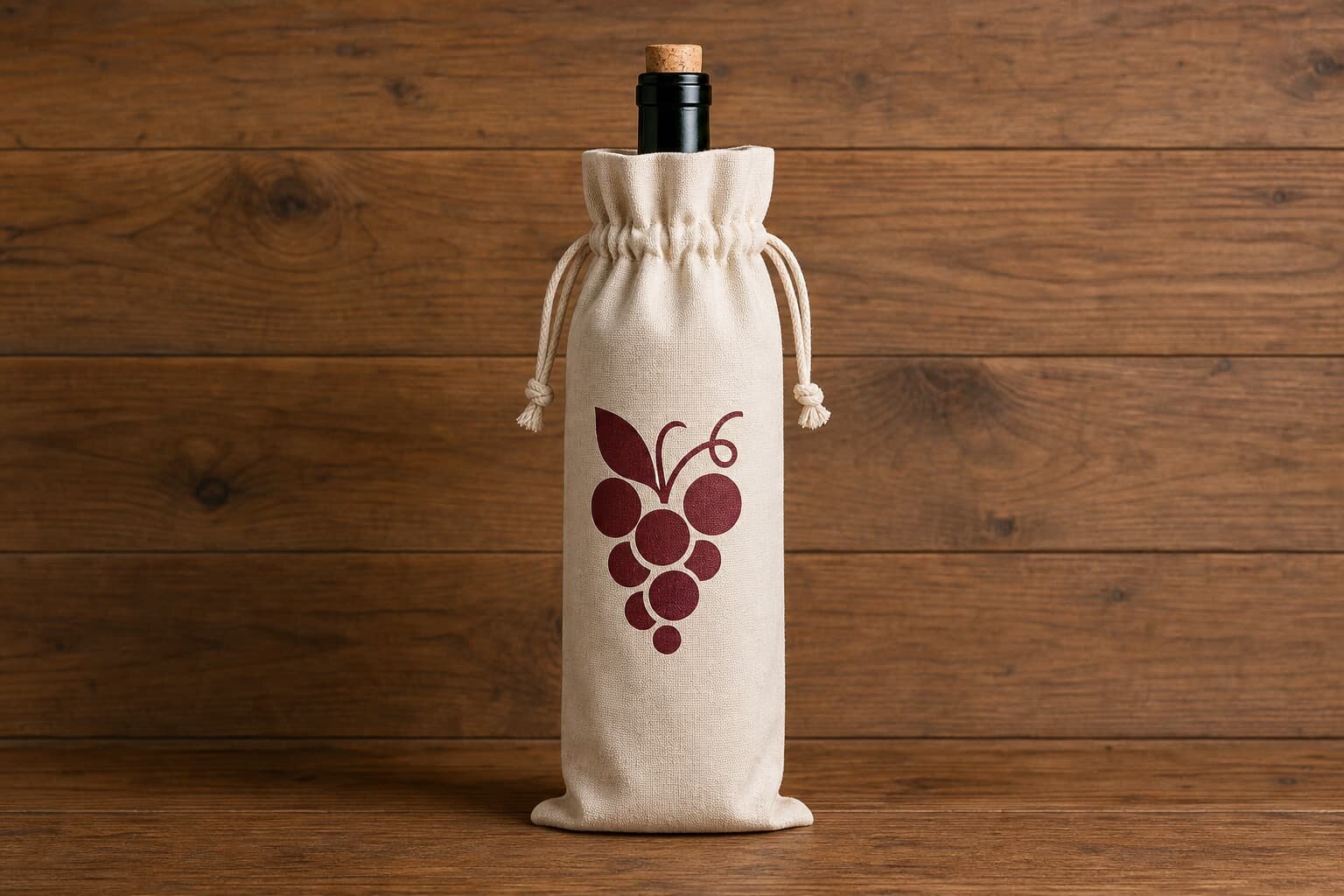
1. The audit problem: branded wine bags fail when print risk is checked too late
Wine and bottle bags look simple until a buyer receives bulk goods with a crooked logo, weak handle, wrong bottle fit, or ink that sits badly on a rough jute surface. In many problem orders, the factory did not intentionally cut corners. The real issue is that the RFQ did not force the supplier to confirm fabric weight, print method, logo position, MOQ logic, and packing assumptions before the price was accepted.
For wholesale wine and bottle bags, the factory audit should focus on whether the supplier can control branding on a three-dimensional textile product. A flat artwork file does not guarantee a clean print after the bag is sewn, folded, pressed, or packed. The buyer should audit how the factory samples, prints, measures, dries, packs, and documents the bag before issuing a production PO.
- Use this audit when the order includes retail branding, winery branding, corporate gifting, distributor programs, or seasonal promotion packaging.
- The main buying problem is not finding the cheapest wine bag; it is preventing brand and fit defects before bulk production.
- Ask the supplier to quote against a technical spec sheet, not only a photo of a similar bag.
2. Start with the bottle, not the bag drawing
A wine bag factory cannot correctly size the product if the buyer only says single bottle bag or two-bottle carrier. Bordeaux, Burgundy, Champagne, sparkling wine, spirits, olive oil, and specialty gift bottles have different height, base diameter, shoulder shape, and filled weight. A few millimeters can affect whether the drawstring closes, whether the bottom looks rounded, and whether the handle carries the bottle safely.
Before you ask for a quote, provide the factory with the actual bottle dimensions or a bottle sample. If you are selling to multiple bottle formats, decide whether one universal size is acceptable or whether separate SKUs are needed. Universal sizing reduces MOQ pressure but may look loose on standard bottles and tight on sparkling bottles.
- Single Bordeaux bottle reference: give bottle height, base diameter, shoulder width, neck height, and filled weight.
- Champagne or sparkling wine: check wider base, thicker glass, and taller shoulder before approving bag width.
- Two-bottle bag: confirm divider thickness, divider height, and whether bottles touch at the neck or base.
- Six-bottle carrier: request handle load testing and reinforced bottom construction, not only a fabric GSM quote.
3. Fabric GSM changes print quality, feel, and bottle support
Cotton, canvas, jute, and non-woven styles can all be used for bottle bags, but they do not behave the same in printing or carrying. A 140 GSM cotton bag may be acceptable for a low-cost promotional giveaway, while a 220 GSM cotton or 10 oz canvas bag gives a stronger handfeel for retail gifting. For premium two-bottle or multi-bottle bags, 12-16 oz canvas is often more practical because the fabric supports stitching, handles, and dividers better.
Jute gives a rustic look, but its coarse fiber and uneven surface can reduce logo detail. Laminated jute adds body and moisture resistance but may create odor, crease marks, or sustainability claim questions. If the buyer wants a small fine-line logo, heavy jute may be the wrong material unless the logo is simplified, printed on a cotton patch, or applied with a woven label.
- 140-160 GSM cotton: cost-sensitive promotions, simple print, lighter handfeel.
- 180-220 GSM cotton: better balance for reusable single-bottle gift bags.
- 10-12 oz canvas: good for sturdier single-bottle or premium retail programs.
- 12-16 oz canvas: better for two-bottle carriers, reinforced bottoms, and heavier loads.
- 10-14 oz jute: useful for rustic branding, but check hairiness, odor, lamination, and print edge clarity.
4. Match the print method to the fabric surface
Screen printing is usually the most stable choice for solid logos, winery names, simple icons, and one to three spot colors. It is economical at wholesale volume and works well on cotton and canvas when the artwork is clean and the ink is properly cured. However, screen print setup depends on print size, color count, and fabric color. A white print on dark canvas often needs a stronger ink layer or underbase, which can change handfeel and cost.
Heat transfer can reproduce gradients and small detail, but it is not automatically better. On rough jute, textured canvas, or seams near the print area, transfer film may not bond evenly. Embroidery or woven labels can solve some print issues, but they add cost, lead time, and MOQ constraints. The audit question is simple: can the factory explain why the quoted method is suitable for your exact logo and material?
- Screen print: best for solid logos, spot colors, large repeat orders, and controlled Pantone matching.
- Heat transfer: useful for gradients or photo-style artwork, but check wash, rub, and cracking risk.
- Embroidery: premium look for canvas, but small lettering can close up and backing may rub against the bottle.
- Woven label or sewn patch: useful for rough jute or multi-color logos where direct print will not be sharp.
- Embossing or debossing: possible on certain leather patches or coated labels, not a universal textile solution.
5. Audit artwork handling before sample approval
Many print disputes begin with poor artwork control. A buyer sends a JPEG, the supplier redraws it, and the bulk print comes back with altered spacing or wrong line weight. For wine and bottle bags, artwork also needs placement control because the print area is narrow, the bag may close with a drawstring, and the bottle shape can distort the front panel when filled.
A serious factory should ask for vector artwork and provide a print layout showing size, position, and color reference. The layout should measure the print from physical bag edges, not only center it visually on a flat drawing. If the logo is printed before sewing, cutting and sewing tolerances must be considered. If it is printed after sewing, the available flat print area may be smaller.
- Provide AI, EPS, PDF, or SVG vector artwork when possible.
- Specify print size in millimeters, not only percentage scale.
- State position from top edge, side seam, bottom seam, or bag center line.
- Confirm whether printing happens before sewing or after sewing.
- Require a print strike-off for new colors, dark fabrics, or textured materials.
- Set reasonable placement tolerance, such as plus or minus 3-5 mm depending on bag size and production method.
6. MOQ logic: the number you hear first may not be the number that controls the order
MOQ for wholesale wine and bottle bags is rarely just one number. It can be controlled by fabric roll quantity, dyeing minimum, printing setup, handle material, label order, carton packing, or labor efficiency. A factory may accept a low total order quantity if all bags use the same natural cotton and one print color. The same quantity may become difficult if the buyer wants five fabric colors, six logo versions, and individual retail packaging.
Procurement teams should ask how the MOQ is calculated. If a quote says MOQ 1,000 pieces, clarify whether that means per style, per fabric color, per print design, or per shipment. This matters for distributors and wineries ordering across multiple SKUs. Without this detail, the buyer may compare two supplier quotes that are not commercially equal.
- Same bag, same fabric, one logo: usually easier to consolidate.
- Same bag, multiple print versions: screen charges and setup time increase.
- Multiple fabric colors: dyeing or stock fabric availability may control MOQ.
- Custom woven labels: label supplier MOQ may affect the whole order.
- Retail individual packing: extra labor and material can change both MOQ and lead time.
7. What a complete factory quote should include
A useful wine bag quote should allow the buyer to compare suppliers line by line. If one supplier includes 220 GSM cotton, screen print, drawstring, carton packing, and sample cost while another only quotes a basic bag body, the cheaper line price is not a real saving. Ask for quote data in a structured format and require the supplier to state assumptions.
The quote should show fabric specification, dimensions, logo method, color count, packing, sample terms, production lead time, trade term, and validity period. If freight is included, ask whether it is based on actual carton volume or only an estimate. Wine bags are usually not heavy, but bulky packing and reinforced styles can affect air and courier cost.
- Fabric: composition, GSM or ounce weight, color, finish, lamination if any.
- Size: width, height, gusset or bottom size, drawstring or handle length.
- Branding: method, print size, color count, Pantone references, setup charge.
- Construction: seam type, stitch density, divider, reinforcement, label, eyelet if used.
- Packing: pieces per inner pack, pieces per export carton, carton dimensions, gross weight.
- Commercial terms: MOQ, unit price, sample cost, tooling cost, payment term, lead time, quote validity.
8. Sampling: approve the product, not a pretty reference photo
A photo sample or digital layout is not enough for a branded bottle bag order. The buyer should approve a physical sample that uses the final fabric, final print process, final size, and final closure. If timing is tight, separate the process into a blank size sample and a print strike-off, then combine both into a pre-production sample before mass production starts.
During sample review, place the actual bottle inside the bag and check the filled appearance. Look at how the logo sits when the fabric curves around the bottle. Pull the drawstring or lift the handles with a filled bottle. If the print cracks, the logo disappears into folds, or the drawstring cannot close cleanly, the spec needs adjustment before the PO moves forward.
- Check sample dimensions flat and filled.
- Measure fabric GSM where possible or request the factory material test record.
- Compare print color to Pantone reference or approved physical standard.
- Check print alignment after bottle insertion, not only on the empty flat bag.
- Lift and shake gently with the filled bottle to test handle or drawstring stress.
- Approve packing method if the bag will be folded, banded, polybagged, or retail packed.
9. Packing and lead time risks that affect final delivery
Packing is often treated as a warehouse detail, but it can damage the presentation of wine bags. Heavy compression can leave crease lines on canvas, crack transfer prints, flatten jute texture, or mark ink that was not fully cured. If the bag is intended for retail or gift use, packing quality is part of the product quality.
Lead time should be split into stages. Material booking, sample approval, screen making, printing, sewing, curing, trimming, inspection, and packing all take time. If the buyer changes artwork after screens are made, or changes fabric color after material is booked, the delivery date may shift. A reliable factory should explain which stage is on the critical path.
- Confirm whether bags are packed flat, folded once, bundled, or individually polybagged.
- Ask if printed surfaces are protected from direct rubbing during carton compression.
- Check carton size and gross weight against the buyer warehouse limit.
- Use moisture protection for sea shipment where humidity risk is high.
- Ask for production schedule milestones instead of one general ready date.
- Reserve inspection time before the booked shipping date.
10. Practical acceptance criteria for inspection
Inspection standards should be practical and measurable. A buyer should not simply say good quality or same as sample. For wine and bottle bags, the inspection team needs criteria for fabric, size, logo, stitching, closure, bottle fit, odor, cleanliness, and packing. The approved sample remains the main reference, but written tolerances reduce arguments.
The acceptance criteria should match the product purpose. A low-cost event giveaway may allow wider stitching tolerance than a premium retail bottle carrier. However, safety and brand visibility should not be compromised. If a handle tears when carrying a filled bottle, or a logo is visibly crooked on a gift item, the commercial damage can exceed the unit cost difference.
- Fabric weight: define allowed tolerance from approved GSM or ounce weight.
- Bag size: set tolerance for width, height, and gusset or bottom depth.
- Logo position: measure from fixed seams or edges, not only visual center.
- Print quality: no major smearing, peeling, missing ink, wrong color, or obvious pinholes in main logo area.
- Stitching: no open seams, skipped stitches, broken thread, or loose reinforcement at stress points.
- Bottle fit: test with approved bottle type during inspection.
- Odor and cleanliness: no heavy chemical smell, mildew, oil marks, or loose jute dust beyond agreed standard.
- Packing: correct SKU, quantity per carton, carton mark, and separation of different print versions.
Specification comparison for buyers
| Spec decision | Recommended option | When it fits | Buyer risk to check |
|---|---|---|---|
| Fabric for single wine bottle gift bag | 180-220 GSM cotton or 10-12 oz canvas | Retail gifting, promotional wine sets, reusable brand packaging | Thin fabric may show bottle outline, distort print, or feel too promotional for premium wine |
| Rustic bottle packaging | 10-14 oz jute laminated or unlaminated depending on structure | Organic, winery, farm shop, craft beverage, holiday gift packs | Jute hairiness reduces fine print sharpness; lamination affects smell, fold, and recyclability claims |
| Low-cost event giveaway | 140-160 GSM cotton with simple one-color print | Short campaign use, trade show giveaways, single-season promotions | Low GSM can shrink, wrinkle, and cause print-through if ink deposit is too heavy |
| Premium two-bottle carrier | 12-16 oz canvas with reinforced divider and box stitching | Retail wine bundles, corporate gifts, spirits and olive oil sets | Divider height, handle strength, and base width must match filled bottle weight |
| Logo application | Screen print for solid logos; heat transfer only for gradients or photo artwork | Most wholesale wine bag branding programs | Heat transfer may crack on textured jute or heavy canvas if temperature and pressure are not controlled |
| Packing method | Flat packed by size and print color, with export carton drop protection | Importers needing efficient warehouse receiving and retail repacking | Over-compression can crease coated jute, mark ink, or bend divider panels |
Buyer checklist before sampling
- Confirm bottle type, height, shoulder width, base diameter, and filled weight before asking for a quote.
- State fabric type and target GSM or ounce weight instead of only saying cotton, canvas, or jute.
- Attach vector artwork and specify print size, position, number of colors, and Pantone references.
- Ask the factory to confirm whether the selected print method suits the fabric surface and bag construction.
- Request a pre-production sample using final fabric, final print method, final drawstring or handle, and final packing method.
- Check whether quoted MOQ is per design, per color, per fabric, per print color, or per shipment.
- Require carton packing details, inner polybag policy, carton size, gross weight, and pallet suggestion if needed.
- Ask for lead time split by material booking, sample approval, bulk production, inspection, and packing.
- Define acceptance criteria for logo placement tolerance, print color deviation, stitch density, and fabric weight tolerance.
- Keep one signed sample or sealed approved sample at the factory and one with your buying team for inspection comparison.
Factory quote questions to send
- What exact fabric composition and GSM or ounce weight are included in this quotation?
- Is the fabric greige, dyed, bleached, natural, laminated, or coated, and what shrinkage should we expect?
- Which print method are you quoting, and why is it suitable for this fabric and logo detail?
- Is the MOQ calculated by bag style, fabric color, print design, print color, or total order quantity?
- Does the unit price include artwork setup, screen charges, plate charges, sample cost, and packing materials?
- What is the maximum print area available after sewing, and what tolerance do you control for print position?
- Will the drawstring, handle, divider, and bottom reinforcement be made from the same material as the body?
- What sample types can you provide: blank sample, digital mockup, print strike-off, or full pre-production sample?
- How many days are required after artwork approval, sample approval, deposit, and final packing confirmation?
- What carton quantity, carton dimensions, gross weight, and loading estimate are assumed in the quote?
Quality-control points to confirm
- Measure fabric GSM from bulk material, not only from the approved sample.
- Compare print color under consistent lighting against Pantone or approved physical sample.
- Check logo placement from bag top edge, side seam, and bottom fold using a ruler.
- Load test handles or drawstrings with filled bottle weight and a safety margin.
- Inspect inner seams for loose threads that can snag bottle labels or capsules.
- Check bottle fit using the buyer’s actual bottle, including tall Riesling, Burgundy, Champagne, or square spirits bottles where relevant.
- Confirm divider position and height on two-bottle or six-bottle bags before packing.
- Rub test printed areas after curing to check ink adhesion and transfer risk.
- Open several packed cartons to check creasing, odor, moisture, and color mixing.
- Verify carton marks, SKU labels, and retail pack sequence against the purchase order.