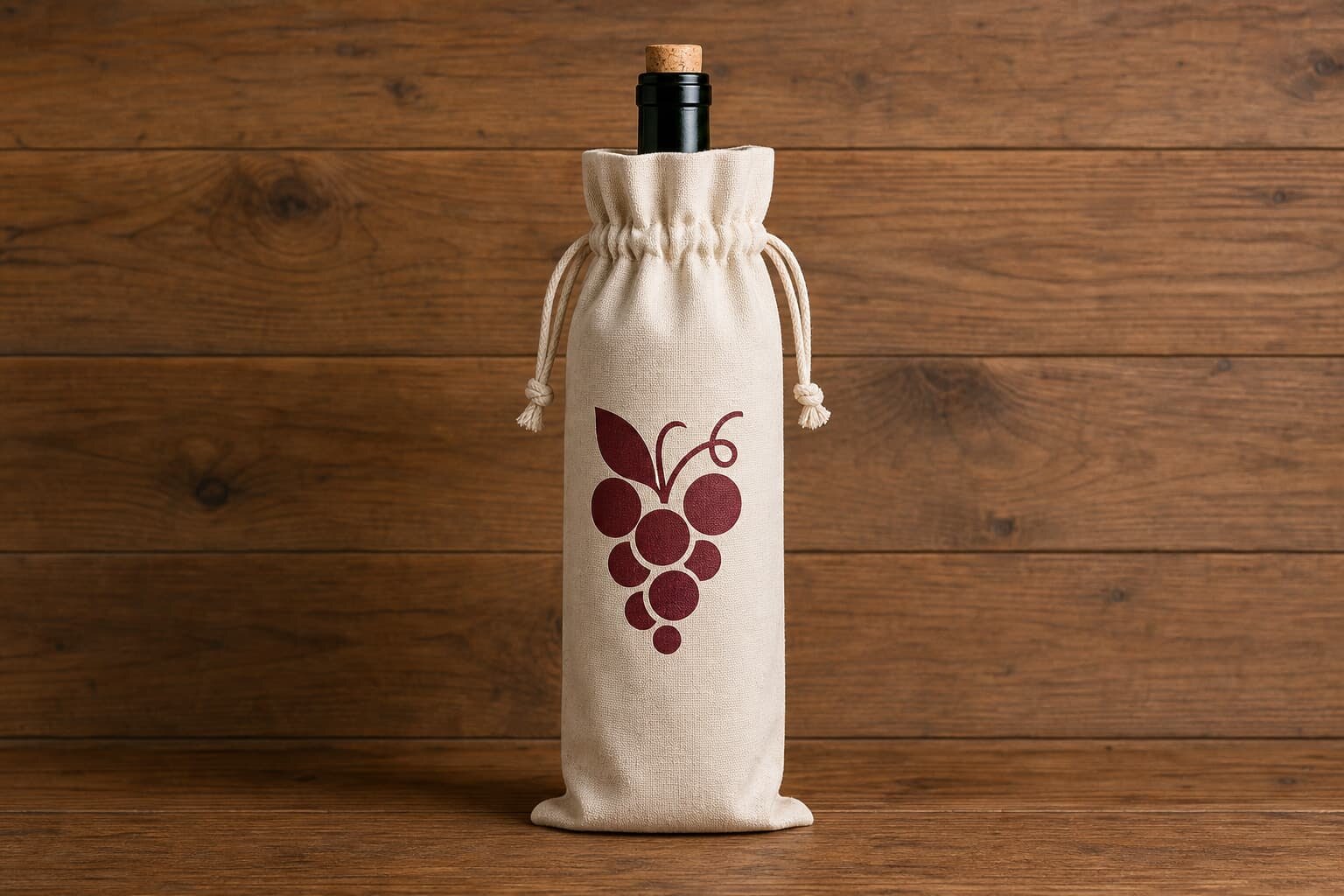
1. The cost problem: wine bag quotes look simple until the specs are unclear
Wholesale wine and bottle bags are often treated as small packaging items, but the quote can change quickly when the buyer changes fabric weight, handle structure, print coverage, or packing method. A single-bottle cotton drawstring bag and a canvas wine tote may both be described as wine bags, yet the material consumption, sewing time, inspection points, and carton volume are very different. If an RFQ only says natural cotton wine bag with logo, suppliers will fill the gaps in different ways, and the lowest quote may simply be the thinnest fabric or weakest construction.
For procurement teams, the first control point is to make each quote answer the same product question. The supplier should not be guessing bottle size, bag opening, gusset, drawstring quality, or print method. A good cost comparison starts with a fixed specification sheet, then asks factories to show the assumptions behind their price. This article focuses on quote control for wholesale wine and bottle bags: how to define the bag, read price differences, and prevent the common production problems that create chargebacks, delays, or unusable stock.
- Do not compare quotes until the finished size, fabric weight, print method, and packing are the same.
- Ask for the quoted fabric weight and finished piece weight; it quickly exposes under-specified offers.
- Treat single-bottle bags, handle totes, and multi-bottle carriers as separate product families, not one generic line.
2. Start the RFQ with the bottle, not the bag
The bottle determines the usable bag size. A standard 750 ml wine bottle, a champagne bottle, a spirits bottle, and a tall slim bottle do not need the same height, width, bottom gusset, or closure. If the buyer does not specify the bottle, the supplier may quote a common size that looks acceptable on paper but fits poorly in retail use. A bag that is too tight slows packing and may tear at the seam. A bag that is too loose looks cheap and allows the bottle to move during handling.
For single wine bottle drawstring bags, common finished size ranges are often around 15 x 35 cm or 16 x 38 cm, but these are only starting points. Champagne bottles, gift boxes, or padded protection need more room. For handle wine totes, the bottom gusset and handle drop matter as much as width and height. A six-bottle carrier needs divider width, divider height, base support, and handle reinforcement defined before a meaningful cost can be quoted.
- Send bottle diameter, bottle height, shoulder shape, and filled weight if available.
- State whether the bag must cover the full bottle neck or leave the top visible.
- For retail packing, confirm whether a hangtag, barcode, or insert card must fit with the bottle.
- For multi-bottle bags, specify divider layout and whether the divider is sewn-in, removable, or folded.
3. Fabric weight is the biggest visible cost driver
Fabric weight is one of the most important cost drivers because it affects material cost, sewing behavior, product feel, and shipping volume. For cotton drawstring wine bags, buyers often see 120-180 GSM cotton for promotional use and 200-280 GSM cotton for stronger retail packaging. For canvas wine totes, specifications may be written as 8 oz, 10 oz, 12 oz, or 16 oz canvas. For jute wine bags, buyers may see 10-13 oz jute, sometimes with lamination to improve shape and reduce fiber shedding.
A low quote may be based on lighter fabric than expected. The difference between 140 GSM cotton and 250 GSM cotton is not just a small quality upgrade; it changes the fabric consumption cost and the perceived value of the finished bag. Natural cotton also varies in color, seed flecks, and shrinkage. Dyed fabric adds dye lot control and minimum fabric requirements. Laminated jute improves structure but can affect recyclability claims and smell. Buyers should require the supplier to state fabric type, GSM or ounce weight, and finish in the quote.
- Promotional cotton drawstring bag: usually 120-180 GSM, suitable for light gift packaging.
- Retail cotton or canvas wine tote: often 250-340 GSM or 10-12 oz for better structure.
- Premium canvas wine carrier: 12-16 oz, higher sewing cost, stronger hand feel.
- Jute wine bag: confirm natural, dyed, laminated, or unlaminated jute, because print and odor risks differ.
- Nonwoven bottle bag: confirm GSM and lamination, but do not compare it directly with cotton or canvas.
4. Construction details separate a cheap bag from a safe bottle carrier
Wine and bottle bags carry concentrated weight. A filled bottle places stress on the bottom seam, side seam, handle connection, and drawstring channel. For a simple drawstring bag, the key points are seam strength, channel stitching, drawstring quality, and bottom fold alignment. For a handle tote, the handle attachment is critical. A plain single stitch may be acceptable for a very light promotional bag, but a reusable bottle tote should use reinforced stitching such as bartack, cross stitch, or box stitch depending on the design.
For multi-bottle carriers, the structure is more complicated. The divider must keep bottles from knocking together, and the base must resist sagging. Some suppliers quote a low price by using a thin divider, reducing the height of the divider, or removing base reinforcement. The product may look correct when empty but fail when loaded. Procurement teams should request construction drawings or clear reference photos with dimensions and stitch details, especially when the order is for retail sale or repeated bottle handling.
- Define seam allowance and stitch density where possible, especially for heavier canvas and jute.
- Ask whether the handle is self-fabric, cotton webbing, jute webbing, rope, or PP webbing.
- For a bottle tote, specify handle width and handle drop; both influence comfort and material cost.
- For six-bottle carriers, confirm divider fabric, divider height, base reinforcement, and folded carton volume.
- Include a load test requirement in the purchase order, not only during final inspection.
5. Print method changes unit cost, MOQ, and defect risk
The cheapest print method is not always the safest print method. Screen printing is commonly used for cotton, canvas, jute, and some nonwoven bottle bags, especially for one-color or two-color logos. It gives good opacity on many fabrics, but fine lines and rough jute texture can reduce edge sharpness. Heat transfer can handle more detailed artwork and gradients, but buyers need to check adhesion, hand feel, and cracking on folded areas. Digital printing can be suitable for small runs or multicolor artwork, but fabric compatibility and color consistency must be approved by sample.
Embroidery, woven labels, leather patches, and debossed patches create a premium look but add setup, sewing, and placement control. A logo printed over a seam, near a drawstring channel, or across a heavily textured jute surface is more likely to have defects. The artwork should be reviewed together with the bag pattern before quoting. If a supplier quotes without asking print size and print position, the price may exclude important cost or hide a production risk.
- Screen print: good for simple logos and larger orders; ask for screen charge and color count.
- Heat transfer: useful for detailed artwork; test rubbing, peeling, and heat marks on fabric.
- Digital print: useful for multicolor small orders; confirm color tolerance and wash or rub performance.
- Embroidery: premium but heavier and slower; check puckering on lightweight cotton.
- Woven label or side label: clean branding option; confirm label MOQ and sewing position.
- Embossed or debossed patch: suitable for premium bags; ask for mold cost and patch material details.
6. MOQ logic: the real MOQ is usually hidden in material and setup
Many buyers ask for one MOQ, but the factory usually manages several MOQs at the same time. There is the sewing line MOQ, the fabric MOQ, the dyed fabric MOQ, the screen print setup logic, the label MOQ, and the packing MOQ. For natural stock fabric and one-color screen print, the supplier may accept a lower order quantity. For custom dyed canvas, custom woven labels, special cord colors, or retail packaging with barcode labels, the real minimum can rise quickly.
A low MOQ may still have a higher unit price because setup cost and material handling are spread over fewer pieces. A higher MOQ may reduce the unit price but increase inventory risk and cash tied up in slow-moving SKUs. For distributors and retail buyers, it is often better to ask suppliers for price breaks at realistic quantities rather than pushing for the lowest possible MOQ. The right comparison is not MOQ alone; it is MOQ plus setup charge, sample charge, delivery time, and leftover material handling.
- Ask price breaks at practical levels such as 500, 1,000, 3,000, and 5,000 pieces, if suitable for the style.
- Separate MOQ by colorway and artwork, because mixing colors may not count as one production batch.
- Check whether the supplier can combine several bag sizes in one fabric order to improve material efficiency.
- For custom dyed fabric, ask who owns leftover fabric and whether it can be used for repeat orders.
- For private-label retail packing, confirm the MOQ of hangtags, barcode stickers, and printed cartons.
7. How to read a quote breakdown without being misled
A useful quote should show more than one unit price. At minimum, procurement teams should understand the product cost, print cost, setup cost, label or trim cost, sample cost, packing cost, and freight basis. If a supplier only gives one combined price, it becomes difficult to compare alternative print methods or change fabric weight later. It also becomes harder to identify why one factory is lower than another. The difference may be fabric grade, sewing detail, print coverage, packing quantity, or simply a missing item.
For wine and bottle bags, carton volume can be a hidden cost. A thick canvas wine tote or jute carrier with a base gusset takes more shipping space than a thin flat drawstring bag. Multi-bottle carriers can be bulky even when empty. Ask for pieces per carton, carton dimensions, gross weight, and CBM per 1,000 pieces. This information helps importers estimate landed cost and warehouse space before placing the order.
- Request quoted Incoterm clearly, such as EXW, FOB, FCA, CIF, or DDP if offered.
- Ask whether local export carton, polybag, palletization, fumigation if needed, and document charges are included.
- Compare sample charges and setup charges separately; do not hide them inside the first production unit price.
- Ask for estimated production wastage policy if the order requires exact retail set quantities.
- Require quote validity date because cotton, canvas, jute, exchange rate, and freight can move.
8. Sampling should prove the risky points, not just show a logo
A sample is not only a sales presentation. It is a production control tool. For a wine bag, the sample should prove finished size, bottle fit, fabric weight, print appearance, seam strength, handle comfort, and packing method if retail presentation matters. Many problems appear only after inserting the real bottle. The bag may be too narrow at the base, the drawstring may not close smoothly, the print may sit too low, or the handle may feel weak when the bottle is inside.
Buyers should distinguish between an existing sample, a custom sample, and a pre-production sample. An existing sample only proves factory capability and general workmanship. A custom sample proves size and artwork direction but may use available fabric or substitute trim. A pre-production sample should match bulk material, bulk print method, bulk labels, and final packing. For important orders, the approved pre-production sample should be kept as the inspection reference.
- Check sample weight and fabric thickness, not only visual color.
- Insert the actual bottle and test closure, handle comfort, and balance.
- Measure print placement from fixed points such as bottom seam and side seam.
- Rub the print with dry and slightly damp cloth to identify weak curing or transfer issues.
- Photograph approved details and include them in the purchase order or QC file.
- Do not approve bulk production from a digital mockup alone.
9. Packing and lead time are part of cost control
Packing is often treated as an afterthought, but it affects unit cost, carton volume, barcode accuracy, labor, and delivery condition. A bulk-packed cotton drawstring wine bag is inexpensive to pack, while a retail-ready wine tote with hangtag, barcode sticker, tissue insert, and individual polybag takes more labor and materials. For natural fibers, the packing method can also affect moisture risk. Bags should be dry, clean, and packed in export cartons strong enough for the shipment method.
Lead time depends on material availability, dyeing, sample approval, print setup, sewing capacity, and packing complexity. A stock fabric, one-color print order can move faster than a custom dyed canvas bag with woven labels and retail packing. Buyers should not ask for a final delivery date without first confirming when artwork is approved, when the deposit is received, and whether the sample approval is blocking production. The safest RFQ asks the factory to split lead time into sample time, material preparation time, bulk production time, packing time, and booking or dispatch time.
- Define whether bags are bulk packed, inner packed by dozens, individually polybagged, or retail packed.
- Ask for carton dimensions and gross weight before confirming freight planning.
- Confirm moisture prevention for jute, cotton, and canvas, especially in humid seasons.
- Set the production clock from approved artwork and approved sample, not from first inquiry date.
- For seasonal promotions, reserve time for re-sampling if the first sample fails fit or print checks.
10. Practical acceptance criteria to put into the purchase order
A purchase order should translate the approved sample into measurable acceptance criteria. Without this, final inspection becomes subjective. For wine and bottle bags, the most important criteria are finished dimensions, load performance, print position, print appearance, stitching quality, odor, stains, packing count, and carton condition. Natural fabric variation should be allowed within reason, but serious defects such as mildew odor, oil stains, broken seams, or wrong print color should be clearly rejected.
Procurement teams should also control substitutions. A supplier should not change fabric lot, handle webbing, drawstring, label material, or packing method after sample approval without written confirmation. If the order includes several SKUs, each SKU needs its own approved size, artwork file, carton mark, and barcode data. Many shipment problems come from mixing similar wine bag sizes or printing the right logo on the wrong fabric color. Clear acceptance criteria reduce disputes and help the factory train operators before mass production.
- Finished size tolerance: define an acceptable range, for example plus or minus a few millimeters depending on fabric and size.
- Print tolerance: define position tolerance, color reference, and unacceptable defects such as cracking, heavy bleeding, or missing ink.
- Stitching defects: reject open seams, skipped stitches, broken thread, poor handle reinforcement, and unsecured drawstring channel.
- Load test: test with intended bottle weight and reasonable handling movement.
- Odor and cleanliness: reject mildew, strong chemical odor, visible dirt, oil marks, or heavy fiber contamination.
- Packing accuracy: verify SKU count, carton label, barcode, and inner packing before shipment release.
Specification comparison for buyers
| Spec decision | Recommended option | When it fits | Buyer risk to check |
|---|---|---|---|
| Single bottle promotional bag | 140-180 GSM cotton drawstring bag with one-color screen print | Budget gift packaging, wine clubs, events, seasonal retail inserts | Thin fabric can show bottle outline; confirm finished size after shrinkage and drawstring strength |
| Retail wine tote with handles | 10-12 oz cotton canvas or 250-300 GSM cotton with reinforced handles | Reusable gift bag, winery shop, brand merchandise, higher perceived value | Handle box stitch and seam allowance must be specified or quotes will not be comparable |
| Rustic natural bottle bag | 10-13 oz jute or laminated jute with cotton webbing handle | Farm shop, organic wine, craft beverage, hamper packaging | Jute odor, loose fibers, and print edge definition need sample approval before bulk |
| Premium presentation bag | 12-16 oz canvas with lining, gusset, and woven label or embroidery | Corporate gifting, premium liquor, retail gift sets | Higher labor minutes and trim costs; ask for piece weight and packing volume |
| Multi-bottle carrier | Canvas or jute carrier with internal divider and reinforced base | Two-bottle and six-bottle retail carriers, tasting rooms, distributors | Divider height, base board, and load test must be defined; otherwise factories may quote different structures |
| Low MOQ branded order | Stock fabric color, standard size, single-position screen print | First purchase order, event deadline, distributor trial order | Unit price may look higher but tooling and fabric dye risk are lower |
Buyer checklist before sampling
- Define bottle type and dimensions before asking for price: 750 ml wine, champagne, spirits, 1 liter bottle, or mixed bottle set.
- State finished bag size including width, height, bottom gusset, and handle drop or drawstring opening.
- Lock fabric type and weight: cotton GSM, canvas ounce, jute ounce, nonwoven GSM, or laminated material details.
- Specify print method, print size, number of colors, print position, and whether artwork has fine lines or full coverage.
- Ask whether quoted fabric is greige, dyed, washed, laminated, or pre-shrunk, because these affect size tolerance and hand feel.
- Confirm MOQ by bag style, fabric color, print method, and packing method, not only by total order quantity.
- Request sample cost, sample lead time, and what parts of the sample will match bulk production.
- Require packaging details: pieces per inner polybag, carton quantity, carton size, gross weight, and export carton strength.
- Ask for separate quote lines for bag cost, printing, labels, special trim, packing, testing, sample, mold or screen setup, and freight if applicable.
- Set acceptance criteria for size tolerance, print tolerance, stitching defects, odor, stains, color variance, and load test before production starts.
Factory quote questions to send
- What exact fabric construction are you quoting: material, GSM or ounce weight, weave, lamination, dye process, and shrinkage expectation?
- Is the price based on finished bag size or cutting size, and what tolerance do you apply after sewing and finishing?
- What MOQ applies to the bag body, fabric color, drawstring or handle color, print method, and carton packing?
- Which print method do you recommend for this artwork and fabric: screen print, heat transfer, digital print, embroidery, woven label, or embossing?
- Are print setup, screen charges, digital file handling, label mold, or embroidery tape charges included or separate?
- What sample will you provide: existing quality sample, blank pre-production sample, printed approval sample, or full PPS using bulk materials?
- What is your normal production lead time after artwork approval and deposit, and what items can extend it?
- How many pieces per carton, what carton size, what gross weight, and what is the estimated CBM per 1,000 pieces?
- Do you include individual polybags, master polybag, tissue paper, hangtag, barcode sticker, or retail-ready packing in this quote?
- What inspection standard do you use for wine bag load testing, seam strength, print adhesion, needle damage, and packing count?
Quality-control points to confirm
- Measure finished width, height, gusset, handle drop, and drawstring opening against approved sample and tolerance sheet.
- Check fabric weight by GSM or ounce equivalent, and compare hand feel, stiffness, color, and shrinkage with approved sample.
- Inspect stitching density, seam allowance, loose threads, skipped stitches, bartack or box stitch reinforcement, and bottom gusset alignment.
- Run a practical load test using the intended filled bottle weight plus safety margin, especially for handle totes and multi-bottle carriers.
- Check print position, print size, color match, edge sharpness, opacity, cure, rubbing resistance, and cracking on folded or textured areas.
- Inspect jute and natural fiber bags for odor, oil stains, mildew, broken yarns, heavy slubs, and excessive fiber shedding.
- Confirm drawstring length, knot security, stopper quality if used, handle webbing width, and hardware finish.
- Verify carton marking, carton strength, inner quantity, polybag sealing, barcode placement, and packing list consistency.
- Review pre-shipment photos and random inspection reports before balance payment, especially when several SKUs share similar dimensions.