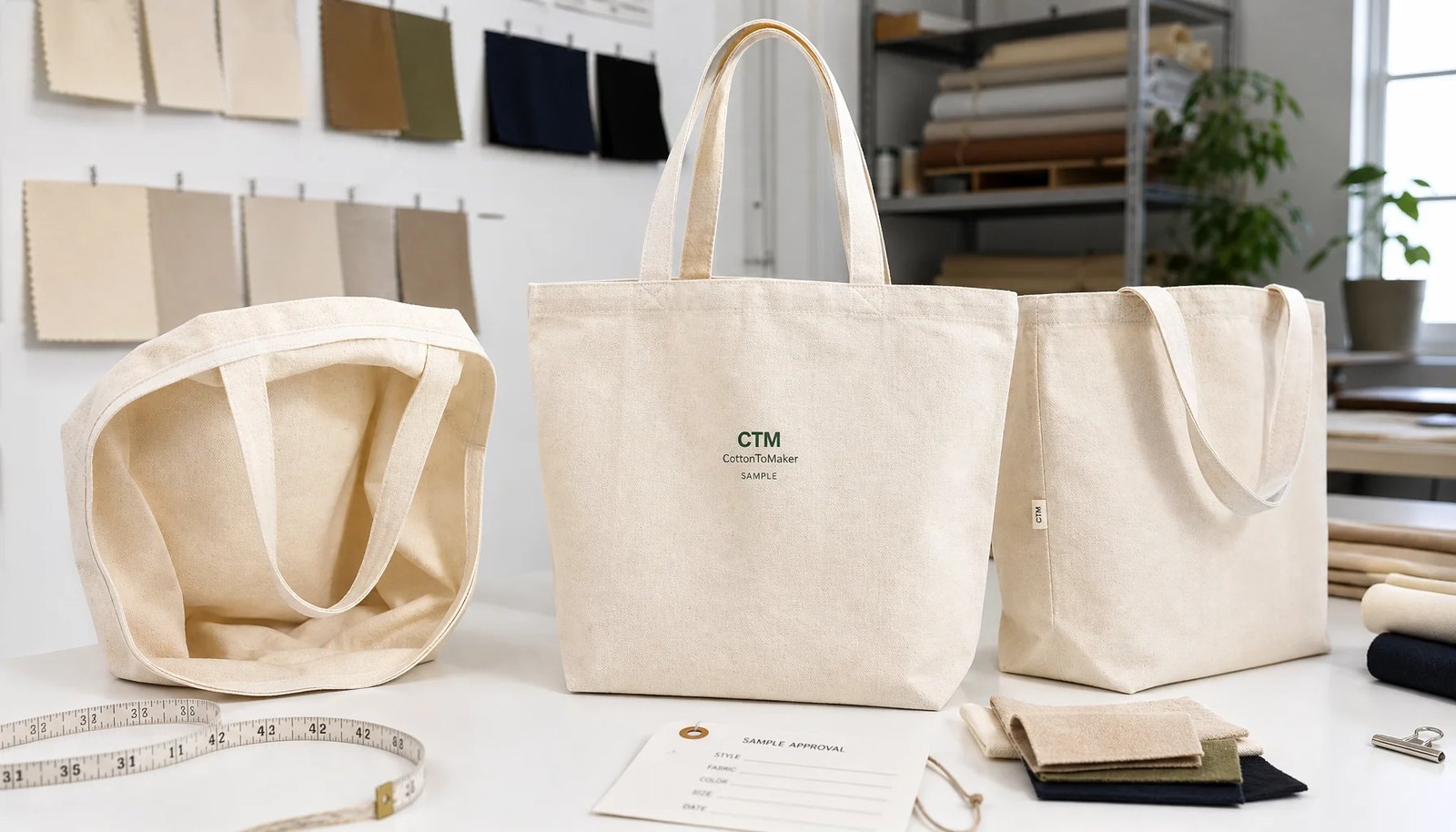
Start the RFQ With the Store Use Case
A university bookstore tote RFQ should begin with the selling situation, not the logo artwork. A tote used as a paid retail item needs a different fabric feel, seam finish, and presentation than a low-cost orientation giveaway. A tote used at checkout must survive books and water bottles. A tote packed inside a welcome kit must fold cleanly and keep the print from rubbing against other items.
When the use case is unclear, suppliers will quote the easiest construction: a basic cotton shopping bag, light fabric, standard handles, and low-cost screen print. That quote may look competitive but can fail after the first sample review. Put the business requirement at the top of the RFQ so every factory prices the same problem.
- Checkout tote: prioritize handle strength, practical size, and fast replenishment.
- Retail merchandise tote: prioritize fabric hand feel, print quality, label detail, and shelf presentation.
- Orientation or event tote: prioritize carton efficiency, simple artwork, and reliable delivery date.
- Alumni or gift tote: prioritize heavier fabric, clean seams, and premium print or woven label options.
- Textbook tote: prioritize load capacity, handle reinforcement, and larger gusset if needed.
Choose Fabric Weight Before Comparing Prices
Organic cotton totes are commonly quoted by fabric weight, but buyers often describe them as light, medium, or heavy. Those words are not precise enough for factory costing. For a basic bookstore tote, 6 oz may be acceptable for event giveaways but can feel thin for retail sale. An 8 oz organic cotton canvas is a common balanced option. A 10 oz tote feels more substantial for bookstore merchandise. A 12 oz tote adds strength and perceived value but raises fabric cost, carton weight, and sewing time.
GSM should be included beside the ounce value because different suppliers may convert or describe fabric differently. A practical RFQ can request options, for example 8 oz, 10 oz, and 12 oz organic cotton canvas in the same size. This lets procurement compare the price step against the actual product upgrade instead of receiving three unrelated quotes.
- 6 oz cotton: suitable for light giveaways, not ideal for heavy books.
- 8 oz cotton: common balance for campus events and bookstore checkout programs.
- 10 oz cotton: better retail feel for paid merchandise and reusable shopping bags.
- 12 oz cotton: stronger and more premium, but increases unit cost and shipping weight.
- Natural cotton: lower processing cost, but shade variation must be accepted or controlled.
- Dyed organic cotton: stronger brand match, but MOQ and color approval time usually increase.
Set Size, Gusset, and Handle Criteria
The most useful tote size for a university bookstore depends on what the customer carries. A flat tote around 38 x 42 cm can work for apparel and notebooks, but textbooks, binders, and drinkware may need a bottom gusset. Adding a gusset improves capacity but changes fabric consumption, carton volume, and sewing operations. A cheap flat tote quote should not be compared directly with a gusseted retail tote.
Handle length is another frequent source of complaints. Short handles may be fine for hand-carry giveaways, while shoulder carry usually needs longer handles. State both handle length and handle width. For heavier bookstore use, specify cross-stitch reinforcement or bartacks at handle attachment points. The factory should quote the reinforcement method clearly instead of treating it as a sample-stage adjustment.
- Flat tote: lower cost, easier packing, suitable for light merchandise.
- Bottom gusset: better for books and boxed items, higher fabric and sewing cost.
- Shoulder handle: usually preferred for campus retail customers carrying multiple items.
- Cross-stitch handle reinforcement: recommended for bookstore loads.
- Inside seam finish: overlock is common; bound seams give cleaner retail presentation.
Select Print Method Based on Artwork and Fabric
For university bookstore programs, most organic cotton totes use screen printing because it is reliable for bold logos, department marks, and mascot graphics. Water-based screen print is often preferred for a softer hand feel and a more natural product story. Plastisol can give strong opacity but may not fit every buyer's sustainability positioning. Heat transfer can reproduce gradients or complex art but may feel less integrated with the fabric and can add risk if the bag is folded or pressed incorrectly.
The RFQ should state print size, location, number of colors, Pantone references, and whether the mark is licensed. If the art includes fine lines, reversed text, or a large solid ink area, request a print strike-off on the same fabric weight and color. Organic cotton canvas can absorb ink unevenly compared with smoother synthetic fabric, so paper proofs alone are not enough.
- One-color screen print: most economical for bookstore logos and event bags.
- Two to three colors: still practical, but registration tolerance must be reviewed.
- Large solid print area: higher ink consumption and greater curing risk.
- Fine detail: needs screen mesh review and approval on fabric.
- Dark fabric with light ink: requires opacity testing before bulk production.
- Licensed university logo: allow time for brand approval after factory proofing.
Understand MOQ Logic Behind the Quote
MOQ is not only a factory policy. It is usually built from fabric purchasing, cutting efficiency, print setup, dyeing minimums, labeling, and carton handling. A supplier may offer a low MOQ for natural organic cotton totes using stock fabric, but the MOQ may jump for custom dyed fabric, multiple artwork versions, woven labels, or individual retail packaging.
To compare suppliers properly, break the order into variables. If 3,000 totes are split across three campus departments, two fabric colors, and five prints, the real production lots are much smaller than the headline quantity. That affects price and risk. A clear RFQ tells the supplier how many pieces per design, per color, and per destination.
- Stock natural organic cotton: usually the easiest route for lower MOQ.
- Custom fabric dyeing: often creates a separate dye lot MOQ and longer approval cycle.
- Multiple prints: each artwork requires setup, strike-off, and production control.
- Retail labels or hangtags: may have their own supplier MOQ.
- Split shipments: increase warehouse handling and carton marking work.
- Reorders: easier when the first order documents fabric, pattern, and print standards.
Compare Supplier Routes, Not Only Unit Price
For wholesale organic cotton totes for university bookstores, the sourcing route matters. A direct tote factory is usually strongest when the buyer has a stable specification, repeat order potential, and clear artwork. The factory can control fabric cutting, sewing, printing, packing, and QC in one production plan. This route often gives better technical communication and fewer hidden markups.
A trading company or sourcing agent can still be useful when the bookstore buyer needs several product categories consolidated into one shipment, such as totes, drinkware, apparel accessories, and stationery pouches. The risk is visibility. If the order is subcontracted, the buyer should require evidence of where the bags are made, how organic cotton documentation is controlled, and who is responsible for final inspection.
- Direct factory route: best for repeat tote programs and detailed construction control.
- Trading route: useful for mixed-category consolidation and smaller combined shipments.
- Local distributor route: faster domestic service, but less control over factory-level adjustments.
- Blank stock plus local print: fast for urgent programs, but fabric certification and print durability may vary.
- Overseas custom production: best when the bookstore needs exact size, label, packing, and cost control.
Request Evidence for Organic Cotton Claims
Organic cotton is a material claim, and procurement teams should treat it as a document-controlled item. A supplier saying 'we can make organic cotton' is not the same as providing valid evidence for the fabric, production scope, or transaction. Depending on the buyer's compliance policy, documentation may need to show certified material input, certified processing, transaction certificate, or supplier scope certificate.
Do not write the RFQ in a way that forces the supplier to guess the compliance standard. State what evidence the bookstore, university licensing office, distributor, or importer requires. If a certification logo will be used on hangtags or marketing pages, the buyer must confirm logo-use rules separately. Factories can supply product, but buyers remain responsible for claims made in the retail market.
- Request the exact certificate type required by your compliance team.
- Confirm whether the certificate covers the material supplier, the bag factory, or the transaction.
- Separate organic cotton evidence from general social compliance or quality certificates.
- Avoid using certification logos on packaging until logo-use rules are cleared.
- Keep approved documents connected to the PO, lot number, and shipment.
Use Samples to Prevent Production Mistakes
A good sample process reduces rework more than any long email chain. Start with a fabric swatch or existing sample if the buyer is still choosing weight. After specifications are fixed, request a pre-production sample using the intended fabric weight, handle style, seam finish, print method, label, and packing concept. This sample should become the reference for bulk production and final inspection.
The biggest sample mistake is approving a beautiful sample that does not match the bulk production route. A stock sample in 10 oz natural cotton does not approve an 8 oz dyed organic cotton bulk order. A digital mockup does not approve screen print opacity. A sample without carton packing does not prove the bag will arrive uncreased or without print transfer.
- Approve fabric weight and hand feel before approving final price.
- Approve print strike-off on the actual fabric color and GSM.
- Measure finished size, handle length, gusset, and seam finish on the sample.
- Record acceptable shade variation for natural or dyed fabric.
- Keep one sealed approval sample at the buyer side and one at the factory.
- Do not release bulk cutting until artwork, print placement, and fabric are approved.
Build Quote Data That Makes Bids Comparable
A professional RFQ should force comparable quotation data. If one supplier quotes FOB with plain cartons and another quotes delivered duty paid with hangtags and individual packing, the unit price comparison is meaningless. Use the same Incoterm, quantity tiers, artwork assumptions, carton requirements, and document requirements for every supplier.
The quote should show separate cost drivers where possible. This helps buyers negotiate intelligently. If the price increase is mainly from 12 oz fabric, the buyer can decide whether the premium feel is worth it. If the cost is from custom dyeing or multi-color printing, the artwork or color plan may be adjusted without weakening the bag itself.
- Quantity tiers: request at least two or three tiers such as 1,000, 3,000, and 5,000 pieces.
- Fabric options: compare 8 oz, 10 oz, and 12 oz in the same construction.
- Print line item: separate setup, color count, and per-piece print cost if possible.
- Packing line item: include hangtags, labels, inner bags, carton marks, and pallet rules.
- Testing or inspection: state whether third-party inspection is included or buyer-arranged.
- Freight term: compare quotes under the same Incoterm and destination assumption.
Control Packing, Cartons, and Moisture Risk
Cotton totes are simple products, but packing can still damage the shipment. Natural cotton absorbs moisture and odor. Over-compressed cartons can create hard creases, especially across printed areas. Poor stacking can distort gussets and handles. A retail bookstore receiving cartons during peak season does not have time to steam, sort, or re-pack defective bags.
The RFQ should include carton quantity, carton size target, gross weight limit, label format, and whether bags are flat packed, folded, or individually packed. For many wholesale bookstore orders, flat packing in export cartons is more efficient than individual polybags, unless retail presentation or fulfillment requirements demand unit packing. If sustainability is important, avoid default polybagging and specify paper bands, carton dividers, or bulk packing where acceptable.
- Flat bulk packing: efficient for bookstore backroom handling and lower packaging waste.
- Individual packing: useful for online fulfillment, but increases cost and plastic use unless alternatives are chosen.
- Carton labels: should show PO, SKU, color, design, quantity, carton number, and destination if needed.
- Gross weight: keep cartons practical for manual handling at store or distribution center.
- Moisture control: use clean dry cartons and consider desiccants for long ocean transit.
- Print protection: avoid folding printed faces against each other before ink is fully cured.
Specification comparison for buyers
| Spec decision | Recommended option | When it fits | Buyer risk to check |
|---|---|---|---|
| Fabric route | Certified organic cotton in natural or dyed canvas, 8-12 oz depending on load need | Campus bookstores selling reusable merchandise totes, orientation packs, alumni store items, or event bags | Supplier must separate organic material claims from general cotton claims and provide the exact certificate scope, not only a logo on a brochure |
| Construction level | Flat tote with reinforced cross-stitch handles and inside overlock or bound seams | Bookstore use where bags may carry books, apparel, drinkware, and checkout purchases | Thin handles, weak bartacks, or loose seam ends can fail before the fabric does; request handle pull test method |
| Print method | Water-based screen print for one to three solid colors; heat transfer only for complex art | University logos, mascot graphics, department marks, and simple campus store branding | Organic cotton fabric absorbs ink differently; approve strike-off on the actual fabric color and weight |
| MOQ logic | Separate MOQ for blank bag production, dyed fabric, print setup, and carton packing | Buyers comparing small event runs against annual bookstore replenishment orders | A low advertised MOQ may exclude custom fabric color, organic certification paperwork, or printed carton marks |
| Supplier route | Direct factory for repeat programs; trading partner for mixed SKU consolidation | Direct factory suits stable tote specs, while a consolidator helps combine totes with other bookstore goods | Direct factories may not consolidate unrelated categories; traders may hide subcontracting unless evidence is requested |
| Sample approval | Pre-production sample with fabric swatch, print strike-off, handle length, seam finish, and carton plan | Orders with licensed university marks or strict bookstore presentation requirements | A sales sample made from stock fabric is not enough when bulk fabric, printing, or packing will change |
| Packing method | Flat packed 50-100 pcs per export carton with moisture barrier and clear SKU labels | Wholesale shipment to campus stores, distributors, or fulfillment centers | Over-compressed cartons cause creasing and print offset; wet cartons can create mildew odor on natural cotton |
| Lead-time control | Reserve 5-10 days for organic fabric confirmation and sample approval before bulk cutting | Seasonal bookstore programs tied to move-in week, graduation, sports season, or orientation | Artwork approval delays are often more damaging than sewing time; set approval deadlines in the PO |
| Quote comparison | Request unit price by quantity tier plus separate line items for print, labeling, packing, testing, and freight terms | Importers and retail buyers comparing factories with different assumptions | The cheapest quote may exclude certification documents, inner packing, hangtags, or replacement allowance for QC rejects |
Buyer checklist before sampling
- Define the tote use case: checkout bag, gift-with-purchase, orientation kit, alumni retail item, or reusable textbook tote.
- State fabric weight in oz and GSM, not only 'heavy cotton' or 'organic cotton canvas'.
- Specify natural, bleached, or dyed fabric and whether color tolerance must match a Pantone reference.
- Provide artwork size, print position, number of colors, logo restrictions, and whether licensed mark approval is required.
- List handle length, handle width, cross-stitch requirement, seam finish, and expected carrying load.
- Separate order quantity by design, fabric color, print color, and delivery destination.
- Request organic certification evidence covering the supplier, material, or transaction scope as applicable.
- Require a pre-production sample using the correct fabric, print method, handle construction, and label plan.
- Define carton quantity, carton dimensions target, gross weight limit, SKU label format, and pallet preference.
- Include inspection acceptance criteria for measurements, print defects, seam strength, odor, stains, and carton condition.
Factory quote questions to send
- Which organic cotton certification documents can you provide for this order, and whose name appears on each document?
- What fabric weights are available for organic cotton tote production: GSM, oz, weave type, shrinkage, and stock or made-to-order status?
- What is the MOQ by fabric color, bag size, print design, and packing style?
- Can you quote 8 oz, 10 oz, and 12 oz options using the same tote dimensions so we can compare cost and load performance?
- Which print method do you recommend for our artwork and fabric color, and what are the setup charges by color?
- Will the sample be made from bulk fabric or substitute fabric, and what differences should we expect before production?
- What handle reinforcement method is included in the price, and what carrying load test can you perform?
- How many pieces per carton do you recommend, what is the estimated carton size, and what is the gross weight?
- What defects are included in your internal QC standard, and what AQL level can be used for final inspection?
- What is the production lead time after print proof approval, and which steps are on the critical path?
Quality-control points to confirm
- Fabric weight should be verified against the approved swatch with a reasonable GSM tolerance stated before production.
- Finished dimensions should be measured after sewing and pressing, with shrinkage risk considered if the bag is washed or dyed.
- Handle length and position should match the approved sample because short handles are a common bookstore complaint.
- Handle attachment should use cross-stitch or dense bartack reinforcement with no skipped stitches at stress points.
- Print registration, opacity, edge sharpness, and curing should be checked on the actual fabric, not only on paper artwork.
- Natural cotton shade variation should be controlled by lot; mixed fabric lots should not be packed randomly across one SKU.
- Seams should be cleanly trimmed with no loose threads longer than the buyer's agreed tolerance.
- Bags should be free from mildew odor, oil stains, rust marks, heavy creasing, and visible needle damage.
- Cartons should meet the agreed quantity, gross weight, label format, and moisture protection requirements.
- Final inspection should include carton drop condition, barcode or SKU label readability, and count accuracy.