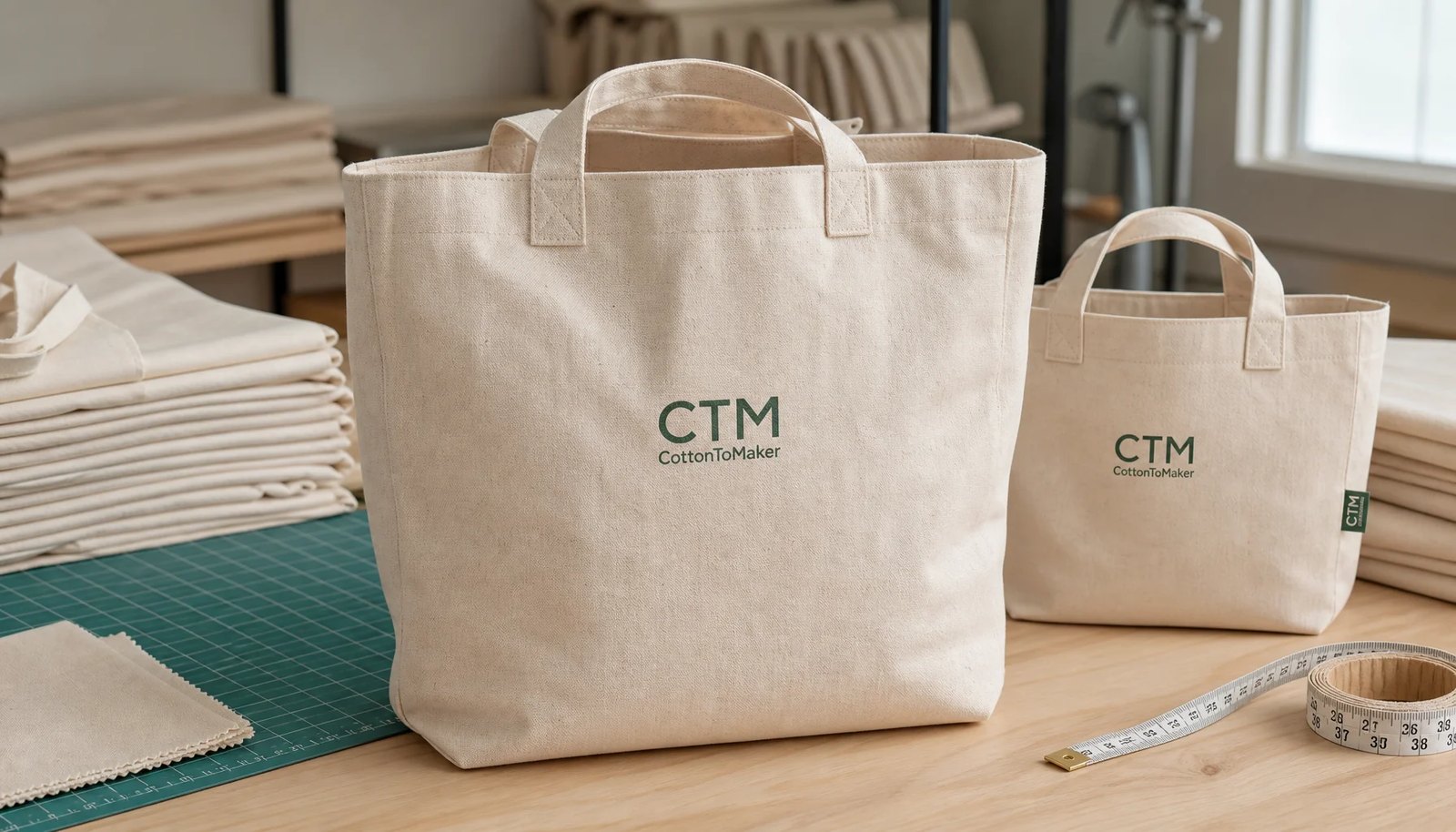
Start the MOQ discussion from the buying purpose
A university bookstore tote can be a low-cost giveaway, a paid retail item, a course-material pickup bag, or a sustainability-led merchandise product. Each purpose changes the acceptable MOQ. A giveaway can usually accept simpler fabric and one-color artwork. A paid retail tote needs better handfeel, stronger handles, cleaner print edges, and more consistent packing because customers compare it with branded merchandise on the shelf.
Before negotiating MOQ, classify the program by use and sales risk. Suppliers quote more accurately when they understand whether the order is a one-time event, a semester replenishment item, or a standing bookstore SKU. The strongest MOQ position is not simply saying the quantity is low; it is showing which specifications are fixed and which can follow factory efficiency.
- For orientation kits, prioritize delivery date, carton labeling, and fast unpacking over custom-dyed fabric.
- For paid retail totes, prioritize fabric weight, handle strength, print consistency, and shelf presentation.
- For department resale, separate each artwork version early because logo changes can affect screens and packing.
- For sustainability campaigns, confirm what organic cotton claim the supplier can support before printing hangtags.
Choose fabric weight before negotiating quantity
MOQ negotiation for organic cotton totes is strongly tied to fabric availability. Natural organic cotton canvas is easier to source than custom-dyed organic cotton, and standard weights are easier than unusual constructions. For bookstore use, many buyers land between 10 oz and 12 oz canvas, roughly 270 to 340 GSM. This range supports books and apparel without making the bag too expensive or heavy for freight.
A lower 6 oz to 8 oz fabric can work for lightweight events, but it often feels closer to a promotional bag than a retail tote. A heavier 14 oz fabric gives a premium handfeel, but it can raise sewing time, needle breakage, carton weight, and the chance of visible creasing. If the bookstore wants a responsible product at a negotiable MOQ, a standard natural organic cotton canvas usually creates the best balance.
- Specify fabric in GSM or ounce weight and avoid using only words such as heavy, premium, or thick.
- State whether the quoted weight is before washing, after finishing, or based on supplier standard fabric.
- Accept natural cotton shade variation within an approved range instead of demanding pure white consistency.
- Avoid custom dyeing for small first orders unless the bookstore can accept a higher MOQ and longer lead time.
Understand what really drives MOQ
The visible order quantity is only one part of MOQ. A factory also considers minimum fabric purchase, cutting table efficiency, print setup, sewing line planning, label production, packing labor, and export documentation. A quote for 1,000 pieces of one natural tote may be workable, while 1,000 pieces split across five artworks, two handle lengths, and individual retail packaging may behave like several small orders.
The practical way to negotiate is to reduce factory changeovers. Keep the same bag body, same fabric, same handle, and same print method, then vary only the artwork if necessary. Some suppliers can combine artwork versions under one production run, but screen setup and inspection still need to be counted. Buyers get better answers when the RFQ asks which elements trigger a separate MOQ.
- One fabric plus one size usually gives the best MOQ leverage.
- Multiple print designs may share fabric MOQ but still add screen and packing complexity.
- Custom labels can create their own MOQ even when the tote quantity is acceptable.
- Dyed organic cotton often requires fabric-level MOQ that is higher than sewing MOQ.
- Retail hangtags and barcode stickers add labor that should be priced separately.
Use print choices to protect cost and lead time
For most university bookstore logos, water-based screen print is the practical starting point. It works well on natural organic cotton, keeps the handfeel soft, and is cost-efficient for solid campus marks or bookstore graphics. One to three print colors are easier to manage than full-color artwork, especially when the buyer needs consistent placement across a large batch.
Digital print can help for complex art or lower quantities, but it may not match the durability, cost, or color density expected on canvas. Heat transfer can produce clean detail, yet it may conflict with the natural-handfeel message of an organic cotton tote. Embroidery adds perceived value but can distort lighter fabric and raises both cost and production time. The print method should be chosen for the bag’s retail role, not only for the artwork file.
- Use screen print for solid logos, short slogans, and simple mascot graphics.
- Request a strike-off when ink coverage is large or PMS color is brand-critical.
- Keep print away from seam folds and bottom gusset stress areas.
- Define print size in centimeters or inches, not only as a percentage of bag front.
- Approve ink handfeel and curing quality before bulk printing begins.
Build an RFQ that lets suppliers quote fairly
A strong RFQ for wholesale organic cotton totes does not need to be long, but it must remove guessing. The supplier needs finished size, fabric weight, handle style, print method, artwork count, packing method, target quantity, delivery destination, and required documents. If any of these are missing, suppliers may quote a low base price that later changes after sampling.
For MOQ negotiation, add a short flexibility note. For example, state that the bookstore prefers 12 oz organic cotton but can review 10 oz if it reduces MOQ and keeps load strength acceptable. Or state that individual polybags are preferred but bulk flat packing is acceptable if it improves cost and sustainability. This gives the factory room to propose efficient options without weakening the core product.
- Include target order quantity and expected reorder frequency rather than asking for lowest MOQ only.
- List each artwork version with estimated quantity per version.
- State whether the quote should include samples, screens, labels, cartons, and export packing.
- Request both unit price and setup charges so quotes can be compared on total landed cost.
- Ask the supplier to identify any specification that is causing a higher MOQ.
Compare quotes beyond the unit price
Two tote quotes can look close on unit price but differ sharply once packing, samples, setup, freight volume, and defect risk are included. A supplier quoting a heavier fabric may appear more expensive but may reduce customer complaints for paid retail use. Another supplier may quote a lower unit price by using thinner fabric, smaller carton quantities, or excluding print screens and inspection support.
Build a quote comparison sheet that separates base bag cost, print cost, label cost, packing cost, sample cost, tooling or screen cost, inspection cost, carton cube, and estimated freight. This is especially important for university bookstores that receive goods through campus warehouses or third-party logistics partners. Carton size and labeling accuracy can affect receiving labor just as much as the bag price affects purchase margin.
- Compare total order cost at the same specification, not each supplier’s preferred substitute spec.
- Calculate cost per sellable unit after expected reject rate and overage policy.
- Review carton cube because bulky packing can erase a small unit-price saving.
- Separate one-time setup charges from repeat-order costs.
- Confirm whether quote validity depends on cotton price, exchange rate, or fabric stock.
Set sample approval rules before bulk cutting
Sample approval should not be treated as a design formality. It is the point where the buyer locks fabric, dimensions, handle construction, print color, print placement, label content, and packing style. For organic cotton canvas, the sample should also show the expected natural shade and surface texture. Small slubs are normal, but stains, oil marks, and foreign fibers should be defined as defects.
A pre-production sample is more valuable than a random showroom sample because it uses the intended construction and artwork. If timing is tight, a print strike-off on the actual fabric can approve color and ink handfeel while the sewing sample confirms construction. Bulk cutting should wait until the buyer approves the critical points in writing, especially for paid retail programs.
- Measure finished width, height, gusset, handle drop, and handle width.
- Review handle reinforcement, seam allowance, stitch density, and loose thread trimming.
- Compare print color under consistent lighting against the approved artwork or PMS target.
- Test whether the print cracks, rubs, or feels too heavy after curing.
- Keep one approved sample at the factory and one with the buyer for inspection reference.
Define QC thresholds that match bookstore use
University bookstore totes need inspection standards that reflect actual use. A bag that carries textbooks and bottles needs stronger handle control than a lightweight conference tote. The buyer should define load expectations and visual defect limits before production. Without agreed thresholds, disputes often become subjective: the factory says the bag is normal, while the bookstore says it is not retail-ready.
For practical inspection, set measurement tolerance, print placement tolerance, and defect categories. A typical finished-dimension tolerance may be around plus or minus 1 centimeter for sewn cotton bags, depending on size and construction. Print placement tolerance should reference fixed edges. Handle pull testing should be agreed with the supplier based on fabric and seam construction instead of invented after goods arrive.
- Dimension tolerance should cover width, height, gusset, and handle drop separately.
- Print placement should be measured from top edge and side seam, not only judged by eye.
- Major defects include broken handles, open seams, heavy stains, wrong artwork, and uncured print.
- Minor defects may include small natural slubs within approved fabric appearance limits.
- Inspection reports should identify carton numbers for any failed samples or mixed artwork errors.
Plan packing for campus receiving, not only export
Packing affects cost, freight, receiving labor, and sustainability perception. Flat packing in 50 or 100 pieces per carton is often efficient for wholesale organic cotton totes. Individual polybags can protect retail presentation, but they add plastic, labor, volume, and unpacking work. For many university bookstores, a clean bulk pack with accurate carton marks is better than excessive individual packaging.
If the tote is sold as a premium retail item, consider folded packing with a belly band, hangtag, or barcode sticker. If the tote is used for course pickup or orientation kits, prioritize fast counting and distribution. Mixed artwork cartons should be avoided unless the receiving team specifically wants them, because mixed cartons increase the risk of SKU confusion during campus events.
- Specify pieces per carton and whether cartons contain one artwork or mixed artworks.
- Require carton marks with PO number, SKU, artwork version, quantity, and destination.
- Request carton dimensions and gross weight before booking freight.
- Avoid cartons that become too heavy for safe bookstore handling.
- Confirm whether barcode labels, hangtags, or retail stickers are applied at factory or locally.
Protect the schedule with realistic lead time stages
Lead time risk often appears after MOQ is solved. Organic cotton fabric booking, sample making, print strike-off, buyer approval, bulk cutting, sewing, print curing, inspection, packing, and export documentation all need calendar space. A supplier may quote a production time that starts after all approvals, not from the date the buyer sends the first inquiry.
For university bookstores, the receiving window is usually tied to orientation, semester start, homecoming, or holiday retail. Missing the date can turn a good product into dead stock. The RFQ should ask for a stage-by-stage calendar and identify which dates depend on buyer approval. If the bookstore has a fixed event date, simplify the product before compressing production in a way that damages quality.
- Add approval deadlines for artwork, strike-off, pre-production sample, and packing marks.
- Leave time for re-sampling if the print color or fabric handfeel is not acceptable.
- Do not assume custom labels and hangtags can be added without extra days.
- Schedule final inspection before goods are sealed for shipment.
- Confirm campus receiving blackout dates and warehouse appointment requirements early.
Specification comparison for buyers
| Spec decision | Recommended option | When it fits | Buyer risk to check |
|---|---|---|---|
| Supplier route for first bookstore program | Direct factory with export packing and sample approval process | Best when the bookstore needs custom size, certified organic cotton claims, and repeat semester replenishment | Verify the factory can show fabric traceability, carton marks, print tolerance standards, and a realistic production calendar |
| Supplier route for urgent event quantities | Domestic stock decorator or importer holding blank organic cotton totes | Useful when the delivery date is fixed and artwork is simple, such as orientation week or alumni weekend | Unit cost is usually higher, size and GSM choices are limited, and organic cotton documentation may not match the bookstore claim |
| Fabric weight for daily bookstore retail | 10 oz to 12 oz organic cotton canvas, about 270 to 340 GSM | Good balance for textbooks, apparel, water bottles, and gift sets without making freight too heavy | Below 8 oz can feel promotional; above 12 oz may raise cost, sewing difficulty, and carton weight |
| MOQ negotiation unit | Negotiate by fabric lot, print setup, and carton efficiency instead of only by bag quantity | Works when the buyer can keep one fabric, one size, and one print method across several bookstore designs | Splitting colors, handle lengths, or private labels can quietly reset MOQ even when total units look large |
| Print method for bookstore logos | Water-based screen print for 1 to 3 solid colors on natural cotton | Suitable for campus marks, bookstore names, mascot text, and sustainability messaging | Fine reverses, large ink coverage, and very tight PMS matching need a strike-off before bulk approval |
| Handle construction | Self-fabric handles with X-box reinforcement or heavy cotton webbing | Needed when bags may carry books, bottles, and apparel in one purchase | Weak handle insertion, narrow seam allowance, or no reinforcement can cause failures during load testing |
| Packing method | Flat pack 50 or 100 pieces per export carton with inner polybag only if required by the buyer | Keeps carton cube efficient and reduces plastic use for sustainability-focused bookstores | Individual polybags add labor, plastic, and volume; unpacking labor at store level should be considered |
| Reorder strategy | Agree a repeat-order MOQ tied to the same approved fabric and artwork | Useful for semester replenishment, campus tours, and bookstore webstore stock | If fabric batch, print ink, or label changes, the supplier may need a new sample and longer lead time |
Buyer checklist before sampling
- Define the selling use first: gift-with-purchase, paid retail tote, orientation kit, alumni merchandise, or department resale.
- State finished bag size, gusset depth, handle length, fabric GSM or ounce weight, and whether shrinkage allowance is included.
- Separate mandatory requirements from negotiable items such as individual polybags, custom hangtags, inside labels, and mixed artwork.
- Provide artwork files with print size, color count, PMS targets, and whether the logo can move slightly to suit seam placement.
- Request MOQ by plain tote, printed tote, fabric color, artwork version, and reorder quantity, not only one total MOQ number.
- Require a pre-production sample or print strike-off before bulk cutting when artwork, fabric color, or logo size is new.
- Set acceptance criteria for dimensions, print placement, seam strength, stain level, odor, and carton marking before production starts.
- Ask for carton dimensions, gross weight, pieces per carton, and packing style so freight quotes can be compared correctly.
- Build schedule buffers for fabric booking, sample approval, print curing, final inspection, export documentation, and campus receiving windows.
Factory quote questions to send
- What is the MOQ for this exact organic cotton fabric weight, and does it change if we use natural, dyed, or custom-dyed fabric?
- Can several bookstore designs share one MOQ if the bag size, fabric, and handle construction remain the same?
- What are the setup charges, screen charges, label charges, sample charges, and any minimum print run charges?
- What fabric certification or transaction documents can be provided, and which claim can we safely print on the product or retail tag?
- What is the standard shrinkage range after washing or pressing, and are quoted dimensions finished size or cut size?
- What print tolerance do you use for position, color difference, registration, and ink coverage on organic cotton canvas?
- How many days are needed for lab dip, strike-off, pre-production sample, bulk production, inspection, and export packing?
- What carton size, carton weight, packing quantity, and pallet loading pattern do you recommend for our order quantity?
- What changes would reduce MOQ or unit cost without weakening the bag for bookstore retail use?
- What happens to the MOQ, price, and lead time if the university adds a second logo version after sample approval?
Quality-control points to confirm
- Fabric weight should be checked by GSM test or panel weight calculation against the approved specification, with tolerance agreed before cutting.
- Finished size should be measured after sewing and pressing, including width, height, gusset, handle drop, and handle width.
- Print placement should be checked from top edge and side seam references, not only by visual centering on a loose panel.
- Color should be compared under consistent light against approved strike-off, with realistic tolerance for natural cotton base shade variation.
- Seam strength should include handle pull testing and visual review of skipped stitches, loose threads, broken needles, and seam allowance.
- Stains, oil marks, slubs, foreign fibers, and excessive creasing should be classified before inspection so the factory and buyer use the same defect standard.
- Carton marks should match purchase order, SKU, quantity, color, artwork version, and destination requirements for bookstore receiving.
- Packing quantity should be counted by carton and by random inner pack opening, especially when mixed bookstore designs ship together.