Start With The Event Job
Wholesale organic cotton totes are not difficult to buy, but they are easy to compare badly. One quote may cover a thin flat cotton shopper. Another may include 8 oz organic cotton canvas, a bottom gusset, reinforced shoulder handles, water-based screen print, carton labels, and order-level document support. Both emails may say organic tote bag, but they are not the same product or the same commercial risk.
For trade show exhibitors, the tote has a public job. It carries brochures, samples, notebooks, small boxes, bottles, and sponsor inserts while visitors move through the show. It also becomes a moving brand surface. Weak handles, poor ink curing, transparent fabric, or late cartons are visible problems, and event teams rarely have time to repair them once freight arrives at the venue.
A useful buying plan starts with one locked specification, then compares volume tiers. Define the tote first: fabric weight, size, gusset, handles, print method, organic claim, packing, carton plan, inspection, and delivery basis. After that, ask suppliers to quote 500, 1,000, 3,000, 5,000, and 10,000 pcs without changing the bag between tiers.
- Write one master spec sheet and send the same version to every supplier.
- Put event date, booth setup date, receiving window, and delivery address at the top of the RFQ.
- Compare only like-for-like tiers where fabric, construction, print, packing, document route, and Incoterm stay unchanged.
- Use the approved sample as the product standard, not the digital mockup.
Define The Organic Claim
Organic cotton can mean several things in a sourcing conversation. It may mean the cotton fiber was grown organically, that the fabric supplier can provide supporting evidence, that the order is handled under OCS chain-of-custody documentation, or that the finished product follows a GOTS-supported route. It can also be confused with the natural unbleached look of cotton, which is not the same as an organic claim.
The first decision is whether the bag or event material will make a public claim. If the tote says organic cotton, made with organic cotton, certified organic, or similar wording, procurement should confirm what document route supports that language. A supplier profile certificate or website badge may show that a company has a scope, but it does not automatically prove that a specific tote order, quantity, subcontractor, and shipment are covered.
Clear distinctions prevent late rework. Fabric-level evidence may be enough for internal procurement records when the buyer is not making a strong public claim. OCS documentation is generally about chain of custody for organic content. GOTS can involve broader processing and handling requirements, and not every supplier, printer, or subcontractor is approved for every finished-product claim. Ask what can be issued for the exact PO before artwork is approved.
- Use no organic wording when the requirement is only a natural cotton appearance.
- Use fabric-level evidence when internal records need material support but no certified finished-product claim is being made.
- Use OCS or GOTS support when tender language, retailer policy, corporate sustainability rules, or public claims require it.
- Confirm whether documents can reference buyer name, PO, product description, quantity, and shipment.
- Do not print claim wording until the document route and exact language are approved.
Choose Fabric And Shape
Fabric weight drives unit cost, print result, carton weight, and perceived value. Buyers should specify both GSM and ounces per square yard because suppliers use different systems. As a rough conversion, 1 oz/sq yd equals about 33.9 GSM, so 5 oz is about 170 GSM, 8 oz is about 271 GSM, and 10 oz is about 339 GSM. Ask for the quoted fabric specification rather than relying on marketing names such as standard canvas or heavy cotton.
For most exhibitor programs, 7 oz to 10 oz cotton canvas is the practical range. A 5 oz or 6 oz tote may suit light inserts and cost-sensitive handouts, but it can feel thin when loaded with catalogs. A 7 oz or 8 oz tote often balances budget, body, and freight efficiency. A 10 oz bag feels more substantial for sponsor kits or higher-value events. At 12 oz and above, the tote moves toward premium merchandise, with higher fabric and shipping cost.
Shape should follow what the tote will carry. A flat 15 x 16 in, or about 38 x 42 cm, tote is a common baseline for A4 or letter-size materials. Add an 8 to 10 cm bottom gusset when the bag will carry apparel, sample boxes, bottles, or multiple booth items. A gusset costs more and uses more carton space, but it helps the bag stand better and reduces print distortion under load.
- 5 oz to 6 oz: light inserts, postcards, minimal giveaway contents.
- 7 oz to 8 oz: mainstream booth giveaways with brochures, notebooks, and light samples.
- 8 oz to 10 oz with gusset: fuller event kits and mixed booth materials.
- 10 oz to 12 oz: premium conference totes, sponsor bags, and merchandise-style programs.
- Approve fabric swatch, finished piece weight, opacity, texture, and natural cotton shade before bulk cutting.
Specify Handles And Construction
Handles deserve the same attention as fabric. Narrow straps can twist, dig into the hand, and make a decent tote feel cheap. For trade show use, self-fabric handles around 2.5 to 3.0 cm wide are usually more comfortable than very thin straps. Handle drop should be measured from the top edge of the bag to the top of the handle opening. If the bag is meant for shoulder carry, test it filled, not empty.
The RFQ should describe finished dimensions rather than only cutting dimensions. Sewing, folding, shrinkage, and seam allowance can change the final tote. Reinforcement at handle attachment points is critical because that is where load failure usually appears. Box stitching, cross stitching, bar tacking, or another approved method should be shown on the sample and named in the PO.
Construction choices also affect artwork. Logos should stay outside handle reinforcement zones, side seams, gusset folds, and lower folds created by packing. If the print is too close to these areas, the finished tote may look misaligned even when the printer followed the artwork file. Ask for a print-safe area based on the actual bag pattern.
- Specify finished width, height, gusset depth, handle width, and handle drop.
- Approve reinforcement pattern and stitch quality on the pre-production sample.
- Set the logo distance from top edge, side edge, and bottom edge in measurable terms.
- Confirm stitch density, seam allowance, and recommended load for the quoted construction.
- Check handle comfort with expected booth contents inside the tote.
Match Print To Artwork
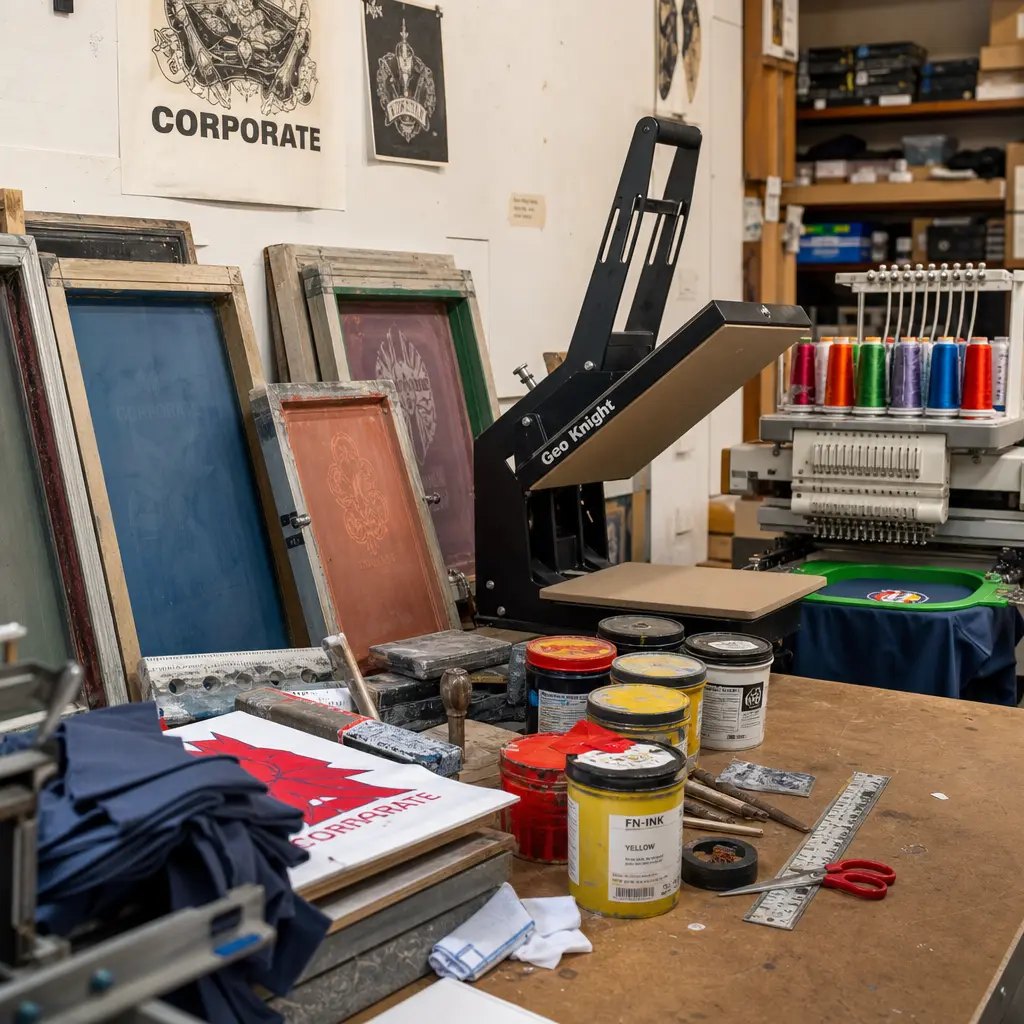
Water-based screen print is often the best fit for organic cotton totes with one to three solid colors. It works well on cotton canvas, gives a relatively natural hand feel, and becomes economical after screen setup is spread across the order. Screen charges should be shown separately by color, side, and artwork version, especially when sponsor logos or multiple event versions are involved.
Heat transfer is useful for gradients, many-color artwork, photographic detail, or very small sponsor marks that screen print cannot hold cleanly. It needs testing on cotton. Transfers may show a film edge, feel less natural, or fail if time, temperature, and pressure are not controlled. Poor heat settings can cause scorching, weak adhesion, glossy patches, or visible press marks.
A digital proof is not enough for brand approval. Natural organic cotton texture changes edge sharpness and color appearance. A Pantone color on unbleached cotton will not look exactly like the same color on coated paper or white fabric. For brand-sensitive orders, approve a strike-off on the final fabric specification and record the viewing standard for color judgment.
- Use screen print for bold logos, solid colors, and high-volume exhibitor bags.
- Use heat transfer when artwork complexity matters more than a fully cotton-like feel.
- Define minimum small-text height for sponsor marks on textured fabric.
- Approve print size, placement, side, Pantone reference, and acceptable visual tolerance.
- Include dry rub and fold checks in the print approval process.
Build A Real Pricing Plan
A bulk pricing plan should do more than collect quotes. It should show why cost changes by tier and what the buyer will actually pay to receive usable event goods. Early price breaks usually come from spreading fixed costs such as samples, artwork handling, screens, production setup, document handling, and line preparation. At higher quantities, the unit price may flatten because fabric, labor, packing, freight volume, and documentation still have real cost.
Use one specification for every tier. If 500 pcs are quoted as 10 oz gusseted totes and 5,000 pcs are quoted as 7 oz flat totes, that is not a volume discount. It is a different product. The same problem appears when a supplier changes from order-level organic support to a generic material statement, removes inner bundles, changes print method, narrows handles, or switches Incoterms.
A simple planning model helps procurement challenge vague offers. Example only: if a 3,000 pc order has a bag price of $2.20, print at $0.32, allocated screens and sampling at $0.08, document and packing costs at $0.10, inspection at $0.03, and estimated freight plus domestic delivery at $0.42, the planned delivered cost is $3.15 per tote. At 5,000 pcs, setup may fall to $0.05 per unit and freight may improve slightly, but the fabric and labor portion will not disappear.
- Example 500 pcs: $3.10 product and print, $0.45 allocated setup/sample, $0.18 documents and packing, $0.75 freight, estimated delivered cost $4.48 each.
- Example 1,000 pcs: $2.75 product and print, $0.25 allocated setup/sample, $0.15 documents and packing, $0.62 freight, estimated delivered cost $3.77 each.
- Example 3,000 pcs: $2.52 product and print, $0.08 allocated setup/sample, $0.13 documents and packing, $0.44 freight, estimated delivered cost $3.17 each.
- Example 5,000 pcs: $2.40 product and print, $0.05 allocated setup/sample, $0.12 documents and packing, $0.39 freight, estimated delivered cost $2.96 each.
- Example 10,000 pcs: $2.30 product and print, $0.03 allocated setup/sample, $0.11 documents and packing, $0.35 freight, estimated delivered cost $2.79 each.
- Treat these as worksheet placeholders, not market promises; replace them with supplier quotes, current freight, duty, and delivery data.
Read MOQ As A Signal
MOQ is tied to fabric availability, cutting efficiency, print setup, packing labor, and document handling. Common natural organic cotton weights may be available at lower minimums. Custom dyeing, unusual GSM, special handle tape, multiple artwork versions, or certified finished-product handling may raise the minimum because the supplier must commit to fabric yardage, segregation, approved subcontractors, or administrative work.
When a buyer pushes below a workable MOQ, the supplier may try to make the order fit by changing the product. Those changes can be subtle: lighter fabric, narrower handles, simpler reinforcement, mixed fabric lots, no third-party inspection access, or no order-specific organic documentation. A short quote email may not reveal the change.
If the budget is tight, reduce complexity before weakening the tote. Keep fabric and handles strong enough for the expected event contents. Then review print sides, artwork versions, custom dyeing, individual packing, hangtags, inserts, and carton requirements. Moving from individual polybags to bulk packing may save money without making the bag fail in use.
- Ask for MOQ by exact fabric, color, size, gusset, handle, print method, packing, and claim level.
- Use standard natural organic cotton when schedule and minimum flexibility matter.
- Expect custom dyeing to add lab dips, shade approval, higher yardage, and more lead time.
- Limit sponsor versions unless the order value supports repeated setup costs.
- Verify surprisingly low MOQs against fabric source, documents, construction, and inspection access.
Make Sampling Measurable
The pre-production sample should be a near-final version of the real order, not a stock tote pulled from a shelf. It should use the intended fabric weight, dimensions, gusset, handle width, handle drop, reinforcement, print method, print size, fold, and packing style. If the final organic cotton lot is not available yet, the supplier should state what differs and provide the final swatch or strike-off before bulk production.
Sample approval should be written. Record dimensions, fabric weight, finished piece weight, Pantone references, print position, allowed natural cotton characteristics, handle construction, reinforcement, fold, and packing. Photos help remote teams discuss the sample, but the physical sample is the control standard. Keep one with the buyer or inspector and one at the factory.
Test the sample the way visitors will use it. Fill it with catalogs, notebooks, small boxes, inserts, and any bottle or sample item planned for the show. Look at handle comfort, seam behavior, print distortion, bag shape, and whether folding creates a hard crease through the logo. These checks are simple and much cheaper than event-floor disappointment.
- Measure width, height, gusset, handle drop, handle width, and logo placement.
- Weigh the sample and record finished piece weight for inspection comparison.
- Rub the printed area after curing to check adhesion and transfer.
- Check readability of small text and sponsor logos on real cotton texture.
- Approve, approve with listed changes, or reject and require a revised sample.
Plan Packing And Delivery
Packing affects price, carton cube, waste, and booth readiness. Bulk packing is often best for exhibitor giveaways because staff distribute totes from cartons, shelves, or event storage. Individual polybags can improve presentation and cleanliness, but they add material, labor, carton volume, and disposal work. Inner bundles are a practical middle ground for counting without wrapping every piece.
Carton planning belongs in the quote stage. Ask for pieces per carton, carton dimensions, net weight, gross weight, and total CBM at each tier. A carton that is too heavy can slow booth setup or conflict with warehouse handling rules. A weak carton can crush during export freight, domestic transfer, show-warehouse handling, or final booth delivery. Many tote orders use 50 or 100 pcs per carton, but the right count depends on fabric weight, gusset depth, fold style, and local handling limits.
Trade show delivery requires accurate labels. Advance warehouses may require show name, booth number, exhibitor name, PO number, destination, carton count, and a strict receiving window. Fulfillment centers may require pallet labels, delivery appointments, or routing instructions. Missing references can delay correct goods, so approve carton marks before final packing starts.
- Use bulk pack for most giveaways and inner bundles when booth staff need fast counts.
- Use individual polybags only for retail handling, premium kits, dust control, or strict presentation needs.
- Confirm carton dimensions, gross weight, carton count, pallet plan, and total CBM.
- Approve carton marks with show name, booth number, PO, destination, and receiving window.
- Request packing photos when fold direction, label placement, or bundle count matters.
Set QC And Timeline
Quality control should be agreed before the PO is released. The approved sample is the reference, but the order should also state measurable checks for GSM, finished size, handle drop, print position, color, stitching, stains, odor, carton quantity, packing, and documents. For higher-risk orders, use a third-party final random inspection with agreed AQL or practical acceptance criteria before final payment and shipment release.
Frame tolerances as buyer-approved limits, not assumed industry defaults. For example, a buyer may accept plus or minus 5 percent on cotton canvas GSM, plus or minus 0.5 cm on standard finished dimensions, and plus or minus 0.5 cm to 1.0 cm on print placement. Those numbers should be adjusted for the bag size, fabric behavior, artwork, and supplier process, then written into the PO.
Build the timeline backward from booth setup, not event opening. Include sample creation, sample shipping, approval cycles, fabric reservation, production, strike-off review, inspection, export documents, freight, customs, domestic delivery, and the advance-warehouse window. Lead time should start only when the supplier has deposit, final artwork, sample approval, fabric confirmation, packing instructions, and any required organic document route.
- Schedule inspection before shipment release so rework is still possible.
- Reserve fabric early for large orders, custom dyeing, or document-backed organic claims.
- Keep buffer for sample revisions, print corrections, inspection findings, and document updates.
- Avoid using air freight as the default recovery plan because it can erase bulk savings.
- State whether lead time starts from deposit, artwork approval, sample approval, fabric arrival, document confirmation, or all combined conditions.
Specification comparison for buyers
| Option | Best use for exhibitors | Cost effect | Buyer control point |
|---|---|---|---|
| 5 oz to 6 oz flat tote | Light handouts, postcards, small inserts, low-load booth giveaways | Lowest fabric cost and compact cartons, but lighter hand feel and less opacity | Approve finished piece weight and load expectation; avoid for heavy catalogs or boxed samples |
| 7 oz to 8 oz flat tote | Mainstream brochure bags, conference inserts, notebooks, lightweight sponsor items | Balanced unit cost, fabric body, printability, and freight weight | Request GSM, oz/sq yd, fabric swatch, and a pre-production sample in the final size |
| 8 oz to 10 oz gusseted tote | Trade show kits with catalogs, apparel, water bottles, samples, or multiple booth items | More fabric, sewing, and carton cube than a flat tote, but better capacity and shape under load | Confirm bottom gusset depth, side construction, seam allowance, and print-safe area |
| 10 oz to 12 oz premium tote | VIP sponsor bags, paid merchandise, executive conference kits, higher-retention giveaways | Higher material and freight cost; stronger perceived value and better structure | Check handle reinforcement, stitch density, finished bag weight, and carton gross weight |
| Water-based screen print | One to three solid logo colors, large marks, clean sponsor panels, volume orders | Setup cost per screen, then efficient at higher quantities | Approve strike-off on bulk fabric; set Pantone reference, placement tolerance, and rub check |
| Heat transfer | Gradients, many-color marks, small sponsor logos, or artwork screen print cannot hold | May add film, transfer labor, and stricter heat-control requirements | Test adhesion, edge visibility, hand feel, scorching, cracking, and wash/rub behavior if relevant |
| Bulk pack cartons | Most booth giveaways distributed from cartons, shelves, or event storage | Lower labor, less packing material, smaller waste burden | Confirm pieces per carton, inner bundle count, carton marks, and warehouse labels |
| Individual polybag packing | Retail-style kits, premium presentation, dust control, or pre-packed attendee bags | Adds material, labor, carton volume, and disposal work | Use only when needed; approve fold direction and packaging material before bulk packing |
| Fabric-level organic evidence | Internal procurement records where public claim language is limited or absent | Usually simpler than certified finished-product handling | Ask what fabric evidence can reference this PO; do not treat a generic certificate screenshot as order proof |
Buyer checklist before sampling
- Lock the event opening date, booth setup date, advance-warehouse receiving window, delivery address, routing rules, and latest acceptable arrival date before pricing.
- Define the tote use: light insert bag, standard booth giveaway, sponsor kit, retail-style merchandise, or VIP conference bag.
- Choose the organic claim level before artwork: no public claim, fabric-level organic cotton evidence, OCS-supported claim, GOTS-supported route, or customer-specific documentation.
- Specify finished width, height, gusset depth, handle width, handle drop, reinforcement pattern, seam type, and target fabric weight in GSM and oz/sq yd.
- Provide vector artwork with logo size, placement, print side, number of colors, Pantone references, minimum text size, and any sponsor-version matrix.
- Ask for 500, 1,000, 3,000, 5,000, and 10,000 pc tiers using the same fabric, construction, print method, packing, organic route, and Incoterm.
- Separate bag unit price, print run charge, screen or setup fee, sample fee, document fee, packing cost, carton labeling, palletizing, inspection, and freight basis.
- Build a simple landed-cost worksheet that includes product, setup, documentation, inspection, freight, duty or import costs where applicable, and domestic delivery.
- Approve a physical pre-production sample made with the intended fabric, construction, print method, fold, and packing style before bulk production.
- Set written QC tolerances for GSM, finished size, handle drop, print placement, color, stitching, stains, odor, carton count, packing, and mixed-lot control.
Factory quote questions to send
- What exact fabric weight are you quoting in GSM and oz/sq yd, and is it measured before or after finishing?
- What is the finished bag weight for this exact size, gusset, fabric, handle, and print specification?
- Which organic documentation can be issued for this exact PO: fabric supplier declaration, scope certificate reference, OCS transaction document, GOTS transaction document, or another route?
- Can the document reference our buyer name, PO, product description, quantity, and shipment, or only your internal order?
- What MOQ applies to this exact fabric weight, color, size, gusset, handle, print method, packing method, and organic claim level?
- Can you quote 500, 1,000, 3,000, 5,000, and 10,000 pcs without changing specification, packing, certification route, or Incoterm?
- Which charges are separate from the unit price: sample, screens, artwork adjustment, organic documentation, individual packing, carton labels, inspection, palletizing, and freight?
- What are the estimated carton dimensions, pieces per carton, net weight, gross weight, and total CBM for each quantity tier?
- What handle drop, handle width, stitch method, stitch density, and reinforcement pattern are included?
- Will the strike-off and pre-production sample be made on the same fabric specification intended for bulk production?
Quality-control points to confirm
- Fabric GSM should be checked against the buyer-approved tolerance. A buyer might set plus or minus 5 percent for cotton canvas, but the PO should state the actual accepted range.
- Finished width and height should be measured flat on random samples using the approved method. Example tolerances such as plus or minus 0.5 cm should be written into the order if acceptable.
- Gusset depth should be checked at the bottom fold and side construction. The buyer should define the allowed variation based on size, fabric weight, and sewing complexity.
- Finished bag weight should be compared with the approved sample because a lower piece weight can reveal lighter fabric, narrower handles, reduced seam allowance, or measurement differences.
- Handle drop and handle width should remain consistent across the lot and match the approved sample, especially for shoulder-carry totes.
- Handle attachment points should use the approved reinforcement, with no open seams, skipped stitches, broken threads, loose thread nests, or weak backtacking.
- Side seams, bottom seams, hem folds, and gusset corners should be secure, symmetrical, and clean enough for the expected event load.
- Print placement should be checked against the buyer-defined tolerance, often set around plus or minus 0.5 cm to 1.0 cm depending on artwork size and bag construction.
- Ink coverage should be even, with no obvious pinholes, bleeding, cracking, offset marks, scorching, heavy hand feel outside the approved sample, or clear color mismatch.
- A dry rub check and, where relevant, a light damp rub check should confirm that ink is cured well enough for folding, packing, and normal handling.